Fire Emblem: Fortune’s Weave appears to have a particularly frustrating early-game problem: its most appealing material is locked behind a loop that can make players feel less like a battlefield commander and more like a very tired regional produce inspector.
An early, roughly 30-hour account focused on Theodora’s route praises the game’s setting, its colorful cast and its character writing. But it also describes a Part One structure dominated by incremental map travel, resource gathering, gated progression and too few substantial tactical encounters. The result is a sharp disconnect between the fantasy the game presents and the labor it asks of the player before that fantasy can properly get moving.
That is an important distinction. This is not an argument that every slow strategy RPG is a bad strategy RPG, or that a time-management system is inherently unwelcome in Fire Emblem. The complaint is more specific: when travel consumes the resource that ostensibly represents a player’s opportunity to act, while training, recruiting and exploration all pull that player in different directions, the system can stop feeling like strategy and start feeling like administrative drag.
It is an early impression rather than a complete evaluation of every route or later-game system. Fast travel is reportedly unlocked at a later, unspecified point, and longer-term bonuses are said to help make subsequent playthroughs smoother. Still, if the opening of the game is asking players to repeat an exhausting routine before those relief valves arrive, that first stretch has to carry a great deal of weight on its own.
Theodora sounds like the reason to push forward
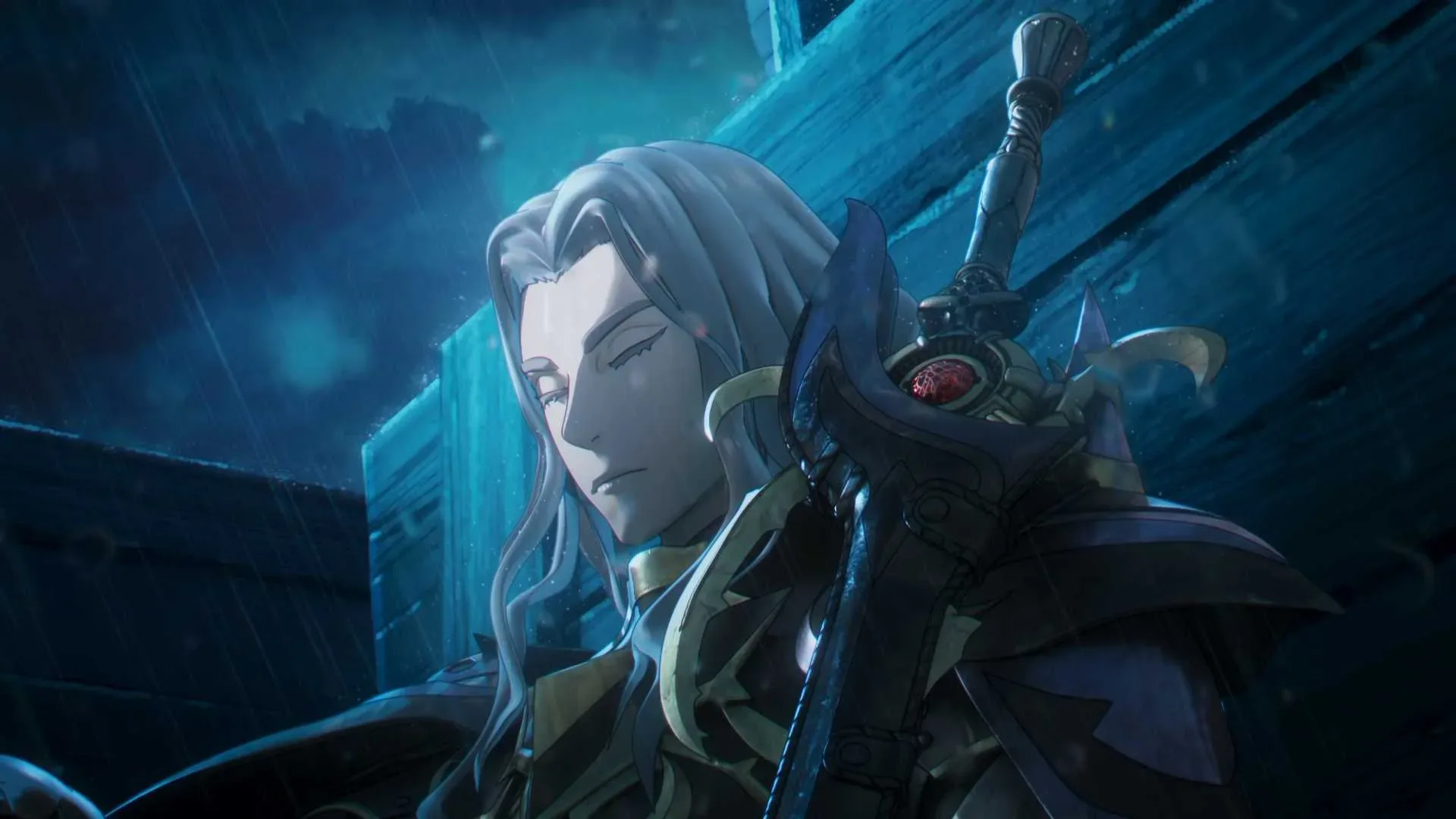
The strongest part of this account is Theodora herself. She is a newly crowned queen who gained the throne after fighting her brother, a conflict that cost her an arm. She now possesses a powerful magical replacement, but the arm is corrupting her mind. Her goal at the Heroic Games is to reclaim ancestral land lost by her kingdom, placing political responsibility, personal trauma and a looming magical threat on the same character arc.
That is a potent setup for a strategy RPG protagonist. Theodora is not simply a ruler issuing orders from a safe remove; the stakes of leadership and the consequences of power are made physically personal through the magical arm. Her route also seems to offer something video games do not always foreground: the chance to inhabit a queen whose characterization is not reduced to arrogance, cruelty or incompetence.
The support conversations are described as especially effective. In Fire Emblem terms, support conversations are optional or semi-optional character scenes that develop relationships among members of the army. They can be a vital storytelling tool because they provide smaller, more intimate moments outside the central campaign plot. When those scenes are working, they make recruits feel like people instead of interchangeable units with weapon types attached.
Here, the cast and those interactions are doing considerable work. Theodora’s slowly assembled crew is compelling enough to sustain interest even as the surrounding progression loop creates resistance. That is both praise and a warning sign. Great characters can motivate a player through friction, but a game should not routinely require its cast to rescue the systems designed to deliver them.
Related coverage includes Fire Emblem: Fortune's Weave Has a Strong Heroine but a Frustrating Early Grind.
A time currency needs meaningful choices, not repetitive clicks
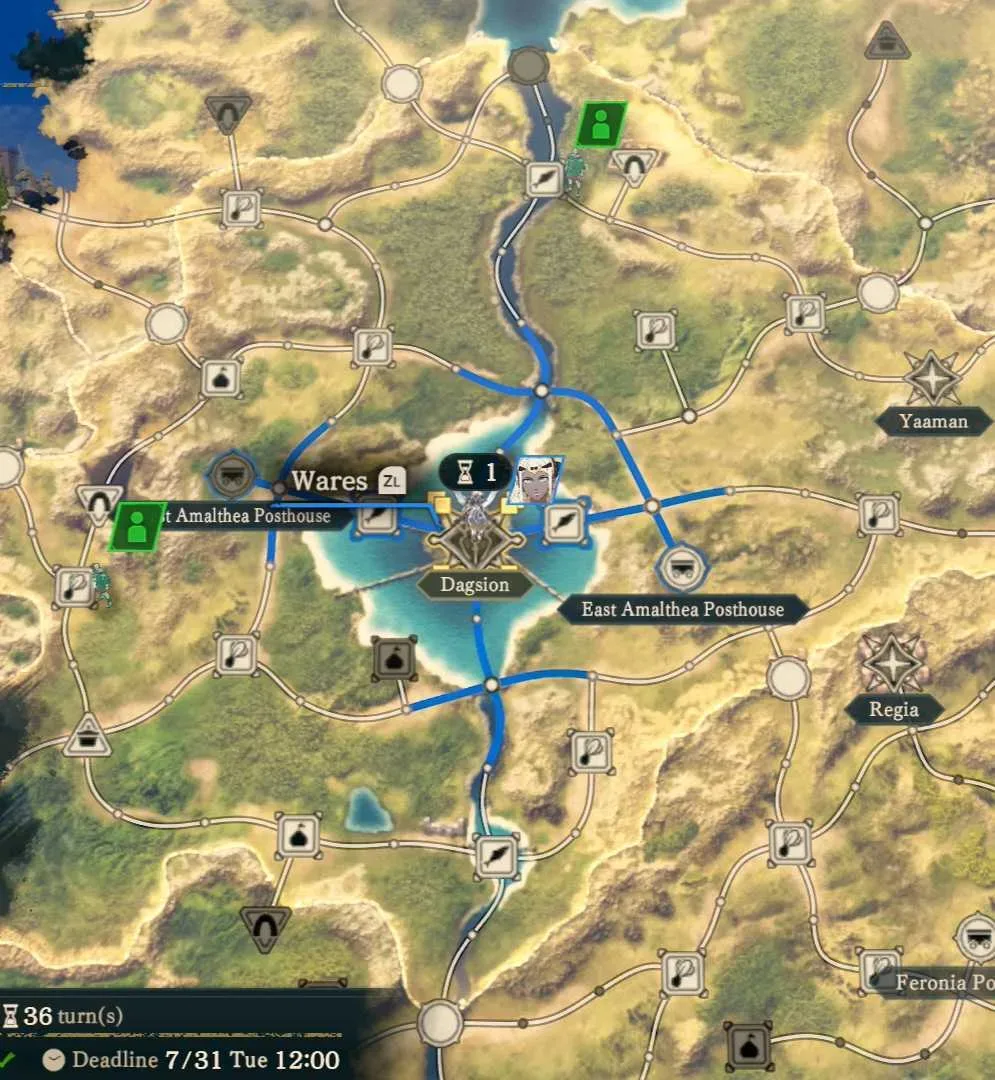
Fortune’s Weave reportedly divides the calendar into days and smaller time segments. Those segments function like a spendable budget. Moving around the world map and completing certain tasks consumes them, so the player is not merely choosing where to go; they are deciding which opportunities will be lost along the way.
In principle, this is a sound design concept. A limited time budget can turn ordinary planning into strategy. If visiting one town means delaying a recruitment, or pursuing a resource means sacrificing a training session, the player has a real trade-off to consider. Designers often call this opportunity cost: choosing one benefit means giving up another.
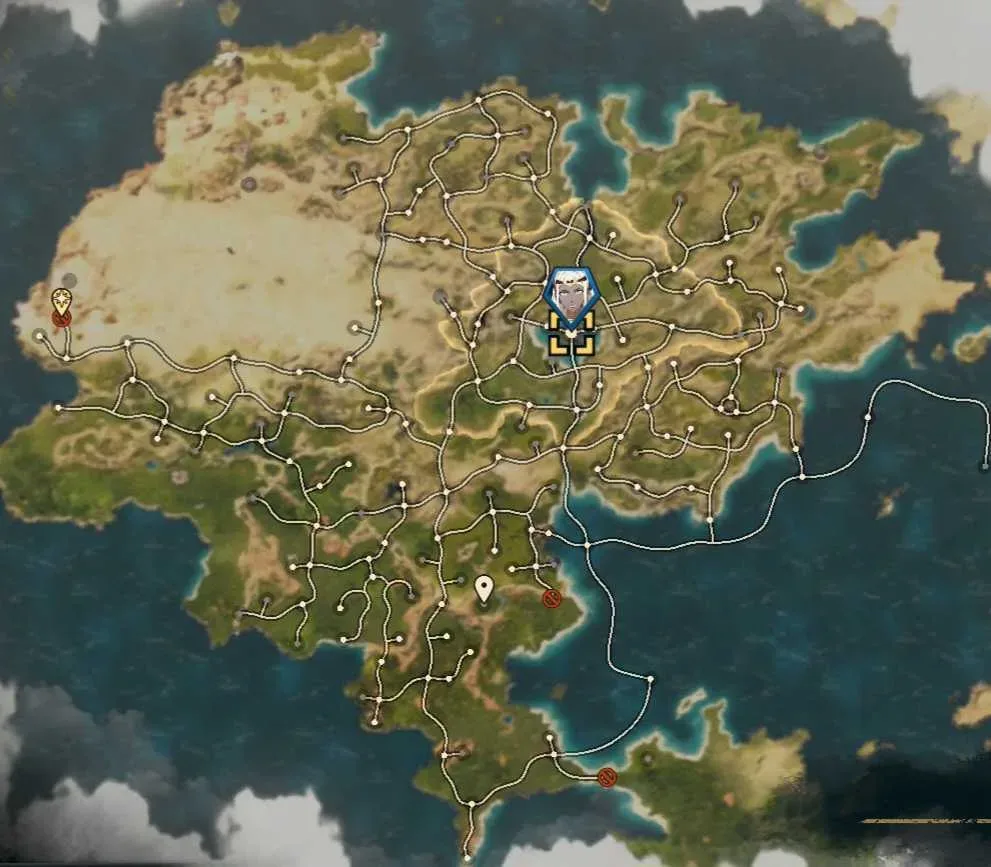
The problem described here is that too much of the cost seems attached to traversal itself. Instead of selecting a distant destination and paying its total travel cost in one action, players reportedly move in one-segment increments through the map’s routes. That map contains gathering nodes, towns and dungeons, and its intersecting paths may be the reason an automated route choice is not available. But understandable design logic does not automatically make the interaction satisfying.
Manually confirming a long sequence of nearly identical travel steps can create what players often call friction. Friction is not always bad. A difficult decision, a tense battle or a costly detour can create useful friction by asking the player to think. Repeated inputs that rarely involve a meaningful decision create a different kind: interface friction. It slows the player down without reliably deepening the strategic layer.
The reported travel costs are substantial. Reaching a newly accessible region can take 15 to 20 time segments, unlocking its nodes can cost another 15 to 20, and returning may demand the same again. Some chapters reportedly provide more than 100 segments before a deadline, but a large allowance is less comforting when much of it is needed just to commute between systems. Carriages can reduce travel within a single area, though they reportedly do not connect separate areas.
Training and exploration appear to work against each other
The travel issue becomes more severe because skill training is said to be limited to once per week and only in the main city. A player exploring distant regions who wants to improve their party must interrupt that expedition, spend time returning to the hub, train, then spend still more time retracing the route.
This creates a potentially punishing triangle:
- Exploration is necessary to reveal nodes, resources and new territory.
- Training is necessary for party progression but is tied to the central city and a weekly schedule.
- Travel drains the same time resource needed to accommodate both activities.
A system like this can be strategically rich if it creates several viable approaches. For example, a player might deliberately prioritize one concentrated expedition, accept weaker short-term training and receive a meaningful payoff. But it becomes restrictive if the apparent best response is repeatedly shuttling to the hub simply to avoid falling behind.
Notably, activities such as training or sharing a meal reportedly do not consume time segments in the same direct manner that they did in Fire Emblem: Three Houses. Instead, they use individual stamina meters and limits on how many times they can be performed in a day or week. This may look generous at first: more activities can be completed without advancing the calendar. Yet the account suggests that the saved time is swallowed by travel, replacing one kind of restriction with another.
There is also an issue of thematic fit. Time pressure can strengthen a story when the narrative itself communicates urgency. The current comparison points to The Blood of Dawnwalker as an example where a time-management framework created narrative tension. In Fortune’s Weave, the reported effect is the opposite: the calendar and movement costs are felt as barriers between story moments rather than expressions of the story’s stakes.
Renown gates turn resource gathering into a progression bottleneck
Renown is another central term in this early-game account. It appears to be a progression value that controls access to blocked areas and broader recruitment options. Players can earn it through main-story missions, general side quests and Flame Lord-specific objectives.
For Theodora, that special objective involves sending supplies to her citizens. The difficulty is not that gathering resources exists. Resource collection can be a useful way to reward exploration and make a world feel interconnected. The concern is that generic side quests reportedly award too little renown, leaving collection as the most effective Part One route to the renown needed for map access and party growth.
Those supply objectives can require 10, 20 or 30 units of a designated material from a designated region. Since the required finds are reportedly determined by random chance, a player can travel to the appropriate area, spend limited time visiting nodes, and still fail to make useful progress toward the goal.
That is a form of random-number-generator dependence, commonly shortened to RNG. RNG means a game uses chance to determine an outcome: in this case, whether gathering produces the material the player needs. Chance can make a game exciting when it adds variety to otherwise familiar decisions. It feels much worse when it is attached to a mandatory progression gate, particularly one already burdened by expensive manual travel.
There is a practical design lesson in that distinction. Optional resource hunts can support players who enjoy optimization. Required resource hunts with uncertain outcomes can make players feel as though the game is withholding access to its own content. The latter is especially risky in a route-based game that expects players to experience multiple protagonists.
The tactical battles reportedly arrive too rarely to sustain the loop
The central irony is that the activity most associated with Fire Emblem—the strategic, map-based battle—is described as too scarce in this opening stretch. Those encounters are reportedly the primary place to gain the experience points, or EXP, needed to make characters stronger. EXP is the numerical progression system through which units level up and improve over time.
Dungeons do not appear to fill the gap. Their clashes are described as exchanges with little challenge or tactical pressure, making them feel like another time expenditure rather than a satisfying substitute for major combat maps. And where active battles are not available, players can assign characters to automated activities to train, search for materials or fight.
Automation can be a welcome quality-of-life feature. It is often useful for reducing repetition or allowing a player to keep secondary systems moving. But it is a poor answer when the player’s actual desire is more engaging combat. The concern here is not that auto activities exist; it is that they may become the practical route to character growth while the game offers too few opportunities to actively command the party.
For a tactical RPG, that balance matters enormously. Battles are typically where positioning, unit matchups, terrain and risk management make the player feel responsible for victory. If the game spends too much of its opening making the player walk, collect and delegate, it may undercut the very role fantasy of leading an army.
Four Flame Lords raise the stakes for a slow opening
Fortune’s Weave is structured around four Flame Lords, each with a story divided into parts. That premise creates an obvious attraction: multiple perspectives can make a setting feel larger, and separate protagonists can reveal conflicts from different political and personal angles. It also puts extra pressure on the opening pace.
If each initial route requires a lengthy period of similar exploration, gathering and training before its story accelerates, players may reasonably worry about repeating the same chores four times. The game reportedly has boons intended to ease parallel playthroughs, but their effects have not yet been observed in this early experience. That uncertainty is significant. A later improvement cannot fully erase a first route that teaches players to associate progression with exhaustion.
There may be a useful point of comparison in how other role-playing games handle expanding access and party control. Final Fantasy VII Revelation’s reported changes to party and world access underline how strongly movement freedom and party flexibility can shape the feel of an RPG, even when story and combat remain the headline attractions.
For now, the clearest picture of Fire Emblem: Fortune’s Weave is one of a game with a compelling heroine, a promising world and warmly received character interactions, caught in an early progression structure that may be asking too much patience from players before it delivers enough tactical payoff. Fast travel and later-run boons could materially change that calculus. But for a player beginning with their preferred Flame Lord, the opening hours should feel like an invitation into that character’s campaign—not a sacrificial march through the supply chain.