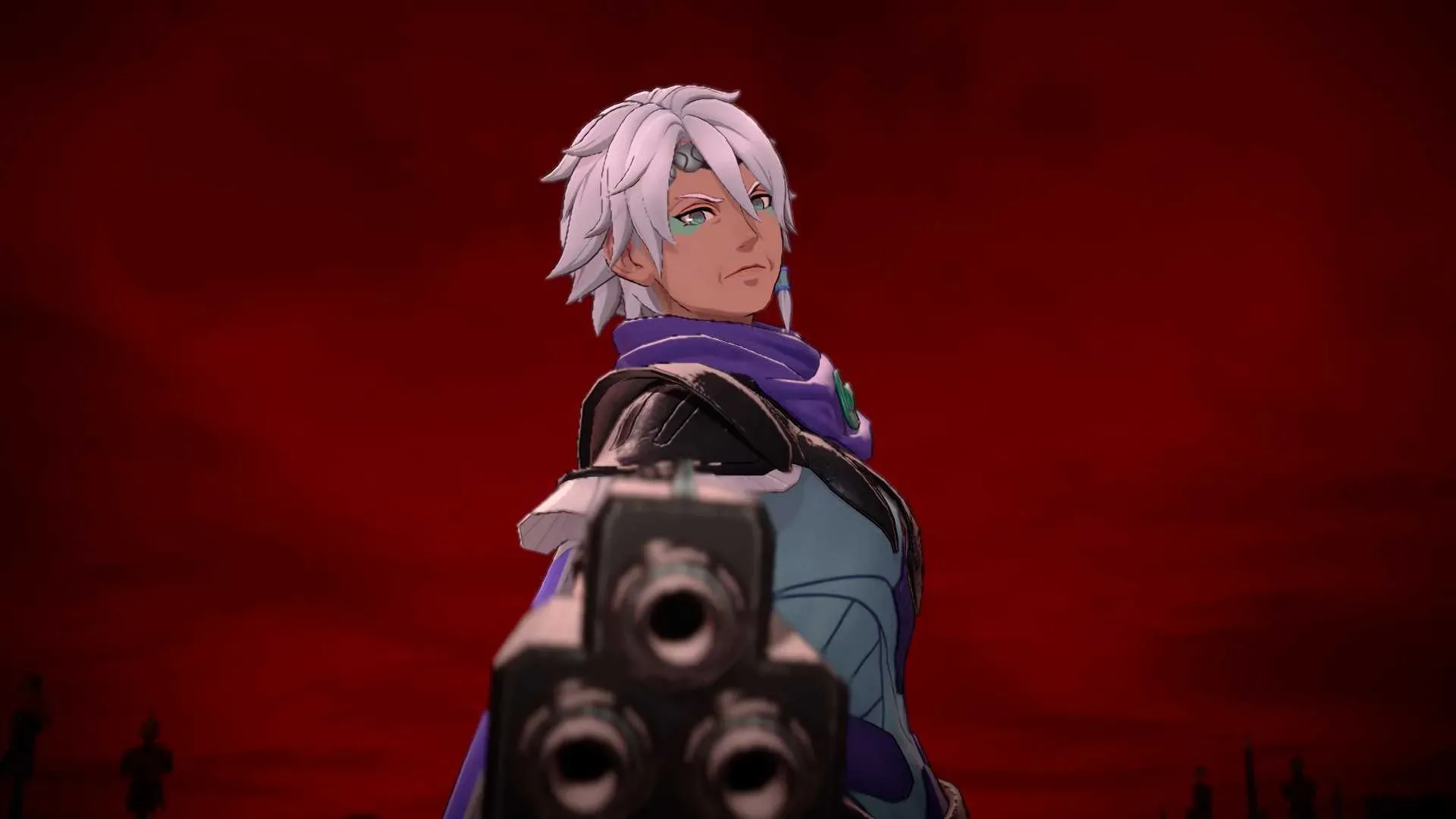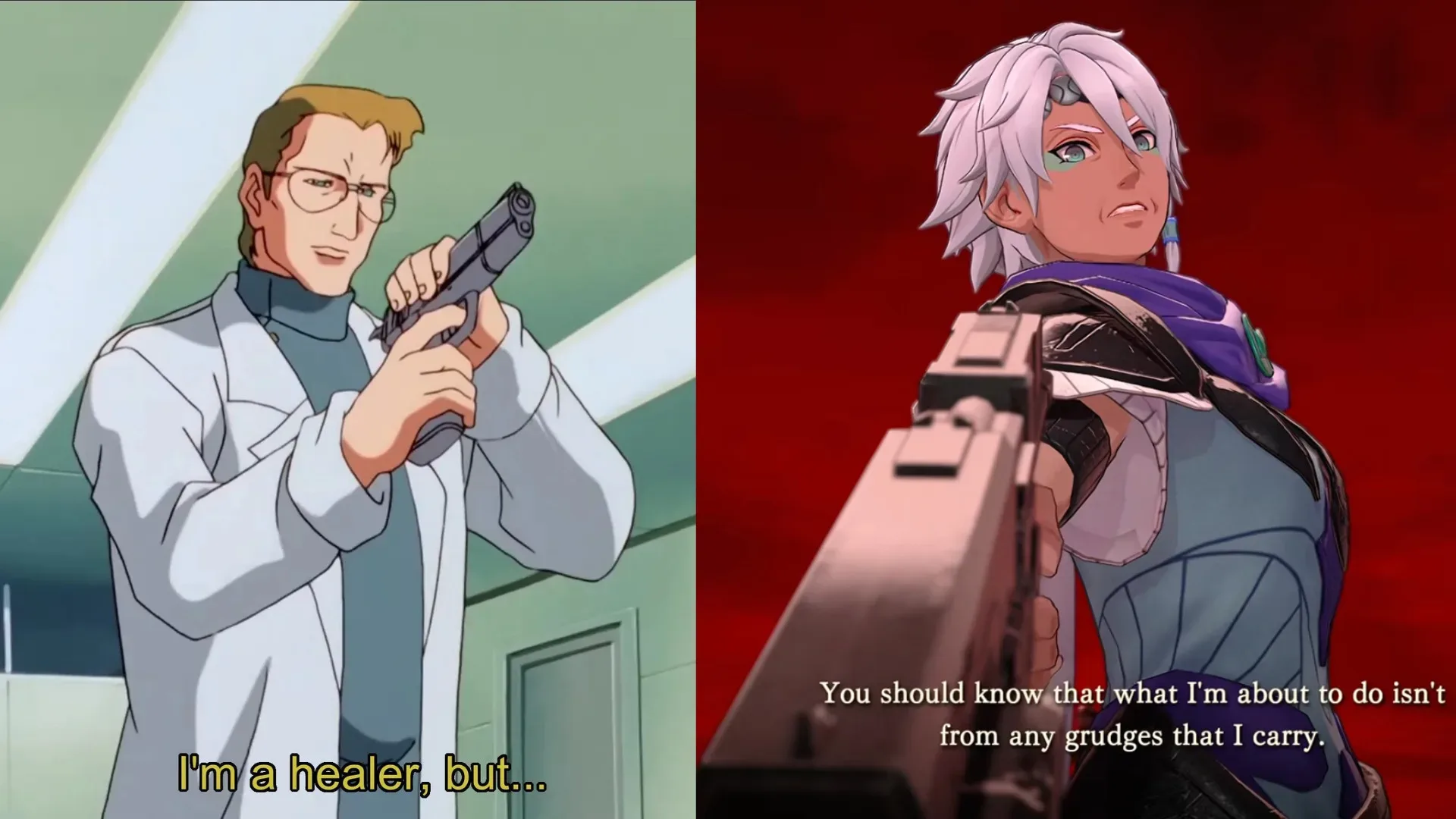
Fire Emblem: Fortune’s Weave has added guns to a series whose familiar battlefield language is usually built around swords, lances, axes, bows, magic, and healing staves. That is already a major tonal adjustment. But the more telling detail is who appears to use one early on: Troy, an older priest who arrives with both the apparent responsibility of a healer and the very direct solution of a firearm.
That contrast is the joke, and it is also the point. In a fantasy tactical RPG, weapon types do more than calculate damage. They establish silhouettes, roles, expectations, and personality. An armored fighter carrying a heavy weapon reads one way. A rogue with a dagger reads another. A priest traditionally signals protection, restoration, and support. Putting a gun in that priest’s hands makes the character legible in a fraction of a second: Troy may heal the party, but she is plainly not going to be delicate about it.
The early material makes it clear that guns are not merely a new icon in an equipment menu. The game uses them to land a narrative punchline with enough force that players will remember the weapon’s introduction long after the tutorial explanation fades. It is a smart way to make an unfamiliar system feel native to the world: connect it to a character who understands exactly how strange it looks and uses that strangeness to command the scene.
What guns do in Fortune’s Weave
Mechanically, guns are classified as gauntlet weapons in Fortune’s Weave. That classification matters because gauntlets raise the equipped character’s evasion, the stat that affects how difficult they are for enemies to hit. In straightforward tactical terms, higher evasion means a unit has a better chance to avoid incoming attacks.
That is an unusual but potentially meaningful fit for firearms. A player might initially expect a gun to be defined only by range or raw attack strength. Instead, the known mechanical identity places it in a category associated with survivability through avoidance. The available information does not establish how gun damage, range, ammunition rules, weapon durability, or matchup advantages compare with other weapon classes, so it is too early to call them powerful, weak, or meta-defining. Their full performance in the main game also remains uncertain because the weapon has only been seen in the brief prologue material described so far.
Still, the gauntlet label offers a useful clue about design intent. Weapon categories are often a compact form of communication in strategy games. They tell a player what sort of positioning, risk, or role a unit may reward. A weapon tied to evasion suggests a character who can survive pressure by slipping attacks rather than by standing behind the heaviest armor. That could make guns particularly interesting on support-oriented characters, who often need to remain alive and in the right spot to help everyone else.
None of that proves Troy’s exact gameplay role beyond her identification as a priest, nor does it guarantee that every gun user will play the same way. It does mean the game is pairing a mechanically agile category with an archetype normally associated with healing. The result is a class fantasy with more bite than “medic who stands safely in the rear.”
Troy turns a weapon category into character writing
Troy is introduced as one of the first gun users encountered, and the available details make her memorable for reasons beyond the weapon. She is an older woman in a game space where older women are often less visible than younger heroes, rivals, and romantic leads. Her presence alone broadens the character mix. The gun does not replace that characterization; it intensifies it by giving her an unexpectedly aggressive visual and dramatic hook.
Related coverage includes Fire Emblem: Fortune's Weave Makes Guns Its Most Unexpected Storytelling Tool.
There is a long-running, instantly recognizable comedic contrast in the idea of a holy figure wielding a gun. It collides two assumptions: the priest as calm caretaker and the firearm as emphatic escalation. Fortune’s Weave leans into that collision instead of trying to smooth it away. Troy is not framed as a healer who happens to own a strange accessory. The early narrative foregrounds the gun as part of how she acts when the situation turns dangerous.
This distinction matters. New weapon systems can sometimes feel detached from the story: a player receives a tutorial prompt, learns a rule, and then the narrative behaves as if that object barely exists. Here, the weapon’s presence is acknowledged in the scene itself. The game appears willing to ask what a gun means in its own fantasy setting rather than treating it as an invisible combat abstraction.
That approach gives the writing a practical advantage. A single strong scene can teach several things at once: Troy is decisive, guns are dangerous, and the tone has room for abrupt dark humor amid divine and apocalyptic stakes. It is efficient characterization, but it is also an invitation to pay attention to how the game continues to integrate its newest armament into conversations, conflicts, and class identities.
The early ambush gives the gun its payoff
The key sequence arrives early, after the party defeats a lieutenant serving Balor, the death god. The defeated enemy launches a surprise attack and catches the party off guard, bringing down a building on them. Fortuna, the goddess of Fate, intervenes by rewinding time, allowing the party to avoid the ambush.
The time-rewind premise does more than rescue the cast. It sets up the gag. The lieutenant, suddenly faced with the disappearance of the people he expected to have trapped, has a moment of confusion. Troy then confronts him at point-blank range and fires repeatedly into his head. Her response is followed by the line: “That’s the force it takes to get anything into the skull of a man like that.”
It is an intentionally brutal beat, and its comedic construction depends on timing. First comes the villain’s seemingly successful surprise attack. Then comes a godly reversal of fate. Finally, rather than extending the scene into a conventional second showdown, the game hands the release valve to the priest with the gun. The surprise is not simply that the enemy loses. It is that Troy gets the most blunt, practical possible answer to an enemy who has just been granted a bewildered pause.
There is also a useful thematic fit between the scene’s two major elements. Fortuna’s intervention bends time and fate on a divine scale. Troy’s answer is entirely earthly and immediate. The goddess creates an opening; Troy ends the problem. That contrast keeps the scene from becoming overly solemn after its supernatural rescue. Destiny may be complicated, but Troy’s preferred method of communication is not.
Why the scene matters beyond one punchline
It would be easy to reduce the moment to shock humor, especially because the weapon is so conspicuous in a sword-and-board fantasy setting. But its better function is establishing a promise about the game’s personality. Fortune’s Weave is signaling that it knows firearms change the flavor of its world, and that it plans to make room for the consequences.
That does not mean every later scene needs to escalate the joke or that the game’s entire identity will rest on guns. The early evidence simply supports a more measured expectation: firearms will be acknowledged as narrative objects, not only combat tools. The difference is substantial. When a story recognizes what its weapons imply, character choices can gain specificity. A weapon becomes part of the speaker’s voice, a way to punctuate a scene, or a clue to how a culture has adapted to power and danger.
For players interested in the tactical side, the unanswered questions remain important. Since guns are categorized as gauntlets and are associated with evasion, players will want to see their full stat profiles and how widely they are distributed once they become available outside the prologue. Does the category reward particular unit builds? Do priests gain unusual flexibility through it? Are guns common to a broader set of classes, or is their association with healers part of a deliberate worldbuilding rule? The material available so far does not answer those questions.
For players interested in character writing, however, Troy has already supplied a clear reason to watch the system closely. The priest-with-a-gun premise could have been a one-note visual gag. Instead, it has been embedded in an early reversal involving Balor’s lieutenant, Fortuna’s temporal intervention, and a finishing remark sharp enough to make the weapon feel inseparable from the character wielding it.
A new Fire Emblem tool with an immediately recognizable voice
Guns may ultimately prove balanced like any other weapon type, with tradeoffs that only become clear across the campaign. What is already distinct is their storytelling entrance. The classification as gauntlets gives them a defined mechanical association with evasion. Troy gives them a face, a role, and a sense of comic menace. The ambush scene makes sure nobody mistakes the addition for background decoration.
That is an effective introduction for a new system in a long-running fantasy framework. It lets the game preserve the tactical vocabulary players expect while adding an element capable of disrupting the genre’s usual assumptions. A healer can still be a healer. She can also be the person who gets the last word, the last shot, and arguably the most memorable moment in the opening stretch.
For more on the game’s current retail oddities, see our look at an unusual Fire Emblem: Fortune’s Weave checkout workaround.