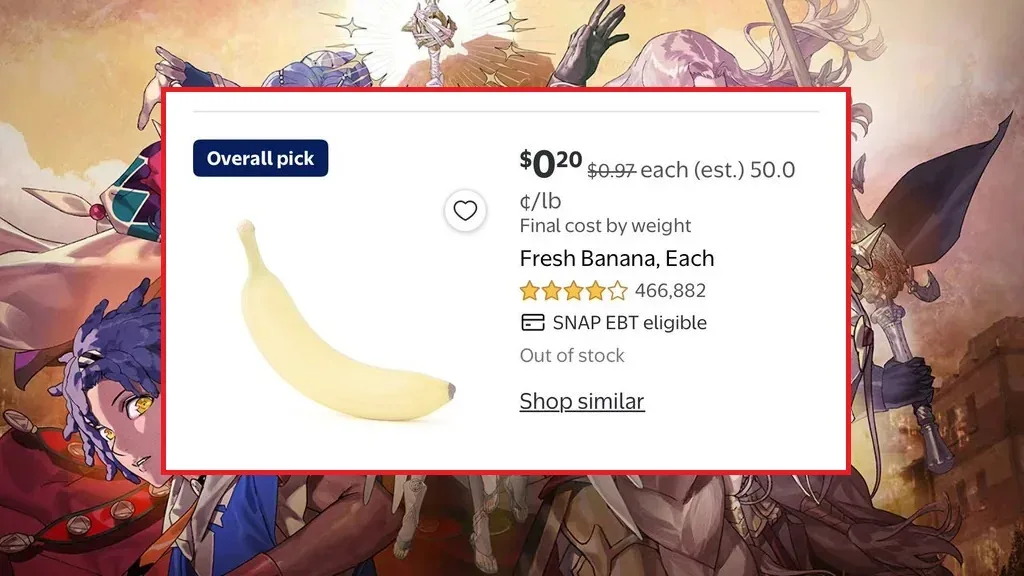
Fire Emblem: Fortune’s Weave has barely arrived, yet its launch-week shopping story is already unusually fruity. Players looking to trim the cost of the Switch 2 strategy RPG reportedly found that placing a single banana in a Walmart online order could help a discount code apply. The result: pictures of new copies of the game posed beside bananas, and an online shipping listing for single bananas that was shown as out of stock.
The oddity began with a Walmart promotion offering $10 off qualifying online pickup or delivery orders. That potential reduction mattered because the digital version of Fire Emblem: Fortune’s Weave is listed at $70. A $10 discount is meaningful on a full-price release, even if it is not an automatic or universally successful reduction. The promotion code, identified as FAST30 in the reported workaround, did not consistently apply for every cart or fulfillment option.
When a deal-sharing account suggested trying pickup and, if necessary, adding a banana, buyers quickly tested the theory. That advice was not presented as a guaranteed feature of the promotion. It was an observed checkout quirk: a minor item could apparently alter a cart’s eligibility or the way Walmart’s system evaluated it. The accounts of buyers sharing their game-and-banana purchases indicate that the method worked for at least some orders, but they do not establish how frequently it worked or whether it remained available.
A cart workaround, not a game feature
It is worth separating the joke-worthy visual from what may actually be happening at checkout. A promotion code is a discount applied only when an order meets the retailer’s rules. Those rules can include fulfillment method, minimum spend, eligible items, location, account status or other conditions. Online carts can also behave differently when they contain delivery-eligible grocery items rather than digital-only items.
Adding a banana was therefore not a secret Fire Emblem bonus, a Nintendo offer, or a reason to expect Walmart stores to have physically exhausted their produce aisles. It was a user-discovered attempt to make a checkout configuration qualify when it otherwise did not. A single banana is cheap, easy to add and comically visible in an order confirmation, which explains why it became the item attached to this particular deal-hunting story.
The online banana listing being unavailable for shipping should be read narrowly. It signals that the specific online inventory and fulfillment status for that listing had changed at the time it was checked. It does not demonstrate that Walmart had run out of bananas in its stores, nor does it reveal how many game buyers used the workaround. Retail inventory statuses are local and can fluctuate quickly, especially for delivery and pickup systems that depend on nearby inventory.
Why fulfillment choice may matter
Pickup means an order is assembled for collection at a selected store. Delivery means items are sent to a customer, either from a store or another fulfillment channel depending on the retailer’s setup. A digital product is delivered electronically, while a banana is a grocery item tied to physical inventory and a location. Combining those categories can change how an e-commerce platform classifies the order.
That does not tell customers exactly why the code applied in some cases. The available evidence does not establish Walmart’s internal promotion logic, and it would be a mistake to treat an anecdotal trick as a stable policy. It does, however, explain why changing from one fulfillment choice to another—or adding a physical item—could plausibly produce a different checkout result.
Related coverage includes Fire Emblem: Fortune's Weave Deal Hunters Turn Walmart's Online Bananas Into an Unlikely Checkout Trick.
For anyone tempted to recreate the move, the practical takeaway is modest: check the promotion’s terms, confirm the total before paying, and do not assume a social-media workaround will work for every account, location or version of the game. If a code fails, repeated cart edits are not proof that a discount is owed. Retailer eligibility conditions can change, and a successful order should be judged by the final checkout screen rather than a tip that worked for somebody else.
Physical copies are also drawing attention
The banana episode is only one part of the launch-week picture. Walmart has listed physical copies of Fire Emblem: Fortune’s Weave as low stock, while Amazon has reportedly moved in and out of stock since launch. Boxed copies are priced at $80, above the $70 digital version referenced in the Walmart deal. Even at that higher price, players appear to be buying physical editions.
Low-stock labels and temporary online sellouts are useful signals, but they do not settle the biggest question: is demand unusually high, or was the initial physical allocation relatively small? Both explanations can create the same consumer-facing outcome. A retailer can appear nearly sold out because a large number of customers bought copies, because it received fewer copies, or because stock is being split among stores, online fulfillment and future replenishment.
The available evidence supports caution rather than a sweeping declaration about the state of physical games. It shows constrained availability at particular major retailers during a launch window. It does not provide sales totals, shipment figures, retailer-wide inventory counts or a comparison with prior Fire Emblem releases. Those missing pieces matter before treating a low-stock indicator as proof of a broader market trend.
Still, the distinction between digital and physical pricing makes the situation notable. Digital buyers were looking for a way to reduce the $70 price, while some physical buyers were willing to pursue an $80 boxed copy amid uneven availability. Those are different purchasing decisions. A customer may favor the convenience of immediate digital access, while another may want a disc or cartridge release, may prefer having a boxed product, or may simply be responding to concern that it will be harder to find later. The specific motivations are not known here, but the price gap makes it clear that physical interest is not necessarily driven by the cheapest option.
What the launch says—and does not say—about Fire Emblem
Fortune’s Weave is the first entry in the strategy RPG series to arrive on Switch 2 and is positioned as the console’s first major exclusive of the fall season. That status gives the launch extra visibility: fans of the series have a new installment, Switch 2 owners have a prominent exclusive, and discount-focused shoppers have a high-ticket game for which a $10 reduction is worth chasing.
In games, a strategy RPG generally describes a role-playing game built around tactical decision-making rather than only direct action. Fire Emblem’s place in that genre helps explain the intensity of the audience response without requiring the game to be a mass-market phenomenon on the scale of Nintendo’s biggest brands. A dedicated fanbase can move quickly when a release, a promotion and an apparent supply constraint all converge in the same week.
There is a recent point of comparison for the uncertainty surrounding physical availability. Pokémon Pokopia was difficult to obtain in physical form around its release month, but inventory later became easier to find when new stock arrived. That example does not predict what will happen with Fortune’s Weave; it simply illustrates why a brief launch shortage should not automatically be mistaken for permanent scarcity.
For buyers, the sensible response is to distinguish inconvenience from scarcity. “Low Stock” can mean a preferred retailer or format is temporarily limited. It does not, on its own, mean a game will never be restocked, that every store is sold out, or that consumers should pay inflated prices from third parties. Checking retailer listings over time is more informative than drawing conclusions from a single day’s status.
The real story is how fast a workaround travels
The banana itself is the memorable punchline, but the more revealing part is the speed with which a small checkout observation became a community experiment. Deal-sharing accounts increasingly serve as rapid alert systems for game buyers: they surface discounts, report stock movement and circulate tips that can be tested by thousands of people almost immediately. In this case, an unreliable promotion code became a shared problem, and a bizarrely inexpensive grocery item became the proposed fix.
That dynamic can be helpful, especially when it points consumers toward legitimate retailer promotions and encourages them to verify the final price. It also rewards skepticism. A workaround can be real for one cart and irrelevant for another. A viral screenshot can document a completed purchase without proving the method’s reliability at scale. And a product page being unavailable for shipping can be a fleeting logistical condition rather than a sign of a genuine nationwide shortage.
As Nintendo’s launch calendar and shopping promotions continue to intersect, deal hunters will likely keep looking for ways to make expensive releases less expensive. Readers following the business side of game releases and ongoing-service pressures can also find useful context in this look at a producer’s view of the JRPG escape plan from live-service shutdowns. For Fire Emblem: Fortune’s Weave, though, the immediate lesson is much simpler: a checkout quirk may save money for some players, but it should be treated as temporary, conditional and decidedly less reliable than a piece of fruit.
Shop the products
Check current price, model and availability at the retailer.