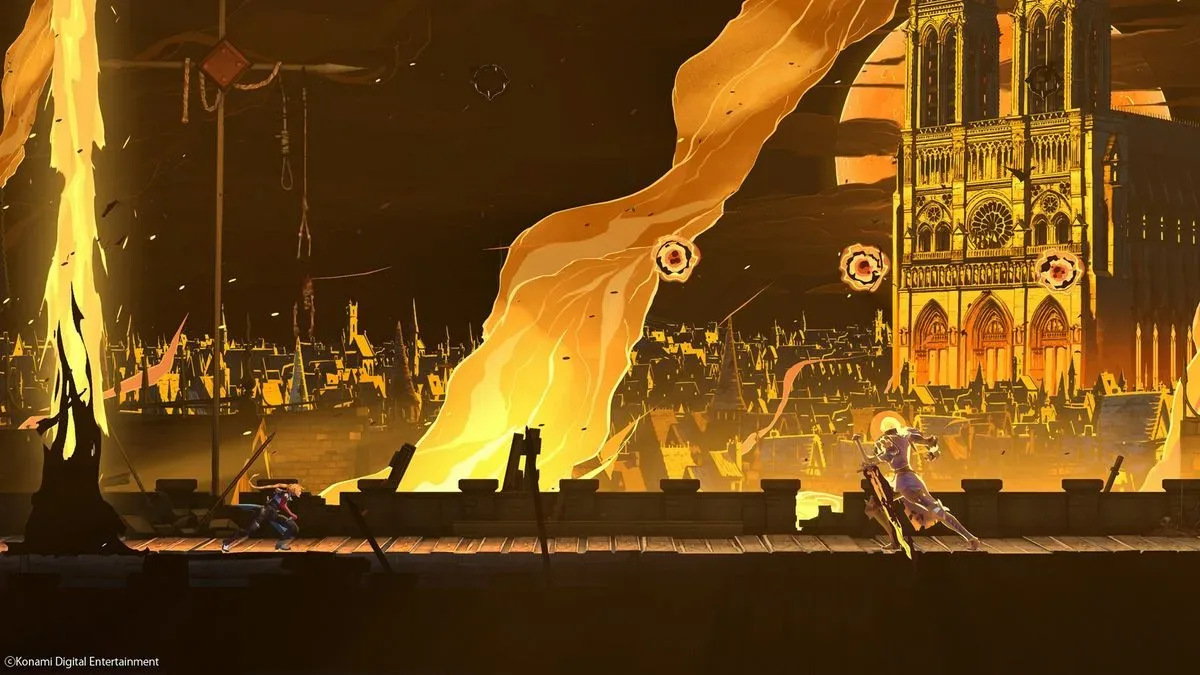
Castlevania: Belmont’s Curse appears to understand one of the great pleasures of the series: starting vulnerable, learning a hostile world’s rules, and slowly assembling the tools needed to overcome it. Its opening puts players in the role of Rose Belmont, daughter of Sypha and Trevor, investigating supernatural events in a burning Paris. Rose begins with a sword rather than the family’s familiar collection of tools, and her broader kit is built through exploration.
That setup makes the game’s reported early design sound especially promising. Bosses are not simply presented at the end of a straight line. Ghosts and unmoving watchers provide clues, and those clues point Rose toward targets and the means of opening routes to them. It is a structure that asks the player to observe, infer and explore rather than merely clear every room in a prescribed order.
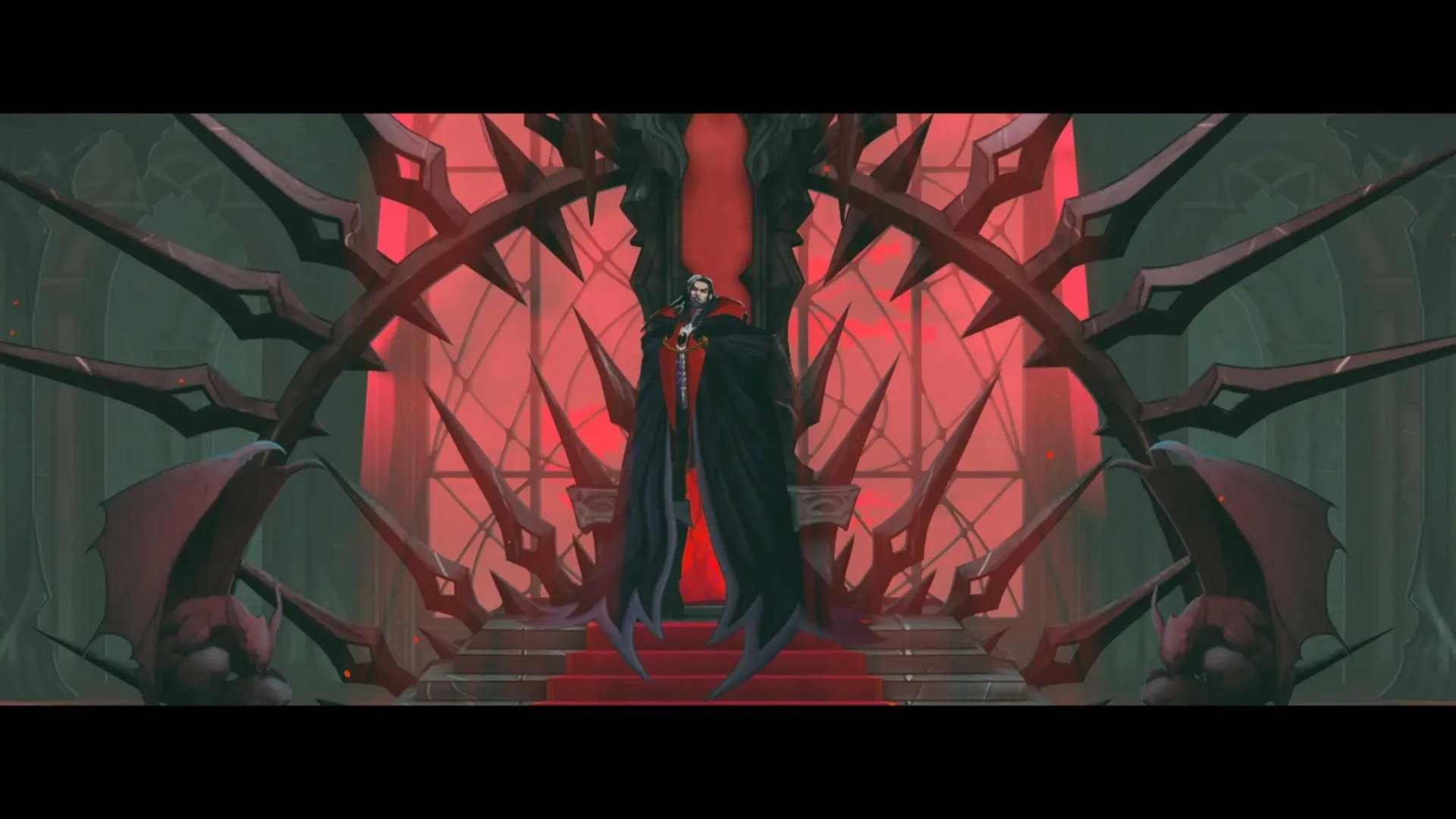
There is even a striking degree of route freedom. Reaching Dracula early can apparently trigger a bad ending and roll credits if Rose has not developed enough to survive the encounter. That is an unusual and appealing proposition: the game lets a player find the finale before they are ready for it. A premature ending is still an ending with consequences, and it makes the world feel less like a corridor built solely around a checklist.
But the same game can be generous about route choice while being uncompromising at a single point of execution. The Builder encounter reportedly turns from a relatively manageable boss fight into a punishing timed platforming sequence—then requires the player to run the same obstacle course in reverse within 90 seconds. That is the point where an enjoyable test of skill risks becoming a wall.
The Builder is not only a boss fight
The Builder’s first combat phase is described as surprisingly simple compared with earlier bosses. That alone is not a problem. A boss can use a comparatively forgiving combat phase to establish attacks, offer a breather, or set up a twist. Here, the twist comes when the Builder flees at a health threshold.
Rose must pursue through narrow passages where pistons descend from above or fire from the sides. The hazards sit around spike pits and collapsing platforms, creating a compound challenge: read the piston timing, keep moving, preserve footing and avoid the environmental traps. Clearing that sequence leads to another boss room and another straightforward stretch of combat. Once the Builder loses more health, the chase begins again—only now the route runs backward and has a 90-second limit.
That reversal matters more than it may sound. In a platforming challenge, direction establishes the player’s view of incoming danger, the order in which jumps are approached, and the rhythm used to read hazards. A route designed to be legible moving forward may demand a wholly different reaction when reversed. Fast side-firing pistons that are visible and intuitive from one direction can become much harder to judge on the return trip, particularly when the player is already rushing against a countdown.
A health threshold is the amount of damage needed to move a boss into a new phase. It is a common way to add escalation to a fight. In this case, though, the threshold is not just a combat change. It locks progression behind a separate test of movement execution. Players who can learn the Builder’s attacks and reduce its health still have to master a high-pressure traversal gauntlet before they can finish the encounter.
Related coverage includes Castlevania: Belmont's Curse Has a Brutal Platforming Wall That Overshadows Its Strong Start.
Difficulty is not the same thing as pressure
Hard games can be satisfying because they create a clear loop: identify a mistake, adjust, improve, and see that improvement carry into the next attempt. The account of Belmont’s Curse’s Builder chase suggests that its friction comes from a different combination: a time limit, instant-fail environmental danger, a reverse route, and a boss encounter that must be revisited to reach the test again.
A timer changes the emotional shape of practice. The player is no longer only attempting precise jumps; they are deciding quickly, recovering from errors under pressure and watching a visible deadline erase the possibility of a cautious correction. If the full area explodes once the timer expires, that deadline is not merely a scoring target or optional challenge. It ends the run.
There is nothing inherently wrong with that. Timed escapes are a familiar action-platformer device, and a reversal can be a memorable way to make an environment feel newly dangerous. The issue is whether players can develop the necessary skill in conditions that make the challenge readable. If piston timing is difficult to parse, and the reverse path offers little margin for experimentation, repeated failure can feel less like a lesson and more like a demand for a performance the game has not adequately prepared the player to give.
That distinction is why the comparison to a soulslike is useful, even though Belmont’s Curse is an action platformer rather than a game in that genre. Soulslike difficulty is often associated with enemies that punish mistakes heavily, but players can frequently respond by changing their approach: exploring another direction, finding upgrades, practicing a fight, or returning later with a different build. A tightly scripted chase has fewer of those escape valves. If the obstacle itself is fixed and mandatory, mechanical execution becomes the only route forward.
Combat options do not automatically make platforming accessible
Belmont’s Curse reportedly includes difficulty settings that can prevent death or reduce how hard enemies hit. Those options can be meaningful for players who want the story, world and boss encounters without the usual combat penalty. Yet they apparently do not directly simplify the Builder’s traversal sequence.
That creates a practical gap in accessibility. A player may reduce combat damage, or even remove death, but still be unable to clear a mandatory timer because the challenge is based on navigation and pacing rather than enemy survival. Turning off death may allow more experimentation, but it does not necessarily teach the required timing or alter the 90-second objective. It is also unclear whether the setting changes what happens when time runs out.
Accessibility is sometimes reduced to an easy-mode debate, but the Builder scenario illustrates why that framing is too narrow. Challenge has components. Damage output, health, checkpoint placement, timer length, movement speed, hazard frequency, visual clarity and input demands can all independently determine whether a section is playable for a given person.
A game can retain the drama of a collapse sequence while offering settings that address its specific pressure points. Examples in principle include more time, more forgiving hazards, an optional checkpoint after the initial route, or a way to practice the traversal without replaying surrounding combat. None of those measures must make the encounter trivial; they simply target the element that blocks progress. Whether Belmont’s Curse will offer changes along those lines is unknown.
A strong opening makes the abrupt wall sting more
The frustration here is sharpened by what comes before it. Rose’s underpowered beginning, the haunted clue-givers, the search for bosses and the possibility of discovering Dracula prematurely all suggest a game willing to make uncertainty part of its identity. The early Paris and sewer exploration is described as demanding but manageable through patience and practice. That is the kind of difficulty curve that can build trust.
The Builder chase seems to break that trust because it changes the terms. A player can reasonably expect a Castlevania-inspired game to ask for careful combat and platforming, and can accept that a mysterious route may need decoding. A sudden requirement to execute a reverse obstacle course at speed after a boss phase is another kind of ask altogether. It asks for fluency, not just understanding.
The game’s willingness to let players stumble into an early bad ending reinforces the contradiction. On one hand, it offers agency: go where curiosity takes you, discover that the endgame is closer than expected, and learn that readiness matters. On the other, the Builder section appears to narrow agency to one exact solution performed within a strict window. Freeform progression and rigid execution can coexist, but the latter needs especially clear feedback if it is going to feel like a deliberate climax rather than an ambush.
The Lion King comparison is about design incentives, not just pain
The reported experience naturally evokes the notorious difficulty of the SNES version of The Lion King. Its early areas could seem friendly before later sections became infamous for demanding platforming. Developers behind that game said its severity was meant in part to stop players from finishing during a typical video-store rental period. That context does not make the frustration disappear, but it explains why an adaptation built around a popular film might have been tuned to last longer than a weekend.
Belmont’s Curse has no identified equivalent reason for making a mandatory chase so severe. The reported concern is not that a game should never be hard, or that a player should never need practice. Rather, a modern action platformer has ample room to make failure productive instead of simply repetitive. If a run ends because one piston’s timing remains unreadable, replaying the boss lead-in may not add insight. It may only add fatigue.
That is also why a future patch or a player-made demonstration could matter so much. A clear route video could reveal visual tells and movement patterns that are currently easy to miss. A developer adjustment could preserve the Builder’s panic while giving players more room to recognize those tells. Neither possibility is confirmed, and no release-stage changes should be assumed. But the encounter highlights an area where a small adjustment could have an outsized effect on how players receive an otherwise compelling opening.
What players should take from this now
For prospective players, the important takeaway is expectation-setting. Belmont’s Curse appears to combine investigation, exploration, combat and precision platforming rather than treating them as separate optional activities. The flexibility to find Dracula early and receive a bad ending is intriguing, but it also means reading clues carefully matters. A conspicuous clock is not necessarily the clocktower the game means.
Players who relish timed traversal and repeat-until-mastered sequences may see the Builder chase as the kind of sharp skill check that gives a game its reputation. Those who are primarily drawn to the Belmont family setup, the mystery structure or the combat may want to know that accessibility settings for damage and death do not necessarily translate to platforming relief.
That tension is worth watching because the game’s best ideas are not at odds with difficulty. Rose beginning with only a sword gives progression weight. Obscure boss clues encourage attention. An early path to Dracula gives exploration consequences. The Builder pursuit could fit that same philosophy if its demands are legible enough to turn failure into learning. When the lesson is obscured by speed, reversal and a hard timer, though, the haunted streets of Paris risk becoming less a mystery to solve than a piston-powered detention sentence.
For more on how game structure can shape an ending, see this look at the open-world problem behind Red Dead Redemption’s ending.