By Darryl Polo
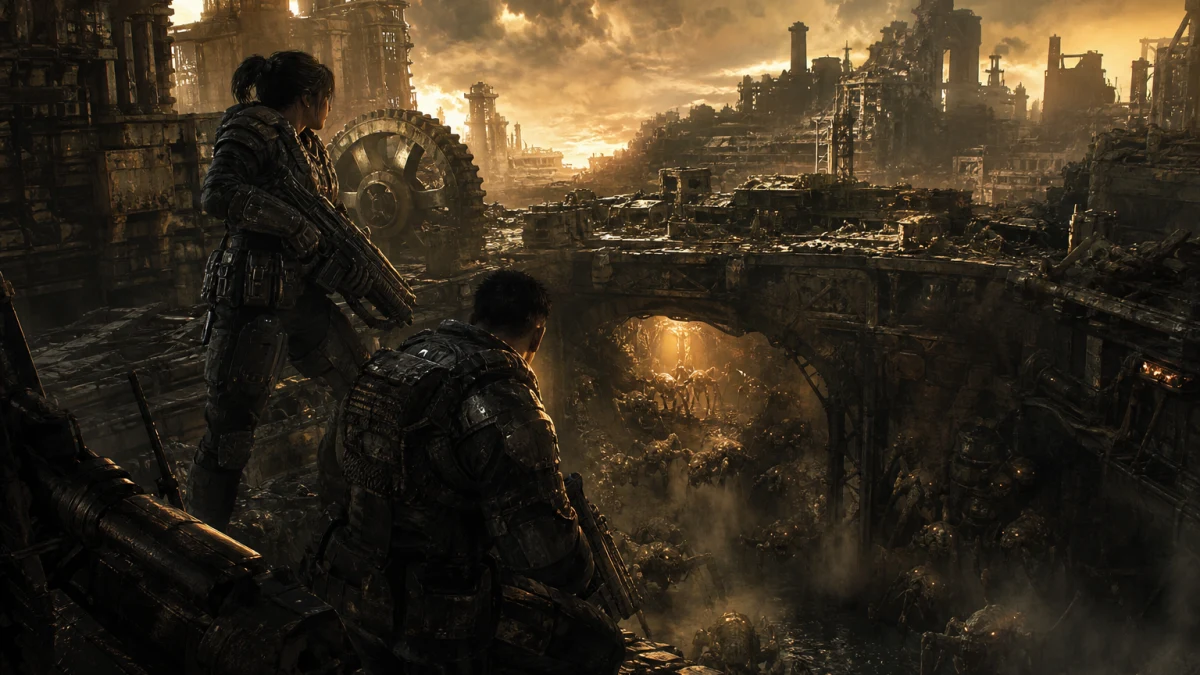
Gears of War: E-Day begins at a historical turning point, not at the beginning of Marcus Fenix or Dominic Santiago’s lives. The men who face the Locust in Kalona are already combat veterans, childhood acquaintances and survivors of a loss that has damaged their relationship. The game’s central character origin is therefore not their first meeting. It concerns the brotherhood they rebuild when one war ends and a far more destructive one erupts beneath their feet.
That distinction matters because E-Day occupies two positions at once. It is the earliest mainline Gears campaign in the chronology, covering the first three days of the Locust invasion, but it was created with the benefit of stories published across games, novels and comics. Some of its foundation was established years earlier. Other elements, including Kalona, Bravo Squad, Mags Carter, Lucas Reyes and Vraahk, substantially expand a previously unobserved part of the timeline.
The game also makes at least one acknowledged continuity adjustment rather than merely filling untouched space. The broad hardware-store origin of the Chainsaw Lancer remains, but The Coalition has said the relevant event was moved from roughly a year later in the books into E-Day. That change needs its own category: it is neither a wholly new invention nor straightforward preservation of the former timing.
This primer keeps those categories separate. Its main discussion is spoiler-light and avoids final-act outcomes. It identifies inherited canon, material added or substantially detailed by E-Day, deliberate continuity adjustments and interpretation. It then places Bravo Squad’s local experience alongside Judgment, Tactics, the original trilogy and the later Swarm storyline without treating one city’s perspective as the complete history of Sera.
Evidence note: This article distinguishes inherited canon, E-Day additions, deliberate continuity adjustments and interpretation. The five-act campaign division comes from the public achievement list. The approximately six-week interval after the Pendulum Wars and some observations about Mags and Lucas derive from specialist post-launch coverage rather than a retrieved official master chronology. The Chainsaw Lancer section reflects The Coalition’s official acknowledgment that the broad hardware-store origin was moved from roughly a year later in book continuity into E-Day as a lift and shift. Relative dating is used where official sources do not provide exact calendar dates.
Spoiler Policy and the Three Layers of This Primer
The main body discusses E-Day’s premise, opening circumstances, publicly demonstrated early-campaign material and broad three-day structure. It does not reveal the ending or give definitive final fates for Mags Carter, Lucas Reyes, Colonel Trench, Captain Akila Grey, Kalona’s mayor or Vraahk. It also does not reconstruct concealed story beats from achievement names. Readers can use it before or during a first campaign without having the concluding acts summarized.
The first evidence layer is established canon inherited from material that predates E-Day. It includes the long Pendulum Wars, Marcus’s connection to the Santiago family, Carlos Santiago’s death at Aspho Fields, Dom’s marriage to Maria, the existence of their two children and the fourteen-year interval between Emergence Day and the original Gears of War. Karen Traviss’s Aspho Fields is especially important because it made Carlos and the childhood relationship among Marcus, Dom and Carlos central long before E-Day adapted that history into a game premise.
The second layer consists of additions or substantial elaborations made by E-Day. Kalona is the clearest example. The city, its three-day destruction, Bravo Squad’s composition, Mags and Lucas, the command conflict at City Hall, Vraahk and the Scorched Legion belong primarily to this account. These additions occupy territory earlier stories had not mapped in comparable detail. Their novelty does not automatically displace events involving other squads elsewhere on Sera.
The third layer is interpretation. It is reasonable to read Kalona as a concentrated image of Sera’s collapse or the campaign as the point when Marcus and Dom convert inherited friendship into a durable wartime brotherhood. Those readings fit the material, but they remain analysis rather than dates, ranks or directly documented events. The same caution applies to claims about precisely when their estrangement ends, which man bears more guilt or what an individual landmark symbolizes.
A fourth classification is needed for deliberate continuity adjustments. The Chainsaw Lancer’s origin is the important example. The broad idea involving a hardware-store chainsaw is retained from prior material, but The Coalition explicitly described moving the relevant event from roughly a year later into E-Day as a lift and shift. It is inaccurate to classify that change as untouched inherited canon or as a clean use of empty narrative space. It is an acknowledged revision to timing and context.
That label does not settle whether every reader should regard the adjustment as harmless or disruptive. The available evidence establishes what was moved, not that the change has no downstream consequences or that it breaks the entire chronology. A responsible primer identifies the revision, preserves the distinction between broad origin and revised placement, and avoids turning a documented production decision into a larger verdict unsupported by the sources.
One further boundary is essential: Bravo Squad’s knowledge is not identical to the audience’s knowledge. Players who completed later games may understand the Locust, the Lambent and the history below Sera long before Marcus or Dom could. E-Day deliberately follows people encountering unknown attackers. Their confusion reflects their place in history, not an erasure of information revealed later.
Mode boundaries matter as well. A fixed campaign scene has a different narrative status from a repeatable multiplayer match, Horde scenario or optional objective with variable results. A character appearing on a roster does not place that person in every campaign battle. This primer gives greatest weight to explicit campaign events and official narrative descriptions, while identifying specialist testing and interpretation where they fill narrower gaps.
- Established canon: documented before E-Day.
- E-Day additions: Kalona, Bravo Squad and this local invasion account.
- Interpretation: thematic or psychological readings open to debate.
- Continuity adjustments: inherited material whose timing or context was deliberately changed.
- Not automatically fixed history: every optional objective, multiplayer match or Horde scenario.
The Short Version: Where E-Day Sits
The simplest chronology begins with the Pendulum Wars, a human conflict that consumed almost eighty years of Sera’s recent history. Marcus Fenix, Dom Santiago and Carlos Santiago served during it. Carlos died shortly before the war ended, leaving Marcus and Dom alive but divided by grief. The armistice created the possibility of peace, and E-Day catches the survivors during that extremely brief transition rather than after a stable postwar era.
Gears of War: E-Day covers the first three days and nights of the Locust invasion as experienced in Kalona. The campaign remains with Bravo Squad, so it is not a planet-wide documentary. Events of enormous scale occur across Sera, but one city remains the field of view. Official background says roughly two-thirds of Sera’s population is wiped out in the wider catastrophe, illustrating how much lies beyond what four squad members can witness.
Specialist post-launch coverage places the game about six weeks after the Pendulum Wars. That interval is useful context, but the retrieved official overviews establish the broader point more securely than the precise count: the end of the human war is extremely recent. E-Day does not occur after society has rebuilt, demobilized completely or learned how to live with peace.
Gears of War: Judgment is the nearest previously released campaign in chronological terms. It takes place in the immediate aftermath of Emergence Day and follows Damon Baird’s Kilo Squad rather than Marcus’s Bravo Squad. Its existence shows that multiple groups respond to the catastrophe at once. A character absent from Kalona is not necessarily inactive, and an event seen by Kilo Squad need not be witnessed by Bravo.
Gears Tactics occurs approximately one year after Emergence Day. Its story belongs to a phase in which the war is established, the enemy is better recognized and the COG is preparing to use the Hammer of Dawn against the surface. That differs sharply from E-Day’s first hours, when civilians and soldiers do not yet understand what has broken through their streets.
The original Gears of War opens fourteen years after E-Day. Dom retrieves Marcus from prison, and they return to the fight in the campaign associated with Delta Squad. E-Day therefore does not end on the threshold of that prison break. Fourteen years of warfare, personal decisions and political catastrophe separate Kalona from Marcus’s reintroduction as a disgraced prisoner.
The mainline sequence then continues through Gears of War 2, Gears of War 3, Gears of War 4 and Gears 5. The original trilogy carries the Locust and Lambent conflict forward, while the later games shift toward JD Fenix, Kait Diaz, Del Walker and the Swarm. The Coalition has said revisiting Emergence Day does not erase or abandon that continuing storyline.
- Pendulum Wars: nearly eighty years, ending shortly before E-Day.
- E-Day: the invasion’s first three days in Kalona.
- Judgment: the immediate aftermath with Kilo Squad.
- Tactics: approximately one year later.
- Gears of War: fourteen years later.
- Gears 2 and 3: escalation and resolution of the original trilogy.
- Gears 4 and Gears 5: a later generation and the Swarm storyline.
Sera Before the Ground Opened
Emergence Day did not destroy an untouched golden age. Sera had just endured almost eighty years of the Pendulum Wars, an extended human conflict that shaped its institutions, families and generations of soldiers. For Marcus and Dom, war was not a short interruption to settled adulthood. It was the environment in which they grew up and the profession through which their closest relationships were tested.
The armistice preceding E-Day therefore carried unusual weight. It promised an exit from a conflict so old that younger veterans had never known durable peace. Official material presents Marcus and Dom as trying to imagine civilian futures after lives formed by military service. That does not make either man an inexperienced civilian. Both arrive in Kalona with battlefield competence, military habits and recent memories of combat.
The reported six-week interval helps convey how narrow the transition may be, but it should not become the sole support for the chronology. The more firmly established point is that peace is new and uncertain. Uniforms can be removed more quickly than military reflexes, grief or suspicion. Political agreement can stop organized hostilities without instantly repairing the society that fought them.
Kalona’s armistice memorial embodies that unstable moment. It is intended to acknowledge sacrifice and mark a passage out of war, yet those attending have barely had time to process what the conflict cost. Marcus and Dom are present because of peace, not because military intelligence has identified the city as their next battlefield. The invasion turns remembrance into mobilization before either man can determine what ordinary life might mean.
Imulsion is part of Kalona’s material identity. The city contains refineries, and Mags Carter works at one when the invasion begins. That supports describing Kalona as an industrial center linked to a resource central to Sera’s technology and wars. It does not support an elaborate account of the city’s wealth, government or exact position in a global economic hierarchy. The verified emphasis is the refinery’s place in the city and in Mags’s civilian life.
This background changes the meaning of first contact. Marcus and Dom are capable soldiers confronting something outside the categories their previous war supplied. They understand cover, weapons, command and mutual protection. They do not initially understand ruptures opening beneath streets, Feral Wretches attacking civilians or armed subterranean Drones speaking and coordinating in battle. Their experience is necessary, but it cannot explain the enemy for them.
The old war also helps explain why Sera cannot respond from a position of abundant strength. Its society has expended lives and resources for generations. An armistice can stop fighting between human powers, but it cannot immediately restore trust, replace casualties or reorganize every institution for an unexpected subterranean invasion. The Locust arrive when people are ready to stop fighting one another but have not recovered from doing so.
Calling the period simply peacetime can consequently mislead. Politically, the previous conflict has ended. Socially and psychologically, peace has barely begun. E-Day attacks that narrow interval, while military structures still exist but veterans are contemplating departure, civilians expect relief and public ceremonies attempt to give meaning to losses that remain painfully recent.
Marcus Before He Became the Prisoner from Gears 1
The original Gears of War introduces Marcus Fenix as a disgraced and imprisoned war hero. Dom brings him back into the fight, and the campaign demonstrates that the prisoner remains an extremely capable soldier. E-Day moves fourteen years backward and removes the prison-break framework. Its Marcus is younger, recently returned from the Pendulum Wars and still much closer to the military identity built during that conflict.
He is not a rookie. Marcus served in the Pendulum Wars and fought at Aspho Fields with Carlos and Dom. His experience explains why he can respond effectively when Kalona’s streets rupture, but the earlier setting permits differences in temperament. Early E-Day material presents him as comparatively disciplined about military organization and the chain of command. That is not the same as unthinking obedience; it means his later reputation should not be projected backward without qualification.
Marcus’s bond with Carlos is indispensable. Carlos was not merely Dom’s brother or another soldier in a large formation. He was Marcus’s closest friend, connected to him from childhood and through combat. Carlos’s death shortly before peace leaves Marcus without someone who helped tie him to the Santiago family and to a life beyond his difficult relationship with his own father.
That father is Adam Fenix. During Bravo Squad’s City Hall processing, Marcus identifies Adam as his next of kin. Official material identifies Adam as a noted veteran and creator of the Hammer of Dawn. For established fans, the name carries knowledge from later games. The immediate E-Day point is narrower: Adam remains Marcus’s familial contact even though their relationship is difficult rather than emotionally uncomplicated.
The distinction between Marcus’s knowledge and audience knowledge is especially important around Adam. Later games provide information about Adam, the Locust and the Lambent that cannot simply be inserted into Marcus’s understanding during Kalona’s first hours. Foreknowledge gives players dramatic irony; it does not grant young Marcus access to future revelations.
E-Day consequently offers neither a blank-slate hero nor the fully hardened prisoner from the first game. It occupies the middle of a transformation. Marcus has endured war and bereavement, but he has not lived through fourteen years of the Locust conflict or made every choice that leads to imprisonment. His reserve, competence and willingness to move toward danger are already present. The entire later legend is not.
This separation guards against a common prequel error. It is tempting to treat every disagreement with authority as proof that Marcus was always destined for prison. E-Day instead leaves room for contingency. He has obligations, relationships and possible futures at the armistice memorial. Knowing where his life eventually goes does not mean every intermediate decision was inevitable.
The useful comparison is how recognizable qualities operate under different pressures. His reserve exists before imprisonment, but its immediate context includes Carlos’s death. His competence predates the Locust War, but it was developed against human enemies. His relationship with authority predates disgrace, but it has not yet accumulated fourteen years of conflict with the COG. E-Day explains part of the road without pretending Marcus has already reached its destination.
Dom Before Delta Squad
Dom is often remembered through his loyalty to Marcus, particularly because the original game begins with him retrieving Marcus from prison. E-Day restores a broader context. Dom is already Marcus’s old friend, but he is also Carlos Santiago’s younger brother, Maria’s husband and the father of two children. His identity and obligations cannot be reduced to the needs of one squadmate.
Carlos’s position as the older brother matters because his death changes the Santiago family as well as Marcus. Dom and Marcus do not grieve the same relationship even when they mourn the same person. Dom lost a sibling with whom he shared childhood and military service. Marcus lost his closest friend. Their pain overlaps without becoming identical, leaving room for anger, avoidance and misunderstanding.
Maria and the children are already part of Dom’s life when E-Day begins. The family is not a later development that appears only after he becomes Marcus’s familiar campaign partner. During processing at Kalona City Hall, Dom names Maria as his next of kin and asks about his family in Ephyra. The exchange makes his predicament immediate: he is fighting in Kalona while the people he most wants to reach are elsewhere.
The sources used here do not establish Kalona’s exact geographic relationship to Ephyra. The separation should not be converted into an invented distance, route or travel time. What matters is uncertainty. Communications and institutions are under extraordinary pressure, the invasion’s scale is not yet understood, and Dom cannot simply leave the crisis around him without consequences.
That creates two simultaneous stories. Privately, Dom wants information and a way back to his family. Militarily, he has immediate duties beside Marcus, Mags, Lucas and Kalona’s defenders. Those motives can conflict without making either insincere. Protecting the people in front of him does not erase his concern for Maria and the children. Wanting to reach them does not make him indifferent to the city.
E-Day’s Dom therefore should not be described merely as Marcus’s emotional support. He has his own grief, anxiety and priorities. His continued movement alongside Marcus matters because it occurs amid competing responsibilities, not because the story has given him no independent identity. Their partnership becomes stronger when understood as one commitment among several.
For newcomers, this family context prepares the emotional ground of the original trilogy without requiring a summary of later spoilers. Dom’s choices across the series are inseparable from the importance he places on family. E-Day begins the wartime portion of that thread at the moment when a global catastrophe makes contact, safety and reunion uncertain.
Dom also represents a different lost civilian future. Marcus’s difficult tie to Adam and the loss of Carlos leave him with one set of questions about life after the Pendulum Wars. Dom has a household to which he hopes to return. Emergence Day does not simply hand both men another deployment; it threatens distinct futures. That difference gives their actions shared urgency without making their motives identical.
Carlos Santiago and the Wound Between Them
Carlos is absent from E-Day’s present but central to its emotional structure. His importance was not invented for this game. Aspho Fields established the childhood relationship among Marcus, Dom and Carlos and developed their shared military history. E-Day builds upon that foundation, which is why Carlos belongs in any account of the road to Kalona.
The three knew one another before entering military service. That shared youth gave Marcus a connection to the Santiago family independent of future squad assignments. When they fought together at Aspho Fields, personal loyalty and military obligation became inseparable. The operation was pivotal to the Pendulum Wars, but E-Day’s immediate concern is what its aftermath did to the survivors.
Carlos died in combat shortly before the Pendulum Wars ended. He received the Embry Star posthumously, a public recognition reflected in E-Day’s official material. The decoration establishes honor, but honor cannot resolve private grief. A medal can record sacrifice while leaving Marcus and Dom with incompatible emotions about what happened and how they should discuss it.
Official descriptions state that grief over Carlos has left Marcus and Dom emotionally distant when E-Day begins. That is more complicated than an uninterrupted lifelong friendship. Shared bereavement does not automatically draw people together. Each survivor can become a reminder of the dead person, unresolved guilt or words neither is ready to say. Carlos remains present in the story through the strain his absence creates.
It would be excessive to assign one comprehensive motive to that distance. The evidence supports grief and estrangement, but it does not conclusively divide every feeling into guilt, blame, resentment or self-protection. Performance and audience interpretation can suggest those elements without turning them into separately documented facts.
Carlos also prevents the phrase Marcus and Dom origin story from being misunderstood. Their bond did not emerge in isolation. It was formed within a three-person history and then forced to change after one member died. The durable pair later associated with Delta Squad is, in that respect, the surviving shape of an earlier relationship.
Their movement toward one another in Kalona therefore carries more weight than a conventional first meeting. They already know what the other can do. They possess shared memories, military habits and emotional wounds. The question is whether those foundations can support renewed trust once the peace they expected collapses. The Locust invasion does not introduce them; it makes continued distance increasingly untenable.
Carlos performs three historical functions at once. He joins E-Day to the Pendulum Wars, connects Marcus to Dom’s family and explains why men with extensive shared history are not emotionally synchronized at the start. Omitting him makes their strained opening appear arbitrary. Treating him as an E-Day invention erases the earlier canon that the game deliberately inherited.
What E-Day Means by an Origin Story
The Coalition has described E-Day as an origin story, but the term has two major applications. The first is historical: this is the beginning of the Locust War on the surface. Characters meet enemies without established names, doctrine or familiar battlefield classifications. Institutions that later organize around fighting the Horde are improvising during a catastrophe.
The second origin is personal. E-Day explores the form of Marcus and Dom’s brotherhood that sustains them in later wars. Because they knew each other in childhood and fought beside Carlos, it cannot be their literal introduction. The campaign instead depicts a strengthening, reconstruction or redefinition of their old bond following Carlos’s death. Reconstruction is an interpretation, but it fits the officially established distance between them at the opening.
The Coalition has described Marcus and Dom’s previously undetailed activities on Emergence Day as narrative negative space. Earlier canon fixed major boundaries: Emergence Day occurred, both men survived it, Carlos had recently died, and the original game would begin fourteen years later. It did not provide a comprehensive record of where Marcus and Dom stood during every opening hour. Kalona fills part of that gap.
Negative space is not permission to ignore continuity. A prequel must respect outcomes and relationships established by prior stories while inventing local people and events. Kalona provides room to construct a complete urban disaster around Bravo Squad without claiming that this city contained every important participant in the wider invasion.
Karen Traviss consulted with The Coalition during development, and the studio specifically drew on Aspho Fields when constructing Carlos, the Santiago family context and the heroes’ emotional foundation. That does not make every reader’s interpretation of the novel mandatory. It does show that the game’s premise was built in conversation with an established source rather than by independently reinventing the trio’s past.
The origin label also applies to battlefield language. Bravo Squad gives practical names to creatures it has never encountered, and those names become familiar franchise terminology. That is an origin within the broader historical beginning, but the ability to label a creature does not give the squad complete knowledge of its biology, command structure or underground history.
The Chainsaw Lancer requires more care. Its appearance in E-Day is not merely another untouched gap being filled. The developers have acknowledged moving the relevant hardware-store origin event from approximately a year later in book continuity into E-Day. The broad origin survives, but its timing and immediate campaign context change. That is a deliberate continuity adjustment alongside the game’s more straightforward additions.
E-Day is therefore mostly additive history, but not exclusively so. It adds a city, squad and local campaign to a known catastrophe; it deepens inherited relationships; and in at least one prominent case, it repositions an established event. A useful continuity discussion must be able to hold all three operations at once rather than forcing every new scene into the same category.
The origin-story label also does not mean E-Day replaces what follows. It adds context to the original trilogy and the later Swarm era. The Coalition has explicitly rejected the idea that returning to the past abandons the storyline established by Gears of War 4 and Gears 5. This is a beginning added to an existing sequence, not a substitute chronology.
Why Marcus and Dom Are in Kalona
Marcus and Dom are not dispatched to Kalona because the COG expects a Locust assault. They are there for an armistice memorial following the Pendulum Wars. Their presence belongs to a public act of remembrance and an anticipated transition into peace, making the invasion’s timing deliberately cruel.
Officially shown opening material places them in a bar wearing civilian clothing when the crisis begins. Their clothes establish that neither expects an organized combat deployment. Armor, weapons, units and orders must be recovered or improvised during the emergency rather than supplied through a prepared anti-Locust operation.
The bar also keeps the opening human in scale. Before the campaign can frame a planetary catastrophe, it places two strained friends in a room together. Recent grief and social discomfort exist before the ground ruptures. The Locust do not create every difficulty between Marcus and Dom; the attack forces their unresolved relationship into a situation where cooperation becomes a matter of survival.
When roads break and Wretches emerge, the men’s prior service becomes immediately useful. They can move toward danger while civilians flee because they understand organized resistance, even if they do not understand the enemy. Their response is neither that of ordinary bystanders nor that of soldiers executing a prepared plan based on established Locust doctrine.
The armistice setting creates one of E-Day’s strongest contrasts. Sera has marked the end of one war, and veterans have started imagining lives outside it. Within hours, an invasion on a far greater scale destroys that horizon. Peace is not interrupted after becoming normal. It is attacked before it has time to become real.
Kalona should not be mistaken for Marcus and Dom’s routine home posting. Mags and Lucas possess the local connection, while Marcus and Dom arrive for the memorial. This difference helps explain Bravo Squad’s composition. The visiting veterans know combat; the residents know the city and its institutions.
Dom’s family being in Ephyra reinforces the temporary character of his visit. He did not come to Kalona expecting a long deployment while Maria and the children remained elsewhere. The invasion traps him between a city requiring immediate defense and a family whose safety he cannot confirm.
Kalona can consequently become foundational to Marcus and Dom without being their lifelong home. Historical importance does not require prior residence. The city matters because it is where the old war’s survivors confront a new enemy, where their damaged relationship is tested and where spontaneous resistance begins to acquire military form.
Kalona: One City Standing in for a Planet
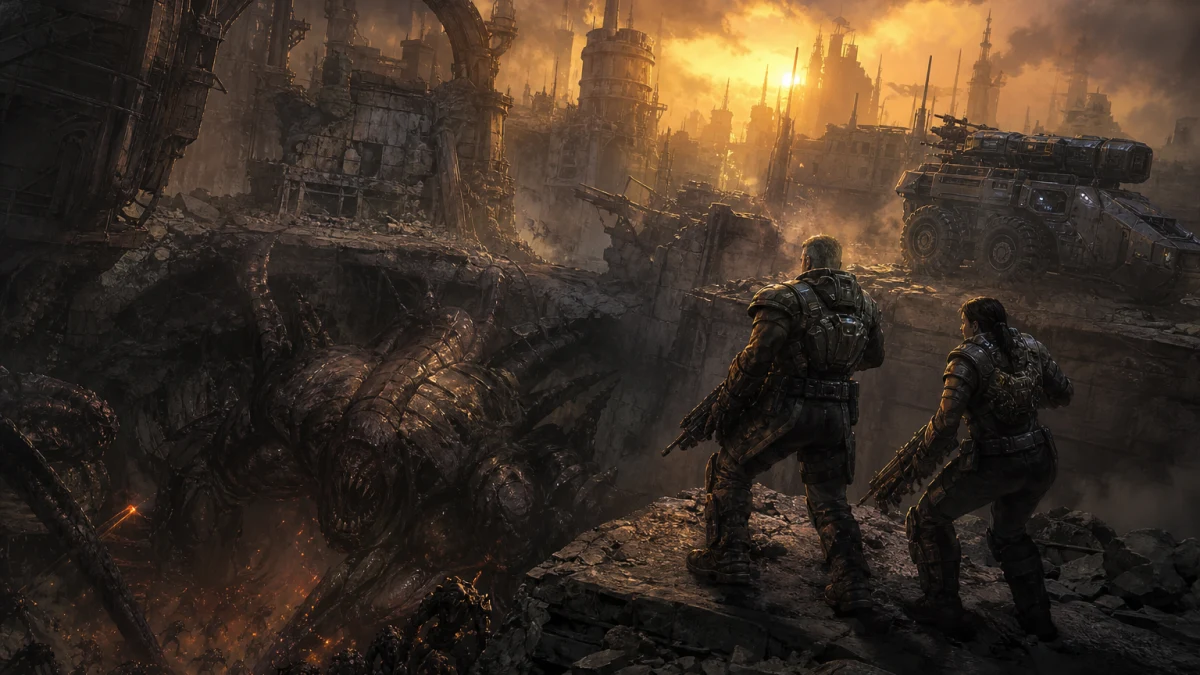
The entire E-Day campaign takes place in Kalona. That restriction produces concentrated geography rather than a tour of disconnected fronts. The city includes a stadium, industrial waterfront, airfield, residential neighborhoods and Imulsion refineries, allowing the campaign to move through civic, industrial, military and domestic spaces while staying inside one urban system.
The Coalition drew partly on Vancouver, its home city, for Kalona’s geography. Its visual identity also incorporates elements of 1970s New York and deliberately old-fashioned vehicles. These influences distinguish the period from later games without turning Kalona into an exact fictional duplicate of any real city.
An integrated setting lets landmarks acquire memory. A stadium, road or neighborhood can first appear as a functioning public space and later return damaged, militarized or abandoned. Deterioration becomes legible because the audience has already seen another state of the same place. The destruction means more when the lost civic function remains recognizable.
Mags and Lucas help provide a resident’s perspective. Official material establishes Mags as a refinery worker and Lucas as a communications cadet, while specialist post-launch coverage emphasizes their local knowledge. Marcus and Dom can assess a firefight, but they do not know every route or institution. Bravo Squad combines battlefield experience with urban familiarity.
Kalona works as a representative case of Sera’s catastrophe, but representative is an interpretation rather than literal equivalence. The city shows ruptured streets, overwhelmed institutions, frightened civilians, improvised defenses and increasingly organized attackers. It cannot tell the audience precisely what happens in every settlement during the same three days.
That limitation follows from the campaign’s perspective. E-Day does not leave Bravo Squad to supply omniscient briefings from every front. Information reaches Marcus, Dom, Mags and Lucas through movement, communications and encounters. The local lens preserves uncertainty at the cost of completeness.
The sources do not establish Kalona’s exact geographic relationship to Ephyra. It would therefore be inappropriate to label Kalona the capital, assign it an invented regional location or calculate Dom’s route home. The city’s verified importance comes from what happens there, not from an unsupported political rank or map coordinate.
Kalona’s campaign history should also be kept separate from multiplayer convenience. Competitive and Horde settings can reuse its streets, characters and visual identity without making every repeatable match an event in Bravo Squad’s chronology. Campaign scenes and explicit narrative statements carry the historical burden.
The setting’s variety performs a chronological function as well. Because the squad moves through connected districts over three days, changes in familiar spaces can mark the progression from surprise to organized defense and then desperation. That reading does not require every ruin to have one officially prescribed symbolic meaning.
Kalona is therefore both specific and incomplete. It has workers, officials, defenders and a distinct physical identity, so it is not generic scenery. It is also one local experience inside a catastrophe devastating Sera. Preserving both facts prevents the city from becoming either disposable background or an implausible substitute for the whole planet.
How Bravo Squad Forms
Bravo Squad consists of Marcus Fenix, Dom Santiago, Mags Carter and Lucas Reyes. The designation belongs to an improvised early-war unit, not a longstanding Pendulum Wars team. Marcus and Dom bring shared combat history; Mags and Lucas contribute different relationships to Kalona and military service.
Mags is a former Gear and Pendulum Wars veteran who works at an Imulsion refinery when the invasion begins. Her background bridges military and civilian life. She has the training to respond under fire, but she also has an occupation and community rooted in Kalona. The city is not merely a temporary battlefield to her.
Lucas is a young cadet and communications officer. He wanted battlefield experience but never reached the Pendulum Wars front. That distinguishes him from the squad’s three veterans without making him unnecessary. Communications expertise becomes especially important as command networks break and scattered defenders require information.
The four future squad members converge in plain clothes and run toward Wretches emerging from a ruptured road while civilians flee in the opposite direction. The image establishes a common instinct before command gives the group a formal identity. They become a functional team through action and an official squad through later processing.
Bravo Squad formally assembles at City Hall at the beginning of Act 2. That transition marks movement from spontaneous survival toward organized military response. City Hall records identities and next of kin, places the group within a chain of command and turns people who happened to resist together into a deployable unit.
Marcus and Dom remain the leading pair, but Mags and Lucas are not interchangeable extra weapons. Mags knows what combat costs and has already returned to civilian work. Lucas trained for a battlefield he never experienced. Their positions let the campaign examine the end of peace from perspectives other than those of its central veterans.
The squad’s construction mirrors Kalona’s emergency. Command combines whatever people and expertise remain available rather than waiting for an ideal formation. Improvisation should not be confused with incompetence. During first contact, adaptation is the beginning of usable doctrine.
Because this primer is spoiler-light, Mags and Lucas are not defined by their final outcomes. Their importance lies in their backgrounds, local knowledge and relationships throughout the campaign. Nor should Bravo be mistaken for a preliminary version of Delta Squad. Marcus and Dom later serve under different conditions with different companions. Within Kalona’s three days, Bravo is the unit through which this history is experienced.
- Marcus Fenix: experienced Pendulum Wars veteran and central protagonist.
- Dom Santiago: veteran balancing immediate duty with concern for his family.
- Mags Carter: former Gear and Kalona refinery worker.
- Lucas Reyes: communications cadet without Pendulum Wars front-line experience.
City Hall, Trench, Grey and the Mayor
Kalona City Hall becomes an improvised COG command center and medical triage site following the initial assault. Its civic function has to absorb military coordination and mass casualties simultaneously. The building becomes both a practical staging area and an image of institutions attempting to survive a disaster they did not anticipate.
Colonel Trench assumes military command in Kalona. His responsibilities push him toward operational priorities: organizing defenders, assessing threats and deploying squads. The mayor argues for civilian protection, creating tension between military and civic obligations. Neither concern is trivial. A city cannot protect its population without force, but a defense that forgets civilians risks preserving command while abandoning its purpose.
Captain Akila Grey oversees Bravo Squad’s processing and deployment. Her work gives the improvised group a formal position within the response. Processing can appear bureaucratic beside the chaos outside, but records, assignments and next-of-kin information are part of turning scattered survivors into accountable military formations.
The next-of-kin exchange anchors the central pair. Dom names Maria and asks about his family in Ephyra. Marcus names Adam Fenix. The difference does not mean Marcus has no meaningful family attachment or that Dom is less dedicated to immediate duty. It reveals the separate personal worlds each carries into the new war.
Adam’s identification as a noted veteran and creator of the Hammer of Dawn connects Marcus’s family to technology of enormous later importance. References to bringing the Hammer online must nevertheless be handled carefully. Discussion of capability or readiness does not by itself prove that the full later policy of surface strikes occurs during that City Hall scene or during Bravo Squad’s immediate mission.
City Hall also marks a transition from fear toward attempted comprehension. During the first night, attackers erupt into ordinary spaces before defenders have stable terminology or command. By Act 2, officials are gathering reports, naming units and issuing objectives. The enemy remains poorly understood, but resistance has acquired structure.
That structure is contested rather than seamless. Trench, Grey and the mayor hold different responsibilities because catastrophe produces competing demands. Soldiers require objectives and authority; medical personnel require resources; civilians require evacuation and protection; Dom wants information about Ephyra. The command scenes matter because they expose those priorities instead of presenting orders as context-free instructions.
Optional rescues or variable player choices should not be converted automatically into universal canon about how the civic-military dispute ends. The fixed historical layer includes City Hall’s function, the principal officials, their competing priorities and Bravo’s deployment. Flexible objectives demand narrower claims.
The dispute should not be reduced to competent soldiers against obstructive civilians, or the reverse. The verified setup supports a conflict among legitimate responsibilities rather than a complete moral verdict. Trench must defend a collapsing city, the mayor remains responsible for its population, and Grey must create usable units from the people available. Their friction shows why first-contact command is inherently unstable.
The Three-Day Shape of the Campaign
E-Day follows Kalona’s destruction across three days and nights. That is long enough for the emotional and military situation to develop, yet short enough to preserve the pressure of a city collapsing almost in real time. The span should not be forced into an unsupported hour-by-hour reconstruction, particularly because official descriptions alternately emphasize three days or three nights.
The first night is structured around confusion and horror. Marcus and Dom are in civilian clothing, Wretches emerge through ruptured streets, and familiar institutions have not established what is occurring. The threat can initially resemble a monstrous outbreak because the characters have not seen enough to recognize an organized army.
Day two brings regrouping. City Hall becomes a command and triage center, Bravo Squad formally assembles, and assigned operations replace purely immediate reactions. Organization is not the same as control. The COG can issue orders while still lacking a complete account of the enemy, Kalona or the wider catastrophe.
By the third day, the emergency can no longer plausibly be understood as an isolated urban disturbance. The attackers demonstrate language, tactics, armor and escalating force. Official descriptions frame this phase through desperation and recognition that a global war has begun. Kalona’s defenders are no longer trying simply to restore yesterday’s civic order; the world supporting that order is disappearing.
The public achievement list divides the campaign into five acts and includes the completion achievement Remember Kalona. That confirms the broad act structure, but concealed descriptions and titles are not substitutes for direct narrative evidence. Five acts do not establish which optional rescue succeeds, how every operation concludes or which supporting characters survive.
Detailed event discussion here stops around officially demonstrated Act 2 material. The later acts contain decisive reversals and final outcomes, so a comprehensive plot summary would require a clearly marked spoiler section. The broad description of the third day remains appropriate because the developers publicly outlined the emotional progression without requiring disclosure of individual fates.
The three-day structure distinguishes E-Day from campaigns set after years of accumulated doctrine. The original Gears of War begins after the COG and its soldiers have spent fourteen years learning the enemy’s patterns at enormous cost. Kalona captures the period before names, standard responses and expectations have solidified.
Acts and days measure different things. Acts are narrative and gameplay divisions; days describe elapsed fictional time. There is no basis for assuming that each act occupies equal hours or that every act boundary corresponds to sunrise or nightfall. Separating those structures prevents false precision.
The same restraint applies when comparing E-Day with Judgment. Judgment occurs in the immediate aftermath of Emergence Day, but the available sources do not synchronize every Kilo Squad operation with each hour of Bravo’s campaign. Relative placement is reliable. A detailed minute-by-minute merged schedule is not.
The three-day lens cannot explain every strategic event on Sera. It can show how rapidly an experienced society loses its assumptions. The movement from bar to ruptured street, from City Hall to organized missions and from local fear to recognition of global war supplies a coherent framework without converting the primer into a mission walkthrough.
First Contact: What Bravo Knows and What the Audience Knows
The first visible wave consists of Feral Wretches. They are fast, animalistic and horrifying, encouraging the impression that Kalona faces a creature outbreak. That impression belongs to the evidence available to the characters at the time. It is not the franchise’s final explanation of the Locust Horde.
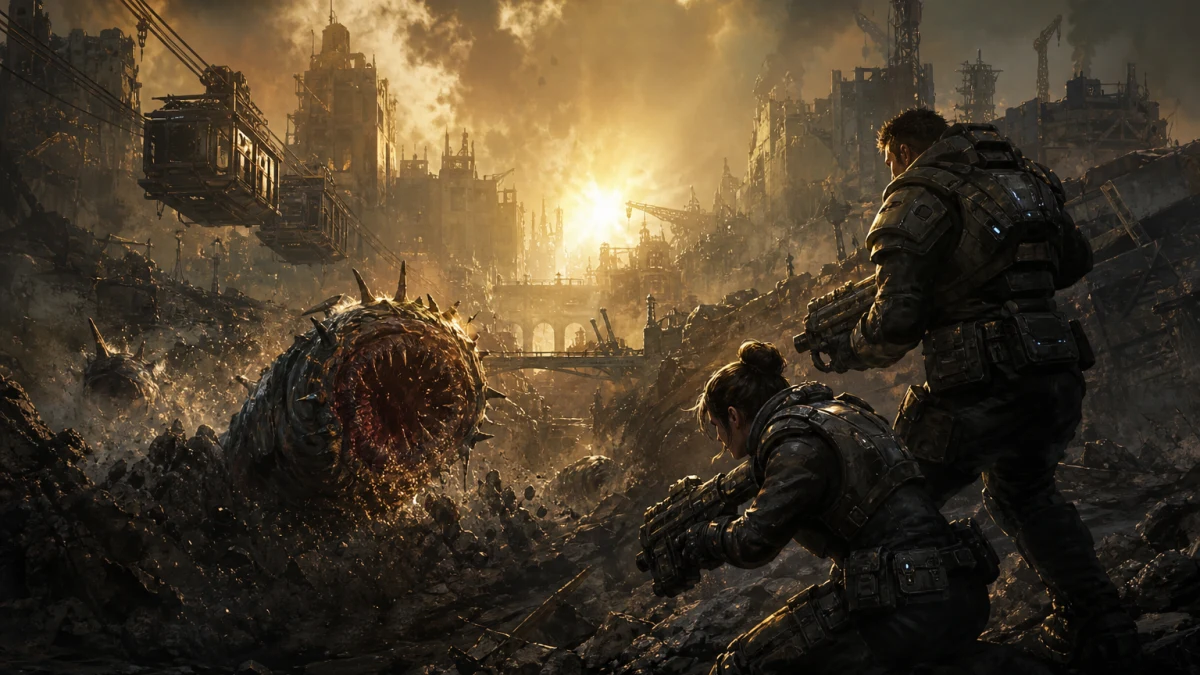
Armed Drones change the assessment. They carry weapons, speak and use tactics, demonstrating that the attackers are not a mindless mass. The transition from Wretches to Drones is therefore a revelation about organization. Bravo Squad discovers an army in stages rather than receiving a complete enemy dossier during first contact.
The squad assigns informal battlefield names to unfamiliar creatures, and those labels become established terminology. This is a practical feature of emergency communication: defenders need short, shared words before intelligence services can provide formal classifications. A useful name does not imply complete knowledge.
Escalation toward larger armored creatures, including Brumaks, makes the military scale harder to deny. What initially resembled predatory creatures in city streets becomes evidence of coordinated subterranean forces capable of fielding enormous combat assets. The sequence is designed to revise the characters’ understanding encounter by encounter.
The Locust should not be called extraterrestrial aliens. They emerge from beneath Sera, and Vraahk’s history includes the underground Lambent War. Characters may initially speak about unknown monsters, but the established setting does not describe an invasion from another planet.
Series veterans possess knowledge Bravo lacks. Later games reveal much more about Locust leadership, origins, the Lambent threat and major relationships within the conflict. E-Day can use dramatic irony because players may recognize a Wretch, Drone or Brumak immediately while Marcus meets it without inherited terminology inside the fiction.
That difference is not itself a retcon. A chronologically earlier character should know less than an audience that has followed later revelations. The continuity question is whether E-Day makes incompatible claims, not whether young Marcus can recite information he will learn years afterward.
Bravo’s restricted viewpoint also means its encounters cannot define the Horde’s complete order of battle. An enemy absent from Kalona may operate elsewhere. A locally coined name may spread. A commander confronting Bravo can be important without commanding the entire invasion. First contact supplies a fragment that later history expands.
Institutional knowledge will also be uneven. One officer receiving a report does not mean every unit across Sera instantly acquires the same classification. Distance, disrupted communications and the invasion’s speed prevent a perfectly synchronized encyclopedia. E-Day’s local naming process works precisely because catastrophe produces practical language before comprehensive understanding.
- Wretches create the initial appearance of a monster outbreak.
- Drones reveal speech, weapons and tactics.
- Battlefield names solve an immediate communication problem.
- Larger creatures reveal the attackers’ military scale.
- Bravo’s ignorance is not the same as audience ignorance.
- The Locust are subterranean, not extraterrestrial.
Vraahk and the Scorched Legion
Vraahk is E-Day’s major new Locust antagonist. The developers identify him as a Blight commander associated with the Scorched Legion. Those descriptions establish substantial authority within the Kalona campaign, but they do not define his exact position relative to Queen Myrrah, RAAM or every other commander in the Horde.
His history predates the surface invasion. Vraahk was injured during the underground Lambent War before emerging with the objective of destroying humanity. That detail gives him motives and scars rooted in a conflict Bravo does not yet understand. To Kalona’s defenders, he belongs to an unprecedented attack. To informed players, he demonstrates that the invaders bring an older war and established history to the surface.
The Scorched Legion is an elite force whose visual identity reflects Vraahk’s brutality. Spikes and self-mutilation echo its commander’s damaged appearance and violent character. The design communicates factional identity without requiring Marcus to possess a formal intelligence dossier during the first days of the invasion.
Vraahk helps personalize an otherwise overwhelming catastrophe. A planet-wide event can become dramatically abstract if no individual enemy exerts continuing pressure on the protagonists. A commander and recognizable formation give Bravo a recurring focus of hostility while leaving the wider Horde larger than one campaign.
Narrative prominence must not be inflated into supreme hierarchy. Official material supports identifying Vraahk as a Blight commander and the leader of the Scorched Legion. It does not support claiming that he alone planned or controls every Locust assault across Sera. Kalona is one theater, Bravo one squad and the Scorched Legion one force within a much broader invasion.
His injuries reinforce the distinction between audience and character knowledge. Later-series players understand that the Lambent reference connects to a major part of the saga. Bravo encounters consequences before comprehending the underground history that produced them. E-Day can connect to established lore for the audience while preserving uncertainty for its cast.
Because this primer remains spoiler-light, Vraahk’s final outcome is not part of the setup. His supported importance comes from his command role, underground past, hostility toward humanity and association with the Scorched Legion. Any definitive account of his fate belongs in a clearly marked ending discussion.
Vraahk also prevents the Horde from being misunderstood as a force that came into existence on Emergence Day. His old injuries and elite formation imply organization, conflict and history below the surface before Kalona is attacked. Humanity’s discovery of the Locust is not the beginning of the Locust’s own story.
Narrative role and military rank are separate categories. Vraahk can be Bravo Squad’s most consequential opponent without being the highest authority in the Horde. Maintaining that distinction preserves his importance while respecting the scale and hierarchy that the local campaign does not fully document.
Tai Kaliso and Other Links to Familiar Gears History
Tai Kaliso appears among Kalona’s defenders and has a substantial role in the campaign material. His presence connects the city directly to a character later encountered in Gears of War 2 and developed through the franchise’s comics. Newcomers can meet him as an early-war defender, while returning players bring knowledge of another stage of his life.
Tai demonstrates how early-war stories can overlap without merging into one squad. A soldier can defend Kalona, serve in other formations as the conflict develops and appear in a later campaign without every stage becoming one uninterrupted assignment. A war of this scale necessarily involves reassignment, changing units and personal histories crossing at different times.
That makes Tai more useful than a cameo included only for recognition. His participation gives E-Day a returning figure with established history while allowing Mags, Lucas and other new characters to remain central. He links periods without turning Bravo into an early version of every later team.
His appearance also shows the difference between publication order and fictional chronology. Gears of War 2 introduced many players to a later version of Tai first. E-Day now depicts an earlier part of his life. Chronological players see a future beginning; release-order players see a past recovered. The fictional sequence stays the same even though the audience’s information changes.
The comics form part of that bridge because they supplied Tai material beyond Gears of War 2. As with E-Day’s use of Aspho Fields, this does not mean newcomers must complete every tie-in before playing. It means the game is drawing from a wider established canon rather than treating only numbered games as relevant history.
Tai broadens Kalona’s range of veteran experiences. Marcus and Dom carry one shared Pendulum Wars history. Mags is a veteran who moved into refinery work. Lucas trained without reaching the front. Tai adds another military path. Grouping them all as Gears should not erase differences in background, responsibility or response to renewed war.
His presence does not establish that every future Delta member participates in Kalona. Damon Baird has an immediate-post-E-Day story with Kilo Squad in Judgment. The available evidence does not require Augustus Cole or every recognizable Gear to enter Bravo’s campaign. A shared era is not proof of a shared location.
Baird is the clearest reason for restraint. Importing him into Kalona without evidence would collapse two distinct perspectives merely to gather familiar names. E-Day gains historical scale by allowing multiple fronts to coexist. The same principle applies to Cole: later importance does not prove participation in these three days.
Selective continuity links are more effective than a cameo parade. Carlos connects the emotional premise to Aspho Fields. Tai connects Kalona to another established veteran. Adam’s name connects Marcus to a larger family and technological history. Each reference performs a distinct function instead of relying only on recognition.
A spoiler-light primer need not summarize Tai’s entire later arc. It is sufficient to establish his defense of Kalona and his later connection to Gears of War 2 and the comics. That preserves future discoveries for chronological newcomers while explaining the added weight experienced by returning players.
Tai’s inclusion is therefore evidence of historical overlap, not proof that E-Day contains the origin of every relationship in the original trilogy. He demonstrates how inherited characters and newly created histories can meet inside Kalona. Mags, Lucas and Vraahk add material; Tai carries established material into the addition.
This suggests a useful standard for evaluating other claimed appearances. Ask whether participation is explicitly established, whether the location fits known history and whether the connection performs identifiable narrative work. Familiarity alone is not evidence, and an absent character does not create a contradiction during a planet-wide catastrophe.
- Confirmed in E-Day: Tai is among Kalona’s defenders.
- Established later connection: Tai appears in Gears of War 2 and the comics.
- Not established: Baird, Cole or every future Delta member participating in Kalona.
- Continuity lesson: overlapping timelines do not require one shared squad or city.
- Spoiler boundary: Tai’s later fate is unnecessary to explain his E-Day significance.
The Chainsaw Lancer: Canonical Origin, Careful Terminology
The chainsaw-equipped Lancer is one of Gears’ defining images, but it is not an established standard weapon when E-Day begins. The period uses the Mark 1 Lancer, which has a detachable bayonet. That gives the invasion’s opening a different close-combat vocabulary and creates a practical need for adaptation.
E-Day depicts the origin of a prototype Chainsaw Lancer. Official material connects the initiating chainsaw to a hardware store, grounding the concept in emergency improvisation rather than presenting it as a mature anti-Locust weapon delivered through an established procurement program.
The practical logic is clear. Existing equipment was developed for human warfare. The Locust introduce bodies, armor and close-range threats for which old assumptions may be inadequate. Soldiers adapt tools already available because standardized manufacturing cannot solve a battlefield problem that appeared only hours earlier.
Terminology remains important. The Mark 1 Lancer, the improvised or prototype chainsaw weapon and the familiar later standardized rifle are related, but they are not interchangeable. E-Day can depict the key conceptual breakthrough without proving that every later mechanical specification, official designation and manufacturing decision is completed during one scene.
There is also a continuity distinction that cannot be reduced to narrative negative space. The Coalition said in its June 2026 podcast discussion that the relevant origin event occurred roughly a year later in the books and was moved into E-Day as a lift and shift. The game retains the broad hardware-store origin while revising when it happens and placing it within Bravo Squad’s Emergence Day experience.
That acknowledgment means the sequence should be classified as a deliberate continuity adjustment. It is not wholly new E-Day lore, because the broad origin existed already. It is not an untouched inheritance, because the timing and context changed. It is also not simply a gap that earlier canon left empty. The developers knowingly repositioned the event.
The evidence does not require either extreme verdict about that choice. It would be unjustified to declare the shift consequence-free merely because the basic hardware-store idea survives. It would be equally unjustified to claim that moving the event necessarily collapses the entire timeline. Assessing wider consequences requires comparing affected stories and later references rather than assuming them in advance.
The careful formulation is therefore that E-Day preserves the recognizable origin concept but revises its chronological placement. Readers discussing canon should identify both halves. Saying only that the game faithfully reveals an untouched origin conceals the change; saying it invents the hardware-store idea from nothing ignores inherited material.
Calling the scene the origin of the Chainsaw Lancer remains useful at the concept-and-prototype level. It should not be expanded into a claim that the final mass-produced weapon enters universal service immediately. A prototype can begin a historical process involving refinement, approval and distribution without completing every stage in Kalona.
Gameplay availability must not blur these distinctions. A multiplayer loadout, cosmetic model or player’s continuing access to a weapon does not establish when every fictional COG unit received it. Fixed campaign scenes and explicit narrative descriptions carry more chronological weight than cross-mode convenience.
The sequence ultimately illustrates why a four-part classification is more useful than a simple canon-or-retcon argument. The Mark 1 belongs to established period equipment. The prototype is concretely dramatized by E-Day. The hardware-store concept is inherited. Its move into the invasion’s first three days is an acknowledged adjustment. Claims about what the change means for the larger canon remain analysis.
That middle position is more precise than treating the scene as either disposable fan service or instantaneous creation of the final iconic rifle. E-Day depicts an improvisation that starts the weapon’s development while deliberately relocating an older origin event. Both facts are necessary to explain what the campaign contributes and what it changes.
- Mark 1 Lancer: existing rifle with a detachable bayonet.
- Hardware-store chainsaw: an inherited part of the broad origin.
- Prototype Chainsaw Lancer: concretely depicted within E-Day.
- Continuity adjustment: the event was moved from roughly a year later into Emergence Day.
- Later standardized rifle: related, but not proven to be finalized immediately.
- Interpretive question: whether the timing change creates broader consequences.
From Kalona to Judgment, Tactics and Gears 1
Kalona is the beginning of the Locust War, not a complete bridge to every later campaign. After Bravo Squad’s three-day perspective, the chronology moves among different units, locations and stages. Treating the series as one continuous camera following Marcus creates confusion whenever another entry changes protagonists.
Judgment sits closest to E-Day. It follows Damon Baird’s Kilo Squad in the immediate aftermath of Emergence Day. The retrieved official material does not synchronize every Judgment operation with each hour of Bravo’s three days, so relative language is safest. It belongs to the opening phase of the invasion rather than the period fourteen years later.
This parallel perspective illustrates the catastrophe’s scale. Bravo experiences Kalona while Kilo responds on another front. Neither account invalidates the other, and neither is exhaustive. Units can encounter different enemies, orders and institutional responses because communication and resources are unevenly distributed.
Gears Tactics moves approximately one year forward. Its campaign takes place before the COG’s planned use of the Hammer of Dawn against the surface. By then, the conflict has moved beyond first contact. Forces have accumulated enemy knowledge, and strategic decisions operate at a scale Kalona’s defenders cannot yet comprehend during the opening days.
The original Gears of War begins fourteen years after Emergence Day. Marcus is imprisoned and disgraced; Dom retrieves him and returns him to combat. That scene is not E-Day’s immediate epilogue. It reflects a long period during which the war, Marcus’s standing and his relationship with COG authority changed profoundly.
The gap prevents projection in both directions. Young Marcus does not need to behave in every scene exactly like the prisoner Dom later rescues. The older Marcus nevertheless carries the experiences and relationships formed before and during Kalona. A prequel adds value by showing what existed before familiar traits became hardened reputation.
For newcomers choosing an order, broad chronology runs through E-Day, Judgment, Tactics and then the original game. Release order creates a different experience, letting E-Day revisit causes after the original trilogy established many consequences. Neither order changes what is canon; it changes when the audience learns it.
Tie-in works complicate any exhaustive reading order because novels and comics can move among memories and periods. Aspho Fields has a focused role in this primer: it establishes Carlos, Aspho and the earlier relationship needed to understand E-Day. Listing every publication would add volume without improving Kalona’s placement.
The Hammer of Dawn provides a marker between phases, but each reference needs the correct scope. Adam’s connection to the weapon and early discussion about bringing it online belong to E-Day’s context. Tactics occupies a later point before planned surface strikes. Those facts do not compress every policy, deployment and consequence into one City Hall conversation.
The larger pattern is changing war knowledge. E-Day shows recognition beginning. Judgment presents another unit in the immediate early-war environment. Tactics belongs to a conflict with developed targets and strategy. The original game begins after fourteen years have turned improvisation into institutional memory. These games are related chapters, not consecutive missions in one operation.
The Rest of the Series in One Clean Line
Fourteen years after E-Day, the original Gears of War begins with Dom freeing Marcus from prison. Marcus returns to the campaign against the Locust and becomes associated with Delta Squad. The world now possesses years of fortification, enemy knowledge, doctrine and loss that did not exist during Kalona’s first night.
Gears of War 2 escalates humanity’s response into an all-out counterattack while cities are swallowed by the threat below. Its operations demonstrate how far the conflict has developed from improvised street defense. Tai’s later appearance also provides a personal connection across the intervening years without requiring every part of his life to occur beside Marcus.
Gears of War 3 concludes the original trilogy’s central struggle against both Locust and Lambent threats. E-Day’s reference to Vraahk’s underground Lambent War gains added meaning in light of that later conflict, but Bravo Squad must not be treated as knowing the trilogy’s explanations during first contact.
Gears of War 4 moves to a later generation led by JD Fenix, Kait Diaz and Del Walker. Its altered social setting and new enemy begin a saga shaped by the consequences of earlier wars rather than merely repeating Emergence Day. Marcus remains historically important, but the narrative center broadens.
Gears 5 shifts its central mystery toward Kait, her connection to the enemy and the danger that relationship poses to Sera. That storyline remains unresolved in ways E-Day is not intended to erase. The Coalition has explicitly said that creating the prequel does not abandon what Gears 4 and Gears 5 established.
E-Day should consequently be treated as additional context. It shows the initial wound whose effects later generations inherit. It can deepen Marcus and Dom’s relationship, the meaning of familiar equipment and the terror of the Locust without replacing the outcomes or unanswered questions of later games.
The clean main line is: the human Pendulum Wars; Emergence Day in Kalona; immediate early-war stories such as Judgment; Tactics approximately one year later; the original trilogy beginning fourteen years after the invasion; and the JD-Kait-Del era after that trilogy. Novels and comics move around this spine, supplying character history and parallel fronts.
The line is clean only at that scale. No single current official chronology located for this primer assigns exact calendar dates to every game, novel, recollection and downloadable campaign. Relative descriptions such as immediate aftermath, approximately one year later and fourteen years before are more responsible than invented precision.
E-Day’s status as a new mainline entry matters. It is not merely an isolated side story despite moving backward chronologically. It adds a foundational campaign to the main sequence while leaving later history in place. Mainline significance does not mean Kalona was the only decisive theater on Emergence Day.
The timeline also explains why later revelations should not erase early uncertainty. A player can know where the Locust-Lambent conflict eventually leads while accepting that Kalona’s defenders lack those answers. The series accumulates information across decades of fictional history; E-Day dramatizes a point when much of that knowledge did not exist on the surface.
Canon, Addition or Interpretation: A Reader’s Checklist
A reliable lore discussion begins by asking whether a claim existed before E-Day. Carlos Santiago, his relationship to Marcus and Dom, Aspho Fields, Dom’s family and the fourteen-year gap all have roots outside the new game. E-Day dramatizes or emphasizes them, but it did not invent every component of its own character foundation.
The next question is whether E-Day adds a previously undetailed event. Kalona, Bravo Squad, Mags, Lucas, Vraahk and the Scorched Legion substantially enlarge the record. Their novelty is not a contradiction by itself. A planet-wide war can contain cities, formations and commanders that earlier stories did not follow.
A third question is whether the game intentionally changes the timing or context of inherited material. The Chainsaw Lancer origin demonstrates why this category matters. Its hardware-store basis was already established, but The Coalition moved the relevant event from roughly a year later into E-Day. Calling that only an addition or only preserved canon loses essential information.
Interpretive claims deserve another label. Kalona can be read as a symbol of Sera’s collapse because connected districts let the audience watch civic life deteriorate. Marcus and Dom can be understood as reconstructing their brotherhood through shared action. Those are supported readings, but they remain readings unless a source defines every symbolic and emotional step.
Perspective resolves many apparent disputes. Bravo initially sees Wretches and does not understand the Horde. The audience may know far more from later games. The characters’ lack of information does not show that established Locust history disappeared; it shows that the story is respecting what these people could know during the opening hours.
Mode boundaries matter too. A mandatory campaign event or fixed cutscene has a stronger claim to settled history than a repeatable multiplayer match. Horde Siege, competitive maps, optional rescues and flexible gameplay systems may use canonical places and characters without making every possible result historical at once.
A missing explanation is not automatically a contradiction. Earlier games did not provide an hour-by-hour record of Marcus and Dom on Emergence Day, leaving room for Kalona. Contradiction requires claims that cannot both be true, not merely an older story’s failure to mention a newly detailed city.
Conversely, the phrase narrative negative space should not be used to conceal a documented adjustment. If developers say they moved an event from one period into another, the move should be acknowledged even when the broad concept remains intact. Honest classification does not require an exaggerated verdict; it requires stating what changed.
Precision in terminology prevents further errors. Vraahk is a Blight commander, not a confirmed supreme ruler of the Horde. The prototype Chainsaw Lancer is not automatically identical to every later production rifle. Kalona is a major setting, not a confirmed capital. Marcus and Dom are veterans, not rookies meeting for the first time.
Chronology and publication order also differ. A novel published after an early game can describe older events, while a prequel released after Gears 5 can become the earliest mainline campaign. Canon asks where events occur inside the fiction and how sources relate, not which product reached stores first.
Source type provides another filter. An explicit developer statement, fixed campaign event or official game description carries more weight than a retailer placeholder, fan timeline or theory based on visual resemblance. Specialist post-launch testing can establish matters such as public achievement structure, but it should be identified rather than silently promoted into an official master chronology.
The strength of a claim depends on scope. Confirming that Tai defends Kalona does not place every future Delta member there. Establishing that Vraahk leads the Scorched Legion does not give him command of the entire Horde. Showing a prototype does not settle every manufacturing detail. Many lore errors begin when a supported narrow fact becomes an unsupported universal claim.
Readers should distinguish what must happen from what can happen. Fixed cutscenes, mandatory transitions and explicit official summaries are candidates for settled history. Optional rescues, tactical variations and multiplayer combinations may represent possible play without fixing one outcome for the chronology. A mechanic’s existence is not always evidence of a unique historical event.
Used consistently, these questions make E-Day easier to place. The game inherits Carlos, Dom’s family and the fourteen-year gap; adds Kalona, Bravo Squad and Vraahk; deliberately adjusts the Chainsaw Lancer origin’s timing; and invites interpretation about grief, brotherhood and what one city represents. Those categories interact, but they should not be collapsed.
- Was the claim established before E-Day or introduced by it?
- Does a new detail conflict with old canon or fill an unobserved interval?
- Has inherited material been deliberately moved or recontextualized?
- Is the claim explicitly stated, visibly shown, specialist-tested or inferred?
- Whose knowledge is being described: Bravo Squad’s or the audience’s?
- Does the evidence come from a fixed campaign event, optional content or multiplayer?
- Is a narrow title, rank or prototype being expanded beyond the evidence?
- Has missing information been mistaken for contradiction?
- Has an acknowledged continuity adjustment been mislabeled as untouched negative space?
E-Day’s position becomes clearer once its different kinds of beginning are separated. It begins the Locust War on the surface, showing unknown creatures become recognizable as an organized subterranean army. It also begins a new phase of Marcus and Dom’s relationship—not by introducing them, but by forcing veterans divided by Carlos’s death to fight together again.
Kalona gives that transformation a concentrated stage. Across three days, an armistice memorial becomes a battlefield, City Hall becomes a command post, civilians and veterans form Bravo Squad, and a local emergency reveals itself as part of a planet-wide war. Mags, Lucas, Vraahk and the Scorched Legion add new history, while Carlos, Tai and Adam connect that history to established canon.
Not every part of the game fits the same continuity category. Much of Kalona fills previously undetailed space, but the Chainsaw Lancer sequence deliberately relocates an inherited hardware-store origin from roughly a year later into E-Day. Recognizing that adjustment does not require declaring it harmless or catastrophic. It requires describing the retained concept, revised timing and uncertain wider consequences accurately.
From Kalona, the timeline extends through Judgment’s immediate aftermath, Tactics about a year later, Marcus’s prison break fourteen years after E-Day, the original trilogy and the later Swarm saga. E-Day does not replace those stories. It changes how their foundations can be understood by showing the moment peace seemed possible, the ground opened and the partnership at the heart of Gears had to be chosen again.
Sources
- Gears of War: E-Day – Surviving the First Night of Emergence
- Rebuilding Brotherhood: How Gears of War: E-Day Renews a Legendary Franchise
- Reinventing a Mad World: Why Gears of War: E-Day Represents the Future of the Series
- Gears of War: E-Day Campaign – Brotherhood and Hope in a Hopeless World
- Gears of War: E-Day Campaign Hands On
- Gears of War: E-Day Gameplay Reveal Deep Dive
- Discover the Gears of War: E-Day Collector’s Edition
- Official Gears of War: E-Day Game Page
- Gears of War: Aspho Fields
- Gears of War: E-Day Campaign Review
- Gears of War: E-Day Achievements
- Official Gears of War: Judgment Game Page
- Gears Tactics Developer Blog: Characters
- Official Gears of War 2 Game Page
- Official Gears of War 3 Game Page
- Official Gears of War 4 Game Page
- Official Gears of War Franchise Home