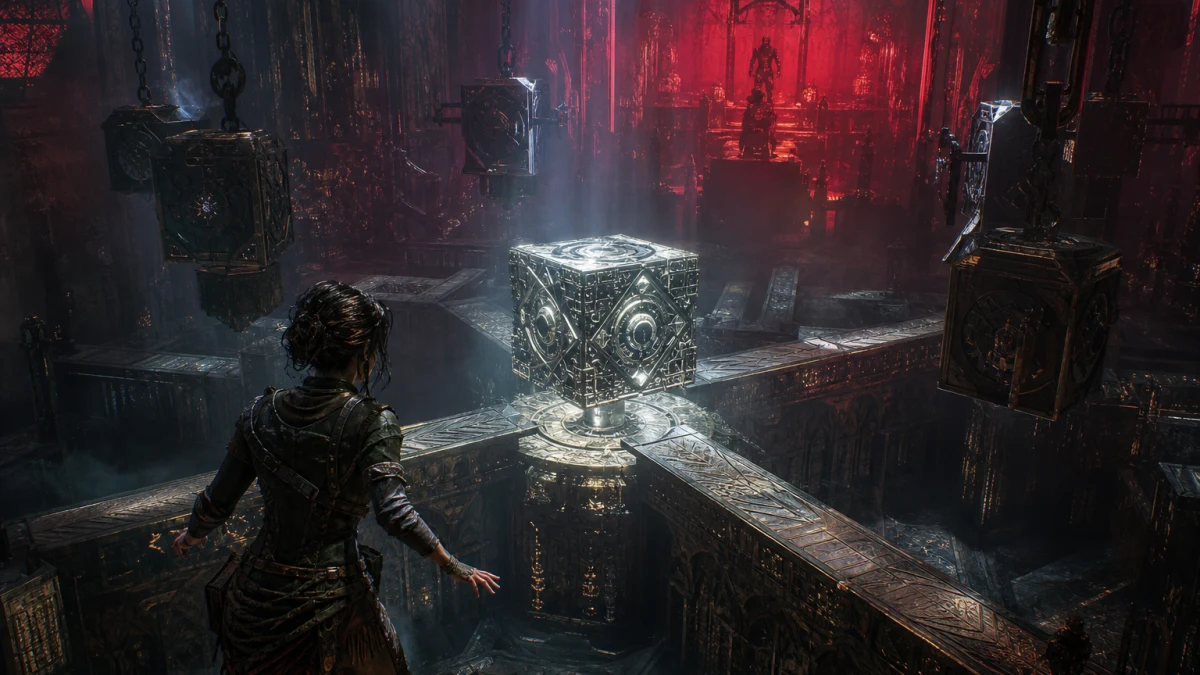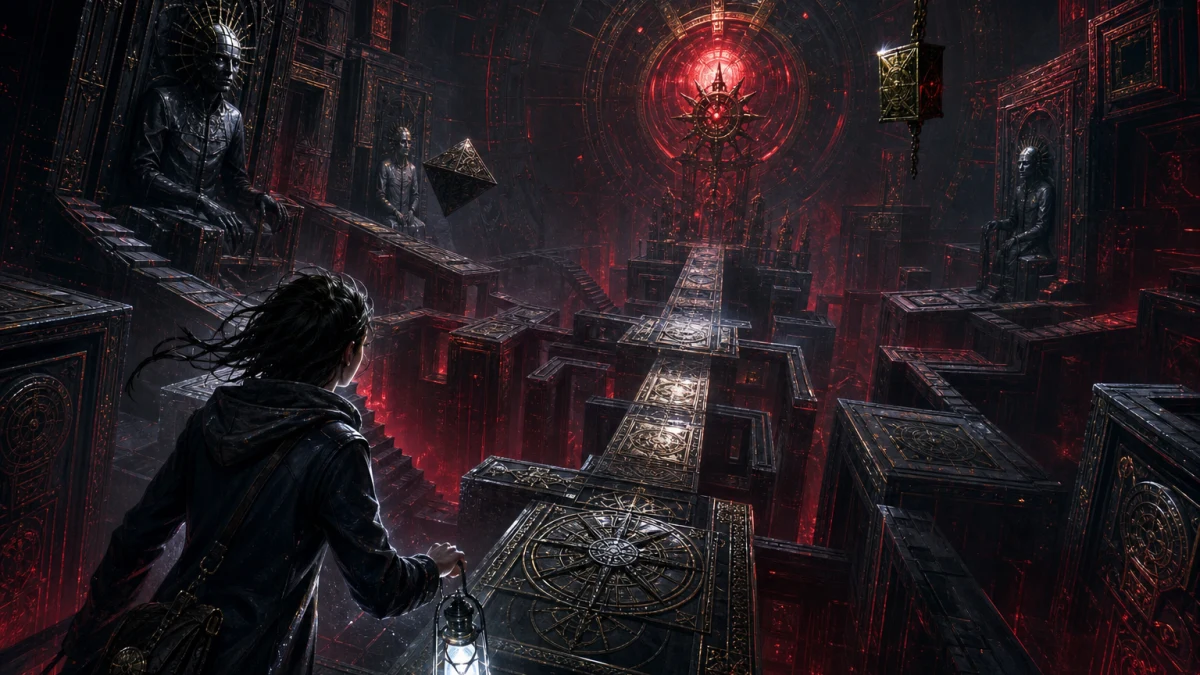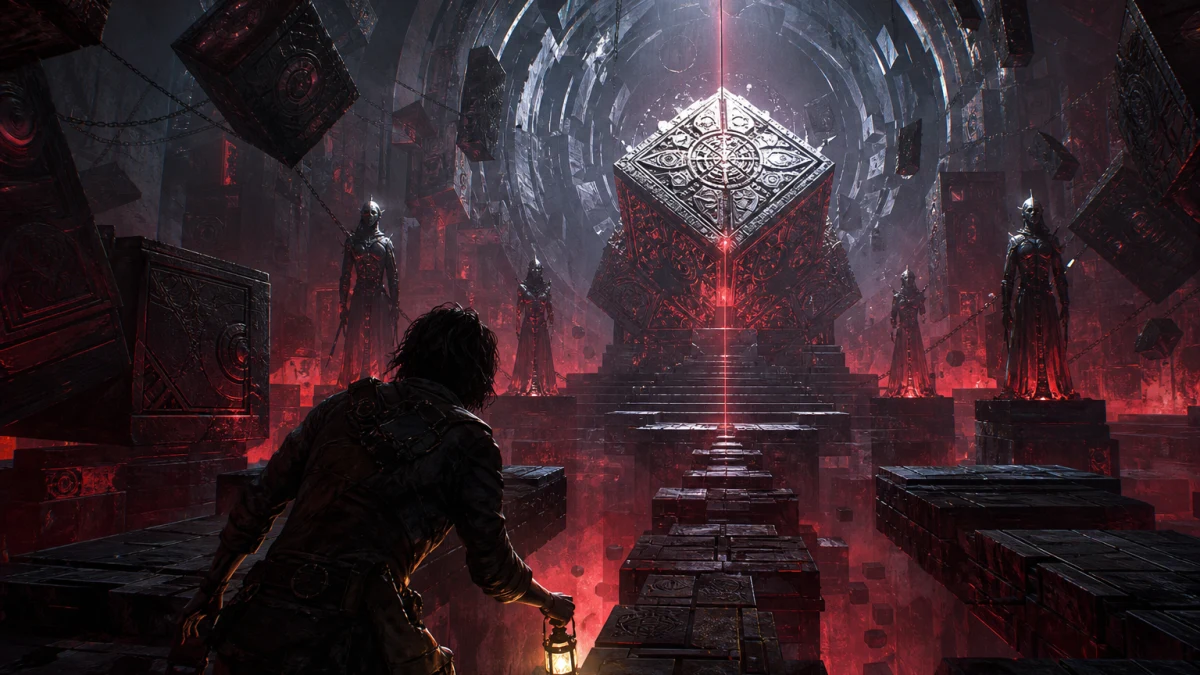
Clive Barker’s Hellraiser: Revival is not a game adaptation of the first Hellraiser film, even though its puzzle box, Cenobites, resurrection imagery and returning Pinhead make that an understandable first impression. Released on October 8, 2026, the single-player first-person action-horror game tells an authorized new story drawing most visibly from The Hellbound Heart, Hellraiser and Hellbound: Hellraiser II. Its human characters and principal conflict are new, while much of the supernatural framework around them is inherited and adapted.
That distinction matters because Hellraiser has accumulated films, prose works, comics and reinterpretations that do not fit neatly into one contradiction-free timeline. Revival does not require a theory capable of reconciling all of them. Its clearest foundations are Barker’s original story and the first two films, supplemented by new mythology designed for an interactive horror campaign.
This primer discusses Revival’s opening premise, including what happens to Sunny and why Aidan deals with Pinhead. Mid-game ritual details are introduced only after a separate warning, and the section covering the completed ritual and ending choices carries an explicit full-spoiler notice. The purpose is not to catalog every reference or offer puzzle solutions, but to distinguish what Revival inherits, what it transforms and what belongs specifically to the game.
Evidence note: This article distinguishes official game and franchise information from interpretation and post-release observation. The approximate 20-year placement and Clairport setting come from specialist post-release coverage. The three-heart structure, target identities, ritual details and ending choices are supported by post-release reporting and a reproducible specialist walkthrough rather than the central launch FAQ. The draft’s previous conflation of Charlotte Strauss with the Sister of Mercy has been corrected: the released-game walkthrough identifies Charlotte and the Sister of Mercy as separate heart targets, followed by Marlowe as the final target. Statements about thematic parallels, interactive adaptation and the meaning of the endings are analysis. No ending has been officially designated canonical, and Revival’s exact relationship to later films, prose, comics and the 2022 reimagining remains unspecified.
Spoiler Scope and the Short Answer on Continuity
The shortest accurate continuity description is that Revival tells a new Hellraiser story with established Hellraiser mythology. Official material says the game takes inspiration from the first two films while making clear that its plot is not directly connected to theirs. That permits Pinhead, Chatterer, the Cenobites, the Labyrinth and Leviathan to appear without turning Aidan Lynch’s campaign into a missing chapter of Kirsty Cotton’s story or a playable reconstruction of Frank Cotton’s escape.
The opening setup is discussed freely because it defines the advertised premise. Aidan’s girlfriend, Sunny, activates the Genesis Configuration and is torn apart when the Cenobites arrive. Aidan subsequently learns that her soul may still be recoverable. His attempt to restore her places him in a bargain with Pinhead and makes the Cenobites necessary participants in the rescue rather than monsters that can simply be avoided or destroyed. Those events establish the central question: what must Aidan become, surrender or desire to receive what he thinks he wants?
The first substantial spoiler boundary appears before discussion of the heart-gathering ritual and its named targets. A second, conspicuous boundary protects the conclusion of the campaign, including the final offering and the player’s choice to accept or deny what the Cenobites propose. Readers who only want enough context to understand Pinhead, the major factions and the inherited mythology can stop before the full-spoiler section without losing the primer’s basic argument.
Calling Revival an authorized canon story does not prove that every Hellraiser work occupies one seamless timeline. Canon can identify a licensed and creatively sanctioned addition without settling how it relates to every later sequel, comic continuity, novel or the 2022 reimagining. The official description is deliberately narrower: Revival is a new story rooted principally in the series’ early mythology.
That boundary is particularly important in a franchise where names, configurations, character histories and supernatural rules have changed between adaptations. A concept can be authentic to Hellraiser without operating identically in every version. Revival’s use of Leviathan, for example, can be authoritative inside the game without automatically rewriting a prose continuity that develops the mythology differently. A familiar design may communicate artistic lineage while saying nothing definitive about chronology.
Specialist post-release coverage places the game roughly two decades after the first film and identifies Clairport, north of Detroit, as its principal human setting. That provides useful atmosphere and approximate chronology, but it should not be converted into an exact calendar year merely by adding 20 to the film’s 1987 release date. A fictional chronology does not necessarily begin on a movie’s real-world premiere day, and the central continuity summaries do not define a precise in-world date.
Clive Barker’s involvement gives the adaptation unusual creative legitimacy. He was involved from early development and advised on visual style, story motifs, lore and character personalities. That does not mean he solely wrote every scene, codex entry or line of dialogue. It means Revival’s new material was developed with documented input from the creator whose ideas established the series.
Revival launched digitally on PlayStation 5, Xbox Series X|S, Nintendo Switch 2 and PC through Steam. Platform availability does not change the broad lore summarized here, although patches can correct subtitles, objective wording or codex text. Exact phrasing taken from an individual build should therefore carry less interpretive weight than stable plot events corroborated by official summaries and reproducible post-release documentation.
Readers consequently need neither complete franchise knowledge nor a comprehensive watch order. The Hellbound Heart and the first two films provide the relevant conceptual lineage. Everything else should be admitted only when the game explicitly invokes it, not because an incidental prop, familiar phrase or visual resemblance can be found elsewhere in the franchise.
- Safe before the full-spoiler section: the opening encounter, Aidan’s rescue goal, Pinhead’s bargain, the major factions and the inherited mythology.
- Protected later: the three marked hearts, completion of Sunny’s rebirth ritual and both ending choices.
- Continuity rule: early-film inspiration does not equal direct plot continuation or one unified timeline for every Hellraiser adaptation.
The Three Layers Readers Need to Keep Separate
Revival becomes easier to understand when its lore is divided into three layers. The first comes from Barker’s novella The Hellbound Heart and its first film adaptation. This is the foundation of forbidden sensation: a human seeks an experience outside ordinary limits, uses a puzzle box to reach the Cenobites, discovers that their categories of pleasure and pain are not human categories, and then tries to escape the consequences. Blood, desire, bodily restoration and an unstable boundary between attraction and horror all belong to that foundation.
The second layer was expanded most visibly by Hellbound: Hellraiser II. It gives greater shape to the domain behind the Cenobites, especially the Labyrinth and Leviathan. The first story is intimate and claustrophobic, with supernatural horror invading private space. Hellbound broadens the scale and asks what kind of order might exist beyond the opened doorway. Revival uses that expansion to provide geography, hierarchy and architecture suitable for sustained exploration.
The third layer consists of Revival’s inventions. Aidan Lynch and Sunny are game characters, not renamed versions of people from the novella. The Genesis Configuration is not merely another name for the Lament Configuration. Marlowe and the Scarlet Church belong to this campaign, as do the rejected seekers called the Unworthy. These additions turn recurring Hellraiser ideas into factions, objectives, enemies and tools that can support a full game rather than one contained film narrative.
Some elements sit between those layers because they are adaptations of old principles rather than wholly old or new. Puzzle-box contact with supernatural powers is inherited. A box that remains in the protagonist’s hands as an offensive implement, environmental key and recurring puzzle device is a game-oriented extension. Resurrection through material taken from other people has an unmistakable early precedent, while the particular heart-gathering ritual used for Sunny belongs to Revival.
This structure prevents thematic similarity from being mistaken for literal genealogy. Marlowe resembles earlier sensation seekers in his conviction that forbidden experience can lead to transcendence. That does not make him a relative, disciple or reincarnation of Frank Cotton. The Scarlet Church institutionalizes appetites that earlier stories often express through individuals, but it is not therefore a hidden organization retroactively operating behind the first film.
It also distinguishes source from function. The Labyrinth comes from Hellbound, but Revival’s designers must decide how a player navigates it, what can alter it and how often it intrudes into human space. Pinhead is inherited, but his specific relationship with Aidan is new. Cenobite transformation is an established possibility, while the Unworthy turn rejection from that transformation into a new factional identity.
Barker’s consultation does not collapse these distinctions. Creator involvement can validate a new interpretation while leaving earlier versions different. Hellraiser has repeatedly shifted details while returning to related ideas: desire that exceeds its object, flesh treated as mutable, and supernatural authorities that answer human requests on alien terms. Revival’s legitimacy lies in developing those ideas for a game, not in pretending it has uncovered one exhaustive rulebook that every prior installment secretly followed.
The distinction also protects Revival’s original contributions from being undervalued. Calling everything an old reference would miss how much narrative work Genesis, the Scarlet Church and the Unworthy perform. Conversely, calling every feature new would obscure why the resurrection plot, priestly Cenobites and hostile geometry feel recognizably connected to Barker’s earliest work.
The practical reading method is simple. Ask first whether a concept appears in the original foundation, in Hellbound’s cosmological expansion or only in Revival. Then ask whether the game preserves its earlier function or modifies it for interaction. Finally, distinguish an explicit rule from thematic analysis. That approach explains both fidelity and invention without forcing either into the other.
- Foundation: forbidden sensation, the box, Cenobites, bargains and blood-assisted restoration.
- Hellbound expansion: the Labyrinth, Leviathan and a larger Cenobite order.
- Revival additions: Aidan, Sunny, Genesis, Marlowe, the Scarlet Church and the Unworthy.
- Adaptation layer: inherited ideas given new mechanical or narrative functions.
The Hellbound Heart and the First Hellraiser Setup
The essential starting point is Frank Cotton’s dissatisfaction. Frank is not selected at random by a roaming killer. He actively pursues sensations that ordinary human life no longer seems able to supply. The puzzle box attracts him because it promises access to beings reputed to know experiences beyond familiar limits. His defining error is not simple ignorance of danger; it is confidence that he understands what an ultimate experience would mean.
The box provides contact with the Cenobites. In the original film material, the Lament Configuration opens the way to them and makes the human seeker available to their attention. It is therefore more than a locked container with treasure inside. Solving it is an act of communication and passage. A person manipulates an object in the human world, but the result crosses into another order of experience.
That distinction matters when approaching Revival. Puzzle solving in most adventure stories rewards intelligence with possession, access or safety. Hellraiser’s configuration makes successful manipulation dangerous because understanding the mechanism is not the same as understanding the answer. The solver may complete the physical sequence while remaining radically mistaken about what has been requested.
What arrives is not pleasure separated cleanly from pain. The Cenobites have moved beyond that distinction, or at least beyond the human version of it. Frank wanted unprecedented pleasure, yet the encounter subjects him to extremity that he experiences as torment. Hellraiser’s foundational reversal is that the request is fulfilled according to the provider’s categories rather than the requester’s fantasy.
That difference distinguishes the Cenobites from a conventional moral tribunal. Frank’s appetite and conduct can invite moral judgment from an audience, but the beings who answer him are not simply enforcing familiar rules against lust, greed or curiosity. They offer, administer and embody extreme experience. The horror emerges because the human seeker projects his desires onto powers that do not share his definitions or limits.
The first story’s conflict is consequently different from the structure of a masked killer selecting interchangeable victims. Desire initiates contact, and attempted escape keeps the supernatural transaction active. Human choices matter before, during and after the Cenobites’ arrival. The box does not absolve the humans who use it, but neither does it reduce the Cenobites to a punishment device operating under ordinary morality.
The story then becomes an attempted escape from a completed transaction. Frank returns incompletely when blood is spilled where remnants of him remain. Further blood permits the restoration of flesh. Resurrection is material, predatory and incremental rather than a clean return of an intact person. The desire to regain a body transfers the cost to other people, and the apparent miracle reproduces the selfishness that initiated the catastrophe.
The restoration process establishes several ideas Revival can reuse without copying the plot. The body is reconstructible rather than sacred and fixed. Identity can persist in some form after catastrophic bodily destruction. Returning requires material, and that material can be obtained through violence. Finally, resurrection does not cancel the original supernatural claim; rebuilding a fugitive body does not make the transaction disappear.
This pattern supplies Revival with more than imagery. A human reaches beyond ordinary life, contact occurs through a configuration, the resulting arrangement cannot be understood as a simple gift, and bodily recovery requires other bodies. Aidan’s motive is different from Frank’s: he wants to save Sunny rather than satisfy jaded appetite. Yet his rescue still draws him into a process in which love does not exempt anyone from cost.
The useful comparison is structural, not one-to-one. Frank is not Aidan, and Sunny is not a substitute for one of the first story’s women. Revival takes the older sequence of desire, contact, dismemberment, restoration and attempted renegotiation, then assigns it new participants and a different emotional starting point. The inherited question remains: once the Cenobites answer, can a human still control what the answer becomes?
Who Pinhead Is in Revival
Revival’s official material uses both Pinhead and the Hell Priest. Pinhead remains the immediately recognizable public name, while Hell Priest better captures his narrative office. He is not merely the strongest creature in a collection of monsters. He speaks for an order, presides over encounters and gives supernatural procedure the character of ritual. That role is crucial to a story organized around a bargain.
The familiar nickname and formal title serve different readers. Pinhead identifies the horror icon immediately, while Hell Priest directs attention away from treating him as a conventional slasher. The title implies doctrine, ceremony and an authority exercised on behalf of something larger. It makes his speech and offers part of the threat rather than pauses between physical attacks.
Doug Bradley’s return reinforces the connection to the early films. His voice and performance make Revival’s Pinhead aesthetically continuous with the version most closely associated with the first era of Hellraiser cinema. It also supports the game’s emphasis on measured authority: Pinhead can dominate a scene through certainty and interpretation rather than through the behavior of an ordinary pursuer.
Bradley’s involvement carries iconographic value as well. Voice, cadence and physical conception shape how audiences understand the character’s intelligence and composure. A returning performance can make new dialogue feel grounded in an established dramatic tradition even when the surrounding plot is not a direct continuation of an earlier screenplay.
Performance continuity is not the same as exact timeline continuity. Bradley appeared as Pinhead across several films, but his presence in Revival does not automatically make the game a direct sequel to every one of them. Official continuity guidance instead emphasizes a new story inspired by the first two films. The safest conclusion is that Bradley supplies an iconic performance bridge, not a universal chronological key.
Within Revival, Pinhead functions as a ritual authority, a bargaining party and a source of temptation. Aidan cannot reduce him to the final obstacle standing between hero and rescued companion. The Hell Priest possesses knowledge and access Aidan needs. That makes every apparent concession dangerous, because assistance from Pinhead can advance a design whose meaning Aidan does not yet understand.
This role preserves an important quality of the original Cenobites. Their threat comes partly from their ability to interpret human desire more radically than humans do. Pinhead does not need to deceive in the manner of a petty trickster if Aidan supplies his own assumptions. A promise concerning recovery, reunion or sensation can remain meaningful while concealing an unbearable difference over what those words entail.
The distinction between lying and alien interpretation is essential. A story about a fraudulent contract can be resolved by exposing hidden wording. Hellraiser is more unsettling when both parties understand the same words differently because their ideas of body, pleasure, salvation and identity are incompatible. Aidan may hear recovery and imagine domestic restoration; the Hell Priest can hear it as a stage in transformation.
The priestly title also places Pinhead below the idea of a total sovereign. Revival identifies Leviathan as the ruler of the Labyrinth and creator of the Cenobites in its own explanation of the order. Pinhead therefore has enormous authority without necessarily being the supreme source of the realm. He administers, interprets and tempts from within a larger cosmology.
That makes the familiar icon more effective than a simplified slasher version would be. A slasher can be resisted by escape, force or endurance. Revival’s Pinhead offers Aidan a framework in which resistance and cooperation may advance the same ritual. The danger is not only that the Hell Priest might kill him. It is that Pinhead might teach him to regard transformation as fulfillment.
What the Cenobites Want
The Cenobites are best understood as explorers and authorities of extreme sensation, not ordinary demons assigned to punish conventional wrongdoing. Barker’s original conception allows them to be perceived as demonic by some people and angelic by others. The ambiguity does not make them harmless or morally neutral from a human perspective. It means their identity cannot be exhausted by the language of punishment.
Revival’s developers describe them in similarly nonhuman terms and compare them to monks pursuing the boundaries of pain, pleasure and sensory experience. That monk analogy is an interpretation offered for the game, not a claim that they belong to a human religion. It emphasizes discipline, order and devotion. Their mutilated forms are not merely wounds inflicted in chaos; they signify a sustained vocation in which flesh becomes doctrine.
The comparison also distinguishes Cenobites from creatures driven only by hunger. They have practices, ranks and an apparent conception of worthy experience. Their composure suggests that bodily extremity is neither accident nor temporary injury. It has been incorporated into identity and office. What a human sees as unbearable damage can be treated within their order as revelation, vestment or achievement.
This explains why desire matters. Human beings approach the box with fantasies, grief, ambition or desperation. The Cenobites answer according to a system in which the seeker’s everyday distinction between wanted pleasure and unwanted pain may have little authority. An invitation that sounds metaphorical to a human can become literal bodily experience. A bargain made for one object can expose desires the speaker did not recognize.
Consent remains important but unstable. Hellraiser repeatedly draws power from the act of seeking, opening, asking or agreeing, yet different adaptations do not apply one simple legal rule to every encounter. It would be misleading to say that solving any configuration automatically proves moral guilt or gives the Cenobites identical rights in every continuity. Intent, knowledge and selection have not been handled uniformly across every Hellraiser work.
Revival focuses less on deriving a universal law than on Aidan’s continuing participation after the opening disaster. Sunny activates Genesis, but Aidan subsequently carries it, follows the ritual path and repeatedly uses Cenobite power. His sympathetic purpose does not make those choices unreal. The campaign can therefore explore consent as an accumulating process rather than a single switch thrown in the opening scene.
His motive may remain loving while becoming obsessive. As the rescue continues, the question shifts from whether he intended the original contact to whether he now accepts the logic and costs through which restoration is offered. Pinhead’s power grows wherever Aidan treats the next required act as separate from the whole design.
The Cenobites’ aims also differ from the Scarlet Church’s. Marlowe’s followers want access to an earthly paradise of extreme sensation. They project a human utopia onto the Cenobites, much as individual seekers have projected private fantasies onto them. The Cenobites operate according to their own hierarchy and ritual; they are not simply cult leaders granting believers the lifestyle they imagine.
Nor should the Cenobites be assumed to want indiscriminate destruction. Revival presents them as powers whose goals involve experience, transformation and ritual order. This does not make encounters safe or benevolent. It means a human may matter to them as a participant, candidate, subject or offering rather than only as prey.
This is why good-versus-evil language can obscure the story even when the Cenobites are plainly horrific to their victims. Revival is more interested in incompatible definitions of fulfillment. Aidan wants Sunny restored as he remembers her and wants himself to remain the person who loved her. Pinhead’s involvement raises the possibility that reunion, transformation and extremity are inseparable. The bargain becomes frightening because its parties may use the same words for fundamentally different outcomes.
From Lament to Genesis: Why This Is a New Box
The box associated with the original film is the Lament Configuration. Revival’s central artifact is the Genesis Configuration. Those names should not be exchanged casually. Available evidence treats Genesis as a distinct configuration introduced for the game, not as a universal renaming of the earlier box.
Both belong to the same broad mythological family: intricate artifacts whose manipulation can open contact with supernatural spaces and beings. That shared form explains why Genesis is immediately legible to a Hellraiser audience. It does not establish that all configurations are interchangeable, share the same history or produce identical results.
Calling every puzzle box the Lament Configuration would flatten one of Revival’s major adaptation choices. A configuration is not merely the franchise logo translated into an object. Its identity can matter to its function, the factions pursuing it and the ritual in which it participates. Genesis is named consistently enough to deserve treatment as its own artifact.
The names point toward different narrative emphases. Lament evokes grief and suffering, concepts inseparable from the first story’s consequences. Genesis suggests beginning, creation and rebirth. In Revival, that implication fits Sunny’s possible restoration and Aidan’s transformation. This is thematic interpretation rather than a complete official etymology; available background does not provide a definitive maker, artifact lineage or exhaustive relationship between Genesis and Lament.
Genesis can also refer to more than Sunny’s reconstructed body. It initiates Aidan’s encounter with a reality beyond his previous life, creates new conflicts among the factions seeking it and may prepare a new identity for its bearer. Creation in Hellraiser is not necessarily gentle or benevolent. Flesh can be remade through destruction, and a beginning can be experienced as the end of an earlier self.
Treating Genesis as distinct protects the story from an avoidable continuity mistake. If it were simply called the Lament Configuration under another label, its expanded powers might look like a retroactive rule imposed on every earlier appearance. As a new configuration, it can have functions designed around Revival’s campaign while remaining recognizably part of Hellraiser’s puzzle-box mythology.
Genesis first enables the catastrophic contact involving Sunny and the Cenobites. It then remains central to Aidan’s journey instead of disappearing once the doorway has been opened. Multiple parties pursue it because it offers access, power or a possible route to restored standing. The Scarlet Church wants to use it to reach the Cenobites, while the Unworthy see it as a chance to regain what Leviathan denied them.
The evidence does not justify a complete artifact genealogy. It does not establish who made Genesis, whether it predates Lament, whether one derives from the other or whether both are manifestations of a broader design. Those questions can be interesting without being answered. A lore primer should preserve the gap rather than fill it with rules imported from another film, comic or fan synthesis.
Its title is therefore not cosmetic. Genesis is the object through which the game organizes creation and recreation: the opening of a new story, the potential reconstruction of Sunny and the attempted remaking of human seekers. It also makes Aidan’s agency ambiguous. He wields the artifact, but every use keeps him connected to the order that made his quest possible.
The detailed list of combat powers, upgrade behavior and puzzle procedures belongs in the separate Genesis Configuration guide. For this lore primer, the important distinction is narrative: Lament establishes the classic act of contact, while Genesis adapts that tradition into an artifact accompanying the protagonist throughout an interactive bargain.
- Original film artifact: Lament Configuration.
- Revival artifact: Genesis Configuration.
- Supported conclusion: they are separately named configurations within related mythology.
- Not established: a complete maker, family tree or universal rule set for every box.
How Revival Changes the Box for an Interactive Story
In the foundational story, the puzzle box’s most important function is to initiate contact. Solving it crosses a threshold, and the resulting encounter drives the human attempt to escape or reverse what followed. Revival cannot rely on that single use alone because the player spends an entire campaign inside the consequences of the opening.
Genesis consequently remains with Aidan as a recurring tool. Official descriptions identify it as a source of supernatural offensive abilities that can be combined with ordinary human weapons. It also acts as a key for progression and can manipulate parts of the environment, especially where the Labyrinth intrudes upon familiar space.
This is an adaptation to interactivity rather than evidence that the original Lament Configuration always functioned like a weapon. A game asks the player to manipulate systems repeatedly, recognize recurring rules and make progress through resistant spaces. Giving Genesis multiple functions turns the series’ most recognizable object from an inciting prop into an interface between protagonist, player and supernatural realm.
That translation solves a practical narrative problem. If the box disappeared after the opening, the most distinctive Hellraiser artifact would have little direct presence during ordinary play. Keeping Genesis in Aidan’s hands allows the central mythology to remain involved in exploration and conflict rather than being confined to cutscenes or background documents.
Its environmental role is especially important. Revival uses distorted and repeated spaces to suggest that the Labyrinth is not passive scenery. Genesis lets Aidan respond to that architecture, but the response occurs in terms supplied by the same otherworldly system. He can open a path without demonstrating mastery over the power that designed it.
There is a difference between operating a mechanism and controlling its purpose. Aidan learns what actions produce immediate effects, just as a player learns a game system. That competence can create the feeling of ownership. The larger story undercuts it by asking whether Genesis is enabling his decisions or training him to perform a sequence designed elsewhere.
The box therefore helps him and implicates him at once. It can protect him against immediate threats, unlock routes and advance the rescue. Yet every successful use draws him deeper into Pinhead’s ritual and makes him more capable of operating within Cenobite logic. Mechanical empowerment becomes a narrative measure of entanglement.
That duality is more faithful to Hellraiser’s themes than a purely benevolent magical weapon would be. Objects that grant access do not simply obey human intention. Aidan may experience Genesis as equipment, while Pinhead can understand the same object as an instrument guiding a participant through a prescribed transformation. The player’s growing fluency does not settle which interpretation is correct.
The combination of ordinary weapons and Genesis also preserves Aidan’s divided position. He remains a human survivor using recognizable means of defense, but he increasingly depends on a supernatural artifact tied to the forces he fears. The two categories do not merge cleanly. Human resistance and Cenobite empowerment coexist in the same encounters.
This is why Genesis should not be discussed only in terms of combat efficiency. Its most important power is structural: it keeps Aidan’s rescue dependent on the source of his terror. He cannot leave the supernatural behind and pursue Sunny through ordinary means. The thing that caused the opening rupture becomes the thing he must carry, use and increasingly understand.
Revival thus changes the box without abandoning its core meaning. It still opens forbidden contact and fulfills desire on dangerous terms. The game extends that opening across the campaign, so each use can feel like another turn in a larger configuration whose final shape Aidan cannot yet see.
Aidan and Sunny: Revival’s New Love Story
Aidan Lynch is Revival’s playable protagonist, and Sunny is his girlfriend. Neither character comes from The Hellbound Heart or the first two films. Their relationship supplies a new emotional route into familiar mythology: instead of beginning with a seeker pursuing unprecedented pleasure, the game begins its sustained conflict with a survivor trying to recover someone he loves.
Sunny activates the Genesis Configuration, bringing Aidan into his first encounter with the Cenobites. She is torn apart during that opening supernatural event. Aidan initially struggles with whether the encounter was real, but the possibility of saving her soul transforms shock into purpose. The rescue becomes the organizing motive for the campaign.
The uncertainty about reality serves more than a conventional horror beat. It marks Aidan’s transition between an ordinary framework, in which Sunny’s fate appears impossible, and a supernatural framework that offers an equally impossible form of hope. Accepting that the Cenobites are real also means accepting that their proposed remedies might be real. Terror and hope enter together.
That motive distinguishes Aidan from Frank Cotton without placing him outside Hellraiser’s thematic territory. Devotion can become as consuming as appetite. A person convinced that love justifies any cost may begin treating the loved one as an object that must be restored, regardless of what restoration requires or what the restored person would choose.
Sunny’s condition divides identity into body and soul. The opening destroys the ordinary unity of the person Aidan knew. Learning that her soul may still be saved offers hope, but it also creates a problem: recovery of an immaterial essence does not automatically provide the familiar body, life or relationship he wants. The gap between rescue and restoration gives Pinhead room to define the terms.
That gap raises questions the campaign cannot answer merely by reconstructing flesh. Is the restored Sunny continuous with the woman who activated Genesis? Does saving a soul preserve agency, memory and desire? Can Aidan reclaim a relationship by rebuilding one participant through a ritual she did not design? Revival’s premise makes those questions unavoidable even when it does not reduce them to formal lore rules.
Aidan’s journey consequently invites several readings at once. It is an act of loyalty because he refuses to abandon Sunny. It is an obsession because each step can demand deeper participation in the system that harmed her. It is potentially possessive because the desire to bring back the exact relationship he remembers may outweigh questions about the price imposed on Sunny and others.
None of that requires Aidan to be secretly equivalent to an earlier character. Revival uses a recurring Hellraiser pattern rather than a disguised remake. Human attachment becomes the route through which supernatural powers reinterpret desire. The details are new, but the instability between wanting someone and wanting an idea of them belongs comfortably within Barker’s themes.
The first-person viewpoint strengthens this structure. The player is not simply observing someone make a dangerous bargain. Progress depends on carrying Genesis, entering distorted spaces and completing tasks that make Sunny’s restoration seem incrementally closer. Even without assuming that player and character share identical motives, the campaign makes forward movement resemble consent renewed through action.
Interactive progress can make the next step appear self-justifying. Once Aidan has survived one demand and paid one cost, abandoning the rescue would make that suffering feel wasted. The ritual benefits from this accumulating commitment. Pinhead need not persuade him anew at every stage if the desire to justify earlier choices keeps him moving.
Aidan and Sunny’s love story therefore provides both sympathy and danger. If the rescue had no emotional force, Pinhead’s offer would be easy to dismiss. If love guaranteed moral clarity, the ritual would carry no uncertainty. Revival works from the space between those positions, asking how far devotion can travel before it starts speaking the language of possession and transformation.
The New Bargain With Pinhead
Aidan does not respond to the opening by declaring a straightforward war on Pinhead. The official premise says he must bargain with the Hell Priest and survive that bargain. More importantly, the Cenobites are necessary to his attempt to recover Sunny. They possess the knowledge, access or authority through which her soul and body can be addressed.
This gives Aidan and Pinhead overlapping immediate interests without proving that they want the same final result. Aidan seeks reunion. Pinhead advances a ritual whose larger purpose includes Aidan’s experience and choices. Both can support the next stage of the journey while interpreting its meaning differently.
The arrangement continues one of Hellraiser’s central patterns: humans enter transactions they understand only through their own desires. A seeker thinks the box will provide pleasure. An escapee thinks restoration will undo the original cost. A rescuer thinks cooperation can be limited to the recovery of a loved one. The Cenobites expose the assumptions hidden inside each formulation.
Aidan’s bargain is especially dangerous because refusal has an obvious emotional cost. Walking away would appear to abandon Sunny when recovery may be possible. Pinhead does not have to make cooperation look safe; he only has to make it look like the sole alternative to irreversible loss. Desperation supplies leverage that a conventional contract could not.
It is tempting to describe the bargain as a simple agreement with a numbered list of clauses, but the available official summaries do not support that precision. Pinhead’s ritual is confirmed, as is Aidan’s rescue objective. The later need for three marked hearts is documented through post-release reporting and reproducible walkthrough material. That does not mean every promise, omission and condition can be reduced safely to one definitive legal text.
The more useful distinction is between stated task and inferred outcome. Aidan can know what must be done next without knowing what completing the whole sequence will make possible. Pinhead’s authority lies partly in controlling that horizon. Each completed demand narrows the psychological distance between Aidan and the final offer.
This creates a bargain built through procedure as much as speech. Every route opened with Genesis, every hostile space crossed and every ritual component acquired becomes part of Aidan’s performance. The transaction is not confined to one conversation. It extends through the campaign and changes its participant before final payment is discussed.
The bargain also prevents the campaign’s violence from becoming a simple cleansing operation. Human cultists, rejected seekers and Cenobite threats may oppose Aidan, but defeating them does not free him from Pinhead. Success can be precisely what the Hell Priest requires. The familiar game logic of overcoming obstacles is folded into supernatural ritual.
Genesis embodies that overlap. To Aidan it is the means of surviving and reaching Sunny. To the Cenobite order it can be the mechanism by which he is instructed, tested or transformed. The more competent he becomes, the less credible it is to imagine that he remains merely an outsider who suffered accidental contact.
Pinhead’s role should consequently be understood as more than quest giver or antagonist. He controls interpretation. Aidan sees separate practical problems, while the Hell Priest can see one continuous rite. The imbalance in knowledge allows Pinhead to assist without surrendering authority and to tell the truth without disclosing the whole meaning.
The new bargain is not frightening only because Pinhead might break his word. It is frightening because fulfillment may reveal that Aidan never defined his request completely. To restore Sunny’s body, save her soul and preserve their old human relationship are separate goals. A Cenobite answer can satisfy one while radically altering the others.
Resurrection: The Strongest Link to the Original Story
Resurrection supplies Revival’s clearest narrative link to the first Hellraiser story. Frank’s return begins when blood reaches what remains of him after his encounter with the Cenobites. Flesh is rebuilt through further human sacrifice. The process is physical and cumulative, making restoration inseparable from the consumption of other lives.
Revival reworks that principle around Sunny. Her soul remains potentially recoverable after her body is torn apart, so Aidan’s task is not simply to locate a missing living person. He must bridge the division between surviving essence and destroyed flesh. The possibility of rebirth is offered through a ritual controlled or interpreted by the same powers implicated in her destruction.
The game changes the procedure by organizing it around the hearts of three people marked by the Genesis Configuration. Post-release reporting establishes the three-heart structure, while a reproducible walkthrough confirms the targets’ place in progression. Aidan must take vital human material to build the conditions for Sunny’s bodily return.
The heart is an especially charged choice of material. Anatomically, it sustains the body; symbolically, it is associated with love, courage and inner identity. Aidan’s stated motive is love, yet the ritual turns other people’s hearts into components. The object conventionally used to represent his devotion becomes evidence of the violence that devotion authorizes.
This is not Frank’s resurrection repeated with different names. Frank’s return serves his own escape and appetite. Aidan acts in the name of another person and frames the violence as rescue. Sunny’s soul also matters explicitly, creating a distinction between reconstructing flesh and restoring the person who inhabited it. Revival borrows the principle that bodies can be rebuilt through other bodies, then changes the participants, procedure and professed purpose.
The adaptation intensifies the ethical pressure on Aidan. A resurrection powered by anonymous magic could preserve his image as an uncomplicated rescuer. A ritual requiring human organs forces love into competition with other lives. Each acquisition asks whether Sunny’s possible return has become an absolute value against which everyone else is expendable.
Marking by Genesis further connects the targets to the supernatural design. They are not merely a random supply of biological matter interchangeable with any other body. Their relationship to the configuration makes them elements of a selected process. That selection reinforces the possibility that Aidan is carrying out an authored ritual rather than improvising a rescue.
The rite also places resurrection and sacrifice inside the same causal chain. Aidan cannot treat Sunny’s return as a reversal of violence when violence provides its material. The reconstructed body will embody the costs used to create it. This is the old Hellraiser principle in a new form: restoration does not return anyone to a clean moment before the bargain.
It demonstrates why Pinhead’s assistance cannot be understood merely as useful information. The task reshapes the person performing it. Even if the ritual can restore Sunny, Aidan must arrive at its completion as someone who has accepted its methods. The final product may therefore be two transformations: Sunny’s reconstructed body and Aidan’s altered relation to violence, desire and Cenobite authority.
Mid-game spoiler warning: the next two paragraphs identify the first two marked-heart targets, but they do not reveal the final target, completion of the ritual or either ending.
Charlotte Strauss is the first named figure whose heart Aidan claims for Sunny. The game later sends him after the Sister of Mercy as a separate second target. These are distinct characters, even though post-release summaries that compress the target list can make their identities appear ambiguous. Their roles demonstrate how Revival converts resurrection from background lore into a campaign structure involving particular lives rather than anonymous ritual ingredients.
The distinction also clarifies the ritual’s escalation. Charlotte’s heart establishes what the bargain demands; the Sister of Mercy’s heart confirms that the act is a repeated procedure rather than an isolated emergency. By the time Aidan begins pursuing the final component, he can no longer pretend that the cost of restoring Sunny was an unforeseeable exception.
The inherited and invented elements should remain distinct. Blood-assisted flesh restoration comes from the franchise’s foundation. Sunny, the three marked hearts and the identities involved in Aidan’s ritual belong to Revival. Their relationship is adaptation rather than retroactive revelation: the game has built a new rite from an old idea.
The Labyrinth Before and During Revival
Hellbound: Hellraiser II expanded the early mythology by taking viewers further into the Cenobites’ realm. The Labyrinth transformed the supernatural beyond into something with scale, architecture and apparent order, while Leviathan supplied a commanding presence at its center. Barker described the sequel’s project in terms of exploring what the Cenobites were, what the box was for and what Hell represented within those films.
The expansion changed the implications of the first film. A doorway no longer opened only onto undefined supernatural punishment. It connected the human world to a realm with structure, inhabitants and a governing intelligence. The Cenobites could consequently be understood as participants in an order rather than isolated apparitions summoned independently by each solver.
Revival inherits that cosmological expansion because a game needs navigable space. Its Labyrinth is not confined to one final destination reached after the human-world story concludes. It bleeds into reality, interrupts familiar locations and makes the boundary between Clairport and the other realm unstable.
Officially demonstrated sequences use repeating rooms, distorted spaces and shifting routes to suggest that the Labyrinth is responding to Aidan or teaching him. Architecture becomes an active participant. A corridor can cease to be a neutral connection between rooms and instead function as an instruction, trap or test.
Repetition is particularly appropriate to a puzzle-box mythology. A configuration changes through ordered manipulation, revealing new relationships among familiar surfaces. The Labyrinth applies a similar principle to rooms and paths. Aidan can encounter apparently known space in a changed arrangement, as though he has entered a configuration large enough to walk through.
This is an effective translation of Hellbound’s imagery into interaction. Film can present impossible scale and disorientation through editing and composition. A game can require the player to inhabit repetition, notice changes and manipulate an artifact to continue. Revival turns the Labyrinth from witnessed spectacle into recurring spatial pressure.
The inherited setting should nevertheless be distinguished from the game’s layouts and rules. Hellbound establishes the broad realm and its association with Leviathan. It does not supply every room, environmental mechanism or puzzle convention used by Revival. Those are game-created expressions of the setting rather than lost scenes from the film.
The same distinction applies to interpretation. Developers describe the distorted architecture as responding to or instructing Aidan, but that does not necessarily mean every moving room possesses an individual consciousness. The safer conclusion is that the Labyrinth functions purposefully within the game. Whether that purpose comes directly from Leviathan, from Genesis or from the realm’s own nature can remain open where the story does not specify.
Genesis connects the layers. As an environmental key, it permits Aidan to alter mechanisms or reveal routes. Yet that apparent control occurs within a realm capable of changing around him. The box may let him answer the Labyrinth without allowing him to leave its conversation.
The interweaving of worlds also reflects Aidan’s changing status. If the Labyrinth existed only beyond a single threshold, he might imagine that ordinary life remained intact elsewhere. Its recurring intrusion denies that comfort. Once the bargain begins, human locations can be reorganized according to supernatural logic, just as human motives can be reinterpreted according to Cenobite ideas of experience.
Clairport therefore matters not merely as a setting contrasted with Hell. Its ordinary spaces become raw material for the other realm. The invasion demonstrates that Aidan cannot compartmentalize the bargain. There is no stable human side from which he can use Cenobite power at a safe distance.
Revival’s Labyrinth is both inherited geography and a game-specific storytelling system. It carries the visual and cosmological legacy of Hellbound while making repetition, navigation and environmental transformation part of Aidan’s education. The realm does not merely contain the Cenobites; it gives spatial form to their way of thinking.
Leviathan and the Cenobite Order
Leviathan is central to the larger cosmology Revival inherits from Hellbound. The second film made the Labyrinth more than an undefined hellish elsewhere and associated its order with Leviathan’s immense presence. It also developed the possibility that human beings could be remade into Cenobites, connecting personal transformation to an organized supernatural system.
Revival’s official explanation identifies Leviathan as ruler of the Labyrinth and creator of the Cenobites. That formulation is authoritative for understanding this game. It should not automatically be imposed on every novel, comic and film as though all versions have always expressed the hierarchy in identical language.
Attribution matters because Hellraiser’s mythology has expanded in several directions. Later works may give Pinhead, Leviathan or Hell different histories and relationships. Revival’s creators selected the early-film framework that supports their story. A reader can accept its account without treating it as a correction issued to every other adaptation.
Within Revival’s framework, the description clarifies why Pinhead can be enormously powerful without being the realm’s ultimate sovereign. The title Hell Priest implies service, office and ritual responsibility. Pinhead presides over Aidan’s bargain, but Leviathan stands behind the order that gives the priesthood meaning.
This makes Pinhead more than a subordinate monster while stopping short of identifying him as the supreme deity of the setting. A priest can exercise decisive authority over a participant while still serving a higher principle or ruler. The distinction explains how Aidan’s personal negotiations can belong to a cosmology much larger than either individual.
The hierarchy also explains the Unworthy. They are not simply people who failed to solve a puzzle correctly. They sought extreme experience but were rejected by Leviathan rather than accepted and transformed into Cenobites. Their existence suggests selection, judgment or suitability within the Labyrinth’s system, even though the complete criteria are not reduced to a public rulebook.
Human-to-Cenobite transformation is one of Hellbound’s most consequential additions because it destabilizes the boundary between victim and officiant. Cenobites need not be a wholly separate species arriving from outside humanity. At least some can be products of remaking. Revival builds on that possibility by making acceptance into the order something desired, denied and potentially pursued again.
Transformation does not necessarily preserve a human identity unchanged. Becoming a Cenobite implies bodily remaking and a new relation to sensation, hierarchy and purpose. The Unworthy’s desperation is therefore striking: they do not simply want power. They seek validation through a process that may abolish the selves doing the seeking.
The game does not need every later hierarchy to explain this. Importing ranks, histories or theological details from comics and later prose would create false certainty. Revival gives readers the necessary chain: Leviathan rules the Labyrinth and is identified as the Cenobites’ creator; Pinhead acts as a priestly authority; seekers may be accepted, transformed or rejected.
That order is alien but not chaotic. Rituals have stages, configurations have functions and status matters. The horror comes partly from discovering that the mutilation and impossible architecture are expressions of an intelligible system. Aidan is not wandering through random nightmare imagery. He is participating in procedures whose full purpose is withheld from him.
Leviathan’s importance is therefore less about replacing Pinhead as an immediate antagonist and more about scale. Pinhead can bargain personally with Aidan, while Leviathan represents the order into which that bargain fits. The Hell Priest offers the terms; the Labyrinth demonstrates their world; Leviathan signifies that both belong to something larger than one villain’s whim.
The Scarlet Church: Human Desire Organized
The Scarlet Church is a Revival creation led by Marlowe. It does not appear as an organization in The Hellbound Heart or the first two films. Its importance lies in turning a recurring individual impulse into a social institution: the desire to contact the Cenobites, exceed ordinary sensation and build a life around that pursuit.
Marlowe’s cult seeks contact through the Genesis Configuration. Its goal is an earthly paradise founded on extreme and debauched sensation. That ambition repeats Frank Cotton’s dissatisfaction on a larger scale. What was once the private quest of a jaded seeker becomes an organized program with followers, facilities, rituals and opponents.
The word paradise exposes the Church’s central assumption. Its members believe that Cenobite extremity can be translated into a human utopia. They treat access as the missing ingredient, as though sufficient devotion and technique will ensure that the experience matches their expectations. Hellraiser’s foundational reversal suggests why that confidence is dangerous.
A paradise is normally imagined as a place where desire and fulfillment agree. Cenobite contact threatens that agreement. If pain and pleasure no longer occupy separate categories, the cult’s promised utopia may be intelligible only to people who have ceased to share ordinary human limits. The Church wants the result without fully accounting for the transformation required to experience it as paradise.
Organization magnifies that error. An individual seeker can ruin a household; an institution can recruit, justify, discipline and repeat. Facilities and rituals allow appetite to acquire bureaucracy. The Church can turn private obsession into doctrine and treat anyone standing outside its goal as expendable material or opposition.
The Church should not be treated as a human branch of the Cenobite hierarchy unless the game explicitly grants it that status. Wanting contact is not the same as being authorized by Leviathan. Admiration is not membership. Marlowe’s followers can imitate forms, perform rites and pursue Genesis while still misunderstanding what the Cenobites are.
This distinction separates the Church from Pinhead’s motives. The cult wants sensation organized around human aspiration. Pinhead represents a supernatural order that may regard human categories of pleasure, paradise and selfhood as incomplete. Their temporary interests can converge around Genesis without becoming identical.
For gameplay and narrative structure, the faction performs useful work. A philosophical appetite becomes a material threat with places to infiltrate and people capable of resisting Aidan. It also provides human antagonists whose choices cannot be excused as automatic supernatural compulsion. They have built an institution around wanting what the box appears to promise.
Marlowe functions as an ideological counterpart to Aidan. Both men place an overriding desire at the center of their actions. Marlowe seeks collective access to extreme experience; Aidan seeks Sunny’s restoration. Their goals differ morally and emotionally, but both risk reducing other lives to material for the desired outcome.
Aidan can therefore oppose the Church without standing wholly outside its logic. He rejects Marlowe’s paradise, yet his rescue also depends on Genesis and on a willingness to make other lives serve a transcendent goal. The comparison does not make their motives equivalent. It shows how Hellraiser tests apparently different desires through the costs they authorize.
The Scarlet Church adapts Hellraiser’s concern with voluntary pursuit without pretending to be inherited lore. It asks what happens when the secret of the box becomes a movement rather than one person’s obsession. The answer is not simply more believers. It is hierarchy, infrastructure and violence constructed around the conviction that transcendence can be engineered.
The Unworthy: Hell’s Rejected Seekers
The Unworthy are another faction created for Revival. They once sought the extremes associated with the Cenobites, but Leviathan rejected them rather than accepting them into the order. They occupy an unsettling middle state: changed by pursuit, excluded from its promised destination and still governed by the desire to belong.
They pursue the Genesis Configuration because they see it as a possible route to redemption or renewed acceptance. Redemption here does not necessarily mean a return to ordinary humanity or moral repair. It means another chance to obtain recognition from the supernatural authority that denied them.
That inversion of redemption is central to the faction. In many stories, salvation would mean escape from Hell. The Unworthy seek validation from it. Their ruined condition has not taught them to reject the order that judged them; it has made the judgment more important. They want exclusion corrected, not the system escaped.
That motive distinguishes them from the Scarlet Church. Marlowe’s followers want to establish an earthly paradise through contact and imitation. The Unworthy already understand themselves through rejection by the Labyrinth’s order. One faction seeks entry as fulfillment; the other seeks reversal of a failed judgment.
Their existence adds a significant qualification to the mythology of seeking. Desire alone does not guarantee Cenobite transformation. A person can pursue extremity, make contact and still be deemed unsuitable. Revival therefore introduces scarcity and exclusion into what might otherwise look like an automatic progression from curiosity to Cenobite status.
The game does not fully publish Leviathan’s selection criteria, and that uncertainty should be preserved. Rejection could involve fitness, purpose, response to sensation or some rule inaccessible to human understanding. Treating the process like a transparent examination would give readers confidence the story does not support.
This gives Genesis another contested meaning. For Aidan it is the means of reaching Sunny. For the Scarlet Church it is access to the Cenobites and their imagined paradise. For the Unworthy it may be an appeal, credential or second doorway. The artifact unites the factions without giving them a shared goal.
Their pursuit of Aidan consequently differs from the Church’s agenda even when both groups obstruct him. The Church wants to realize Marlowe’s human project. The Unworthy want standing within Leviathan’s order. Genesis is valuable to each because it mediates contact, but their imagined destinations point in opposite directions: one toward an earthly system, the other toward acceptance by the Labyrinth.
The label Unworthy should not be generalized to every malformed creature or rejected seeker across the franchise. The developers’ explanation establishes this group and its origin within Revival. Other films and stories have their own monsters, transformations and failed subjects, and visual resemblance alone cannot prove they follow the same rule.
The faction also mirrors Aidan’s danger. The Unworthy have allowed supernatural judgment to define their identity so completely that they seek validation from the power that rejected them. Aidan begins with a human relationship as his purpose, but repeated dependence on Pinhead risks making Cenobite recognition equally decisive for him.
They also complicate any assumption that Cenobite status is merely a curse. From a human viewpoint, transformation appears horrific. To the Unworthy, it is an honor they failed to receive. Revival thereby sustains the angels-to-some, demons-to-others ambiguity through factional desire rather than abstract explanation.
In thematic terms, the Unworthy demonstrate that refusal by Hell does not restore a person to safety. Contact can leave desire intact while making ordinary life impossible. Their pursuit of Genesis is both strategic and tragic: they want the very system responsible for their ruined condition to tell them that the ruin has meaning.
Returning Figures and Visual Continuity
Doug Bradley’s Pinhead provides Revival’s strongest line of performance continuity with the early films. His return does more than supply a familiar voice. It reinforces the game’s choice to present Pinhead as composed ritual authority rather than a generic roaring monster. The recognition is aesthetic and dramatic even where precise chronology remains deliberately limited.
Chatterer also appears as a pursuing Cenobite associated with Labyrinth sequences. That presence connects the game to the early ensemble of Cenobites and reminds players that Pinhead is not a solitary species of villain. He belongs to an order populated by figures whose altered bodies express different forms of transformation.
Chatterer’s function is more immediate and physical than Pinhead’s bargaining role, but the distinction should not be turned into a complete rank chart unsupported by the game. The character demonstrates variety within the Cenobites and gives the Labyrinth a pursuing presence. Pinhead remains the figure through whom Aidan’s transaction is interpreted.
The early-film influence extends to atmosphere and cosmology. Labyrinth imagery, priestly procedure, configurations and the relationship between elaborate mutilation and ceremonial order place Revival close to the visual language established by the first two films. These elements help the new factions feel like additions to Hellraiser rather than interchangeable occult enemies.
Design continuity is especially useful in a new story because it communicates rules before exposition does. Ordered mutilation suggests intention rather than random decay. Geometric architecture suggests system rather than chaos. Pinhead’s composure suggests jurisdiction rather than animal aggression. Revival can then place its inventions inside that recognizable language.
Visual continuity must still be handled carefully. A returning design can establish recognition without proving that every event involving that design occurred in the game’s past. Chatterer’s appearance does not map Revival onto all later films, just as Bradley’s performance does not settle the status of each sequel.
The most useful returning elements are those that clarify the story. Pinhead explains the bargain’s priestly authority. Chatterer demonstrates that other Cenobites operate within the Labyrinth and can become immediate pursuers. Leviathan imagery explains the realm’s larger order. Incidental props or musical echoes may reward attentive fans but cannot bear the same continuity weight.
An Easter egg can operate at several levels: homage to a production design, recognition of audience memory, a thematic rhyme or an actual in-world connection. Only the last category has strong continuity implications, and it requires more than resemblance. Without explicit narrative support, recognition should not be upgraded into shared history.
That is why Easter eggs should not form the foundation of a canon theory. A reference can acknowledge another work without asserting that both narratives share every event. Revival’s official statement about inspiration and plot independence is stronger evidence than speculative interpretation of a background object.
Readers interested in incidental callbacks, visual references and concealed details are better served by the separate Easter-egg feature. This primer uses returning material only where it identifies a character, explains cosmology or demonstrates how the game anchors its inventions in early Hellraiser language.
Revival’s visual continuity ultimately creates familiarity without requiring literal repetition. The player recognizes the rules of temptation, ritual and altered flesh, then encounters new parties competing within them. That balance lets Pinhead and Chatterer feel like returning presences while Aidan’s bargain remains its own story.
What the Game Adapts, What It Invents and What It Leaves Unclear
The adapted foundation begins with puzzle-box contact. A human manipulates a configuration, contact with the Cenobites follows, and the resulting experience exceeds the human participant’s expectations. Revival also adapts the pursuit of extreme sensation, the instability between pleasure and pain, the danger of bargains and the restoration of flesh through material taken from other bodies.
From Hellbound, the game adapts the Labyrinth and Leviathan. It treats the otherworld as an ordered realm rather than a vague supernatural void, and it gives Cenobite transformation a place within that order. Pinhead functions inside the hierarchy as the Hell Priest, while Leviathan represents a larger source of authority.
Revival’s principal inventions are Aidan Lynch, Sunny, the Genesis Configuration, Marlowe, the Scarlet Church and the Unworthy. Clairport and the specific human-world conflict also belong to the game. None should be retroactively inserted into the novella or early films merely because they express familiar themes.
The Genesis Configuration’s expanded role is best classified as an interpretive extension. Its connection to supernatural contact is inherited, but its repeated use as weapon, key and environmental manipulation device serves the needs of an interactive campaign. Likewise, the Labyrinth is inherited while the recurring puzzle spaces, repeating rooms and specific route logic are Revival’s implementation.
Sunny’s resurrection occupies the same middle category. Blood-assisted flesh restoration has an early precedent, but the soul-and-body problem, three-heart structure and identities involved in Aidan’s ritual are new. The game is not revealing that Frank’s exact resurrection process secretly applied to every case. It composes a new rite from established thematic material.
The bargain itself is similarly divided. Bargaining with Cenobites, misunderstanding their terms and trying to renegotiate supernatural consequences are inherited patterns. The specific reason Aidan needs Pinhead, the steps he performs and the final offer made to him belong to Revival. Familiar structure does not make the details old canon.
The Scarlet Church adapts a theme rather than an organization. Voluntary pursuit of forbidden sensation comes from the foundation, but Marlowe’s institution is new. The Unworthy extend Hellbound’s interest in transformation by asking what happens to seekers Leviathan rejects, but no evidence establishes them as a faction already active in the first two films.
Several matters remain unclear. Official sources do not establish Revival’s exact relationship to every later film, prose work or comic series. The approximate 20-year placement offers broad context without proving a precise date. The full origin and maker of Genesis, as well as its complete relationship to Lament, are not supplied by the available official background.
Doug Bradley’s return does not answer those questions. It gives Revival a powerful connection to early-film Pinhead, but an actor can reprise a role in a new continuity or selective continuation. Performance is evidence of artistic intention, not by itself a timeline statement.
The 2022 film should be kept separate unless Revival expressly incorporates one of its rules. Its approach to configurations and rewards cannot be imported merely because it also uses puzzle boxes. The same caution applies to later novels and comics whose cosmologies may expand or revise Pinhead, Leviathan and the Cenobite order in other ways.
Barker’s involvement also has a precise boundary. His consultation on style, motifs, lore and personalities supports the authenticity of Revival’s interpretation. It does not establish that he personally authored every new faction or that every game-specific rule overrides versions developed elsewhere.
Finally, no Easter egg can resolve these uncertainties by itself. A recognizable image proves that the creators knew and referenced another work; it does not necessarily prove shared history. Revival is most coherent when read according to its declared foundation: a new story inspired by the first two films, using their mythology and adding game-specific material under Barker’s creative guidance.
- Adapted: puzzle-box contact, extreme sensation, bargains, resurrection, Cenobites, the Labyrinth and Leviathan.
- Invented for Revival: Aidan, Sunny, Genesis, Marlowe, the Scarlet Church and the Unworthy.
- Interactive extensions: an armed, reusable box and a recurring, manipulable Labyrinth.
- Unclear: exact links to later films, comics, novels and the 2022 reimagining.
Full Spoilers: The Ritual of Rebirth and Final Offer
Full ending spoilers begin here. Readers who want to discover the final ritual and choice without advance knowledge should skip to the concluding section.
Aidan’s heart-gathering quest eventually brings him to Marlowe, the third and final marked target after Charlotte and the Sister of Mercy. The cult leader is not merely an ideological obstacle by that point; he becomes part of the material required for the rebirth ritual. Aidan takes Marlowe’s heart and returns it to Sunny, completing the sequence of bodily offerings through which her restoration has been pursued.
Marlowe’s fate closes the conflict between two forms of overriding desire. He wanted Genesis as the route to a paradise of extreme sensation. Aidan wanted it as the route to Sunny. The cult leader ultimately becomes material for the rival project, an outcome that demonstrates how little control either human necessarily has over the configuration’s larger purpose.
That act resolves the long parallel with the original resurrection story. Human flesh has again become the material through which someone lost after a Cenobite encounter can return. The difference is that Aidan performs the gathering in the language of devotion. He has accepted a chain of deaths because the ritual presents them as the route back to Sunny.
Completion of the ritual does not make its costs disappear. Sunny’s restored body is inseparable from the hearts supplied to it, and Aidan’s identity is inseparable from his willingness to obtain them. Rebirth therefore answers the practical question of bodily return while intensifying the moral question of what the rescue has made.
Completion also does not end Pinhead’s interest. The final sequence culminates in a Cenobite offer that the player can accept or deny. The two outcomes are recognized by achievements titled Experience Beyond Limits for acceptance and Human After All for refusal. Those labels frame the decision around transformation and retained humanity rather than a simple victory or defeat.
Acceptance can be read as the culmination of Aidan’s education. He began horrified by what happened to Sunny, but the rescue required him to wield Genesis, navigate the Labyrinth, harvest the ritual’s components and operate according to Pinhead’s design. Saying yes acknowledges that the experience has made the Cenobites’ horizon desirable, or at least preferable to returning unchanged.
The acceptance outcome also reveals how a bargain can create the desire that fulfills it. Aidan did not begin by seeking sensation beyond human limits. Pinhead’s ritual exposed him to power, impossible spaces and escalating costs until the final offer could be understood from inside the experience. Temptation succeeds not by discovering an unchanged appetite, but by cultivating one.
Refusal asserts a boundary after extensive complicity. It does not erase what Aidan did or restore the innocence preceding Sunny’s activation of Genesis. Instead, it says that participation need not become final identification. The Human After All title emphasizes continued attachment to a human category that the Cenobites regard as limited.
That wording should not be mistaken for proof that refusal is morally pure. Aidan reaches the decision only after completing the ritual and paying its costs through other lives. Humanity in this context is not equivalent to innocence. It is a chosen limit maintained after exposure to the attraction of crossing it.
Neither outcome should be declared the official or canonical ending without a future statement from the rights holders or developers. Achievement names can guide interpretation, but they do not establish that acceptance is the true ending, refusal the good ending or either one the required basis for another story.
The choice recontextualizes Pinhead’s bargain. The ritual was not only a series of tasks needed to rebuild Sunny. It was also a path capable of preparing Aidan to receive an offer. Genesis helped him survive, but its deeper function was to keep him moving through experiences that changed what he might willingly choose.
That structure avoids reducing the finale to a boss confrontation. Pinhead’s most significant victory would not be overpowering Aidan. It would be bringing him to a point where the once-unthinkable promise of experience beyond human limits appears meaningful. Conversely, refusal matters because Aidan rejects that interpretation after learning its attraction from within.
The ending returns responsibility to the human participant without pretending the bargain was transparent. Pinhead controlled the ritual’s larger design, but Aidan’s repeated actions carried him to its final threshold. Acceptance and denial offer different answers to the same question: did saving Sunny preserve the person Aidan was, or create someone capable of wanting the Cenobites’ gift?
What Revival Ultimately Says About the Hellraiser Bargain
Revival’s story rests on a principle established at the beginning of Hellraiser: the box does not give a human the simple outcome imagined at the moment of desire. It opens contact with an order that has its own categories, rituals and purposes. The request may be answered, but the answer changes the meaning of the request.
Aidan’s case makes that principle unusually sympathetic. He does not begin as a thrill seeker bored by ordinary experience. He wants Sunny back. Yet Hellraiser’s mythology does not grant moral immunity for loving motives. Rescue can become obsession, and devotion can authorize costs that transform the rescuer.
The difference between Aidan and Frank therefore matters without dissolving the parallel. Frank’s initial appetite makes his miscalculation easier to condemn. Aidan’s grief makes cooperation understandable. Both nevertheless assume that personal desire can define the limits of a supernatural transaction. The Cenobites answer that assumption rather than merely the request.
The Genesis Configuration captures the ambiguity. It is Aidan’s weapon, key and route through impossible spaces. It is also the mechanism by which Pinhead’s ritual advances. Every use appears to increase Aidan’s agency while drawing him further into a design he did not create.
Interactive form sharpens the contradiction. Progress usually means gaining power, understanding systems and overcoming resistance. Revival allows those achievements to serve Pinhead’s purpose. Mastery at the level of play need not equal freedom at the level of story. The more effectively Genesis is used, the more completely its bearer may be performing the configuration’s larger function.
The Cenobites are most effective in this story when understood as tempters, authorities and alternative interpreters of experience rather than conventional bosses. Their threat cannot be defeated solely by greater force because they operate through desire. They ask what the human participant will call salvation after enough exposure to their world.
The Scarlet Church and the Unworthy show two failed forms of that desire. The Church assumes extreme sensation can be organized into an earthly paradise. The Unworthy allow rejection by Leviathan to define their existence and seek another chance at acceptance. Aidan travels between those examples while insisting that his own pursuit is only about Sunny.
His insistence remains meaningful, but the ritual tests whether motive alone can contain consequence. Aidan may begin from love, yet the acts demanded by resurrection have effects independent of his intention. Hellraiser’s bargains are frightening because sincerity does not control interpretation, and good intentions do not make supernatural procedures morally simple.
The final offer tests the claim that Aidan has remained outside Cenobite desire. Acceptance suggests that the journey cultivated a new appetite beneath the rescue. Refusal suggests that humanity can still be chosen after compromise, violence and supernatural instruction. Neither outcome turns the preceding acts into a clean moral fable, and no official source designates one as canonical.
Revival consequently does not need to retell Frank Cotton’s story to remain connected to it. Frank asks for sensations beyond ordinary life and misunderstands the answer. Aidan asks for restoration and risks misunderstanding what must be restored, what may be transformed and who the ritual is ultimately meant to remake.
The new factions reinforce rather than replace that old structure. Marlowe gives individual appetite an institution. The Unworthy reveal that Hell’s acceptance can itself become an object of longing. Sunny’s divided body and soul make resurrection a question of identity, while Genesis turns contact into a sustained course of instruction.
The game’s central bargain is therefore larger than an exchange between Aidan and Pinhead. It involves competing definitions of love, recovery, paradise, redemption and experience. Each faction thinks Genesis can deliver the object it values. The configuration instead draws those desires into a system whose final meaning belongs to the Cenobite order.
That is Revival’s place in Hellraiser lore. Its characters, factions and configuration belong to the game, while its deepest structure comes from Barker’s original reversal: humans approach the threshold believing desire tells them what they want, and the Cenobites answer by showing how little they understood the terms.
Clive Barker’s Hellraiser: Revival is best read as a new branch grown from the franchise’s earliest roots, not as a direct game version of Hellraiser or a bridge automatically reconciling every sequel. The Lament Configuration, Frank’s pursuit, blood-assisted resurrection, the Labyrinth and Leviathan supply the foundation. Aidan, Sunny, Genesis, Marlowe, the Scarlet Church and the Unworthy are the game’s additions.
Its central adaptation choice is to make the puzzle box a companion to the protagonist rather than a one-time trigger. Genesis gives Aidan practical power while keeping him inside Pinhead’s ritual. That contradiction joins gameplay to lore: progress toward Sunny can also be progress toward the Hell Priest’s intended offer.
The result preserves the idea that makes the Cenobites more unsettling than ordinary monsters. They do not merely obstruct human desire. They interpret it, fulfill it according to alien categories and invite the seeker to regard transformation as revelation. Revival’s final question is therefore not whether Aidan can overpower Pinhead, but whether his attempt to save Sunny has taught him to want what once terrified him.
Sources
- Clive Barker’s Hellraiser: Revival FAQ
- Clive Barker’s Hellraiser: Revival on Steam
- Clive Barker’s Hellraiser: Revival – Answering the Deep, Dark Questions
- Announcing Clive Barker’s Hellraiser: Revival – Horror That Doesn’t Hold Back
- Explore Horror’s Furthest Sensations in Clive Barker’s Hellraiser: Revival
- Inside the Brutal Puzzles of Clive Barker’s Hellraiser: Revival
- The Official Clive Barker Website – Hellraiser Screenplay
- The Official Clive Barker Website – Clive on Hellraiser
- The Official Clive Barker Website – Anatomy of a Scene: Hellraiser
- The Official Clive Barker Website – Hellraiser II
- The Official Clive Barker Website – Interviews 1988, Part Two
- Clive Barker’s Hellraiser: Revival 100% Walkthrough
- Clive Barker’s Hellraiser: Revival Review – Creative Bloq
- How Hellraiser: Revival Adapts the Twisted Horror Franchise
- Clive Barker’s Hellraiser: Revival – Official Cenobites Developer Diary