By Darryl Polo
Castlevania: Belmont’s Curse arrives on October 15, 2026, but its public demo and Konami’s pre-release material already establish the broad shape of its action. Rose’s Vampire Killer is more than a traditional whip attack: it can carry her through traversal routes, pull her toward enemies and connect movement directly to offense. Around that central mechanic sit wall jumps, slides, evasive actions, seven weapon categories, boss-derived Arcana, passive Relics and several overlapping recovery resources.
Those pieces support a meaningful systems analysis, but not a final verdict. The downloadable demo is explicitly the opening chapter, and Konami warns that its features and content may be restricted. Controlled preview sessions also came from pre-release builds that may not match the October launch version in every detail. This reference therefore distinguishes official confirmation from mechanics reported by specialists, and it treats broader conclusions about builds or level design as informed interpretations rather than settled facts.
The result is a picture of an authored 2D action-exploration game whose combat and platforming appear designed to reinforce each other. What remains unknown is equally important: the complete weapon roster, late-game traversal vocabulary, overall difficulty curve, final progression balance, character-stat depth and endgame build variety cannot be established from an opening chapter or a few controlled sessions.
Evidence note: Fact-checked against current official and specialist material available on October 10, 2026. This pre-launch reference combines official Konami descriptions with documented public-demo observations and specialist reporting from controlled pre-release builds. Specific controls, weapon properties, boss interactions, Arcana upgrades and Relic effects reported from previews may change in the launch version. Interpretive conclusions about system relationships are presented as analysis rather than confirmation; final balance, complete inventories, progression depth and endgame build diversity remain unverified.
What This Analysis Can and Cannot Establish Before Launch
This article is scheduled for October 12, three days before the verified October 15 release of Castlevania: Belmont’s Curse. It is consequently a pre-launch systems reference, not a review of the complete game. No conclusion here should be read as a campaign-wide judgment about balance, pacing, difficulty or the durability of its progression systems. The useful task before release is narrower: identify what Konami has confirmed, explain what public and controlled demonstrations show, and mark the point at which interpretation begins.
Three evidence layers matter. The strongest is Konami’s own description of the game and demo. That material confirms the 2D action-exploration structure, the dual combat-and-traversal purpose of the Vampire Killer, seven weapon categories, boss-derived Arcana and Relics with combat or exploration benefits. It also establishes that the public demo represents the opening chapter and can transfer progress under specified conditions. These statements define the game’s advertised structure, although they do not answer every mechanical question.
The second layer consists of mechanics accessible in the public demo. Public availability makes the opening easier to inspect than an invitation-only build, but it still does not transform the demo into the final game. It can reveal the early control vocabulary, introductory weapon behavior, basic encounter cadence and the first applications of whip traversal. It cannot demonstrate systems that are deliberately withheld, acquired later or rebalanced for launch.
The third layer is controlled preview reporting. Specialists who played longer pre-release segments described weapons, bosses, Arcana upgrades, Relic effects and traversal situations extending beyond the public opening. Those reports are useful because multiple accounts converge on many of the same mechanics. They remain reports about unfinished builds, however. Button assignments, numerical balance, upgrade rates and specific interactions could change before release or through a launch update.
Konami explicitly warns that content and features may be restricted in the demo. That warning blocks a common but unreliable inference: if an option, movement ability, weapon type or progression menu does not appear in the opening chapter, its absence there does not prove that it is absent from the full game. The reverse also requires caution. An early mechanic’s presence does not establish how strong it remains after dozens of upgrades or against later enemies.
The material supports analysis of design relationships more confidently than analysis of balance. The whip demonstrably connects combat with movement. Arcana demonstrably connect boss victories to new actions. Relics and weapon perks demonstrably provide some customization. Yet the evidence does not establish dominant builds, mandatory upgrades, optimal resource loops or whether one weapon category eclipses another late in the campaign.
Campaign-wide progression and endgame systems therefore remain outside scope. There is no verified basis here for stating a level cap, defining a loot rarity ladder, describing respec rules, calculating grind requirements or ranking final builds. Even the label “role-playing game” needs qualification: Konami presents Belmont’s Curse as 2D action-exploration, while its demonstrated equipment and upgrade systems supply lighter role-playing elements.
The appropriate pre-launch conclusion is not whether the entire game succeeds. It is whether the demonstrated systems form a coherent mechanical proposition. On current evidence, that proposition centers on quick movement, positional combat and abilities that retain value across fighting, traversal and exploration. The public demo lets prospective players test part of that proposition themselves, but only the released game can establish how fully it develops.
- Confirmed by Konami: release timing, demo scope, whip functions, seven weapon categories, Arcana and Relics.
- Demonstrated or reported from pre-release builds: specific weapon perks, dodge behavior, Arcana upgrades and individual Relic effects.
- Not established before launch: final balance, complete inventories, late-game difficulty, stat depth, respec systems and endgame builds.
The Demo Boundary: An Opening Chapter, Not a Vertical Slice of Everything
Konami released the public demo on October 1, 2026, for PlayStation 5, Nintendo Switch, Xbox Series X|S and Steam. Its availability across the announced launch platforms makes it the most accessible evidence for the game’s opening controls and cadence. It is also a practical trial rather than merely a video presentation: players can directly assess movement timing, introductory combat and the early relationship between Rose and the Vampire Killer.
Konami calls the demo the opening chapter. That description matters more than the loose industry term “vertical slice.” A vertical slice is often intended to display a concentrated cross-section of systems, environments and production values. An opening chapter serves a different purpose. It introduces concepts in sequence and normally occupies the earliest part of a progression curve, before later abilities, equipment combinations and more demanding interactions have appeared.
This boundary makes the demo comparatively useful for evaluating fundamentals. Running, ordinary jumping, wall interaction, sliding, attack responsiveness and initial whip traversal all belong near the foundation of play. If a player dislikes the basic cadence or finds the movement vocabulary unappealing, later numerical upgrades may not alter that underlying reaction. Conversely, enjoying the opening controls is evidence of compatibility with the foundation, not proof that every later encounter develops it effectively.
The demo is weaker evidence for breadth. Konami warns that features and content may be restricted, so an absent weapon category, menu option, Arcana function or traversal upgrade cannot safely be declared cut. The opening also cannot reveal how frequently the game revisits earlier locations, how complicated later platforming becomes or whether its customization choices remain consequential throughout the campaign.
Progress can transfer into the full game, but the process has boundaries. The demo and full game must be used on the same platform and account. Players need to retain the demo save data, and Konami says the complete game must be updated to its latest version before transfer. A demo save on one ecosystem should therefore not be assumed to migrate to another, even if the player owns both versions.
That same-platform requirement is worth considering before investing heavily in the opening. Someone intending to buy on Xbox should not assume that time spent in the Steam demo will carry across, nor should a PlayStation demo save be treated as portable to Nintendo hardware. The transferable save makes the trial relatively low-friction when the intended purchase platform is already known, but it is not a cross-platform progression system.
Save transfer also distinguishes the demo from a disposable showcase. Its opening progress can become the beginning of a full playthrough, reducing the need to repeat introductory material. Even so, players should keep expectations conservative until the launch build recognizes the save and completes the documented transfer. Retaining the original data and updating the game are explicit conditions rather than optional precautions.
Most importantly, the demo should be read in sequence. Introductory enemy arrangements are designed to teach, early upgrades are selected to establish a vocabulary, and initial resource availability may be more generous or restrictive than later conditions. Potion counts, drop frequency, checkpoint behavior and upgrade rates in this chapter are not verified templates for the complete campaign.
The correct use of the demo is therefore focused. It can answer whether Rose’s foundational movement feels intelligible to a particular player, whether the initial combat rhythm is appealing and whether whip-assisted traversal creates the desired sense of momentum. It cannot settle final weapon diversity, campaign scale, late-game progression depth or the ultimate difficulty curve.
- Use the demo on the same platform and account intended for the full game if save transfer matters.
- Keep the demo save data.
- Update the full game before attempting the transfer.
- Do not treat missing demo features as proof that they are missing from the complete game.
Rose’s Baseline Movement Before the Whip Changes the Rules
The Vampire Killer is the most distinctive movement tool shown for Belmont’s Curse, but its importance is clearer when separated from Rose’s baseline mobility. Pre-release opening material establishes an ordinary movement foundation built around ground travel, jumping, wall jumps, a floor slide and a backward evasive action. No verified evidence supplies useful movement measurements, so claims about exact speed, jump height, acceleration or animation duration would be premature.
Wall jumping was available near the beginning of the builds examined by specialists. That places vertical redirection in Rose’s early vocabulary rather than reserving every meaningful traversal option for a late upgrade. A wall jump gives room designers several ways to shape movement: narrow shafts can become climbing spaces, walls can provide recovery points, and a route can ask the player to alternate between surfaces before adding whip anchors or hazards.
The floor slide likewise crosses the boundary between navigation and combat. As a movement action, it can carry Rose through low spaces where level geometry permits. Specialist observations also describe sliding behind enemies. That makes the action a positioning tool, allowing Rose to change sides rather than relying exclusively on jumping over an opponent or retreating from it.
Changing sides can matter because an enemy’s threat is partly directional. Moving behind a target may create an opening, avoid a forward-facing attack or simply prevent Rose from being pinned against unfavorable terrain. None of those outcomes should be treated as universal; enemies may turn, use area attacks or punish careless approaches. The established point is that the slide has demonstrated offensive-positioning value in addition to traversal utility.
In the PlayStation preview build, dodge and slide behavior was assigned to Circle, while a double tap produced a backward flip. That button description applies to the tested PlayStation configuration and should not be universalized to Xbox, Nintendo or keyboard layouts. Control remapping and alternate configurations also remain separate questions unless the launch version documents them.
The backward movement was reported to include invincibility frames in that preview build. Invincibility changes the action from simple retreat into a timing mechanic: a correctly timed evasion can pass through the active portion of an attack while preserving a useful distance for retaliation. No reliable public evidence establishes the number of protected frames, and a pre-release report cannot guarantee that the timing remains identical at launch.
Together, wall jumps, slides and backdashes imply that Rose’s movement is not divided into “platforming controls” and “combat controls” as cleanly as those labels suggest. A wall can help establish aerial position during a fight. A slide can change attack angle. A backward flip can avoid damage while setting up a weapon property tied to attacking after a backdash. Movement determines the conditions under which offense occurs.
This foundation also explains why the whip can expand the rules without replacing them. Rose does not merely select a grapple animation and wait to arrive. Demonstrated sequences combine conventional jumps, wall jumps and whip swings. The player’s task appears to involve choosing when to transfer from one movement system to another, with momentum and position linking the actions.
A double jump was not available in the July PlayStation preview segment. Environmental cues led that report to suspect additional aerial movement later, but that is not confirmation of a double jump in the finished game. The responsible conclusion is only that the demonstrated opening kit includes several movement options and that later additions remain possible. The complete traversal vocabulary must wait for the public launch build.
The Vampire Killer as the Game’s Connecting Mechanic
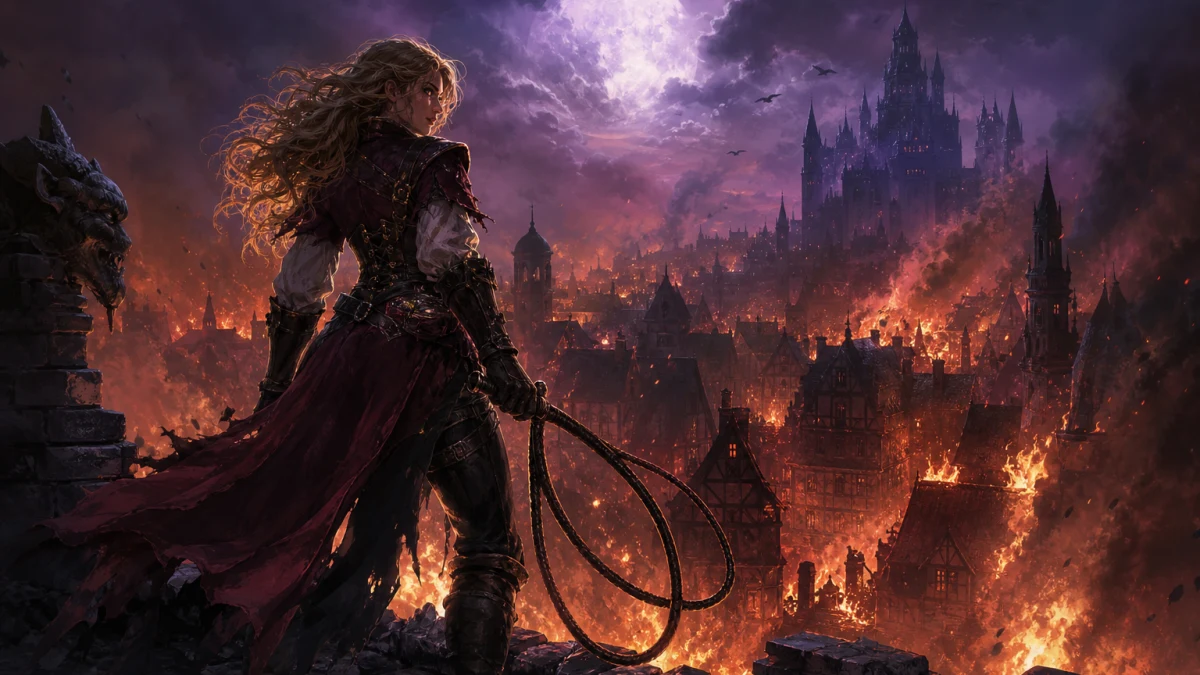
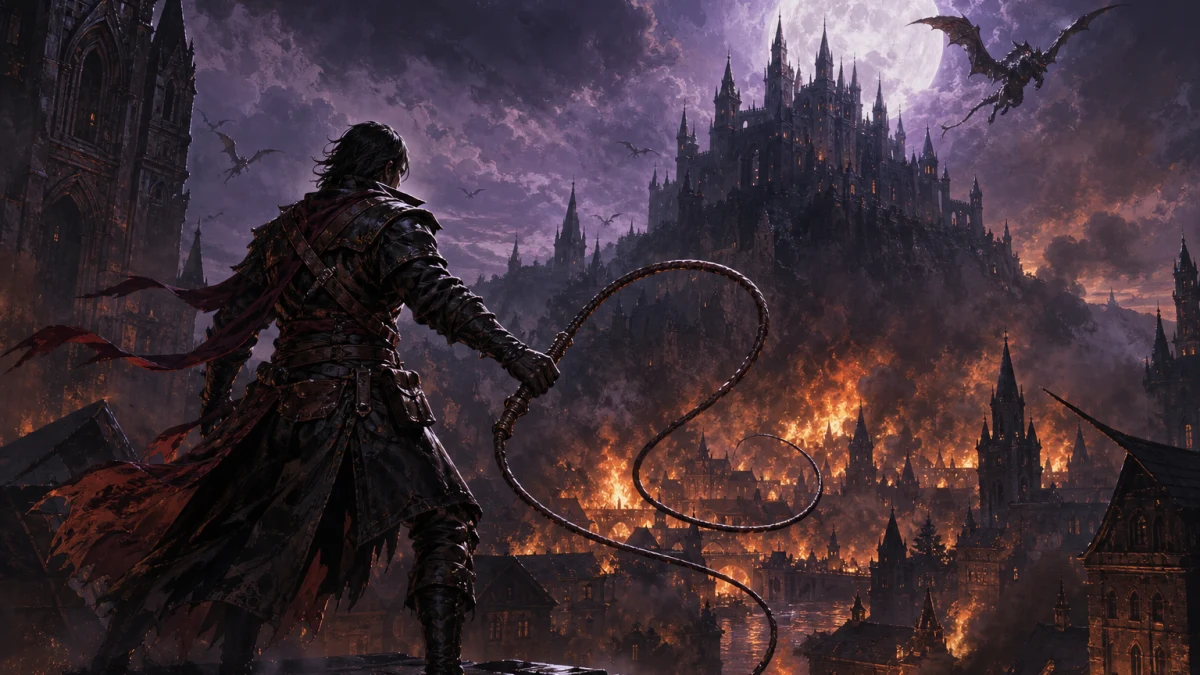
Konami explicitly presents the sacred Vampire Killer as both a combat weapon and a traversal tool. That dual purpose is the clearest organizing idea in the demonstrated mechanics. The whip is not confined to striking monsters during battle and then disappearing during platforming. It provides a common interaction that can connect an enemy encounter, an aerial route and a vertical climb without requiring a hard transition between separate modes.
For traversal, the whip can attach to designated points and carry Rose through a trapeze-like swing. Preview accounts describe fixed hooks or anchors positioned across gaps and along vertical routes. These points give level designers controlled ways to shape an arc, specify a transfer point or place Rose above terrain that an ordinary jump cannot cross.
Enemy grappling introduces a less static version of the same idea. Reports from longer sessions describe Rose connecting the whip to an enemy and pulling herself toward it. The target consequently serves two roles at once: it remains a threat, but its location also becomes a possible destination. Combat composition and platform layout can therefore overlap whenever an enemy occupies useful aerial space.
A reported grapple-to-attack follow-up reinforces that overlap. If Rose can reach a target and immediately attack, grappling is not dead travel time attached to combat. It is an engagement choice that determines approach direction, altitude and proximity. The movement ends in offense, while the attack may leave Rose positioned for another grapple, jump or landing.
That continuity is important in a 2D action-exploration game. Traditional room design can make traversal feel like the quiet interval between fights. Belmont’s Curse instead has the tools to make movement persist through combat. A player can enter a room by swinging from an anchor, redirect toward an enemy, attack in the air and use another target or surface to continue. Not every room must use the full chain for the systems to share a language.
The distinction between official confirmation and broader interpretation remains necessary. Konami confirms that the whip supports fighting and movement. Preview reporting supplies the more specific interactions involving fixed anchors, enemy grapples and immediate attacks. From those pieces, it is reasonable to infer that the whip is the game’s principal connecting mechanic. It is not yet possible to claim how often the full campaign exploits every possibility.
A shared mechanic can also reduce conceptual friction. Players do not need to learn one unrelated device for gaps and another for closing on enemies if the whip handles both contexts. The challenge shifts from remembering a different verb to reading the available target: is the next connection a fixed anchor, a hostile creature or neither? The answer changes the consequence while preserving the underlying action.
That economy does not mean simplicity. A fixed hook is predictable and normally remains available. A living target may move, attack or disappear when defeated. Using it as a movement point can be more opportunistic and more dangerous. The same fundamental grapple can thus support authored platforming and dynamic combat positioning without making those situations identical.
The Vampire Killer should not be confused with the complete equipable weapon system. Konami separately confirms seven weapon categories, and previews demonstrate swords, Cestus gauntlets and a spear. The whip’s traversal role is foundational, while equipped combat weapons supply different offensive styles. Current evidence does not justify collapsing those systems into one category structure.
The most defensible pre-launch thesis is consequently structural rather than evaluative: Belmont’s Curse uses the Vampire Killer to make distance itself interactive. Gaps, vertical routes and hostile spacing all become problems that can be answered with the whip. Whether the full game continually finds new uses for that idea remains a launch-version question.
What Whip Movement Looks Like in Practice
The demonstrated whip mechanics can be translated into several types of movement sequence, although they should not yet be presented as authoritative solutions to final-game rooms. The simplest is a gap crossing: Rose jumps or leaves a platform, catches a designated anchor and swings toward safe ground. The anchor defines a dependable midpoint that extends her range beyond an ordinary jump.
Vertical traversal can add successive decisions. Rose may wall-jump to gain initial height, connect to a hook above her and release toward a ledge or another point. This is not merely horizontal grappling rotated upward. Vertical rooms place greater emphasis on retaining height, reading overhead geometry and recovering when a release does not place Rose exactly where expected.
Enemy placement complicates these authored routes. Longer previews describe enemies functioning as grapple targets, letting Rose pull toward them and use their position to gain height or extend an aerial journey. A creature above a gap can become a temporary stepping stone in space. Because it is still hostile, the route contains an encounter rather than a neutral anchor sequence.
Specialists also reported chains in which Rose moved from one enemy to another to remain airborne. This establishes the possibility of sustained aerial movement rather than a single grapple followed by an unavoidable landing. Each target can lead to the next, with attacks integrated into the chain. The exact targeting rules, forgiveness windows and maximum practical chain length are not established by the available evidence.
A useful conceptual distinction separates designated anchors from living targets. Anchors belong to the architecture. Their placement can teach a route, establish rhythm or signal that a distant area is reachable. Enemies belong to encounter design. Their position may change, and defeating them may remove a movement option. A route built around enemies can therefore evolve during the fight in a way a hook route usually does not.
That distinction creates a possible tactical trade-off. Eliminating a target immediately removes danger, but it may also remove a convenient aerial connection. Leaving it alive preserves the route but allows the creature to keep attacking. This consequence follows logically from enemies serving as grapple points, though the full game’s targeting and respawn rules will determine how often it matters in practice.
Demonstrated platforming combines the whip with Rose’s ordinary jumps and wall jumps. Preview material also points to later world-changing actions that alter barriers or platforms. This means traversal upgrades need not replace the starting vocabulary. A later Arcana can change which surfaces or routes exist, after which the player still uses jumps, walls and whip transfers to move through the newly available space.
Such combinations are more informative than counting movement abilities. A game with many isolated powers can still produce shallow traversal if each solves only its matching obstacle. Belmont’s Curse instead appears interested in layering actions: wall movement establishes height, the whip redirects momentum, an Arcana changes the environment, and ordinary jumping completes the route. The evidence supports the presence of this approach in demonstrated material, not its consistency across the campaign.
The lack of a confirmed double jump is relevant here. It prevents the analysis from filling an apparent gap with a familiar genre assumption. The shown sequences already have ways to extend aerial movement through walls, anchors and enemies. A double jump may or may not appear later, but the known system does not require inventing one to explain its current traversal logic.
Prospective players can use the demo to examine the beginning of this interaction for themselves. The opening can reveal whether grapple targeting is readable and whether transitions between jumping and swinging feel understandable. It cannot reveal the most elaborate late-game chains, the complete set of world-changing abilities or how harsh later hazards become.
Whip Combat Is About Position as Much as Damage
The whip’s most consequential combat function may be its effect on distance. Pulling Rose toward an enemy converts a remote target into an immediate engagement. Rather than walking across the floor or waiting for the opponent to approach, she can use the target’s own position to close the gap. That can accelerate encounters, but rapid engagement is not automatically safe.
A grapple commits Rose toward danger. The target may be in the middle of an attack, surrounded by other enemies or positioned above a hazard. The action’s value therefore depends on reading more than reach. A good target offers a useful arrival point and an attack opportunity; a poor target can carry Rose into overlapping threats. Exact cancel rules and defensive options during the approach remain matters for launch-version testing.
Reported immediate follow-up attacks make the arrival itself part of offense. The player is not simply transported beside a monster and asked to restart a ground combo. A grapple can flow into a hit, giving aerial approach a direct payoff. This may make combat feel quicker than older Castlevania patterns built primarily around measured ground spacing, consistent with Konami’s description of faster and more fluid play.
Aerial chains broaden the positional possibilities. If Rose can attack one target and then grapple another, enemy groups become a network of possible routes. Height can help her bypass ground-level danger or approach from an angle that a conventional run cannot provide. It may also expose her to airborne attacks or leave limited room for correction, so height should not be equated with safety.
One reported equipment bonus increases damage while Rose is airborne. That passive illustrates how customization can reinforce the whip’s movement incentives. A player using frequent grapples and aerial attacks could gain more from such a bonus than someone who prefers grounded exchanges. The available evidence confirms the reported bonus as a pre-release example, not its final value or its comparative strength against other Relics.
Enemy location consequently becomes a resource. A creature is a source of danger and a potential grapple node. Its altitude, horizontal position and relationship to other targets affect the routes available through the encounter. This is a more useful way to understand the whip than treating it solely as another damage source: it modifies the geometry of combat.
Environmental context matters as well. An enemy near a wall may lead into a wall jump; one above a platform may let Rose bypass the floor; one near a hazard may be vulnerable to repositioning or environmental damage. These possibilities do not establish a universal solution. They show why the same enemy can create different tactical options depending on where it appears.
The whip does not erase the relevance of conventional weapons. Konami confirms seven weapon categories, and reported examples have distinct ranges, speeds and perks. A grapple may determine how Rose reaches a target, while a sword or Cestus determines what she does at close range. The interaction between approach tool and equipped offense is more important than declaring one a replacement for the other.
This separation also preserves build variety. A short-range weapon may benefit strongly from instant distance closing, while a weapon with returning or ranged behavior may need the grapple less often. An aerial-damage Relic can favor sustained height, whereas another passive may reward exploration or resource management. Those are plausible combinations based on demonstrated components, not proven optimal builds.
Before launch, the safest conclusion is that whip combat emphasizes choosing where and when to engage. Damage still matters, but the distinctive decision is positional: which target should become the next point in Rose’s path? The final game must establish whether enemy designs consistently make that question meaningful.
Dodges, Slides and the Defensive Rhythm
Rose’s defensive vocabulary is not limited to moving away from danger. The pre-release PlayStation build used Circle for dodge or slide behavior, with a double tap producing a backward flip. That specific label belongs to the PlayStation configuration used in the report; it should not be carried over to Xbox, Nintendo or keyboard controls without direct documentation.
The reported backward dodge included invincibility frames. In practical terms, that means timing can matter as much as distance. A retreat performed during the relevant window may avoid an attack even if the animation passes close to its active area. No verified frame count is available, and the timing could change between a preview build, the public demo and the patched launch version.
Invincibility does not make the action consequence-free. A backdash can surrender ground, move Rose toward a wall or place her outside the ideal range of a short weapon. Repeated retreat can also miss opportunities to punish an enemy’s recovery. Its role is better understood as one component of a defensive rhythm: read the attack, evade at the appropriate moment and use the resulting position.
The longsword example makes that transition explicit. Preview reporting describes a benefit for attacking immediately after a backdash, with the follow-up dealing additional damage. Defense becomes preparation for offense rather than a pause between phases. The weapon property encourages the player to treat the dodge and retaliation as a linked sequence.
The floor slide offers a different answer. Instead of increasing distance, Rose can move through or behind an enemy where the encounter permits. This can reverse facing and create a new attack angle. It also carries risk: a mistimed slide may leave her close to the target, and not every attack pattern will be vulnerable to passing behind it.
The contrast between backdash and slide is strategically useful. One gives up space and may activate a retaliation property; the other contests space and changes sides. An aerial grapple supplies a third response by redirecting Rose toward or above a target. Even in the opening vocabulary, defense appears tied to choosing a destination rather than pressing a universal safety command.
Boss encounters make timing and pattern recognition especially visible. Reported fights include returning projectiles, long-reaching whip attacks, sword sequences, backstabs and fireballs. Different threats ask Rose to manage direction, height and distance. The available material demonstrates this language, although it is not sufficient for authoritative final-build strategies.
A boss with a long-reaching attack can punish passive spacing. A backstab challenges assumptions about which side is safe. A fireball creates a moving obstruction, and a returning projectile can demand attention after its first pass. These examples suggest that evasive actions exist within patterns that must be read rather than used indiscriminately.
Platforming can impose a similar rhythm. A wall jump or whip swing may avoid a hazard while progressing through the room, whereas a panic movement can send Rose into another danger. The shared emphasis is controlled repositioning. Combat and traversal both ask where an action will end, not merely whether it starts successfully.
Difficulty settings, accessibility assists and their possible effects on timing have not been established by the reviewed material. It would therefore be misleading to define one universal precision requirement. What can be said is that the demonstrated defensive system rewards understanding the relationship among attack patterns, invulnerability, spacing and weapon-specific retaliation.
Seven Weapon Categories, but Only a Partial Public Picture
Konami confirms that Belmont’s Curse contains seven weapon categories. That is a meaningful statement about scale, but it is not permission to construct a complete list from fan pages, extracted files or speculation. The official and responsibly reported material reviewed for this analysis publicly demonstrates only part of the system.
The ESRB summary refers broadly to swords, whips, spears and melee-style attacks. Preview reports add specific examples such as a longsword, Cestus gauntlets, a throwable spear and the Burnt Sword of Fierbois. These references show variety, but they do not provide a verified taxonomy of every category or establish where the Vampire Killer belongs within equipment menus.
Preview reporting says categories have distinct styles and special moves rather than differing only through attack values. That distinction is central to the system’s apparent purpose. A meaningful weapon choice changes behavior: reach, tempo, preferred spacing, follow-up conditions or the way sustained pressure is rewarded. A mere numerical upgrade would not create the same relationship with Rose’s movement tools.
The Vampire Killer’s traversal role should be kept separate from the equipable combat-weapon discussion unless the launch game explicitly unifies them. Konami promotes the holy whip as Rose’s signature tool for movement and fighting, while previews describe selecting or receiving other weapons. It is possible for those facts to coexist without assuming an undocumented inventory classification.
The demo’s weapon selection is introductory by definition. Even if it exposes more than one style, it cannot establish how all seven categories evolve, how frequently new examples appear or whether every category remains equally supported late in the game. Konami’s warning about restricted features is especially relevant here.
A category count also says nothing by itself about individual weapon count. There may be multiple weapons within a category, variants with distinct properties or rewards associated with particular encounters, but the complete inventory has not been published. No responsible pre-launch guide can supply rarity tiers, drop tables or an exhaustive arsenal on current evidence.
Upgrade criteria add another layer. Reports describe weapons and spells improving through usage requirements or challenges. A basic condition might ask the player to defeat a specified number of enemies, while a larger unlock can require a more particular action. This makes trying a weapon mechanically productive rather than merely diagnostic: using its intended behavior may contribute to its development.
However, challenge-based upgrades should not be confused with proof of unrestricted mastery trees. The menu structure, number of stages, reset rules and campaign-wide pacing remain unknown. Nor is it established that every weapon follows an identical template. Some may have bespoke requirements, and final balancing may alter conditions seen in previews.
The seven-category confirmation is therefore best used as a ceiling on certainty rather than an invitation to fill gaps. Readers know that the full game is broader than the handful of demonstrated examples. They do not yet know all category names, every special move, the distribution of weapon rewards or the final relationship between upgrades and character growth.
For prospective players, the public demo can reveal whether the first available styles feel meaningfully different. It cannot answer whether the seventh category is enjoyable, whether later weapons outperform early favorites or whether upgrade tasks become repetitive. Those are campaign-level questions for the release build.
- Confirmed total: seven weapon categories.
- Publicly demonstrated examples are not a complete category list.
- Do not infer inventory classifications from the Vampire Killer’s traversal role.
- Do not use datamines or inaccessible files to fill official gaps.
Longsword, Cestus, Spear and Burnt Sword: Demonstrated Examples
The demonstrated weapon examples are most useful as evidence of behavioral differentiation. They do not reveal the full arsenal, but they show how Belmont’s Curse can make equipment interact with spacing, evasion and attack cadence. The longsword, Cestus, throwable spear and Burnt Sword of Fierbois each point toward a different reason to equip a weapon beyond a larger damage number.
The longsword was presented as a balanced option. “Balanced” should not be expanded into undocumented statistics, but it suggests a middle-ground style rather than an extreme commitment to range or speed. Its most informative reported property is a damage benefit for attacking immediately after a backdash.
That property creates a compact combat loop. Rose waits for or provokes an attack, retreats through the danger with a correctly timed evasive action and answers immediately. The weapon rewards composure and recognition of recovery windows. It also gives the defensive move an offensive identity: the backdash is not just escape, but the setup for a stronger response.
Cestus gauntlets demonstrate the opposite emphasis in range. Reports describe fast combinations at the cost of reach. Their damage was said to increase as successive hits connected, encouraging sustained close-range pressure. The user must remain near the target long enough to preserve the sequence, which raises the value of positioning and the risk of interruption.
The whip grapple may complement that weakness by closing distance quickly. Once Rose reaches the enemy, Cestus speed can support a rapid string. Yet the same short reach can make a failed approach more costly. This is a logical interaction between demonstrated mechanics, not evidence that Cestus plus grapple is a dominant launch build.
Escalating consecutive-hit damage changes target selection too. A durable enemy may allow the bonus to develop, while scattered or fragile targets could repeatedly reset the sequence depending on the final rules. Area attacks, evasive enemies or forced retreats may challenge the pressure plan. Exact reset conditions and multipliers have not been verified.
A throwable spear appeared in a longer press preview, establishing at least one weapon behavior that reaches outward or returns rather than functioning solely as a close-range strike. That matters because it broadens the positional spectrum. Rose’s kit is not limited to grappling into every threat; some equipment can apparently act across space.
The available reporting does not establish the spear’s complete move set, ammunition rules or final category name. Calling it throwable is sufficient to distinguish its demonstrated behavior without inventing details. It may interact differently with moving targets or platforms, but those relationships require direct launch-version evidence.
Joan of Arc can award the Burnt Sword of Fierbois in the demonstrated material. The weapon was shown with a charge attack, supplying another behavior distinct from rapid Cestus combinations or post-backdash retaliation. Charging introduces a commitment decision: time spent preparing the attack must be weighed against enemy pressure and the opportunity to release it effectively.
The reward also illustrates that notable weapons may come from particular encounters or characters, while Arcana arise through the boss-sealing system. It would be wrong to generalize this example into a rule that every boss awards both a weapon and an Arcana. The evidence supports an individual reward, not a universal loot formula.
Taken together, these examples describe an arsenal organized around play patterns. The longsword links evasion and retaliation. Cestus rewards proximity and continuity. The spear offers reach through a thrown action. The Burnt Sword introduces charging. The final game still needs to establish how deeply each pattern develops, how upgrades modify it and whether categories remain competitive across the campaign.
Mana, Spells and Healing
Belmont’s Curse layers a mana economy over its weapon combat. Spells consume mana, so Arcana use is constrained by a replenishable resource rather than existing as unlimited secondary damage. This creates a decision between spending mana immediately and preserving it for defense, exploration or recovery, depending on which abilities are equipped and available.
Pre-release accounts agree that ordinary combat can restore mana, but their wording differs. Some describe recovery through damaging enemies, while others refer to defeating them. Without direct current-version verification, the rule should not be narrowed to one trigger. The defensible statement is that active combat contributes to replenishment in the demonstrated builds.
That distinction matters when evaluating flow. Recovery on every successful hit would favor rapid multi-hit pressure differently from recovery only on a kill. A hybrid rule could behave differently again. Because those outcomes affect weapon balance and resource planning, no precise regeneration strategy should be built on ambiguous preview wording.
Combat-linked recovery nevertheless indicates a broad design intention: mana expenditure need not lead only to passive waiting or consumable dependence. The player can return to conventional offense to rebuild access to spells. If retained at launch, that loop ties Arcana to weapon engagement instead of separating magic users from basic combat.
The PlayStation preview also allowed mana to be spent on healing. Healing and spellcasting can therefore compete for the same pool. An offensive Arcana might shorten a fight, but preserving mana can create a safety reserve. Conversely, spending heavily on recovery may leave fewer options for magic or ability use until combat restores the resource.
Separate health potions or ampoules were present in opening pre-release material. These establish another recovery layer rather than making mana the sole route back to health. The final game’s inventory limits, refill rules and balance are not confirmed, so early potion availability should not be projected across the campaign.
Enemies and breakable environmental objects can also yield occasional food or snacks that restore health. This is recognizably consistent with Castlevania’s environmental recovery tradition, but its relevance here should stay mechanical. Breakables may offer opportunistic recovery, encouraging players to inspect combat spaces, while random or occasional drops cannot be treated as a guaranteed plan.
Three recovery channels consequently appear in the demonstrated material: mana-based healing, carried potions or ampoules, and occasional food. Each has a different apparent cost. Mana healing competes with abilities, potions draw on limited items, and food depends on what enemies or objects provide. The final tuning will determine whether these layers create meaningful choices or abundant redundancy.
Relics can modify the economy further. The demonstrated Crypt Key restores health and mana when Rose opens a chest. That passive converts exploration rewards into recovery opportunities, potentially helping a player sustain progress between major encounters. It also gives chest discovery value beyond the chest’s normal contents.
No conclusion should be drawn yet about farming, optimal healing order or resource scarcity. Demo drop rates may be tailored to an opening chapter, preview builds may use provisional values, and the launch patch may adjust costs. Exact mana totals, spell costs and healing amounts require reproducible testing of the current public version.
What is established is a circular relationship. Magic spends mana; combat helps restore it; mana can also support survival; exploration and breakables can supply additional recovery. The economy appears designed to keep weapon combat, Arcana and environmental attention connected rather than functioning as isolated meters.
Bosses Become Arcana
Konami confirms one of Belmont’s Curse’s defining progression ideas: defeated bosses are sealed into Rose’s tarot cards and become Arcana. A boss victory therefore does more than remove an obstacle or conclude a story beat. It can add an ability derived from the defeated opponent, transferring part of the encounter’s mechanical identity to the player.
Arcana can provide spells and special actions, including functions that extend beyond straightforward damage. This breadth matters because it places boss progression at the intersection of combat and exploration. A new card may increase offensive options, alter defense, change environmental access or combine several of those roles.
The Fallen supplies the clearest demonstrated example. After the encounter, his Holy Cross becomes available as an Arcana attack. The player first experiences the cross as part of an enemy’s threat pattern, then gains access to a related capability. The boss therefore teaches the visual and mechanical concept before it enters Rose’s loadout.
That reversal can make rewards easier to understand. An abstract spell obtained from a menu requires separate explanation; an ability previously seen in a boss fight already has context. The player recognizes its theme and broad behavior, even though the usable Arcana version may not reproduce every boss property.
The same principle can strengthen thematic progression without requiring a conventional loot drop from every boss. The tarot card records conquest and converts it into capability. It would be inaccurate, however, to claim that every boss also awards a weapon. Joan’s demonstrated weapon reward is an example, not a confirmed universal rule.
Boss-derived abilities can also create a map rhythm. Defeat establishes a new tool, the tool changes which barriers or routes can be handled, and earlier inaccessible locations become candidates for revisiting. This is a familiar action-exploration loop, but the Arcana framing gives it a specific progression vocabulary.
The reviewed material does not establish the complete boss roster, all Arcana effects or the number of Arcana that can be active simultaneously. It also does not explain whether every boss becomes a card in exactly the same way, whether optional bosses contribute equivalent progression or how cards are organized late in the campaign.
Nor should boss sealing be interpreted as proof of deep character-stat simulation. Its importance lies in acquiring verbs and modifying actions. The system resembles role-playing progression because victories expand and specialize Rose’s capabilities, but the depth of numerical growth remains unknown.
The Arcana loop also connects to its own upgrade system. Works of Mercy can ask the player to use a spell in a particular way; completion opens a Blessing, and assigning that enhancement can reveal an additional Gift. Boss acquisition is therefore the start of an ability’s development rather than necessarily its final state.
For a pre-launch analysis, the key established chain is concise: confront a boss, seal it into a tarot card, gain an associated action and potentially develop that Arcana through use. The final campaign must show how varied those cards are, how often they transform exploration and whether their upgrades create durable choices.
Works of Mercy, Blessings and Gifts
Controlled preview material supplies three important terms for Arcana development: Works of Mercy, Blessings and Gifts. They describe a progression chain attached to a card rather than a generic experience bar. Understanding the sequence helps separate verified structure from assumptions about conventional skill trees.
An Arcana can have as many as three Works of Mercy. The wording “as many as” is important. It does not establish that every card has exactly three tasks, that all tasks unlock at the same time or that each follows an identical pattern. The complete Arcana inventory and task distribution have not been published.
A Work of Mercy is a defined requirement associated with the relevant card. One demonstrated example asks the player to hit an enemy five times with the spell. Other reports suggest that broader weapon or spell development can include simple enemy-defeat totals as well as more particular actions. These conditions turn use into progression.
Task-based development can teach intended behavior. A requirement to land a spell repeatedly encourages the player to understand its reach and timing. A more specialized condition could draw attention to an interaction that ordinary play might miss. The benefit depends on whether tasks remain instructive rather than becoming repetitive, which cannot be judged from a few examples.
Completing a Work of Mercy unlocks a Blessing that can improve the associated Arcana. This establishes a direct relationship between the task and card growth. It does not confirm unrestricted branching, permanent commitment or a shared currency. Calling the interface a skill tree would go beyond the evidence unless the final version visibly organizes it that way.
Assigning a Blessing can unlock an additional Gift for the Arcana. This suggests at least two layers of enhancement: the earned Blessing and a further property made available through assignment. The exact relationship among available Blessings, active selections and Gifts needs launch-version confirmation. It is not established whether choices can be changed freely or whether loadouts can be saved.
The Cursed Flame provides the clearest concrete example. Its fireball can be enhanced to become larger and produce stronger pushback. That improvement changes behavior as well as likely effectiveness. Increased size can affect ease of contact, while stronger pushback alters enemy position and may interact with hazards or spacing.
Pushback illustrates why upgrade analysis should not focus only on damage. Moving an enemy can create breathing room, interrupt a preferred distance or place a target near an environmental danger. Whether particular enemies resist displacement is not established, but the upgrade clearly points toward positional utility.
The progression chain also supports experimentation. A player who acquires an Arcana has a reason to use it enough to satisfy its Works of Mercy. That usage can reveal whether the card fits the preferred approach before its enhanced form is assigned. The system may consequently make breadth of experimentation part of advancement.
There are still substantial unknowns. The number of Blessings per card, mutual exclusivity of choices, respec rules, task tracking, late-game requirements and balance between Arcana are not established. Nor is there evidence that every card receives a size, pushback or damage-style enhancement comparable to Cursed Flame.
The safe summary is procedural: an Arcana can carry up to three defined tasks; completing one unlocks a Blessing; assigning a Blessing can open a Gift; and at least one demonstrated upgrade changes a spell’s size and displacement. That is enough to establish structured card progression without inventing a uniform tree.
Arcana as Exploration Abilities, Not Just Magic Attacks
Arcana matter to platforming because they are not limited to projectile damage. The strongest demonstrated example is Joan of Arc’s Holy Light, which can pass through or alter previously solid Chaos Shards. A barrier that once blocked movement can therefore become part of an accessible route after the relevant ability is acquired.
This creates an ability gate rather than a purely numerical check. The player does not simply return with more damage or health; the world responds differently to a new action. Locations seen earlier can be mentally or physically marked for revisiting once the appropriate Arcana becomes available.
Holy Light also has a defensive combat use. With accurate timing, it can deflect enemy attacks in the pre-release build. The same Arcana consequently serves navigation and protection. Its value cannot be measured solely by spell damage because one of its important functions is changing the state or direction of a threat.
That multifunctionality supports the game’s broader connective design. The Vampire Killer crosses combat and traversal through movement; Holy Light crosses exploration and defense through transformation and timing. An ability remains relevant in several contexts rather than existing only as a colored key for a matching door.
Preview reports also describe world-changing platform or wall interactions. The exact Arcana names and complete operating rules are not sufficiently established to catalogue them all before launch. It is safer to state that demonstrated progression includes actions capable of altering traversal surfaces or barriers, with Holy Light and Chaos Shards providing the verified specific example.
Ability-gated revisits give the map a temporal dimension. A visible obstruction is not merely scenery; it records a future possibility. Once the player obtains the relevant action, an old route can yield a secret, a new connection or continued progression. The full rewards and map structure remain unknown, but destructible walls and visibly inaccessible locations reinforce this pattern.
Using Arcana for exploration also affects mana questions. If a world-changing action consumes mana, resource availability could influence when it is used; if traversal applications are free or handled separately, the implications differ. The reviewed evidence does not establish every cost rule, so no universal statement should be made about exploration draining combat resources.
The defensive deflection adds a timing challenge distinct from evasive invulnerability. A backdash avoids a threat by moving Rose, while Holy Light can answer the attack directly. The player may choose between changing position and changing the projectile or strike, depending on the final interaction rules.
An Arcana that performs several jobs can also complicate loadout choices if active capacity is limited. Equipping a strong exploration card might provide defensive value, reducing the sense that a traversal tool is wasted during combat. Yet the number of simultaneous Arcana slots is not confirmed, so this remains a structural possibility rather than a settled build problem.
The evidence therefore supports a precise conclusion: boss-derived tarot abilities are part of the game’s map progression, not merely a parallel spell list. At least one demonstrated Arcana changes access and deflects attacks, showing how a single reward can operate in navigation, defense and combat. The launch game must reveal how many cards achieve comparable breadth.
Relics and the Early Shape of Build Customization
Konami confirms that Relics provide bonuses associated with combat and exploration. Preview builds allowed Rose to equip up to three, establishing a limited passive loadout in the demonstrated version. Because this capacity comes from pre-release sessions, the launch build should be checked before treating three as an immutable rule.
A limited number of slots creates selection pressure. The player cannot necessarily activate every discovered passive at once, so a Relic’s value depends on the current weapon, Arcana, route and preferred risk level. Even modest effects can produce distinct loadouts when they reinforce different parts of play.
The Crypt Key is the clearest reported example. It restored Rose’s health and mana whenever she opened a chest. This effect links exploration to sustain: locating and opening a chest provides its ordinary reward while also replenishing two resources. The Relic may be particularly useful during first-time exploration, when unopened chests remain available.
That condition also gives the passive a natural boundary. Once a chest is opened, it is no longer an unused recovery opportunity unless the game later resets it, which has not been established. Crypt Key therefore appears oriented toward forward exploration rather than a universally repeatable combat bonus.
Another reported equipment effect increases damage while Rose is airborne. This is an important example because it reinforces a play pattern rather than a location. Whip grapples, enemy chains and aerial attacks can keep Rose off the ground, allowing the passive to reward players who lean into the game’s distinctive movement.
An airborne bonus can influence route choice within combat. A player may seek an anchor or elevated enemy not only for safety or access, but to satisfy the condition for stronger attacks. That interaction remains an inference from the reported effect and demonstrated whip system; no pre-launch evidence establishes its optimal use or final numerical value.
These examples reveal two broad passive orientations. Crypt Key rewards exploration events and resource management. The airborne effect rewards a combat posture. Other Relics may bridge the categories, but the complete pool has not been published, so a comprehensive classification would be speculative.
The Midnight Edition officially includes a Relic called Family’s Grace. Konami’s product information names it but does not explain its effect. Its inclusion should not be converted into claims about power, exclusivity beyond the documented edition offering or impact on balance. A name is not a mechanical description.
Nor is there a verified full Relic list. Fan-maintained pages and extracted demo data cannot safely fill the gap, particularly before release. The responsible boundary is to discuss the confirmed concept and publicly demonstrated examples while leaving undisclosed effects undisclosed.
Relics contribute to light build customization because they can be combined with weapon behavior and Arcana. A player might pair aerial damage with grapple-heavy offense, or use Crypt Key to support exploration and mana expenditure. These combinations are evident possibilities, but their comparative strength and long-term viability remain unknown.
The final shape of the system depends on unanswered questions: total Relic count, slot expansion, duplicate effects, upgrade rules, swapping restrictions and whether loadouts can be saved. Current material establishes passive selection, not the full complexity of a mature build economy.
Platforming Spaces Can Become Combat Tools
Belmont’s Curse does not treat every platforming element as neutral terrain. Preview material establishes that environmental hazards can damage enemies, allowing room geometry to influence combat outcomes. A hazard is therefore not only something Rose must avoid; under the right conditions, it can become a source of pressure against a target.
This possibility increases the importance of displacement. Cursed Flame’s stronger pushback, a slide that changes sides or ordinary attacks that alter enemy position may matter differently near a hazard than on a flat floor. The exact interactions vary by target and room, so no universal hazard strategy can be promised before launch.
Whip routes can also change how Rose occupies a combat space. An anchor above an encounter may offer an aerial approach or a way around a ground-level threat. An enemy positioned at height can become a grapple point, turning the hostile formation itself into a temporary route.
Vertical rooms make these choices especially visible. Fighting on the lowest platform may expose Rose to descending attacks or restrict escape, while moving upward can create separation. Conversely, an aerial approach may place her near additional enemies or leave fewer landing options. Height is a tactical dimension, not an automatic advantage.
The floor slide supplies a ground-level equivalent. Passing behind a target can change which side of the room Rose controls. It may move her away from a wall, place the enemy between her and a hazard or create room for a backdash. Specialist testing establishes the behind-enemy use, while the value of any particular repositioning depends on the encounter.
Wall jumps can support emergency recovery or deliberate setup where the layout permits. A wall is not merely the edge of the arena if Rose can use it to regain height and transition to a whip swing. The same surface that constrains horizontal movement can open a vertical answer.
This interaction means combat quality cannot be assessed entirely through enemy move sets. Room layout determines which movement options are available and how dangerous a commitment becomes. A short-range Cestus sequence in a confined corridor presents a different risk from the same sequence beneath multiple grapple points.
Environmental damage also creates the possibility of efficient victories without proving that every enemy can be manipulated. Some targets may resist displacement, fly over hazards or attack effectively from unsafe terrain. The evidence supports environmental interaction, not a single exploit applicable throughout the game.
The authored nature of the game is important. Evil Empire reportedly rejected a procedural, permadeath-driven run structure in favor of a designed action-exploration campaign. That allows individual rooms to arrange anchors, walls, platforms, hazards and enemy placements for specific interactions rather than relying entirely on procedural combinations.
Authored layout does not guarantee that every room uses the systems well. It does, however, make placement legible as intentional. A target suspended over a gap or a hook above a combat floor can be read as part of the encounter’s design vocabulary. The player is encouraged to consider where to fight as well as what to attack.
The strongest pre-launch conclusion is that traversal space and combat space overlap. Hazards can hurt enemies, movement tools can change facing and altitude, and whip routes can carry Rose around or through hostile formations. The final campaign will determine how consistently those possibilities produce meaningful choices.
Boss Design Demonstrates the Intended Combat Language
Light mechanical-spoiler warning: this section discusses disclosed attacks and rewards from The Fallen and Joan of Arc. It avoids story outcomes and does not provide a final-build strategy.
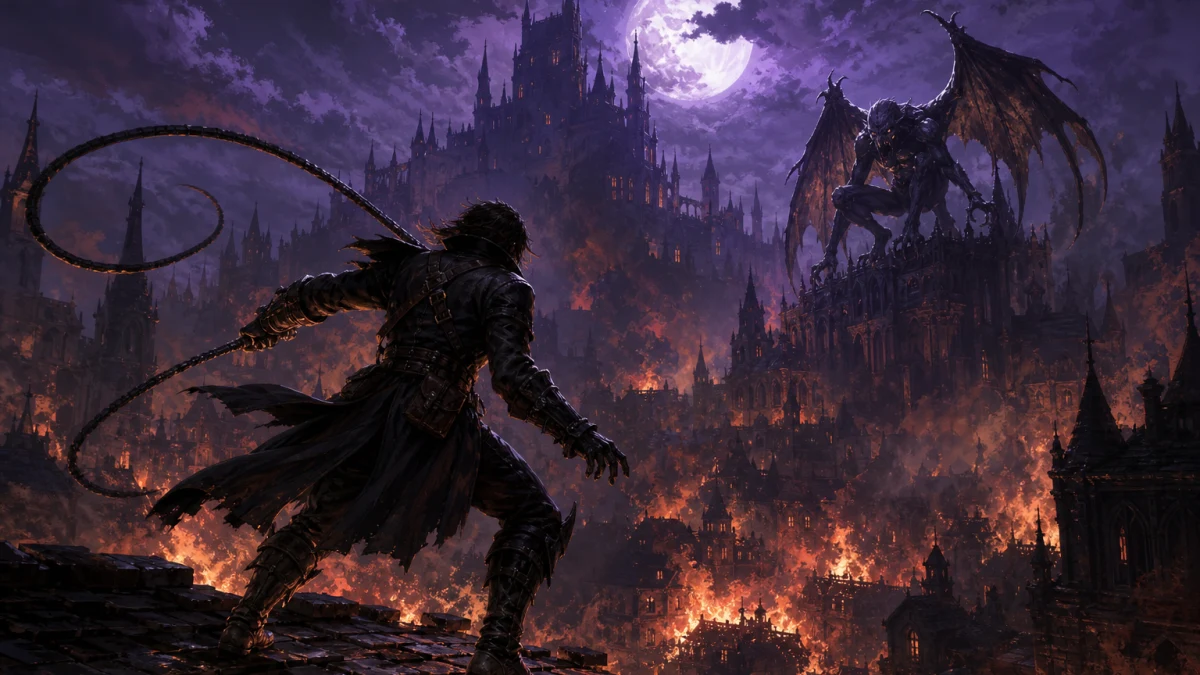
The Fallen’s encounter is a useful systems example because it introduces the Holy Cross as a threat before the corresponding Arcana becomes a player tool. The boss throws the cross as a projectile, creating a moving object that must be tracked rather than a simple close-range strike.
Preview reporting says the thrown Holy Cross can be attacked and redirected against The Fallen. That interaction changes the projectile from something merely avoided into a contested object. The player can respond offensively to the boss’s own attack, reversing part of its pressure.
The mechanic rewards recognition. Avoiding the cross may preserve safety, but striking it at the appropriate opportunity can turn defense into damage or pressure. Exact timing, weapon compatibility and launch-version behavior should be verified before presenting a detailed strategy. The important established principle is that some boss threats are interactive.
Later in the encounter, The Fallen uses long-reaching whip attacks and whip-assisted movement. This mirrors Rose’s own relationship with the Vampire Killer: reach and mobility are connected. The boss demonstrates how a whip can control space and alter position rather than functioning only as a repeated ground strike.
That mirrored vocabulary can teach through opposition. Facing an enemy who uses extended reach encourages the player to read the space a whip controls. Seeing whip-assisted movement from the other side also reinforces the idea that aerial repositioning is part of combat identity, not merely a platforming convenience.
Joan of Arc’s demonstrated move set includes flaming sword attacks, backstabs and fireballs. These threats cover several positional problems. Sword attacks demand attention at close range, backstabs challenge assumptions about safe facing, and fireballs create pressure across space.
A backstab is especially relevant to Rose’s slide and side-changing movement. Moving behind an opponent may be useful, but bosses can possess their own tools for reversing position or punishing predictable orientation. The encounter language therefore does not reduce to “always get behind the target.” Pattern recognition remains necessary.
Joan’s rewards also connect the encounter to progression. Her Holy Light becomes relevant to Chaos Shards and timed deflection, while the Burnt Sword of Fierbois demonstrates a charge attack. The boss’s identity is translated into player capabilities with both combat and exploration consequences.
Boss rewards can reinforce what encounters teach. The Fallen’s cross moves from hostile projectile to Arcana attack. Joan’s light supports deflection and environmental access after a fight built around varied pressure. This does not prove that every boss follows an identical lesson-and-reward formula, but the demonstrated examples establish the design pattern.
These encounters also show why a dodge cannot be analyzed in isolation. Long reach, returning projectiles, backstabs and fireballs demand different movement responses. A backdash may answer one timing, a slide may change the angle of another, and an interactive projectile may reward attacking instead of evading.
Pre-release reports cannot settle boss difficulty. Player familiarity, build choice, accessibility options and launch balancing all affect that judgment. Nor should the disclosed mechanics be inflated into complete move lists. They are controlled examples of the intended combat language: read patterns, manage position and recognize when an enemy’s action can be reversed.
The broader progression loop then turns mastery into acquisition. Defeating the boss does not merely certify that the player survived the lesson. It adds a related capability to Rose’s toolkit, creating a bridge from encounter design to exploration and future combat.
Exploration Structure and Backtracking
Preview material describes destructible secret walls and locations that are visibly inaccessible until Rose gains an appropriate skill. Those features establish an authored exploration structure with reasons to revisit earlier spaces. The map is not simply a sequence of combat rooms leading forward; it contains remembered obstacles and concealed routes.
Destructible walls reward close observation and experimentation. Their exact visual language has not been comprehensively documented, so a pre-launch reference should not pretend to identify every secret surface. The established point is that environmental breakage can reveal hidden space.
Visible but inaccessible locations serve a different purpose. They show the destination before providing the verb needed to reach it. A high ledge, altered wall or Chaos Shard barrier can become a future objective. This makes ability acquisition legible because the player has already seen places where the new action may apply.
Arcana are part of that return loop. Holy Light’s interaction with Chaos Shards is a concrete example of a boss-derived power opening or changing a route. Whip movement, wall jumps and other world-changing actions can then determine how Rose traverses the newly available space.
Map-based route planning becomes important when several unresolved paths accumulate. Players can compare the current position with remembered barriers and choose where a new ability is likely to work. The reviewed material does not establish the final map’s size, district count, completion-percentage system or fast-travel rules, so those details must remain open.
A longer pre-release session reported an absence of conventional waypoint arrows in the tested build. Instead, ghost stories and retained hints supplied navigation clues. Because this observation comes from a preview rather than a final manual, it should not be converted into a universal statement that the launch game has no waypoint options.
The reported approach suggests navigation through information rather than a constantly displayed direction marker. A ghost story can provide context or a clue, while retained hints let the player review useful information later. This potentially asks the player to interpret destinations rather than follow an arrow.
Such a system depends heavily on clarity. Hints must remain specific enough to guide without erasing discovery, and the map must communicate connections well enough to support backtracking. The evidence establishes the presence of these aids in a longer session, not their effectiveness across the full campaign.
Ability-gated revisiting also interacts with rewards. A returned route might contain a chest, Relic, weapon enhancement or continued progression, but no complete reward table has been released. It is safer to describe the access structure than promise what every blocked location contains.
The opening demo is particularly limited as evidence for backtracking. An opening chapter can introduce the idea of inaccessible space, but it cannot show how burdensome or satisfying returns become across a large map. It also cannot establish whether later shortcuts, transit systems or map annotations reduce repetition.
The game’s reported rejection of procedural runs is relevant here. Belmont’s Curse is presented as an authored action-exploration journey rather than a permadeath loop assembled anew for each attempt. Secrets, barriers and clues can therefore refer to stable places that persist as the player develops Rose’s capabilities.
Before launch, the exploration model can be summarized without exaggeration: the world includes secret walls, visible obstacles intended for later abilities, map-supported route planning and reported clue-based navigation. The scale, convenience and long-term density of those elements remain unknown.
How Much of an RPG Is Belmont’s Curse?
Konami formally describes Belmont’s Curse as a 2D action-exploration game. That is the most reliable top-level label. The demonstrated systems nevertheless contain recognizable role-playing elements: equipment choices alter behavior, abilities develop through tasks, passive Relics shape loadouts, resources require management and boss victories expand what Rose can do.
Weapons offer the first layer. The longsword’s post-backdash reward, Cestus pressure incentive, throwable spear behavior and Burnt Sword charge attack represent more than ascending attack ratings. Choosing equipment can change preferred range, timing and risk. Reported usage criteria also let weapons or spells develop through action.
Arcana add an ability-progression layer. Bosses become tarot cards, cards provide spells or special actions, and Works of Mercy can unlock Blessings and Gifts. This resembles role-playing advancement because the player acquires and improves capabilities, although the final breadth of choice has not been established.
Relics create passive combinations. Up to three could be equipped in preview builds, with demonstrated effects tied to chest recovery or airborne offense. Combining a Relic with a weapon and Arcana can produce a recognizable build direction even without a dense attributes screen.
Mana and healing resources add economic decisions. A spell competes for mana that may also support healing; combat helps replenish the pool; potions and food provide additional recovery; and a Relic can tie chests to restoration. These systems influence moment-to-moment priorities rather than existing solely as permanent stat growth.
Boss-derived exploration abilities are another form of progression. Rose does not advance only by dealing more damage. She gains ways to alter barriers, deflect threats and reach previously inaccessible locations. In an action-exploration game, acquiring new verbs can be more structurally important than increasing a numerical level.
Together, these systems justify describing Belmont’s Curse as containing light role-playing and build-customization elements. They do not yet prove deep statistical simulation. Public evidence does not establish a full attribute model, level cap, experience curve, class structure or complex loot economy.
Loot behavior is especially uncertain. Seven weapon categories do not reveal rarity tiers, random affixes or drop tables. Individual rewards and found equipment may exist without forming a loot-driven RPG structure. No pre-launch analysis should fill that gap with conventions imported from another game.
Respec rules are also unknown. The material does not establish whether Blessings can be reassigned freely, whether Relic loadouts can be stored or whether weapon development choices can be reversed. These details determine how experimental or restrictive builds feel over a complete playthrough.
Difficulty scaling remains outside the evidence. It is unknown whether enemies scale with character growth, whether difficulty options alter resource values or whether later encounters assume particular upgrades. Without those facts, it is impossible to rank builds or estimate grinding requirements responsibly.
Endgame diversity is similarly unproven. A system can offer several compelling opening combinations but converge on a narrow set of late-game choices. Alternatively, seven categories, Arcana upgrades and Relics may support many viable approaches. Only the complete, current version can answer that question.
The most precise description is therefore hybrid but bounded: Belmont’s Curse is an authored 2D action-exploration game with weapon specialization, task-based ability development, passive loadouts and resource management. Calling those features role-playing elements is justified. Treating them as proof of a deep RPG economy is not.
- Established RPG-like elements: behavioral weapon perks, Arcana development, passive Relics and resource management.
- Not established: attributes, complete loot tables, rarity tiers, level caps, respec rules, scaling and endgame build balance.
- Konami’s primary genre description remains 2D action-exploration, not roguelite.
What the Demo Reliably Tells Prospective Players
The public demo is most valuable when asked questions that an opening chapter can actually answer. It can establish whether Rose’s early movement is understandable to a particular player, whether the floor slide feels useful, whether initial attacks have an appealing cadence and whether the first whip traversal interactions create satisfying continuity.
Responsiveness is partly experiential rather than a universal statistic. The demo lets each player test how quickly Rose appears to answer inputs and whether transitions among jumping, wall movement, sliding and grappling match personal expectations. That is more useful than adopting another player’s impression as an objective measurement.
The opening can also reveal the first weapon’s feel and the relationship between movement and offense. A prospective player can observe whether changing sides, retreating and closing distance produce the kind of action they want. Early enemies are teaching tools, however, so their pressure should not be mistaken for the campaign’s maximum complexity.
Initial whip traversal is especially suitable for direct evaluation. Players can judge target readability, swing timing and whether movement through anchors feels coherent. Specialist reporting indicates that obtaining the whip substantially expands the demo’s routes and movement possibilities, but the demo itself lets players decide whether that expansion is appealing.
What the opening cannot establish is equally important. It cannot show the final behavior of all seven weapon categories, the complete Arcana inventory, the strongest Works of Mercy, every Relic interaction or the sophistication of late-game platforming. Restricted features and ordinary progression both limit its range.
The demo cannot settle the final difficulty curve. Tutorial encounters may be forgiving, introductory bosses may emphasize teaching, and resource rates may be tuned for the opening. Later enemies could demand more precise execution, different builds or more extensive backtracking. Conversely, the full game may add assists or upgrades that change perceived challenge.
It also cannot establish progression depth. Seeing one upgrade requirement does not reveal how long later tasks take. Equipping early Relics does not show whether passive combinations remain consequential. Acquiring an initial Arcana does not demonstrate the eventual competition among cards or the number that can be carried at once.
Save transfer makes trying the demo relatively low-friction for someone who already knows the intended platform. Progress can move into the full game when the demo and game use the same platform and account, the save is retained and the full game is updated. That removes some repetition while preserving the option to stop if the foundation does not appeal.
Players who are undecided between platforms should be more cautious. A save should not be assumed to cross ecosystems. The demo can still be used as a mechanical trial on any available system, but progress should be created on the intended purchase platform if transfer is part of the decision.
A useful demo decision framework has three levels. First, test the foundation: movement, attacks, evasion and readability. Second, test the connective idea: does using the whip across combat and traversal feel engaging? Third, identify unresolved needs: if enjoyment depends on deep builds, late-game difficulty or a particular undisclosed weapon, the opening cannot provide the answer.
The demo can therefore support a purchase decision without becoming a substitute for a review. A player who dislikes the foundational cadence has learned something relevant. A player who enjoys it has learned that the opening proposition works for them, not that every later system will maintain the same quality.
As of this pre-launch analysis, that is the responsible endpoint. Belmont’s Curse has demonstrated a coherent vocabulary built around movement, position, equipment and boss-derived capabilities. The opening chapter lets players test the beginning of that vocabulary. The October 15 release and its current public version must establish the complete language.
- Use the demo to assess early movement, slide behavior, weapon feel, evasion and whip traversal.
- Do not use it to rank all weapons or predict endgame builds.
- Do not treat opening balance as the complete difficulty curve.
- Choose the intended platform before investing in progress if save transfer matters.
The available evidence presents the Vampire Killer as Belmont’s Curse’s central connective system. It crosses gaps, opens vertical routes, closes combat distance and turns enemies into temporary movement points. Rose’s wall jumps, slides and evasive actions give that whip a flexible foundation, while conventional weapons determine how she capitalizes on the positions it creates.
Arcana and Relics broaden the structure without proving a full-scale statistical RPG. Bosses become cards, card-specific tasks lead to enhancements, selected passives reinforce exploration or particular combat postures, and mana links magic to healing and ordinary fighting. These are meaningful build elements, but their final depth, balance and endgame diversity remain unknown before release.
The public demo can answer the personal question that matters most at this stage: whether the opening movement and combat cadence appeal to the player. It cannot answer every systems question about the finished campaign. Belmont’s Curse should therefore be approached as a bounded pre-launch proposition, with the demo serving as evidence of its foundation rather than a verdict on the whole game.
Sources
- Castlevania: Belmont's Curse Official Website
- Castlevania: Belmont's Curse Demo Information
- Castlevania: Belmont's Curse Product Information
- Konami Demo Launch Announcement
- Castlevania: Belmont's Curse Gameplay and Commentary Trailer
- Castlevania: Belmont's Curse Hands-On Report
- PC Gamer Pre-Release Systems Preview
- GamesRadar Three-Hour Preview
- Nintendo Life Public Demo Impressions
- RPGFan TGS 2026 Hands-On Preview
- ESRB Rating Summary