Castlevania: Belmont’s Curse begins with two inheritances. Rose Belmont has received the duty associated with her father’s famous name, expressed through her training as a vampire hunter and her use of the Vampire Killer. She also carries a more dangerous legacy: Dracula’s curse visibly marks her right arm, connecting her life to the affliction that killed her mother, Sypha Belnades. Konami has made the tension between those inheritances central to Rose’s introduction without disclosing how their conflict will be resolved.
Her first announced adventure moves the Trevor-era story from Wallachia to Paris. In 1499, monsters emerge in the French capital, the city burns and Dracula’s Castle looms over the crisis. Trevor and Rose answer Paris’s request for help together, approaching by way of the Seine before entering the endangered streets. Rose is nevertheless the new protagonist, and Konami describes the game as a story of her growth rather than another campaign centered solely on the already celebrated Trevor.
That premise establishes firm connections to Castlevania III: Dracula’s Curse and Castlevania: Curse of Darkness, but it leaves major answers deliberately concealed. This primer reconstructs only the family line, chronology, locations, returning figures and thematic stakes supported by official material or clearly identified specialist reporting. It does not predict the ending, identify the hidden conspirator or treat trailer imagery as proof of events Konami has not explained.
Evidence note: This pre-release primer uses Konami’s published premise and character biographies as its primary factual basis. Context concerning the game’s canon requirements, represented Paris locations and Rose’s creative conception also draws on identified developer-interview and specialist reporting. Historical comparisons involving Notre-Dame and the Paris Catacombs come from the institutions’ official histories. Interpretive passages are framed as interpretation; the conspiracy, Rose’s curse mechanics, Dracula’s physical state, Joan of Arc’s condition, The Fallen’s identity and the ending remained unconfirmed at publication.
What This Primer Can Establish Before Release
This article is scheduled for October 11, 2026, four days before the announced October 15 release of Castlevania: Belmont’s Curse. It is consequently a pre-release story primer, not a review or a complete plot account. The available public material does not responsibly support an explanation of the ending, the final antagonist or the full sequence by which Rose moves from Paris into Dracula’s Castle. Promotional summaries establish the crisis and its participants; they do not reveal every motive or reversal behind them.
That distinction matters because Belmont’s Curse has been promoted through deliberately suggestive mysteries. Konami confirms that Rose carries Dracula’s curse in her right arm, but it has not published a complete account of how the condition works. It confirms a dark conspiracy beneath the monster attack, but it has not named its architect or objective. It introduces Joan of Arc as an enigmatic boss without establishing whether she is resurrected, controlled, willingly hostile or something less easily categorized. Each gap invites theories, yet none of those theories becomes fact merely because it fits a familiar Castlevania pattern.
The firm foundation comes from Konami’s official synopsis, character profiles and series history pages. Those sources establish Paris in 1499, Rose’s parentage, Sypha’s death, Trevor’s role in answering the city’s plea and the relationship between the new crisis and Dracula’s earlier defeats. Konami also identifies several major enemies, including Isaac, Carmilla, Medusa, Death, The Fallen and Joan of Arc. Developer-interview reporting adds context about the story’s intended place in game continuity and the creative importance of Rose’s relationship with her mother.
Some conclusions in this primer are straightforward deductions rather than separately announced plot facts. If Belmont’s Curse occurs 23 years after Trevor defeated Dracula, and Konami’s history places that victory in 1476, the new story’s stated year of 1499 is internally consistent. Notre-Dame’s documented medieval construction makes it a historically plausible landmark for the period. By contrast, the municipal ossuary known today as the Paris Catacombs was not established until 1786, so underground skull-lined imagery in a 1499 fantasy cannot be treated as a literal reconstruction of that later institution.
The same restraint applies to continuity. Belmont’s Curse is tied to the game histories of Dracula’s Curse and Curse of Darkness. Visual echoes, familiar characterization or performers shared with an adaptation would not by themselves place it in Netflix’s continuity. Rose also should not be treated as a renamed Sonia Belmont or as evidence that Castlevania Legends has been restored to the main timeline. Konami presents Rose as Trevor and Sypha’s daughter and as this game’s new protagonist; that is the useful identity established before launch.
Officially published character art and trailer staging can help identify who and what has been announced, but they have strict limits as story evidence. A threatening pose does not disclose allegiance. A transformation-like effect does not prove permanent corruption. Editing two images together does not establish that the depicted events occur consecutively. This primer therefore uses promotional presentation to clarify announced characters and settings only where accompanying official text supports the conclusion.
Readers can enter release week with a reliable framework but not a solved story. Rose is a trained Belmont facing a curse connected to her mother’s death. Trevor accompanies her into a Paris threatened by monsters and Dracula’s Castle. Dracula’s prior defeat did not destroy his soul, and figures connected to his old conflicts are active again. Everything beyond that framework must remain open until the public game supplies the answers.
The Starting Point: Paris, 1499
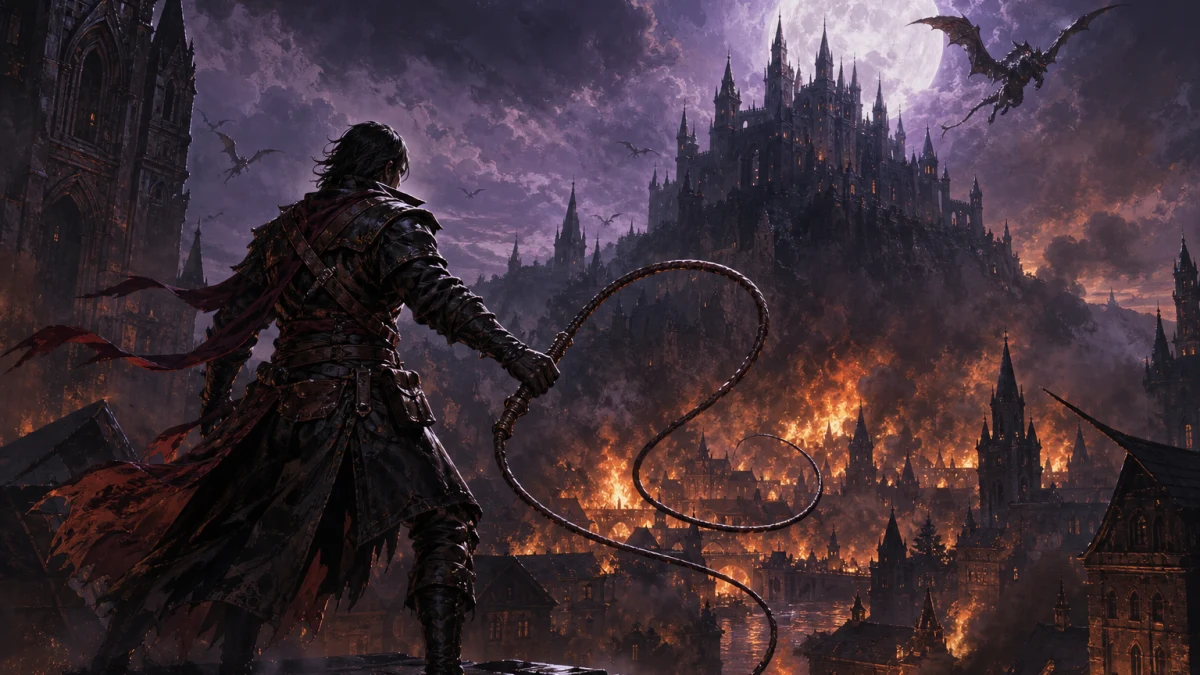
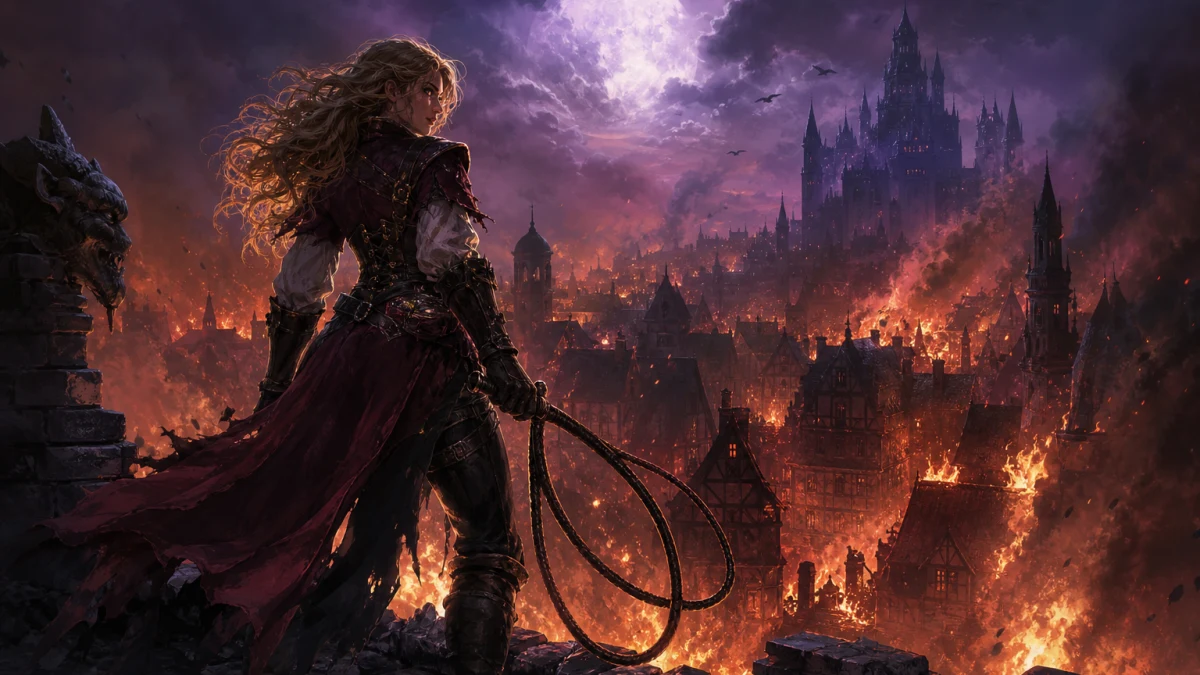
The announced emergency is direct: Paris is burning in 1499 after monstrous creatures suddenly emerge from the shadows and attack the capital. The wording presents the outbreak as an abrupt crisis rather than a danger the city has understood and contained for years. Streets, inhabitants and recognizable urban spaces are placed in immediate danger before Rose reaches the deepest supernatural source of the attack. The opening premise is therefore not merely another journey to an isolated castle; it starts with a populated city already suffering the consequences.
A request for help draws Trevor and Rose toward Paris. Official character material says they travel down the River Seine, giving the mission a clear approach route without establishing every event in the opening chapter. Both Belmonts enter the burning streets and hunt the creatures threatening the city. That is enough to correct the misconception that Rose begins as an unsupported replacement for an absent Trevor, but not enough to reconstruct when the two might separate, how long Trevor remains beside her or which early scenes are playable.
The monster assault is associated with a castle looming over the city, and Konami’s wider promotional material identifies the structure as Dracula’s Castle. Its presence makes the disaster part of the Belmonts’ inherited conflict rather than an unrelated outbreak that happens to involve familiar monsters. Yet the mechanism remains unknown. Public material does not say whether the castle was transported, summoned, reconstructed, manifested through magic or reached by some other route. Even its precise physical relationship to Paris should not be embellished ahead of release.
The declared objective is to save Paris from devastation. Konami’s press language broadens that objective to protecting Parisians from eternal darkness, framing the threat as more than ordinary fire or civic destruction. That phrase does not prove any particular ending, ritual or transformation. It defines the scale of the danger: if Rose and Trevor fail, the consequences extend to the people caught inside the city rather than only to the Belmont family.
This human dimension changes the atmosphere of the mission. Dracula’s Castle remains a central destination, but the premise first asks the Belmonts to respond to a public catastrophe. Burning streets imply homes, institutions and routes through the city under attack. The monsters are not waiting passively behind castle doors. They have already crossed into a human environment, which makes Rose’s first starring role a rescue mission and defensive struggle as well as a hunt.
The year also places the emergency at the end of the 15th century without turning the game into a historical simulation. Paris supplies recognizable geography and a real chronological anchor, but Dracula’s Castle, supernatural creatures and Rose’s curse immediately establish a fantasy crisis. Historical context can explain why a landmark belongs in the city or why a later institution does not; it cannot be used to predict the game’s fictional civic authorities, street plan or response to monsters.
It is safest to understand the opening in three layers. Paris is the visible disaster zone. Dracula’s Castle is the supernatural presence tied to that disaster. The dark conspiracy mentioned by Konami is the concealed layer Rose must uncover. The game may eventually reveal that these elements have one direct cause, several collaborating causes or a more complicated chain of manipulation. Before launch, the important point is that the fire and monsters are the beginning of the mystery, not a complete explanation of it.
Why 1499 Matters to the Castlevania Timeline
Konami places Belmont’s Curse 23 years after Castlevania III: Dracula’s Curse. Its official year, 1499, consequently points back to 1476 for Trevor Belmont’s defining victory over Dracula. That calculation agrees with Konami’s established history for the earlier conflict. The new date is therefore not an ornamental medieval setting chosen without connection to the series chronology; it situates Rose’s story one generation after Trevor’s original campaign.
Dracula’s Curse supplies the first essential reference point. In that game’s history, Trevor confronts Dracula with potential assistance from Sypha Belnades, Alucard and Grant. Later official summaries identify those figures as the playable allies associated with his campaign. Belmont’s Curse specifically builds its family premise from Trevor and Sypha, making their alliance against Dracula the origin of Rose’s household as well as a major victory in the broader war.
Curse of Darkness provides the second reference point. Set three years after the 1476 battle, it shows that Dracula’s defeat did not end the consequences of his campaign. Dracula temporarily returns, while a curse continues to torment the region. Trevor becomes involved in a conflict centered on devil forgemasters Hector and Isaac. Belmont’s Curse reaches back to that sequel by confirming Isaac as a returning figure with a history involving Trevor.
The arithmetic is useful because it prevents an oversimplified description of the new game as merely a direct follow-up to the NES story. From Trevor’s victory in 1476 to the temporary return three years later is one interval. From that return to the darkness stirring in Paris is another 20 years. Belmont’s Curse stands after both events, carrying unresolved elements of Dracula’s Curse and Curse of Darkness into 1499.
This chronology also clarifies what Rose would inherit without requiring an invented age. She belongs to a world shaped by a famous victory that occurred before her life as a hunter, while the consequences of Dracula’s curse entered her family at or around the beginning of her life. Konami has not published Rose’s exact birth date or age, so subtracting speculative dates to assign her a number would overstate the evidence. Young vampire hunter is the supported description.
The timeline does not prove that Dracula is physically alive at the opening. Konami says his temporary resurrection demonstrated that his soul was indestructible, and the appearance of his castle makes his influence difficult to ignore. Those facts establish continuing relevance, not his precise condition in 1499. He could already be embodied, approaching resurrection or exerting power through agents and relics; public material has not selected among those possibilities.
Canon placement also needs to be distinguished from presentation. Reporting on the developers says Konami and Evil Empire required the story to fit established Castlevania game continuity. That requirement supports reading the 1476 and Curse of Darkness links seriously. It does not mean every design choice must look exactly as it did in an older game, nor does it merge the project with a television adaptation that offers its own version of Trevor, Sypha and Dracula.
For newcomers, the shortest reliable chronology is consequently enough: Trevor and his allies defeat Dracula in 1476; Dracula temporarily returns three years later during the period associated with Curse of Darkness; 20 more years pass; and darkness then stirs in Paris in 1499. Belmont’s Curse is about what reaches the next Belmont generation after those victories proved incomplete.
The Belmont Connection in One Family Line
The immediate family line is unusually important and can be stated without constructing an encyclopedic Belmont genealogy. Trevor Belmont is Rose’s father. Sypha Belnades is Rose’s mother. Trevor and Sypha fought together against Dracula, and their daughter later trains as a vampire hunter. This makes Rose’s surname more than a general connection to the franchise’s recurring clan: she is the child of two identified heroes from the 1476 campaign.
From Trevor comes the publicly visible Belmont vocation. Rose has been trained to fight vampires and monsters, uses a whip and carries other weapons. The Vampire Killer remains central to the game’s combat and movement, so her relationship with the Belmont tradition is expressed through action rather than ancestry alone. Official material confirms that she uses the storied weapon; it does not yet detail the permanent terms of ownership, the moment it changes hands or every rule governing its use.
From Sypha comes a second heroic tradition, though Konami’s pre-release biography emphasizes a painful consequence rather than cataloguing everything Rose may have inherited from the Belnades line. Sypha fought alongside Trevor and became Rose’s mother, but she fell victim to Dracula’s curse and died soon after Rose was born. That loss left a continuing shadow over both father and daughter.
Rose thus inherits duty and harm through the same family history. Her father’s victory gives her a model of Belmont heroism and places a famous weapon in the new struggle. Her mother’s fate connects Dracula’s curse to Rose’s own body. The result is not simply the next Belmont fighting Dracula. It is a daughter confronting the fact that her parents’ celebrated triumph did not protect their family from lasting damage.
Specialist reporting on a developer interview adds useful creative context. According to that reporting, the mother-daughter bond and inherited curse were central to making Trevor’s daughter the protagonist. Rose’s motivation includes confronting her fate and avenging her mother’s death. Because that detail comes through interview reporting rather than the short official synopsis, it should inform the framework without being expanded into unannounced scenes, dialogue or a guaranteed path to vengeance.
The family line also establishes an emotional triangle even though Sypha is dead by 1499. Rose acts under the influence of a mother she lost soon after birth. Trevor enters Paris beside a daughter who bears a curse associated with his late wife. Rose must operate beside a father whose historic victory did not prevent that tragedy. Konami explicitly says Sypha’s death casts a lasting shadow over both of them, supporting emotional strain without defining exactly how either character expresses it.
This narrow family focus prevents a common continuity mistake. Rose’s importance does not need to be justified through an exhaustive chain connecting every known Belmont. The announced story identifies the two parents who matter directly, the battle they shared and the consequence that reached their child. More distant genealogy may eventually provide context, but it is not required to understand why Rose belongs at the center of the Paris crisis.
Calling Rose Trevor’s successor can therefore be misleading if it suggests he has died, retired or disappeared before the story. Official material shows Trevor answering Paris’s plea and entering the city with her. Rose succeeds him in the narrower sense of becoming the new protagonist and carrying the Belmont struggle into another generation. The story begins with continuity between father and daughter, not confirmed replacement through loss.
Who Rose Belmont Is
Konami introduces Rose Belmont as a young vampire hunter, Trevor’s daughter and the protagonist of Belmont’s Curse. Those three facts are the safest starting point. She is not an untrained civilian accidentally pulled into her family’s profession, nor is she presented merely as an assistant to Trevor. By the time Paris calls for help, she has already trained with a whip and several other types of weapons.
Her combat identity visibly preserves the Belmont tradition. The Vampire Killer is central to what has been shown, functioning as the most recognizable connection between her and the heroes who preceded her. Other weapons broaden her practical training, while Arcana acquired from bosses provide supernatural actions. Those systems indicate range in her capabilities, but a story primer should not convert their existence into unverified claims about her preferred style, canonical loadout or relative power.
Konami expressly describes the game as depicting Rose’s growth. That wording is significant because it separates a protagonist’s starting competence from a completed personal journey. Rose can already be a vampire hunter and still have substantial room to develop in judgment, mastery, self-understanding or her response to the curse. Which dimensions of growth dominate the plot remain unknown, and marketing language does not prove a particular endpoint.
Her right arm makes her different from a straightforward repetition of Trevor. Dracula’s curse is not only an inherited historical burden; it is physically present in her character design and biography. The arm establishes an internal threat or potential power that accompanies every external fight. Konami’s despair-or-salvation framing implies that Rose’s condition can be interpreted in more than one direction, but it does not yet reveal whether she controls it, fears it, needs it or risks being transformed by it.
Rose’s exact age should remain unstated. The timeline establishes that Sypha died soon after Rose was born and that the Paris crisis occurs 23 years after the original defeat of Dracula, but the available primary material does not give a precise birth date. Young is the official characterization. Assigning a numerical age from assumptions about conception, marriage or the timing of Sypha’s curse would create false precision.
Personality descriptions require similar care. It is reasonable to say that confronting a curse and entering a burning city gives Rose a severe test. It is not responsible to label her reckless, sarcastic, resentful, naïve or emotionally estranged from Trevor unless the finished narrative establishes those traits. A forceful pose in promotional art or a short exchange in a trailer cannot substitute for a complete characterization.
What can be said is already distinctive. Rose is a trained daughter of two veterans, not an anonymous descendant separated from the events that formed her family. Her mother’s death gives the crisis personal history. Her father is physically present at the mission’s beginning. Her own body bears Dracula’s curse. Her announced growth must unfold at the intersection of those relationships rather than through a generic quest for heroic status.
Rose should likewise not be collapsed into an older heroine because both occupy the Belmont line. Konami has given her a defined parentage, condition and historical position. Nothing in the published material identifies her as Sonia Belmont under a new name or uses her existence to restore Castlevania Legends to the principal chronology. Similarities between women who hunt vampires are not evidence of shared identity.
That makes Rose both an heir and an unsettled variable. She can use the tools associated with the Belmont name, but her curse may change what that inheritance means. She enters a conflict linked to her father’s past, yet Konami places her—not Trevor—at the center of the new answer. The premise asks what a Belmont becomes when Dracula’s influence exists inside the hunter as well as outside in the castle.
The Curse in Rose’s Right Arm
The most important established mystery is literal and visible: Rose bears Dracula’s curse in her right arm. Konami does not describe the condition merely as family trauma or a metaphorical burden. It is an affliction tied to a particular part of her body and attributed to Dracula. That specificity makes the title Belmont’s Curse potentially personal, although the exact meaning of the title has not been officially reduced to one explanation.
The curse links Rose to Sypha’s fate. Sypha fell victim to Dracula’s curse and died soon after Rose’s birth, while Rose now carries a related condition. What Konami has not explained is the mechanism connecting those events. Public biographies do not establish whether the curse passed biologically, moved through magic, was deliberately transferred, emerged later or arose through circumstances the story has concealed. Inherited is useful as a thematic description and has been used in developer-interview reporting, but it should not be mistaken for a complete technical account of the magical process.
Konami’s central promotional question asks whether the crimson curse will lead to despair or salvation. This creates two possible moral or narrative directions without promising a binary ending. Despair could refer to personal corruption, grief, defeat or the danger posed to Paris; salvation could refer to Rose, the city or the use of a hostile power toward a protective end. The language is designed to create tension, not to disclose the rule by which either outcome occurs.
The curse’s practical rules remain unknown. Official material has not fully established whether using it causes pain, shortens Rose’s life, changes her mind, attracts monsters or supplies abilities. Nor has it confirmed that the condition steadily worsens, can be removed or must be embraced. Gameplay imagery may encourage guesses, but animations and visual effects cannot independently settle their story meaning.
The right arm also complicates the traditional boundary between hunter and hunted. Belmont heroes ordinarily confront Dracula’s influence as an external evil represented by monsters, cursed lands and the castle. Rose carries an explicitly Dracula-linked mark while performing that same duty. The story can therefore place questions of control, identity and inherited blame inside its protagonist without making her allegiance doubtful by default.
Nothing in the published premise proves that Rose is destined to become a vampire, monster or antagonist. Likewise, nothing proves that the curse is secretly benevolent. The despair-or-salvation formulation deliberately keeps both danger and constructive possibility alive. Treating one interpretation as solved would erase the very uncertainty Konami is using to define her journey.
It is also premature to say the title refers only to Rose. Belmont’s Curse may describe her arm, the recurring duty forced on the family, the consequences Trevor carried home from Dracula’s defeat or several meanings at once. Apostrophe-based title analysis cannot replace story evidence. The singular construction suggests a focused burden, but the person or concept ultimately designated by it remains open.
A useful distinction is between source, transmission and effect. Dracula is the confirmed source associated with the curse. The means by which it reached Rose has not been fully disclosed. The complete effects on her body, mind and powers are also undisclosed. Keeping those categories separate prevents Sypha’s death from being treated as a full technical explanation of Rose’s condition.
The most reliable pre-release understanding is therefore narrow but consequential. Rose’s curse comes from Dracula, manifests in her right arm and connects her story to the affliction that killed Sypha. It may become a source of despair or salvation. Its origin, capabilities, cost, cure and final outcome are all being withheld. Those are not omissions to patch with lore theories; they are central questions the finished story is meant to answer.
Sypha Belnades and the Loss Behind Rose’s Journey
Sypha Belnades enters the new story through history and absence. Twenty-three years earlier, she fought beside Trevor in the battle against Dracula. Castlevania III material associates her with the group of heroes that also includes Alucard and Grant, but Belmont’s Curse narrows the focus to what followed her alliance with Trevor: she became Rose’s mother and remained vulnerable to Dracula’s curse after the apparent victory.
Konami states that Sypha fell victim to that curse and died soon after Rose was born. The wording must be preserved carefully. It does not say that Sypha died during childbirth, and it does not specify the exact interval between Rose’s birth and her death. It also does not publish the symptoms, progression or immediate circumstances of the fatal affliction. Those details may be important to the plot, but they are not established in the pre-release biography.
Her death demonstrates that defeating Dracula did not erase his capacity to injure the victors. Trevor’s campaign is remembered as a heroic success, yet its consequences enter his family and persist into the next generation. Sypha’s fate turns the old battle from distant lore into the cause of Rose’s present condition and Trevor’s continuing grief.
Konami says the loss left a lasting shadow over Trevor and Rose. That supports an enduring emotional effect on both characters but stops short of defining their relationship. It does not prove that Trevor became cold, overprotective or estranged, nor that Rose blames him. Those may be imaginable responses to grief; they remain character theories until the narrative shows them.
Rose’s connection to Sypha is necessarily unusual because Sypha died soon after her birth. Specialist interview reporting says the mother-daughter bond and inherited curse were central to the protagonist’s conception, while Rose is motivated to confront her fate and avenge her mother. Bond in this context need not imply years of remembered interaction. It can be formed through inherited consequences, stories, absence and the way Sypha’s fate structures Rose’s life.
Sypha’s legacy should not be reduced to victimhood. She was one of the heroes who fought Dracula in 1476, and Rose is the child of two combatants rather than only the daughter of a bereaved Belmont. Still, Konami has not yet detailed whether Rose inherits specific magic, equipment or techniques from Sypha. The curse is the explicit connection; any further transmission of Belnades abilities requires evidence from the released story.
The tragedy gives Rose a goal more intimate than saving a city she has just entered. Paris is the immediate public emergency, but Dracula’s curse has already reached into her family. Confronting the forces associated with it can mean seeking answers about Sypha, resisting a repeated fate and addressing harm that Trevor’s victory left unresolved. This personal dimension is supported even though the exact revenge target remains unrevealed.
The distinction between vengeance and explanation may prove important. Reporting identifies avenging Sypha as part of Rose’s motivation, but the public premise does not specify whom Rose holds directly responsible beyond Dracula’s curse. A conspiracy with an unknown architect may complicate the apparent target. Before release, it is better to recognize vengeance as an emotional drive than to assign Rose a confirmed person she intends to kill.
Sypha’s absence also affects Trevor’s role. He returns to a Dracula-linked crisis beside the daughter whose life has been shaped by his wife’s death. The mission therefore asks him to face an old enemy’s legacy under circumstances radically different from 1476. He is no longer only a hunter assembling allies against a tyrant; he is a father accompanying a cursed child into another manifestation of the conflict that took her mother.
Trevor Belmont’s Role in the Paris Mission
Trevor is not simply a name in Rose’s biography. Paris sends a request for help, and he answers it with his daughter. Official material places Trevor and Rose on the Seine as they travel toward the capital, then has both enter the burning streets to hunt the creatures threatening the city. This gives him an active place at the mission’s outset.
That point corrects two easy misconceptions. Rose is not introduced because Trevor has been confirmed dead, and she does not arrive after independently inheriting a vacant role. Konami identifies Trevor as the earlier hero and shows him participating in the response. Rose is the new protagonist because this is her story of growth, not because official material has removed her father before it begins.
Trevor’s presence creates a living bridge to Dracula’s Curse. He can carry direct memory of the 1476 battle, Sypha’s participation and Dracula’s temporary return three years later. Isaac also has an established history with him. The new plot therefore does not need to treat those events as abstract legends reconstructed entirely by a younger generation; at least one central participant enters the Paris crisis in person.
His famous weapon is another connection. Konami says Trevor wielded the legendary holy whip, the Vampire Killer, during his victory over Dracula. Rose uses it in the new game, but the public premise does not fully explain when or under what conditions Trevor passes it to her. That unanswered transition may be a routine element of training or an important story event. Either way, it should not be rewritten as proof of Trevor’s death or retirement.
The amount of Trevor’s involvement after the initial entry remains uncertain. His character biography and the synopsis confirm his arrival, but they do not provide a chapter-by-chapter account, a playable-character schedule or a guarantee that he accompanies Rose throughout the adventure. Preview shorthand about later areas should not be used to invent the time, cause or emotional circumstances of any separation.
Nor is there evidence that Trevor betrays Rose, becomes corrupted or secretly acts as an antagonist. Theories of that kind commonly gather around concealed villains and ominous character designs, but Konami’s published material does not establish them. The same applies to claims that The Fallen is Trevor in another form. A visual resemblance or dramatic possibility cannot override the lack of confirmation.
What can be inferred more responsibly is that Trevor has reasons to see the Paris crisis as both professional and personal. Monsters and Dracula’s Castle call upon his experience as a Belmont. Rose’s curse and Sypha’s death make the mission part of his family’s unfinished history. Isaac’s return carries consequences from Curse of Darkness into the present. These connections give Trevor narrative weight even while Rose occupies the central perspective.
There is also no confirmed measure of Trevor’s playability. His presence in the mission and importance to the story do not automatically mean he can be selected, controlled for a full chapter or used as a permanent companion. Those are mechanical and structural questions outside what the biographies establish. Keeping them open avoids allowing expectations about playable heroes to reshape the known story.
The father-daughter arrangement is one of the game’s clearest departures from a simple generational handoff. Trevor’s legend exists beside Rose rather than only behind her. Her growth can consequently involve acting under the immediate shadow of a renowned parent, receiving his help and eventually defining her own response to an enemy he has already defeated. Exactly how the story balances cooperation and independence is one of the meaningful questions reserved for release.
What Trevor’s Earlier Victories Did Not Resolve
Trevor defeated Count Dracula 23 years before the Paris crisis. In a conventional ending, that might have settled the threat for his generation. Castlevania’s established history says otherwise. Dracula temporarily resurrected three years later, and the events associated with Curse of Darkness showed that his defeat had left curses, followers and violence active in the world.
Konami’s new character material gives that history a particularly important formulation: Dracula’s temporary return demonstrated that his soul was indestructible. Indestructible does not necessarily mean permanently embodied. It means Trevor’s physical victory could not erase the essential source of Dracula’s recurring threat. Twenty years after the temporary resurrection, darkness begins stirring in Paris.
That distinction prevents two opposite errors. It would be wrong to describe Dracula as permanently destroyed after Dracula’s Curse, because Konami explicitly carries his soul and influence forward. It would also be wrong to state that a complete physical resurrection has already occurred when Belmont’s Curse opens. The castle, Death and the monsters make Dracula’s power relevant, but the exact state of the vampire king remains undisclosed.
Curse of Darkness also established that Dracula’s legacy can operate through other agents and ambitions. Isaac is a devil forgemaster capable of creating and commanding demons, and he has a history with Trevor dating back 20 years. His confirmed return means the Paris crisis can connect to the unfinished human and demonic networks surrounding Dracula even before the story clarifies Dracula’s own condition.
Death provides a more direct line of allegiance. Konami identifies Death as Dracula’s right-hand man. His presence in Belmont’s Curse strengthens the relationship between the attack and Dracula’s forces, but it still does not explain the conspiracy in full. A loyal servant can act to revive a master, protect a castle, pursue a separate stage of a plan or respond to another actor’s scheme. The confirmed allegiance identifies loyalty, not the complete objective.
Dracula’s Castle itself functions as evidence of persistence. It appears or looms within the Paris crisis despite Trevor’s earlier victory and the passage of decades. Yet Castlevania’s recurring castle is supernatural enough that its presence raises a question rather than answering one. Public material has not explained who brought it, what condition Dracula must be in for it to manifest or whether its arrival caused the attack.
Trevor’s victories therefore resolved immediate confrontations without removing every curse or follower. That is not the same as saying those victories were meaningless. He stopped Dracula’s campaign, survived later conflict and created the conditions for another generation to exist. Belmont’s Curse instead explores the cost left behind when a victory saves the world but cannot make evil’s consequences vanish from a family.
The difference between defeat and eradication is central to the chronology. Defeat describes what Trevor accomplished against Dracula in a particular confrontation. Eradication would require Dracula’s soul, servants, curses and capacity to return to be removed permanently. Konami explicitly denies that second condition by describing the soul as indestructible. The Paris crisis is consequently compatible with Trevor’s success without retroactively declaring that he failed in 1476.
For Rose, this history makes her mission more than a repeat of her father’s achievement. Trevor already proved that Dracula could be defeated in battle. Rose must confront what persisted after defeat: an indestructible soul, a dead mother, a curse in her arm, returning enemies and a castle tied to a new city’s suffering. Her challenge is not simply to reproduce 1476 in France but to answer the residue that 1476 could not eliminate.
From Wallachia to Paris
The Trevor-era conflicts began around Dracula’s war and curse in Wallachia. Dracula’s Curse sends Trevor into the struggle against the vampire’s forces, while Curse of Darkness returns to a land still suffering three years later. Those settings establish the geographic and emotional ground of Trevor’s legend. Belmont’s Curse moves the next major crisis west to Paris without severing those earlier connections.
The new center is not presented as a random stage for familiar iconography. Paris calls for Belmont assistance, darkness stirs there and Dracula’s Castle is associated with the monster attack. Isaac’s return and Trevor’s involvement connect the new location to events 20 years earlier. Rose’s curse carries the consequences even more directly, allowing the story to change countries while preserving continuity through bodies, memories and enemies.
This move broadens what a Trevor-family story can encompass. In Wallachia, Dracula’s aggression and its aftermath define the land around his domain. In Paris, his influence intrudes upon a prominent city with its own waterways, religious architecture, streets and underground spaces. The contrast allows the supernatural crisis to occupy an urban environment before the journey reaches the castle.
The distinction between historical geography and Castlevania fantasy should remain clear. Historical Wallachia is not interchangeable with every fictional depiction of Dracula’s domain, and Konami’s Paris is not advertised as a documentary reconstruction of the French capital in 1499. Belmont’s Curse uses a real year and recognizable places inside a dark Gothic interpretation shaped for action, monsters and a supernatural castle.
Even so, the date and location carry useful texture. Notre-Dame was already a centuries-old landmark by 1499, and the Seine naturally provides a route through and into Paris. Those elements can anchor the fantasy in a recognizable medieval city. Other imagery, especially anything resembling the later municipal Catacombs, can compress or transform history for dramatic effect.
The geographic move may also change the public meaning of a Belmont intervention. Trevor’s original conflict is embedded in the region afflicted by Dracula’s war. In Paris, father and daughter answer an external request for specialist help. They arrive as hunters entering a disaster that has already begun, which positions the Belmont name as a vocation capable of crossing borders when supernatural threats overwhelm local defenses.
What the move does not establish is how Dracula’s Castle reached France. It may have appeared through the power of Dracula’s soul, been summoned by a servant, followed a curse or obeyed rules unique to this story. None of those explanations has been confirmed. From Wallachia to Paris describes the series’ new dramatic center, not necessarily a literal journey taken by the castle.
The move also gives Rose a degree of narrative space from Trevor’s original battlefield. She is not simply retracing his exact road through the same afflicted territory. Paris presents its own population, visual identity and mysteries, even as old enemies follow the Belmont line there. That balance lets the game invoke established continuity without making Rose’s adventure a scene-for-scene repetition of her father’s campaign.
The result is continuation through displacement. Familiar conflicts are no longer confined to the territory where Trevor first fought them. The old curse can cross generations, and the old darkness can surface in another capital. Paris gives Rose a setting distinct from her father’s celebrated campaign while ensuring that the reasons she is there still arise from his unfinished history.
The Burning City and the Castle Beyond It
Belmont’s Curse divides its announced setting between an endangered city and Dracula’s Castle. That structure matters because a castle assault usually concentrates danger inside a hostile domain. Here, destruction has already spilled outward. Paris burns, monsters attack its streets and the people of the capital face the threat of eternal darkness before Rose can reach the traditional heart of the conflict.
The city raises the stakes through proximity. A castle can appear remote from ordinary life, even when its master threatens the wider world. Streets and landmarks make the victims visible as part of the environment Rose is trying to protect. Konami’s question of whether she can save Paris consequently concerns an inhabited place, not merely whether she can conquer a sequence of supernatural rooms.
Dracula’s Castle remains the looming counterweight. Official material identifies it by name and places confirmed enemies inside or in connection with it. Carmilla waits for Rose there, while Death’s status as Dracula’s right-hand man reinforces its link to the vampire king. Its presence promises the series’ familiar architecture of concentrated supernatural power without making the city sections disposable preliminaries.
Xbox Wire’s reporting indicates that the castle changes the structure of the adventure. The safest conclusion is that reaching it represents a meaningful transition, not that public reporting has disclosed every chapter or route. The streets, underground areas and castle form distinguishable components of the announced journey. Exactly how freely Rose moves among them, and whether the castle alters earlier spaces, belongs more properly to exploration coverage after release.
Narratively, the two-part premise lets Rose face consequences before causes. The fire and creatures are immediate symptoms. The castle is an obvious source of menace, but the hidden conspiracy suggests that entering it may not provide a simple explanation. Familiar enemies can be involved without being the only actors, and Dracula’s influence can be central without proving his precise physical state.
The castle’s relationship with Paris is deliberately mysterious. No official explanation establishes whether it occupies normal geography, exists through a magical connection or has displaced part of the city. It would be tempting to treat its arrival as proof of Dracula’s full resurrection, but that skips a missing step. Castlevania’s supernatural architecture can signal his power without settling exactly how that power currently manifests.
The burning city also complicates Rose’s priorities. Her family history might pull her toward Dracula and answers about Sypha, while the visible emergency requires protection of strangers. Those goals may align, but they are not identical. The premise can test whether a personal quest for vengeance remains subordinate to the Belmont duty of saving people endangered by the same evil.
The division also prevents Dracula’s Castle from accounting automatically for every event in Paris. The castle may be the source, destination or instrument of the crisis, but the conspiracy could involve actors and objectives outside its walls. A familiar landmark can organize the journey while still concealing why this city was chosen and why the attack occurs in 1499.
Together, city and castle turn the setting into a progression from public catastrophe toward concealed power. Rose begins amid devastation that everyone can see, descends through an underworld associated with a hidden conspiracy and ultimately confronts forces within Dracula’s domain. That shape is supported at a broad level. The causes, reversals and final destination within it are still unrevealed.
Notre-Dame, the Seine and the Paris Underground
The Seine is the clearest announced piece of Parisian geography. Trevor and Rose travel down the river in response to the city’s plea. This approach provides a recognizable route and a visual threshold into the emergency: the Belmonts move toward the capital while fire and supernatural danger await within it. The source does not justify a detailed reconstruction of their vessel, conversation or exact landing point.
Specialist hands-on reporting identifies Notre-Dame Cathedral among the recognizable French locations represented in the game. Its appearance is historically plausible for 1499. The first stone was laid in 1163, and the cathedral’s principal medieval construction and modification continued through the 13th and 14th centuries. By Rose’s time, it was already an established monument rather than a later building transplanted wholesale into the setting.
Historical plausibility does not guarantee visual exactness. Notre-Dame changed across later centuries through alterations, damage and restoration. A modern audience’s mental image includes features and restoration choices that may not correspond perfectly to its appearance in 1499. Belmont’s Curse is also a Gothic fantasy, so the cathedral can serve atmosphere and action rather than reproduce every architectural phase with scholarly precision.
The underground requires an even clearer distinction. Reporting refers to the Paris underground, and Konami identifies areas beneath the city among the journey’s settings. The mysterious Fallen is Rose’s first threat in the sewers. These details establish subterranean routes and imagery, but not that every area represents the institution tourists now call the Catacombs of Paris.
The famous municipal ossuary did not exist in 1499. It was consecrated in 1786 after remains were transferred into former quarry spaces in response to cemetery problems. Underground limestone extraction had a much older history, with the official Catacombs history dating the first underground quarries to the 14th century and the Tombe-Issoire quarries to at least the 15th. Cavities and fictional subterranean networks are therefore not inherently out of place, but the organized bone repository belongs to a much later Paris.
This distinction matters because catacombs is often used loosely in Gothic fiction to mean tunnels, crypts, sewers or bone-filled passages. If Belmont’s Curse adopts that vocabulary or imagery, readers should understand it as a fictionalized Parisian underworld rather than evidence that the 18th-century municipal ossuary existed nearly 300 years early. Fantasy can deliberately combine periods; a primer should identify the combination rather than rationalize it as literal history.
The three location types serve different narrative functions. The Seine brings Trevor and Rose into the crisis. Notre-Dame grounds the city in a monumental medieval landmark. Sewers and deeper underground spaces hide dangers beneath the visible fire, providing a natural environment for Rose’s encounter with The Fallen and her movement toward the concealed conspiracy.
Historical context is most useful here as a boundary, not as a prediction engine. Knowing that Notre-Dame existed does not establish which rooms Rose enters or what happens there. Knowing that medieval quarry spaces predated the municipal ossuary does not identify the game’s tunnels as a particular real network. The facts clarify what is plausible and what is anachronistic while leaving the fictional route untouched.
These historical notes should not be turned into a scorecard of inaccuracies before the full game is available. Konami calls Belmont’s Curse a 2D action-exploration game, not a historical simulation. The productive question is how the setting uses recognizable Paris to distinguish Rose’s story. Its landmarks provide identity; its anachronisms and supernatural transformations provide the Gothic fantasy. Keeping those roles separate allows both to be understood.
The Dark Conspiracy: What the Premise Says and Withholds
Konami says Rose becomes caught in a dark conspiracy beneath the visible crisis. That phrase establishes that the monster invasion is not the complete story. Someone or some group is acting with concealed coordination, and Rose’s movement through Paris brings her into the hidden design. The fire and creatures may be an objective, a diversion, a consequence or one stage of a larger plan.
The premise does not identify the mastermind. Dracula is the obvious figure around whom Castlevania expectations gather, especially with his castle and right-hand servant present. Obvious is not the same as confirmed. Dracula might direct events, be the intended beneficiary, be the object of a resurrection attempt or occupy a more complicated position. Konami has not publicly selected one explanation.
Isaac is another plausible subject of speculation because he creates and commands demons and has unfinished history with Trevor. Yet his confirmed return does not make him the architect of the Paris attack. A returning antagonist can serve, oppose, manipulate or be manipulated by another force. The character profile supplies his capability and history, not the full scope of his 1499 agenda.
Joan of Arc likewise should not be promoted from enigmatic boss to conspiracy leader without evidence. Her historical identity and unexplained appearance make her unusually conspicuous, but official material has not established her condition, allegiance or objectives. The Fallen is even less defined. Being Rose’s first threat in the sewers gives the creature dramatic importance, not a confirmed role as mastermind.
Trevor should not be inserted into the conspiracy through betrayal theories. No official source establishes that he is corrupted, secretly hostile or responsible for bringing Rose to Paris under false pretenses. The tragedy surrounding Sypha and Rose’s curse gives him emotional complexity, but grief is not evidence of villainy.
What can be concluded is structural. Rose encounters a crisis with at least two layers: public attack and concealed purpose. Familiar Dracula-associated figures account for part of the threat, while new mysteries prevent the story from being fully explained by old allegiances. The conspiracy may be the narrative device that connects Paris, Rose’s curse and the returning castle, but the exact connection remains a central withheld answer.
The language also suggests investigation through action rather than a simple commission to kill a known target. Rose begins with a request to save Paris, not a complete briefing naming the guilty party. As she moves from streets to underground spaces and the castle, the plot can reveal why the attack occurred and why her family is involved. That broad trajectory is reasonable; any proposed revelation within it remains conjecture.
Even the word conspiracy should not be stretched beyond its announced function. It indicates concealed planning or cooperation, but it does not reveal the number of participants, whether they share one goal or whether every boss knows the plan. Some enemies may be agents, obstacles, victims or opportunists. A roster of encounters is not automatically a roster of conspirators.
A useful pre-release rule is to treat every confirmed antagonist as a participant rather than the explanation. Isaac, Death, Carmilla and Medusa are present. Joan and The Fallen are mysteries. Dracula’s Castle looms over the disaster. None of those facts alone solves who designed the conspiracy, what it seeks or how Rose’s arm relates to it. The story’s promotional restraint depends on keeping those questions open.
Returning Threats and Their Established Connections
The returning enemy roster connects Belmont’s Curse to several layers of Castlevania history, but those connections differ in strength. Isaac has direct relevance to Trevor’s post-1476 life. Death has explicit loyalty to Dracula. Carmilla is confirmed inside Dracula’s Castle. Medusa is a traditional monster appearing as a major enemy. Grouping them all as willing members of one plan would flatten distinctions the public material has not resolved.
Isaac is the most specific link to Curse of Darkness. He is a devil forgemaster, which means he can create and command demons. Konami says he has history with Trevor dating back 20 years, matching the period of Dracula’s temporary resurrection and the later conflict. His appearance in Paris consequently carries a personal connection to Trevor as well as a practical connection to any outbreak involving demonic creatures.
That does not prove Isaac caused every monster to emerge. His abilities make the theory possible, but the premise may distinguish between creatures tied to his forging and other supernatural enemies. It also does not establish whether he remains motivated by precisely the same goals he held two decades earlier. The elapsed time and concealed conspiracy are reasons to await the story rather than assume an unchanged plan.
Death’s role is defined through allegiance. Konami identifies him as Dracula’s right-hand man, making him the clearest confirmed representative of Dracula’s interests. His presence strengthens the case that the Paris crisis is not merely borrowing the castle as scenery. Still, right-hand man does not reveal whether Death initiates the events, executes Dracula’s orders or works to restore his master.
Carmilla is waiting for Rose inside Dracula’s Castle. That location creates a direct obstacle on Rose’s path and places a recognizable vampire within the traditional domain. It does not establish that Carmilla welcomes the castle’s other occupants, knows the full conspiracy or serves Dracula under the same terms as Death. Waiting is a confrontation setup, not a complete statement of loyalty.
Medusa’s confirmation should be handled most conservatively. She belongs to Castlevania’s recurring monster vocabulary, and her presence supplies a familiar mythic threat. It would be unwarranted to infer a special relationship with Rose’s curse, tarot cards or the Paris setting solely from her name. A traditional boss can have an important encounter without becoming the key to the narrative.
The roster collectively tells readers that Rose’s trial spans more than one kind of opposition. Isaac brings human history and demonic creation. Death represents Dracula’s enduring hierarchy. Carmilla adds a powerful castle-based vampire. Medusa contributes a recurring mythological menace. Their announced presence ties Rose’s first leading role to the series’ past while leaving room for The Fallen, Joan and the conspiracy to supply new questions.
It is equally important not to assume that boss status settles a character’s fate. Konami’s Arcana system confirms that defeated bosses can be sealed into cards, but pre-release material does not map every named figure to an identical narrative outcome. Defeated, sealed and killed are not necessarily interchangeable terms. The story may attach different consequences to different encounters.
The crucial evidence boundary concerns cooperation. Only Death’s direct allegiance is explicit in the available profiles. Carmilla’s location, Isaac’s old history and Medusa’s boss status do not automatically make them a unified council serving Dracula willingly. Belmont’s Curse may eventually connect them under one plan, but the pre-release record confirms encounters and associations, not the complete command structure.
The New Mysteries: The Fallen and Joan of Arc
The Fallen is identified as a mysterious monster terrorizing Paris and as the first threat Rose encounters in the sewers. This places it early in her descent beneath the city and gives it a defined function as an immediate obstacle. Beyond that, its identity and origin are unknown. Even the name may be a title rather than a species or personal identity.
Because Trevor accompanies Rose into Paris but her later journey centers on her, The Fallen has attracted an obvious class of transformation theories. None is established. Konami has not said the creature is Trevor, Dracula, a former Belmont or a cursed version of any known character. Silhouette, color and thematic resemblance are insufficient to identify a deliberately mysterious monster.
The Fallen could be connected to the conspiracy, the curse or the general outbreak, but those are categories of possibility rather than facts. Its position in the sewers may simply make it the first major guardian of the underground. Until the story supplies dialogue, history or an explicit reveal, the useful description remains the official one: a mysterious creature terrorizing Paris and confronting Rose below the city.
Joan of Arc presents a different mystery because her historical identity is immediately recognizable. The historical Joan was executed in 1431, 68 years before the game’s 1499 setting. Belmont’s Curse presents Joan as an enigmatic boss, meaning her presence is intentionally extraordinary even within the stated date. Official material has not explained how she appears or what state she is in.
Several familiar fantasy explanations would fit—resurrection, possession, necromancy, illusion or a transformed legacy—but none has been confirmed. Calling her undead or corrupted would convert genre expectation into plot fact. The description enigmatic boss preserves what matters: Rose fights or confronts a figure identified as Joan of Arc, and the reason for that confrontation is being withheld.
Joan’s inclusion also intensifies the French identity of the story without making Belmont’s Curse a historical account of her life. Her symbolic association with France, faith, warfare and martyrdom can create thematic resonance in a burning Paris. The game may use some of those ideas, but no particular symbolic reading should be attributed to the developers unless the story or an interview establishes it.
Both mysteries caution against treating a boss roster as a solved chain of command. The Fallen’s first encounter does not make it the ultimate villain. Joan’s fame does not make her the conspiracy’s architect. Their announced roles are designed to produce questions at different levels: one is an unknown monster beneath Paris; the other is a known historical person appearing under impossible circumstances.
The phrase first threat also needs a narrow reading. It identifies The Fallen’s place in Rose’s sewer experience, not necessarily the first enemy she fights anywhere in the game or the first supernatural event in chronological order. Promotional profiles often summarize encounters rather than provide exact scene sequencing. That is why the opening should not be reconstructed from one line of biography.
They also show how the new game balances inherited lore with local invention. Death and Isaac arrive with established relationships. The Fallen must be understood through new evidence. Joan brings cultural familiarity but no explained Castlevania role. Rose, herself a new Belmont with an old family burden, is appropriately positioned between those categories as she discovers what belongs to her parents’ past and what is emerging specifically in 1499.
Tarot, Arcana and the Story’s Recurring Symbols
Konami confirms that defeated bosses can be sealed into Rose’s tarot cards as Arcana. Those Arcana provide spells or special actions, turning major encounters into additions to her available abilities. This is an announced gameplay system rather than a speculative reading of promotional art, and it distinguishes Rose’s toolset from a purely conventional whip-and-subweapon repertoire.
The cards also fit the language surrounding Rose. Her story is framed around fate, a curse and the possibility of despair or salvation. Tarot imagery naturally evokes interpretation, uncertain outcomes and the tension between a predicted future and individual choice. That makes the system thematically compatible with Rose’s predicament even though Konami has not published an official card-by-card narrative code.
Sealing bosses into cards introduces another potentially meaningful relationship: Rose does not merely destroy every threat and walk away. At the mechanical level, victory allows her to contain and use something associated with the defeated enemy. That pattern resembles her larger condition, in which a power originating with Dracula exists within the hunter opposing him. The parallel is a reasonable interpretation, not a confirmed explanation of the curse.
The lore rules of Arcana remain unclear. Public material does not fully establish who created the cards, why Rose can use them, whether sealing alters the boss in the story or how other characters understand the practice. It also does not say that the cards cause, suppress or cure the curse in her right arm. Their proximity in Rose’s design should not be mistaken for proof of direct causation.
Tarot terminology can encourage overconfident symbolism. A viewer may match a boss to a familiar major arcana concept and infer a betrayal, death or transformation. Such readings can be entertaining, but tarot traditions are varied, card meanings depend on context and gameplay adaptations rarely reproduce one rigid system. More importantly, promotional material has not confirmed that every card predicts a specific plot event.
The safest thematic observation is broader. Rose repeatedly faces forces that seem to define her future: her surname assigns a duty, her mother’s death presents a feared precedent and Dracula’s curse occupies her body. Arcana let her convert defeated threats into chosen actions. Mechanically, what confronts her can become part of her agency rather than remaining only an external sentence.
That pattern supports the despair-or-salvation question. A curse can be understood as a fixed doom, but a protagonist who repurposes hostile powers may find another meaning for inheritance. This does not prove that Rose saves herself by mastering Arcana or that every enemy is redeemed through sealing. It identifies a recurring tension between imposed conditions and active use.
The cards should also be kept separate from claims about moral alignment. Using an Arcana associated with an enemy does not by itself mean Rose shares that enemy’s motives, has absorbed its personality or is becoming corrupted. A mechanical ability can symbolize mastery without carrying every trait of its source. Only explicit story material can establish a deeper transfer.
Until launch, the Arcana should therefore be discussed at two levels. Confirmed: bosses can be sealed into tarot cards, and the resulting Arcana grant spells or special actions. Interpretive: the cards reinforce the story’s concern with fate and the possibility of transforming danger into agency. Unknown: their origin, metaphysical relationship with Rose’s arm and ultimate role in resolving the conspiracy.
What Belmont’s Curse Appears to Be About
At its most visible level, Belmont’s Curse is about inherited duty. Rose is Trevor Belmont’s daughter, trained as a vampire hunter and equipped to use the weapon associated with his victory. Paris calls for help, and the family answers. The Belmont name functions as a commitment to confront supernatural threats wherever they emerge, not merely as ancestry that grants Rose importance automatically.
The second inheritance is harm. Sypha survived the campaign against Dracula only to fall victim to his curse and die soon after Rose’s birth. Rose bears Dracula’s curse in her right arm. The same family history that gives her a heroic model also places an enemy’s influence inside her body. Duty and damage arrive from the same past.
Rose’s position beneath two famous parents is therefore central. Trevor’s victory is established legend, and he accompanies her into the new emergency. Sypha’s heroism and death shape Rose despite the absence of a conventional remembered relationship. Rose must grow while her identity is already crowded by what her parents accomplished, suffered and failed to resolve.
The Paris setting externalizes that inheritance. A conflict rooted in Wallachia has reached another country decades later. Dracula’s Castle appears around a city that did not share the original battlefield, just as Dracula’s curse appears in a daughter who did not fight the original war. Past evil refuses to remain contained by place, victory or generation.
Yet the announced framing does not treat Rose as merely doomed to repeat Sypha’s fate. The question of despair or salvation preserves the possibility that her response matters. Salvation may not mean a simple cure, and despair may involve more than physical corruption, but the opposition implies that the curse’s meaning is not settled at the beginning.
The Arcana system reinforces that interpretation at a symbolic level. Rose can seal defeated bosses and turn them into usable powers. Without claiming a direct lore connection, the system repeatedly asks her to convert an imposed threat into an act she controls. Her whip carries an inherited tradition; her cards represent acquired possibilities. The curse sits uneasily between them as an imposed force whose ultimate use or cost is unknown.
Trevor’s presence makes choice more complicated rather than less important. Rose does not need to discover the Belmont ideal from old stories alone; its most famous recent representative stands beside her. Her growth may require learning from him, diverging from him or understanding what his victories could not accomplish. None of those paths requires Trevor to die or become an enemy.
The conspiracy introduces a question of knowledge alongside fate. Rose initially sees fire and monsters, but another design lies beneath them. Her family has also lived with visible consequences while lacking a complete answer to Dracula’s curse. Uncovering who is acting in Paris may therefore parallel understanding what has acted upon Rose since birth.
The public and personal stakes also test different dimensions of heroism. Rose may want answers about Sypha and relief from her own condition, but Paris needs protection regardless of whether those answers are available. A Belmont duty defined only by family vengeance would be narrower than the rescue mission Konami has announced. Rose’s growth may be measured partly by how she balances the two, although the finished plot must show how that balance develops.
Taken together, the announced material supports a story about whether inheritance determines identity. Rose cannot choose her parents, the history attached to her name or the curse in her arm. She can choose how to enter the crisis, what to protect and what to do with the powers she acquires. Belmont’s Curse appears interested in the point where an inherited fate becomes a personal decision.
That interpretation should remain provisional. The finished plot may complicate every apparent theme through revelations about Sypha, Dracula or the conspiracy. Before release, however, it explains why Rose is more than another whip-wielding descendant. She embodies both sides of the old conflict: the Belmont obligation to resist Dracula and the curse through which Dracula’s harm persists.
The Questions to Carry Into Launch
The first unresolved question is what caused the Paris outbreak. Monsters have suddenly emerged, but the public synopsis does not name the force that released, summoned or organized them. Isaac’s devil-forging ability makes him relevant without proving sole responsibility. Dracula’s forces are present without establishing that Dracula personally initiated the attack.
The second is why Dracula’s Castle has appeared in connection with Paris. Its presence ties the crisis to the series’ central vampire, but no official account explains its movement or manifestation. The castle may be part of a resurrection, a tool used by another actor or a supernatural response to conditions in the city. Each remains hypothetical.
The third is the exact nature of Rose’s curse. Konami identifies Dracula as its source and Rose’s right arm as its location, while Sypha’s death supplies the family connection. It has not explained transmission, symptoms, powers, costs or a cure. The most important answer may be not only what the curse does, but whether Rose can determine what it becomes.
The fourth is what the conspiracy wants. Saving Paris is the immediate task, yet the hidden scheme suggests that devastation may serve another purpose. It could concern Dracula, Rose, the castle or a broader transformation of the city. No named character should be assigned responsibility until the story does so.
Trevor’s ultimate role is similarly open. He enters Paris with Rose, but the amount and form of his later involvement are not confirmed. Nothing establishes his death, betrayal, corruption or permanent separation from his daughter. The meaningful question is how his experience and grief affect Rose’s emergence as the protagonist.
Isaac’s role must be distinguished from his capability. He can create and command demons and has a 20-year history with Trevor. Whether he leads the assault, serves another force or pursues a separate objective remains unknown. Death’s explicit loyalty to Dracula provides a clearer allegiance but not a complete plan.
Joan of Arc and The Fallen carry the largest identity questions. Joan is an enigmatic boss whose condition and motives are concealed. The Fallen is Rose’s first sewer threat but has no disclosed origin. Neither should be explained through possession, resurrection or secret-identity theories before the game provides evidence.
Finally, the state of Dracula himself remains unsettled. His soul is described as indestructible, his castle is present and his right-hand servant opposes Rose. Those facts ensure his relevance. They do not confirm whether he is fully resurrected at the opening, approaching return or influencing events through another means.
A further question concerns the relationship between the Arcana and Rose’s curse. Both involve taking supernatural power into Rose’s personal repertoire, but Konami has not said that one created, controls or resolves the other. Their thematic similarity is worth watching precisely because the lore connection remains unconfirmed.
These uncertainties are not obstacles to understanding the premise. They are the premise’s intended pressure points. A reader entering Belmont’s Curse needs to know who Rose is, why Sypha’s death matters, why Trevor’s old victories did not end the danger and why Paris is now at risk. The answers beyond that belong to the released story.
- What triggered the monsters’ sudden emergence in Paris?
- How and why is Dracula’s Castle connected to the French capital?
- How did Dracula’s curse reach Rose, and what does it do to her right arm?
- Who designed the dark conspiracy, and what is its objective?
- How long does Trevor remain directly involved in Rose’s mission?
- What does Isaac want 20 years after his earlier conflict with Trevor?
- Why does Rose confront Joan of Arc, and what is Joan’s true condition?
- What is The Fallen, and why is it terrorizing the sewers?
- How do the Arcana cards relate, if at all, to Rose’s curse?
- Is Dracula physically resurrected, returning through a plan or present only through his influence?
Before launch, the dependable story is one of connected consequences. Trevor defeated Dracula in 1476, faced the effects of his temporary return three years later and lost Sypha to Dracula’s curse after Rose was born. In 1499, Trevor and Rose answer Paris’s plea together, only for Rose to enter a crisis involving monsters, a hidden conspiracy, returning enemies and Dracula’s Castle.
Rose stands at the center because she carries both outcomes of her parents’ history. The Vampire Killer and her training express the duty that survived their victory. The curse in her right arm expresses the damage that survived it. Konami’s promise that Belmont’s Curse depicts her growth makes the key question not whether she has inherited the Belmont role, but how she will define it when Dracula’s influence is part of her inheritance too.
Everything else—the conspiracy’s architect, the castle’s arrival, Joan’s condition, The Fallen’s identity, Trevor’s full role and Dracula’s physical state—remains intentionally unresolved. Those boundaries make the premise clearer rather than thinner: Paris is the emergency, the family curse is the personal stake and Rose’s ability to turn an imposed fate toward despair or salvation is the story’s central uncertainty.
Sources
- Castlevania: Belmont’s Curse Official Website
- Castlevania: Belmont’s Curse Official Character Profiles
- Konami Release Date and Midnight Edition Announcement
- Konami Castlevania III: Dracula’s Curse History Page
- Konami Castlevania: Curse of Darkness History Page
- Xbox Wire Developer Interview and Hands-on Report
- PlayStation Blog Castlevania Anniversary Collection Guide
- Notre-Dame de Paris Architecture History
- Notre-Dame de Paris Builders History
- Official Paris Catacombs Site History
- GamesRadar Report on Rose’s Character Conception