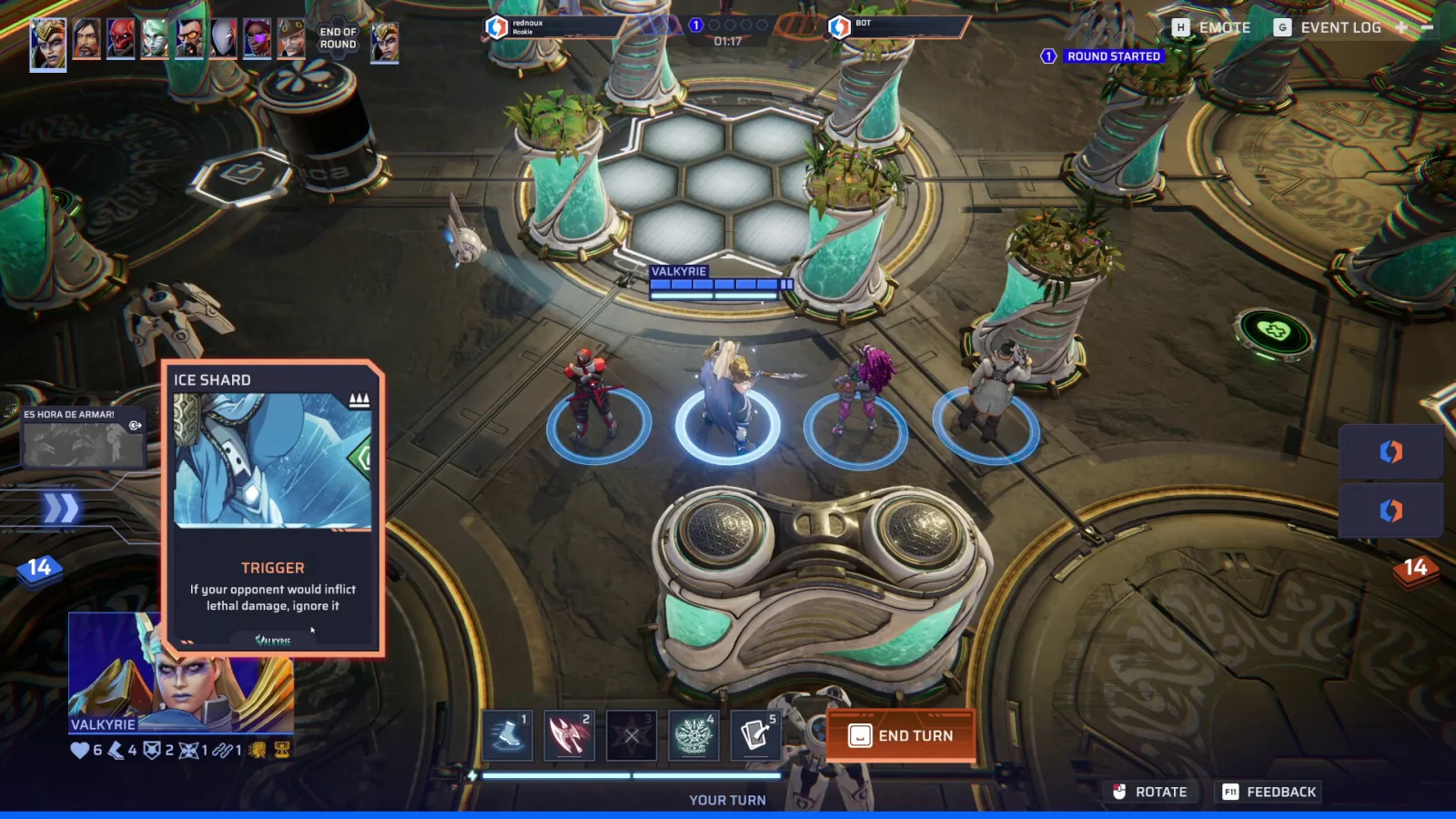
Infinity: HexaDome Tactics is a PC turn-based strategy game from Blindspot Games, which also publishes it. Released on September 10, 2026, it brings the Aristeia/Infinity setting into a compact arena format: players build teams from 12 heroes, use tactical cards through deckbuilding, and compete across multiple arenas. The announced package also includes a single-player story, online PvP, and controller support.
Those are the established components. The more difficult question is what kind of value they create together. Available critical accounts point toward a game whose central turn structure is notably understandable: heroes occupy a hex-based arena, action points constrain the immediate turn, cover matters, and tactical cards widen the available choices. Objectives reportedly keep attention on something more specific than simply removing opposing units. That is a promising foundation for a strategy game because it gives decisions several visible axes at once: position, resource use, card timing, team role, and the current objective.
It is also a foundation that should not be confused with a guarantee of a healthy long-term multiplayer service. Critical accounts describe meaningful tactical satisfaction while also raising concerns about early learning demands, launch PvE breadth, AI behavior, matchmaking, and population dependence. Infinity: HexaDome Tactics therefore looks best assessed as a design with a potentially strong mechanical proposition and a separate, unresolved product-context proposition. The first concerns whether turns are interesting. The second concerns whether the surrounding modes, audience, and ongoing support make that interest easy to access over time.
A tactical game designed for readable pressure
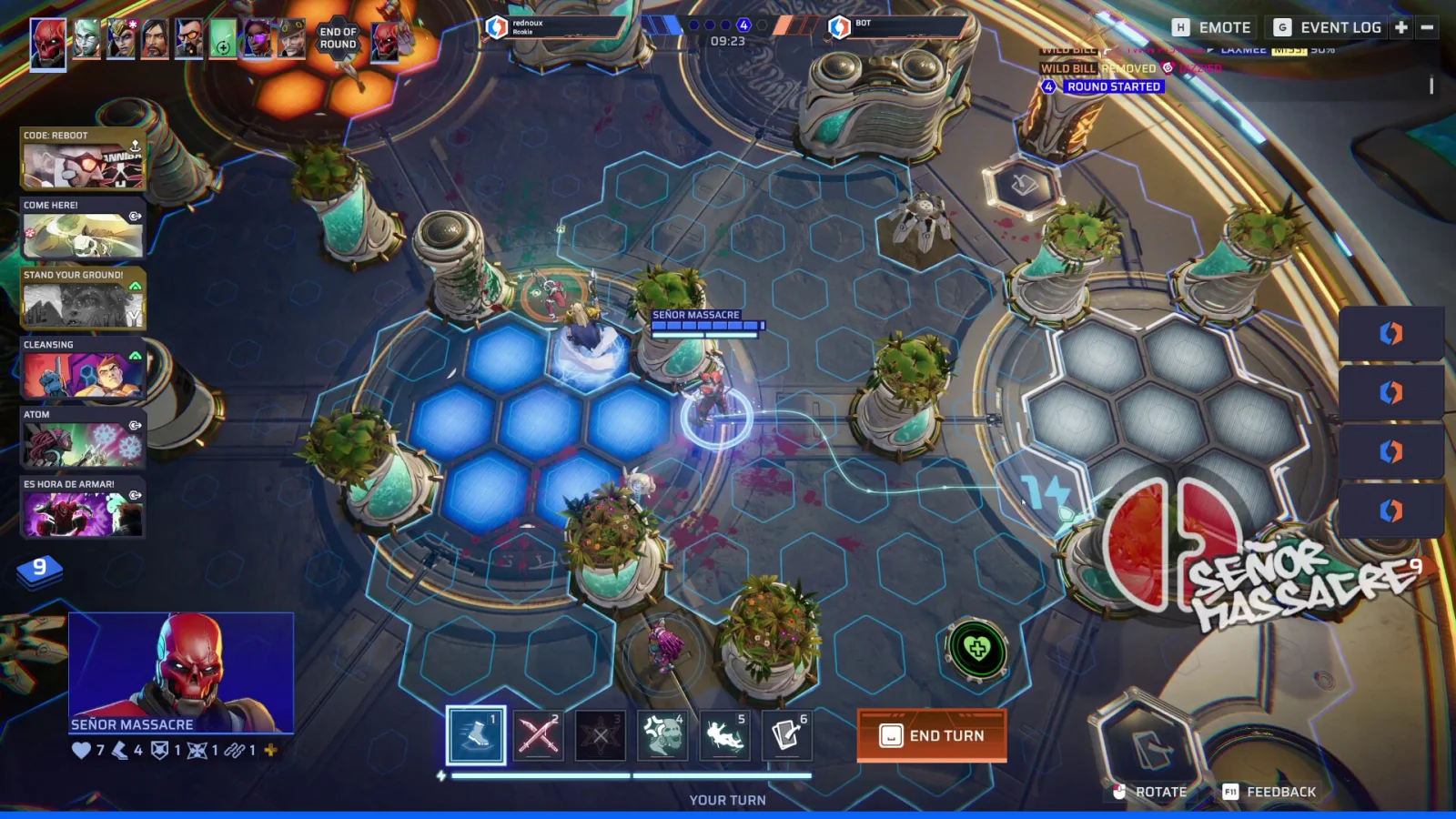
The clearest appeal in the available evidence is the decision to frame competition as arena sport rather than attempt a direct simulation of a large tabletop war. That distinction matters. A large-scale adaptation can ask players to parse sprawling units, long distances, and many interlocking rules before it reaches the drama of a single crucial exchange. Compact hex arenas can instead put that drama at the center. When space is limited and objectives are immediate, a movement choice is less likely to disappear into administrative setup. It can be the decision that exposes a hero, claims cover, threatens a route, or prepares a later card play.
Critics have specifically praised the game’s legibility relative to a more direct tabletop-war approach, along with the compactness of its objectives. That does not establish that every match is simple, nor would simplicity necessarily be the goal. Rather, it suggests the game may be aiming for consequences that can be read from the board: a player can see where the contested space is, see which heroes are committed, and understand why an action-point decision matters. For turn-based competition, that is a valuable quality. Tension becomes easier to interpret when players can recognize both the immediate reward and the exposure created by pursuing it.
Action points appear central to that readability. A limited action economy turns every option into an opportunity cost. Spending resources to improve position can mean forgoing a more direct play; using a card at one moment may deny its utility in the next exchange. The evidence does not establish the exact action-point rules, card cadence, or available actions, so any account of detailed interactions would overreach. Still, the reported emphasis on planning sequences rather than merely reacting indicates a design priority worth examining. A satisfying sequence-based tactics game lets an early decision create a later possibility, while preserving enough opposing agency that the plan must be revised rather than executed automatically.
That is where cover, hex positioning, heroes, and cards can form a productive tactical language. Cover makes a tile more than a coordinate. Hexes make approach angles and proximity easier to visualize. Distinct hero roles can give team selection a strategic purpose before the first turn. Tactical cards can create exceptions, threats, or timing questions that the board alone would not provide. None of those ingredients is unusual by itself. Their value depends on whether they make one another more meaningful. Available criticism and praise suggests that Infinity: HexaDome Tactics has, at minimum, a recognizable core in which those parts are intended to meet.
Heroes and team composition need more than surface variety
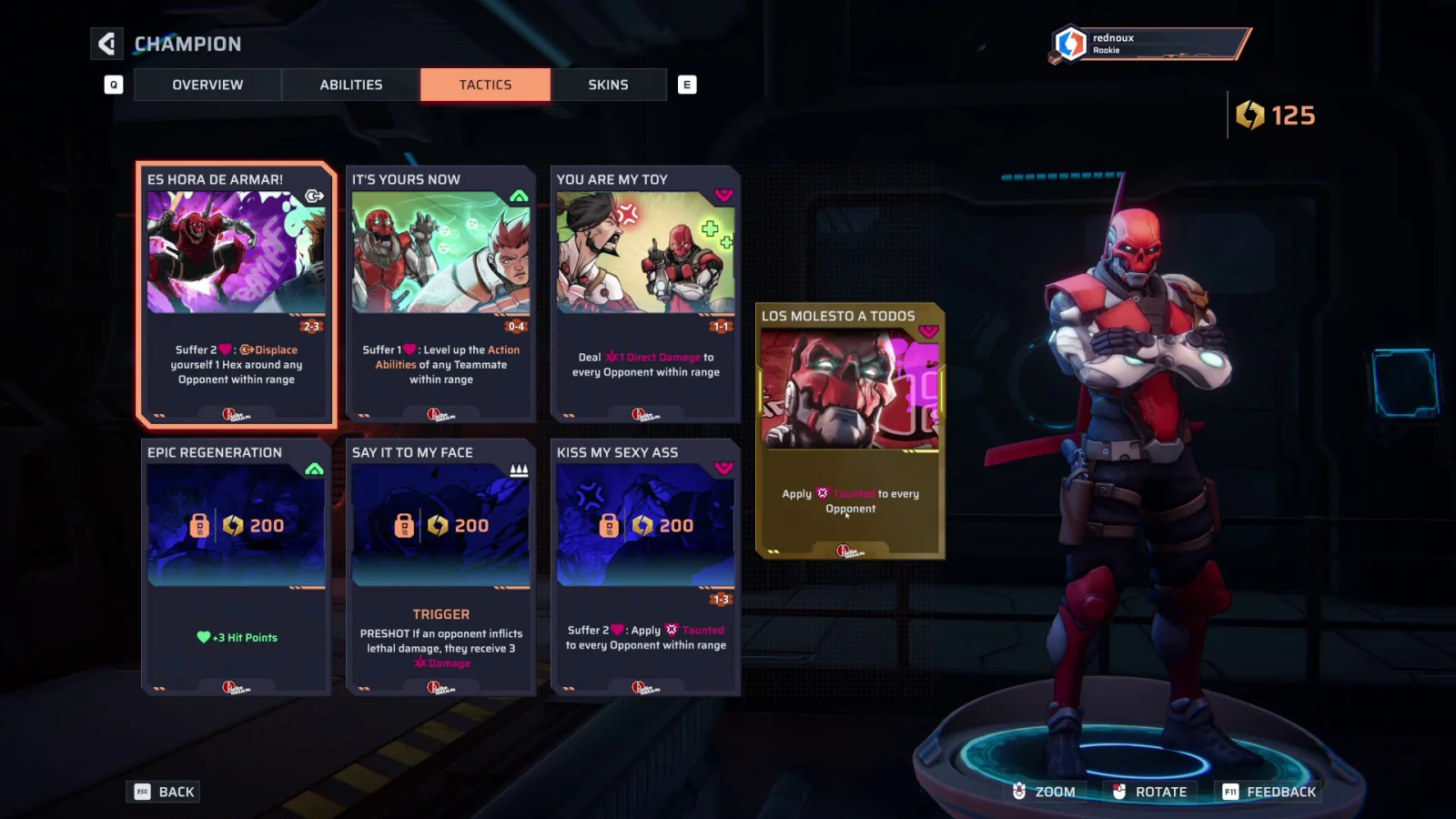
The verified roster count is 12 heroes. Critics have described champion roles as distinct, and that is an encouraging observation because team composition should be one of the game’s major decision layers. A roster does not need to be enormous to support meaningful strategy. A smaller roster can be easier to learn, easier to communicate about, and easier to balance in principle. It can also make the differences between choices more visible. The trade-off is that every hero must justify the space it occupies, and every composition option must contribute to more than cosmetic variation.
Conditional analysis is especially important here. If heroes have roles that produce genuinely different board priorities, then composition can shape how players value space, cover, objectives, and tactical cards. A team that wants to control a central area may ask different questions from a team that prefers to create pressure from another angle. If, however, the choices converge on one repeatedly superior plan, the roster’s apparent variety would do less work than the number 12 implies. The existing evidence supports the first possibility as an early strength in critical impressions, but it does not establish enduring balance across all heroes or compositions.
Deckbuilding adds another possible layer of authorship. Instead of asking players only to select heroes, it asks them to consider what tactical tools they want available around those heroes. This can improve the game’s strategic identity because a team is defined both by who enters the arena and by the options it carries into decision points. Yet deckbuilding also raises the cost of learning. A newcomer is not only reading units and a map; they may be learning card value, timing, synergies, and the relationship between a deck and an objective-focused match.
That learning burden aligns with reports of a steep early curve. A steep beginning is not automatically a criticism. Strategy games often reward sustained study, and an arena game with several overlapping decision systems may be richer precisely because it does not reveal its best choices instantly. But the first hours have to convert complexity into curiosity. Players need enough clarity to identify why a turn went well or poorly. Without that, defeat can feel like hidden knowledge rather than a lesson. The reported accessibility of the broad match structure may help; legible arenas and objectives can provide an anchor even while team and card knowledge accumulate.
The single-player story is important, but its role should be described carefully
Infinity: HexaDome Tactics includes a single-player story. One critical account viewed the campaign as a useful entry point, while another raised concerns about limited PvE at launch. Those observations should be kept in proportion. They establish neither the story’s length nor the full range of single-player content. They do, however, identify a practical distinction between having a single-player route and having a broad PvE offering.
For a tactics game with deckbuilding and team composition, a story mode can do several jobs. It can introduce core rules gradually, provide lower-pressure opportunities to understand hero roles, and give players a place to experiment before entering PvP. That is conditional design analysis, not a claim about how this particular campaign is structured. The available observation that the campaign serves as an entry point is encouraging, but it does not by itself answer whether it satisfies players seeking a substantial primarily solo strategy game.
The launch-PvE concern is therefore material. Players drawn by the Infinity setting or by turn-based tactics may reasonably treat single-player content as a major part of the purchase decision. They should distinguish that expectation from the game’s documented online PvP emphasis. A campaign can be valuable as onboarding and still not replace a wider suite of repeatable or varied solo activities. Conversely, a player chiefly interested in competitive tactical matches may regard the story as an additional route into the rules rather than the main attraction. The same feature can carry different weight depending on the buyer’s purpose.
AI criticism requires similar restraint. One critical account cited questionable AI decisions. That is a relevant warning for anyone considering the single-player side, but it is still a reported evaluation rather than a comprehensive technical finding. It does not prove that AI behavior is uniformly poor in every situation, and it should not be inflated into a claim about every encounter. It does reinforce the broader point that a campaign’s value is not solely a matter of whether it exists. The quality of opponents, scenarios, teaching, and replay interest all affect whether a solo mode becomes a lasting counterpart to PvP or a more limited introduction.
Mechanical quality and service health are different evaluations
The strongest reason to avoid a numerical verdict here is that two separate assessments remain entangled. The first is mechanical: does the ruleset generate satisfying tactical choices? The available critical response offers meaningful positive evidence. Distinct roles, action-point decisions, cards, cover, compact objectives, and an emphasis on planning sequences all point toward a system with a clear tactical identity. Store-user reports are mixed and volatile, but they include praise for deterministic tactics, which broadly supports the idea that predictable rules and planning are central to the appeal.
The second assessment is operational: can an online PvP-forward game reliably provide opponents, reasonable queues, and confidence that its multiplayer package will be supported? Here, the evidence is much less reassuring. One reviewer reported long matchmaking waits and a thin launch population, while also questioning the sustainability of paid multiplayer. These are serious risks for any game whose competitive mode gains much of its value from a dependable opponent pool. They are not, however, a complete measurement of current population or a permanent forecast. Population can change, and an individual wait does not establish every player’s experience in every region or time period.
That distinction is more than a technicality. A mechanically excellent competitive game can be difficult to recommend without qualification if entering a match is unreliable. Equally, a game can have a live audience while possessing shallow or muddled tactical decisions. Infinity: HexaDome Tactics may have the more attractive half of this equation in its underlying turn-to-turn concept, according to the evidence at hand. Whether the other half supports it is a live question rather than a settled conclusion.
Store-user feedback should be treated with the same care. The overall reception is mixed and inherently changeable. Positive comments about deterministic tactics have value as another indication of what some players appreciate; complaints about content packaging and presentation identify areas of dissatisfaction. Neither category should be turned into a universal verdict. Storefront sentiment is a useful signal of points of friction and enthusiasm, not a stable substitute for detailed feature verification.
For readers thinking about other compact arena-driven designs, this site’s Gladio Mori assessment offers a separate look at how an arena premise can place system design at the center of the experience. The comparison should stop there: the available evidence does not support claims that the games share specific mechanics, audiences, or competitive conditions.
Who the current proposition may suit
Infinity: HexaDome Tactics appears best suited, conditionally, to players who want a concentrated turn-based contest where planning ahead matters and the board state is meant to remain interpretable. The verified ingredients—hero teams, tactical-card deckbuilding, multiple arenas, online PvP, and a single-player story—present a coherent package on paper. Critical praise suggests the game’s strongest case is the relationship between those systems in an objective-led hex arena, not sheer scale or an attempt to recreate a massive war game.
Players who want a deep solo-first tactics experience should approach with more caution. The presence of a story is confirmed, and it has been described as a helpful entry point, but launch PvE breadth has been questioned. Players who need consistently available online matches should apply the same caution for a different reason: reported matchmaking and population concerns directly affect the usefulness of a PvP-centered offering. Controller support is confirmed, but no conclusion should be drawn from that fact about implementation quality or accessibility more broadly.
Ultimately, the most defensible reading is neither dismissal nor blanket endorsement. Infinity: HexaDome Tactics has evidence of a thoughtfully focused tactical core: one that values deliberate sequencing, objective pressure, role differentiation, and readable arenas. That core can be genuinely compelling even if the surrounding service conditions are uncertain. At the same time, mechanical promise does not erase concerns about learning friction, limited reported PvE at launch, AI criticism, or the dependence of online competition on an active population. Prospective players should decide which side of that divide matters more to them. The game’s tactics may be the reason to investigate it; its evolving multiplayer and content context are the reasons to remain selective about expectations.