There are no Joking Joystick gameplay notes, performance tests, or direct observations supporting a verdict on responsiveness, difficulty, balance, campaign quality, or overall execution. The established details below come from the game’s public PC listing and description. The analysis that follows considers what those announced elements could mean in practice without treating possibilities as proven results.
Blades & Battles is listed as an Action, Adventure, and Indie game from QUByte Interactive, which is also listed as its publisher. It released for PC on September 29, 2026, with Windows and Linux support listed. Full controller support is listed. Its public description presents a 2.5D beat ’em up set in a fantasy world inspired by King Arthur legends, built around Arthur and Lancelot and their adventures before the formation of the Round Table.
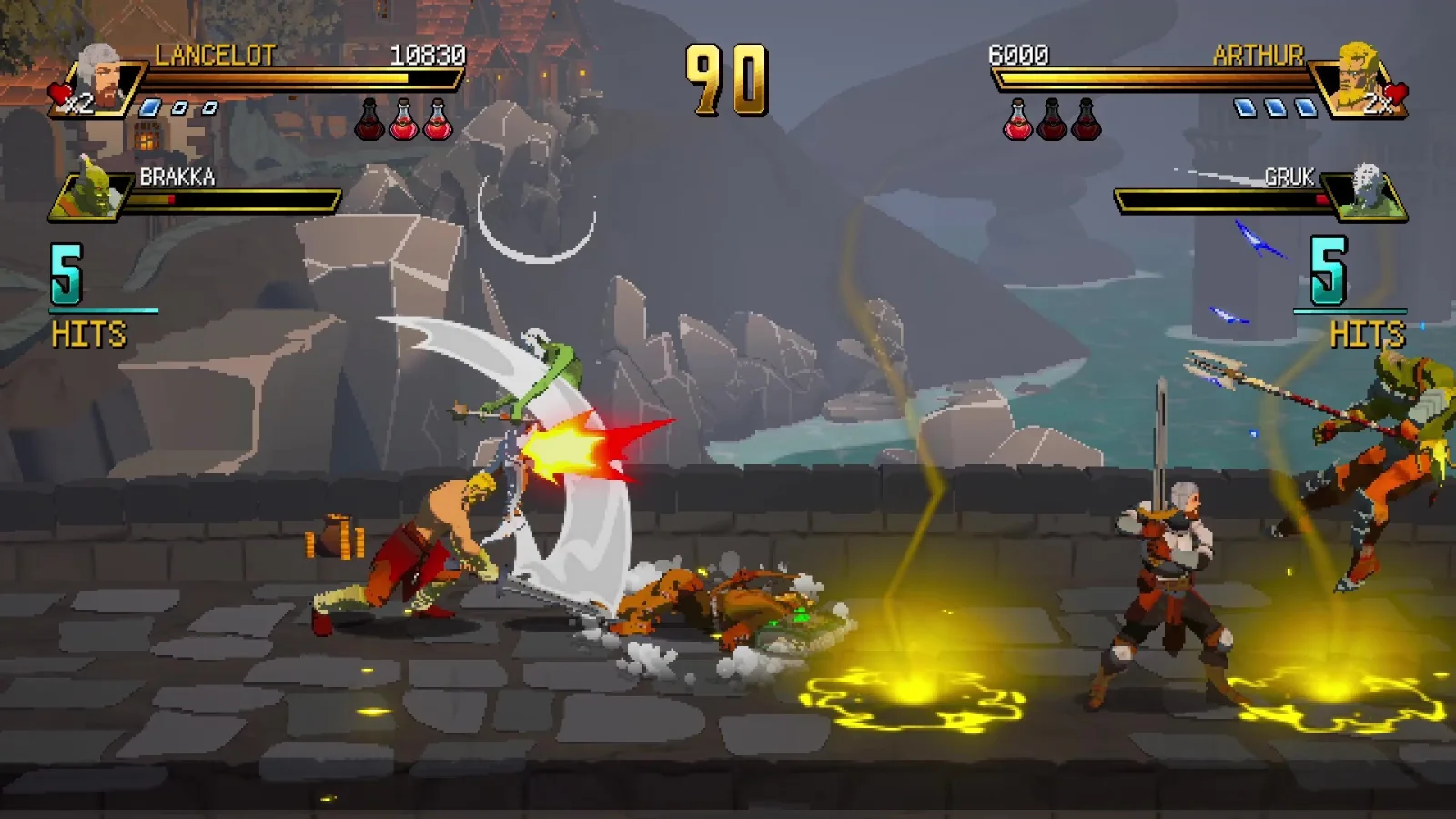
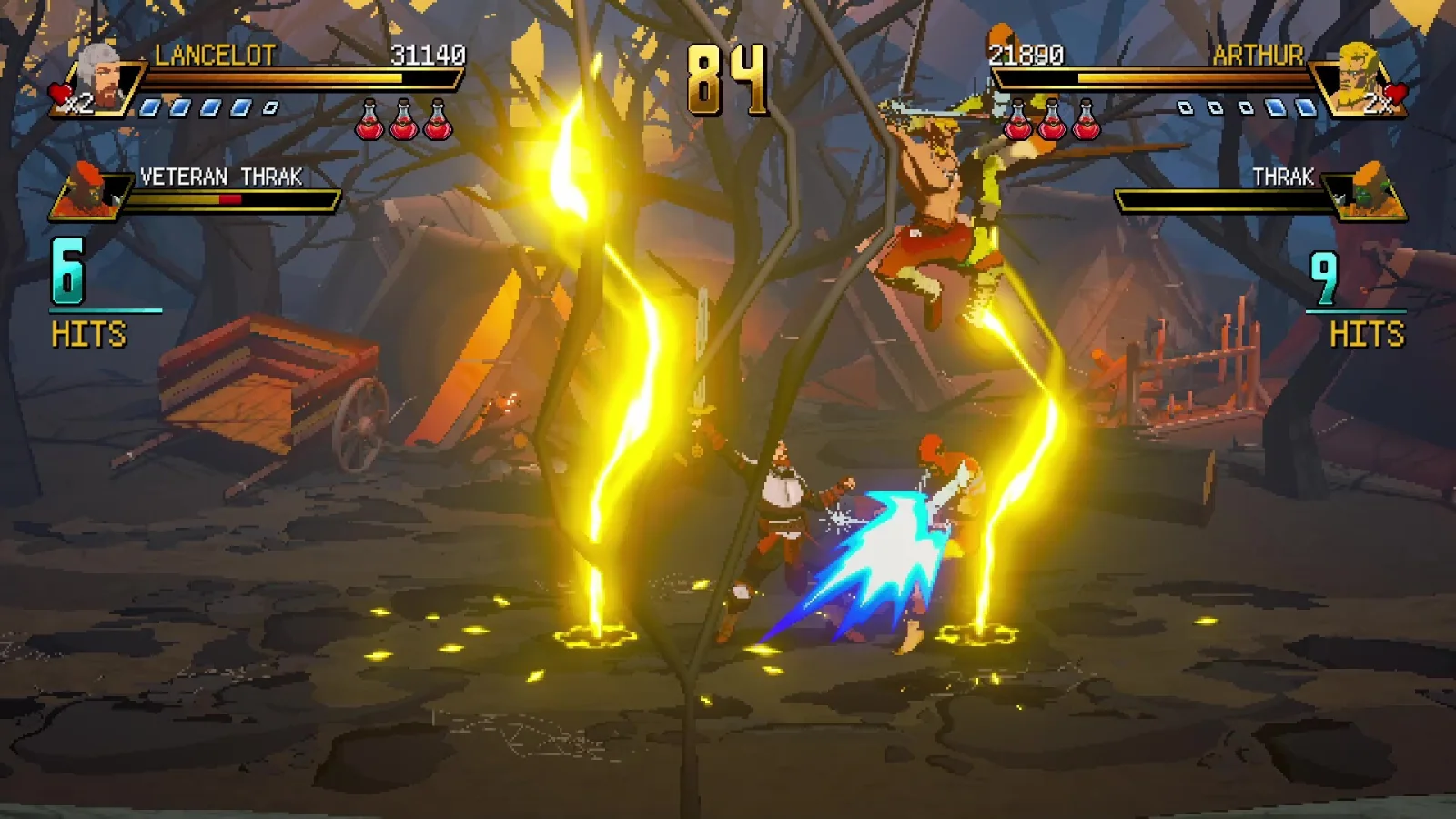
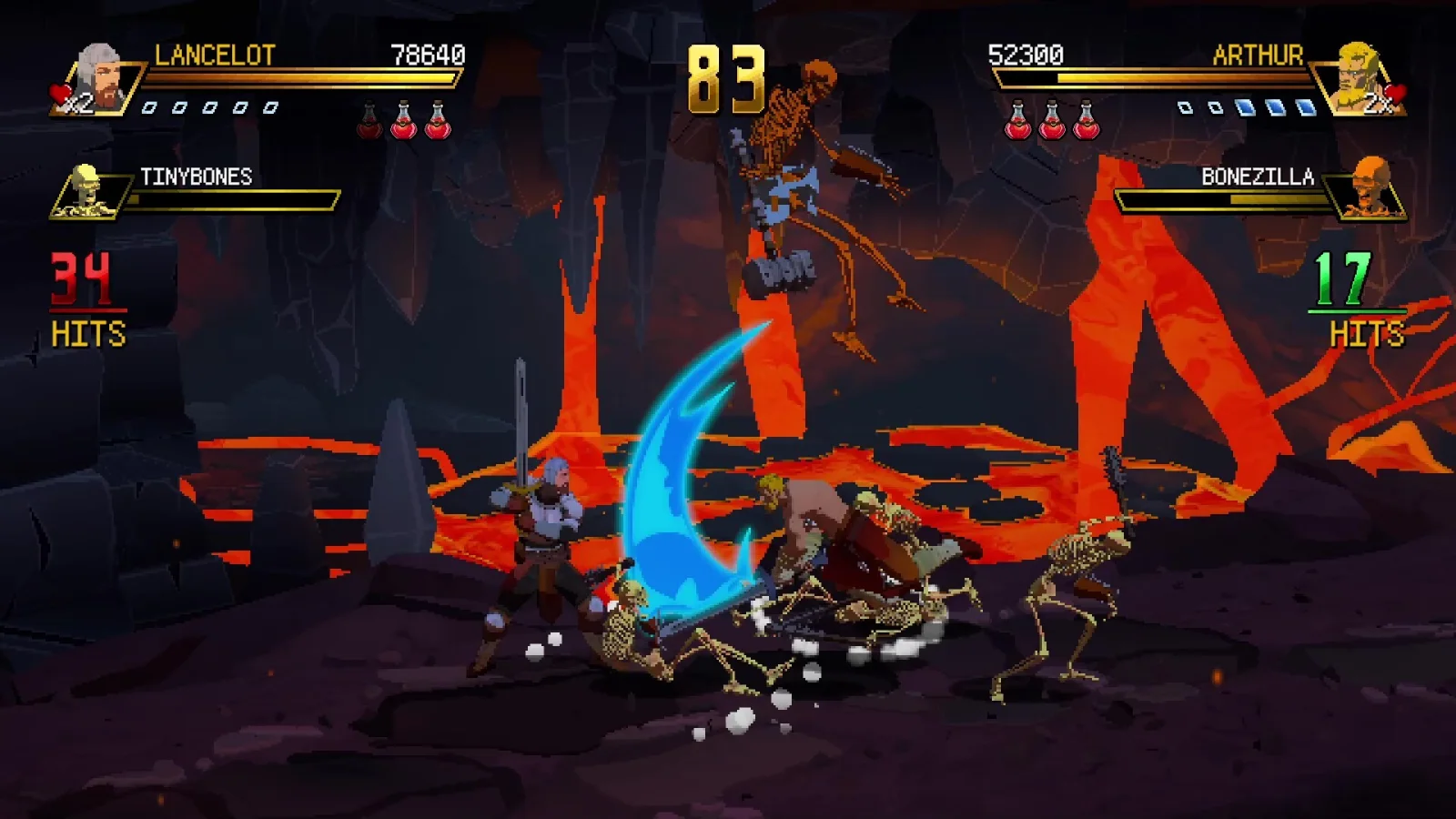
The central pitch is intentionally direct. Players are announced to fight using swords, combos, spells, and special attacks against groups of enemies and colossal bosses. The game also announces local cooperative campaign play. Its visual approach combines 3D environments and combat with a retro pixel filter, positioning the project as a modern presentation shaped by the memory of 1990s brawlers. That is a clear set of ingredients, although their final interaction remains a matter for play rather than assumption.
Established: Arthur and Lancelot are the two announced heroes
The public description identifies Arthur and Lancelot as playable characters. Each is announced to have a distinct fighting style, unique abilities, their own weapons and moves, and special attacks. This is the clearest mechanical promise in the available materials: the game is not merely using Arthurian names as decorative fantasy shorthand, but foregrounding two legendary figures as combatants with stated differences.
A two-character focus can be a sensible structure for a beat ’em up. It gives a game room to make a small cast immediately understandable instead of asking players to learn a long roster of only lightly differentiated fighters. The important issue is what the differences between the two knights mean from one encounter to the next. A weapon, move set, or special attack matters most when it changes a player’s choices about distance, targets, pressure, recovery, or timing.
The announced details do not identify Arthur’s or Lancelot’s precise combat roles. They do not establish attack range, movement speed, defensive options, damage values, resources, or any other specific distinction that would permit a reliable comparison. It would be inaccurate to assign one knight a crowd-control role or the other a duelist role from the available description alone. Still, the basic structure creates a useful question for future hands-on coverage: do the announced unique abilities and fighting styles make character selection meaningful, particularly in a shared campaign?
Combos and spells are also part of the announced design. In a strong arcade-minded action structure, accessible combo inputs can allow players to focus on positioning and enemy behavior instead of memorizing opaque commands. Spells could potentially broaden that loop by adding an emergency option, an area-control tool, or a situational tactical choice. Those are analytical possibilities, not confirmed functions. The public information does not explain how combos are initiated or extended, how spells are accessed, whether either system uses a resource, or how special attacks differ from spells.
Established: a cooperative campaign is announced, and co-op requires a joystick
Blades & Battles announces a local cooperative campaign. The public description also includes an important practical condition: a joystick is required to play in co-op mode. That requirement should be taken literally by prospective players planning a shared session. Full controller support is listed for the PC version, but the published details do not explain solo keyboard controls, device assignment, remapping, or other input options.
Local co-op can alter more than the number of characters on screen. Shared encounters may ask partners to choose targets, avoid obstructing one another, separate groups, or make space for an ally’s more committed attack. Character differentiation could be especially important here. If Arthur and Lancelot’s announced weapons, moves, and special attacks create complementary strengths, cooperative play could give the two-hero premise a practical purpose beyond presentation.
That outcome cannot be assumed. The public description does not establish friendly-fire rules, revival behavior, enemy scaling, camera treatment, shared resources, or whether the game has systems that explicitly reward coordination. None of those omissions demonstrate that such systems are absent; they simply remain unspecified in the available material. The concrete point is narrower: local cooperative campaign play is announced, and co-op requires a joystick.
The setup requirement also makes hardware part of the game’s local social proposition. A player cannot safely presume that any two input methods will support a cooperative session. Future hands-on reporting would need to assess whether beginning and maintaining a co-op session is straightforward, but that is not something the published listing can answer.
Established: 2.5D combat and pixel-filtered 3D visuals
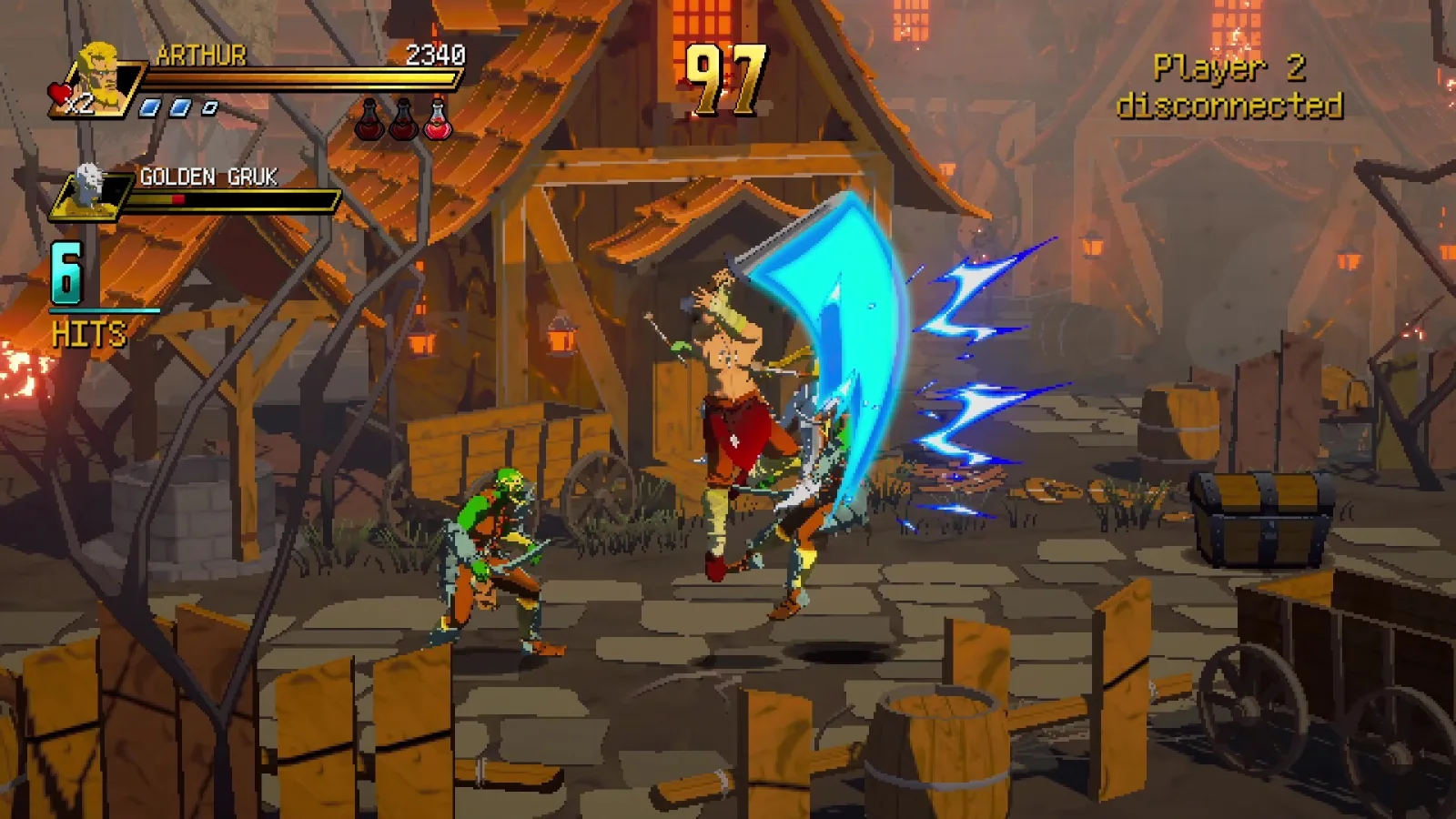
The public description presents Blades & Battles as stylized 3D combat in 2.5D, with 3D environments treated using a retro pixel filter. This is both an aesthetic choice and a potentially consequential gameplay choice. In a brawler, the relationship among player position, opponents, effects, and the camera has a direct bearing on how understandable a fight feels. A 2.5D approach can pursue the focused readability associated with older genre traditions while allowing environments, lighting, and animation to be built in three dimensions.
The retro filter is similarly doing two jobs at once. It connects the game to an arcade-era visual reference point, while its 3D foundation seeks a different kind of environmental depth than a purely sprite-based production. Whether that blend works depends on motion and clarity rather than on the concept alone. A stylized visual treatment may look distinctive while still leaving players able to identify their hero, incoming attacks, enemy silhouettes, and usable combat space. It may also face a difficult readability test when the announced hordes and effects overlap. There is no hands-on evidence here to decide how Blades & Battles performs under that pressure.
Its 2.5D framing raises related questions about movement and hit alignment. Action games in this space can make small position adjustments central to landing attacks cleanly and avoiding danger. Yet the public description does not specify movement planes, targeting assistance, collision rules, camera behavior, or the exact relationship between a character and nearby enemies. Those details are too important to invent from genre convention. They are appropriate criteria for later assessment, not established traits of this release.
Established: straightforward action, enemy hordes, spells, and bosses are part of the pitch
The announced feature list describes straightforward action built around combos and spells, alongside hordes of enemies and colossal bosses. This establishes the intended broad rhythm: frequent combat against groups, punctuated by larger adversaries. It also distinguishes the game’s stated ambition from a methodical, turn-based interpretation of Arthurian material. The public presentation is focused on energetic combat and a classic beat ’em up lineage.
“Straightforward” need not mean shallow. In an effective brawler, an immediately graspable baseline can leave room for the interesting decisions to arise from circumstances: where to stand, which threat needs attention first, whether to continue pressure, and when to commit a more powerful move. Crowds could test space management. Combos could reward offense and timing. Spells could introduce an additional decision layer. Large bosses could ask players to respond to more specific patterns or openings.
Those elements would need to work together for the design to sustain itself. A crowd encounter has more potential texture when the player’s movement and attacks remain readable. A special move has more potential value when using it involves a meaningful context rather than a single automatic response. A boss benefits from scale only if that scale is paired with comprehensible attacks and chances for the heroes’ tools to matter. These are general analytical standards, not claims about this game’s enemy design or encounter quality.
The available information does not specify enemy types, boss structure, combo routes, spell limitations, difficulty settings, checkpoint placement, encounter count, or campaign length. It also does not establish whether environments change during fights or whether any particular boss mechanism is present. Publicly announced categories are useful for understanding intention, but they are not evidence of cadence, balance, or variety.
An Arthurian prelude supplies a frame, not a demonstrated story
The setting is announced as a fantasy world inspired by King Arthur legends, with events taking place before the Round Table is formed. That premise gives the action a relationship to familiar myth while leaving room for its own fictional interpretation. Arthur and Lancelot are culturally recognizable figures, and placing their adventures before the Round Table creates a stated period of the legend rather than simply borrowing medieval imagery.
What that premise means narratively is not yet established by the public description. There are no confirmed details here about plot structure, supporting characters, dialogue, locations, specific antagonists, or the size of the story’s role within the campaign. It would therefore be premature to characterize the writing, dramatic stakes, or treatment of Arthurian source material.
As a design frame, the premise could support a brawler if it gives each stage and confrontation a clear purpose without overburdening the momentum of an action campaign. It could also distinguish the project from generic fantasy if the world, enemies, and character interactions reflect a particular interpretation of the legends. Whether the final campaign achieves either clarity or specificity requires evidence beyond the announced outline.
Questions for a future hands-on assessment
The most useful future questions follow directly from the announced design. Do Arthur and Lancelot encourage genuinely different approaches, or do their differences mainly affect animation and appearance? Are combos controllable and intelligible when combat becomes busy? Do spells and special attacks create situational decisions? Does the pixel-filtered presentation preserve useful visual clarity during enemy-heavy fights? And does local co-op provide meaningful opportunities for coordination beyond placing multiple heroes in the same encounter?
Bosses are another essential point. The announced presence of colossal bosses communicates scale, but memorable boss encounters generally need more than a large model or heightened spectacle. Readable attacks, opportunities to act, and a pace that makes the player’s available tools relevant are all worth examining. Those criteria are not a statement that Blades & Battles meets or misses them.
For a separate design-focused article that likewise keeps announced systems distinct from demonstrated results, read our Tower Tactics II PC preview.
Current assessment
Blades & Battles has a readily legible announced foundation: a 2.5D Arthurian beat ’em up; Arthur and Lancelot as two playable heroes with stated differences; local cooperative campaign play with a joystick requirement for co-op; combos, spells, enemy groups, and colossal bosses; and stylized 3D environments using a retro pixel filter. These are concrete components of the public design.
The unanswered part is the execution that determines whether such components become a satisfying action game: input response, character balance, enemy behavior, combat readability, encounter cadence, cooperative interaction, and campaign structure. The announcement supplies a coherent target for future hands-on coverage, but it does not substantiate a quality judgment. This remains an unscored design feature rather than a review.