There are no Joking Joystick gameplay notes behind this assessment, so nothing here should be read as a claim about control feel, difficulty, performance, restoration quality, or the final balance of its systems. Implicit Conversions developed the PC release and Bliss Brain published it. It released for Windows PC on July 15, 2026, is classified as an Action game, and includes full controller support.
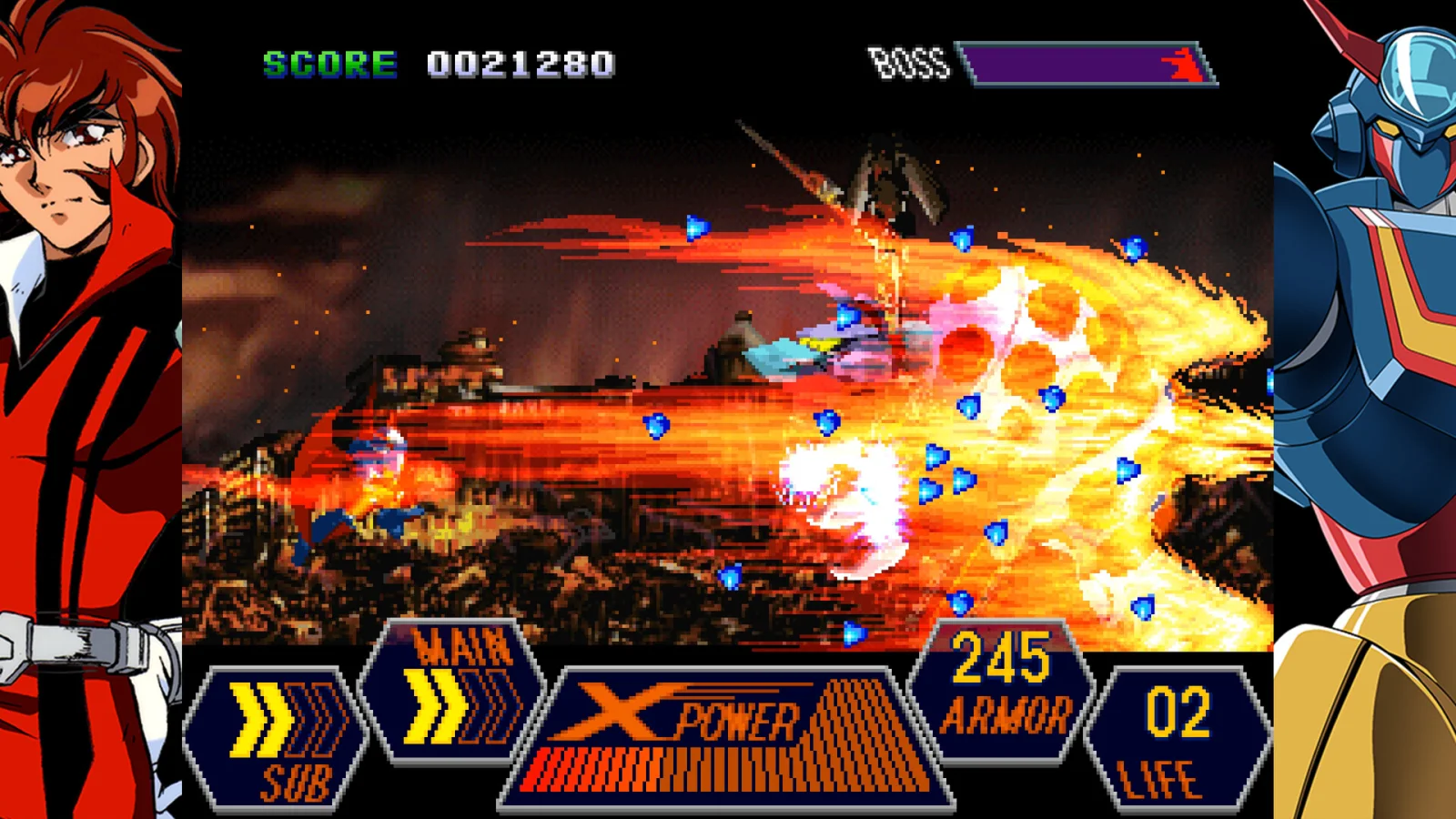
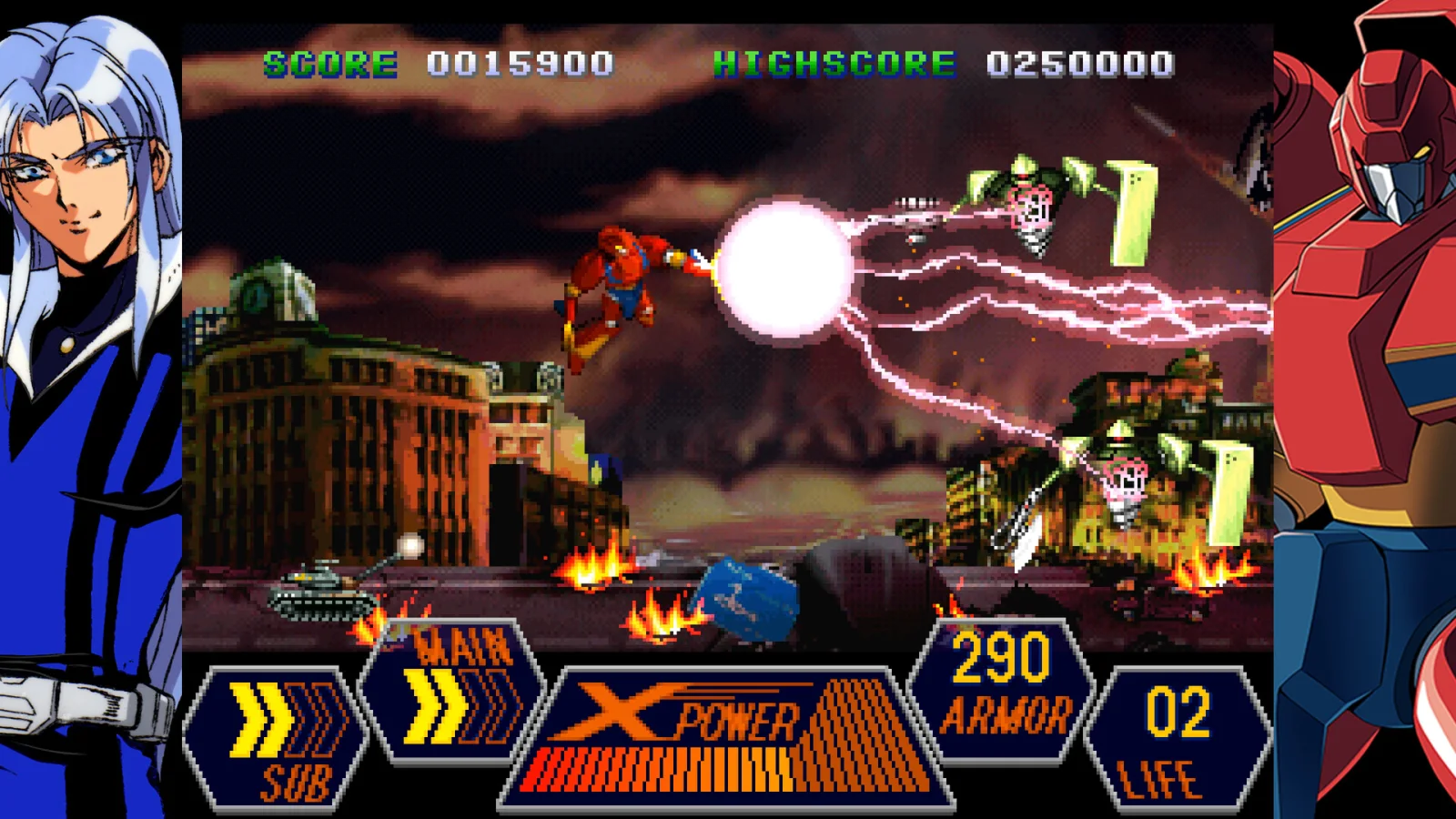
The announced package has an unusually clear dual identity. On one side, it is presented as a fast-paced 2D side-scrolling shooter inspired by Japanese robot anime of the 1970s. On the other, it is a restoration and localization project for a game previously unreleased outside Japan. That combination makes the questions around this version broader than whether its shooting stages remain entertaining. The announced PC release also includes rewind, save states, restored animation, subtitles in multiple languages, CRT filters, a digital manual, achievements, and six unlockable extra modes. These are substantial stated components, but their value depends on implementation details that have not been independently established.
Established premise: a robot-anime shooter framed as a recovered production
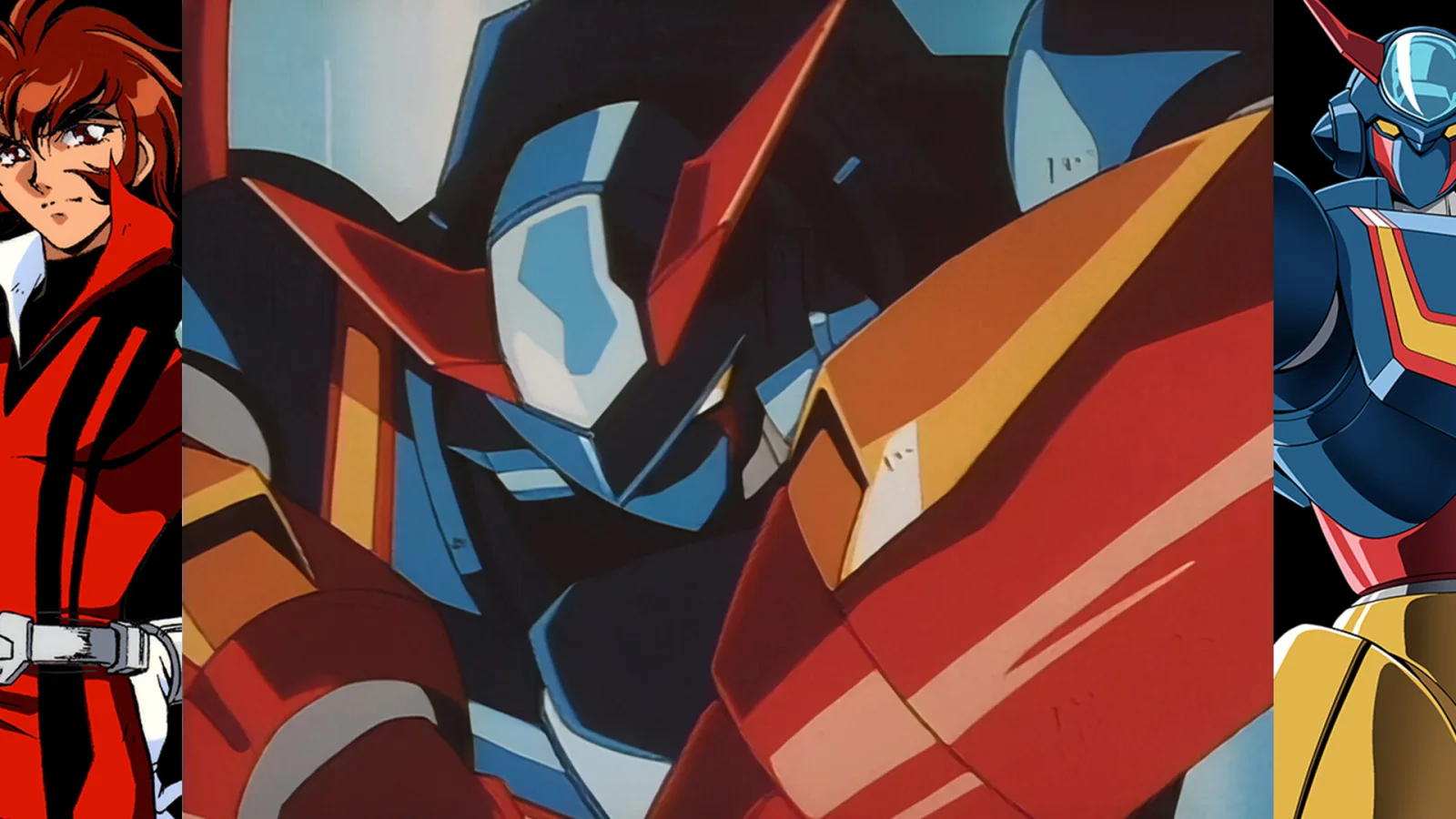
The announced story takes place in “197X,” when the Cosmic Demon Empire attacks Earth with colossal beast-shaped war machines called Space Beasts. A secret Space Robot Laboratory responds by deploying GEPPY-X, a transforming and combining combat robot. This is the stated premise, not a basis for claims about plot depth, character work, pacing, or narrative structure. Still, it communicates a deliberate affection for familiar super-robot genre language: a named machine, an invasion force, an emphatic enemy organization, and an emergency weapon built for a catastrophe.
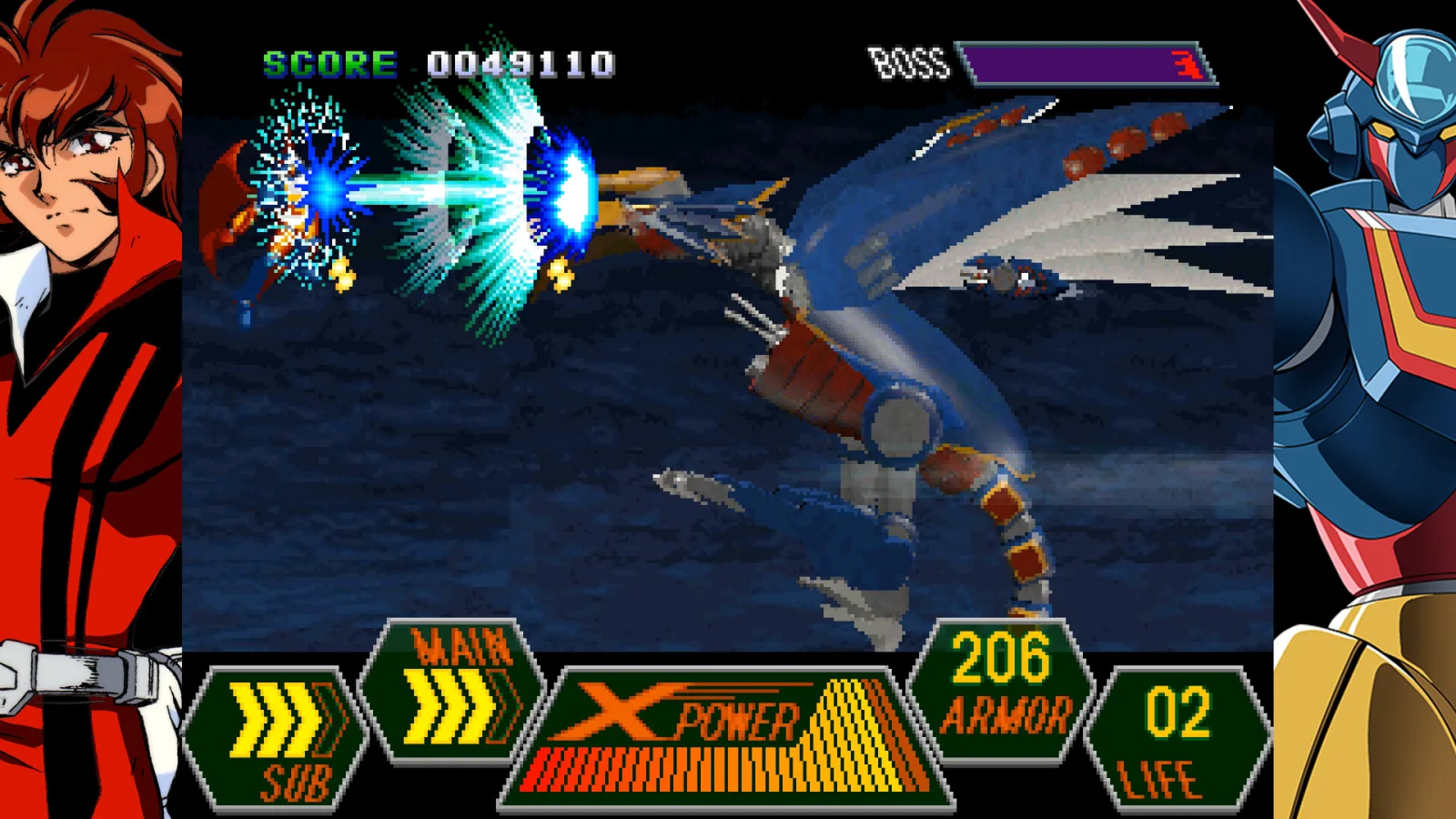
Geppy-X is described as a 2D side-scrolling shooter. Its central announced mechanical hook is the ability to transform among three combat forms in real time, with balance, speed, and power identified as the relevant qualities. This establishes that form-changing is intended to matter during action rather than serving only as a cosmetic transition. It does not establish the precise capabilities, weapons, limitations, damage rules, enemy interactions, or resource costs associated with those forms. Nor does it prove whether each form remains valuable across ordinary encounters or whether one option will dominate.
Those missing specifics are decisive for a transforming shooter. A three-form setup could make moment-to-moment action more expressive if different enemy patterns, spaces, and threats encourage frequent switches. A speed-oriented form could potentially support movement through dense fire; a power-oriented option could create a more deliberate response to sturdier targets; and a balanced form could offer a flexible middle ground. Those are design possibilities, not confirmed behavior. If changing form is immediate, legible, and meaningfully connected to encounter design, Geppy-X could supply a tactical layer beyond aiming and firing. If its distinctions are narrow or poorly communicated, the mechanic could instead become an occasional novelty. The available material cannot decide between those outcomes.
Rewind and save states could change how an older shooter is approached
Two of the most consequential announced quality-of-life options are rewind and save states. Players are promised the ability to rewind after mistakes and to save or reload at any point. These tools can be particularly significant in a historically oriented release, since they may let players see more of the game without requiring a perfect run through each obstacle or boss encounter. They could also allow practice of a difficult sequence, experimentation with transformations, or a return to a particular scene without assuming that the original challenge structure has been removed.
The available announced details do not specify how those functions work in practice. They do not identify rewind duration, speed, interface clarity, save-slot limits, loading behavior, achievement compatibility, or whether special modes handle saves differently. Nor do they explain how the game positions its intended arcade-like rhythm alongside player-controlled recovery tools. These are not minor technicalities. Rewind can work as a thoughtful learning aid when it makes cause and effect visible, but it can become cumbersome if its presentation obscures action or its controls are awkward. Save states can respect players’ time, yet their usefulness depends on reliability and ease of use. Their inclusion is meaningful; their execution remains unproven.
A Rapid Fire option is also announced. It allows players to hold R2 or L2 to fire main and sub weapons rather than repeatedly press buttons. In a shooter associated with sustained firing, that is a practical accessibility-minded proposition. It may reduce physical strain for players who prefer not to mash a control, while leaving open the underlying firing rhythm and weapon behavior. Nothing announced establishes whether rapid fire changes weapon output, applies across all forms, or offers configuration choices. It does, however, indicate that preservation is not being used as an argument for retaining every older input expectation unchanged.
Restored animation is an announced centerpiece, not yet a proven result
The most ambitious preservation claim concerns animation. The original PlayStation version is described as having compressed animation across four discs at 320x240 resolution and 15 frames per second. This release is said to re-digitize each “episode” from original Betacam master tapes, including opening themes, previews, commercials, and end credits, restoring that material to 24 frames per second. The package also announces restoration of 8,000 hand-drawn frames.
That is a specific and appealing restoration goal for a game whose identity is closely tied to anime presentation. The announced use of episode terminology, as well as the inclusion of openings, previews, commercials, and credits, suggests an effort to preserve more than interactive stages alone. It should not, however, be inflated into unsupported claims about the game’s narrative format, total episode count, source-material condition, or the quality of every visual asset. The stated plans support the restoration of those elements; they do not provide enough evidence to assess how consistently the refreshed presentation will integrate with gameplay graphics, menus, or other original material.
Optional upscaling is also announced, though it is planned to arrive shortly after launch. That timing is important. Upscaling may be useful for players who want a cleaner image on modern displays, but its existence does not establish that the release will look best in every mode or on every screen. The meaningful questions are whether the options make tradeoffs understandable and whether the restored material retains the character of its source. Until that setting is available for assessment, the appropriate conclusion is limited to the announced plan.
Several CRT filter options, including CRT curvature, are also part of the stated feature set. Such filters can give players different ways to frame older visual material without forcing one definition of authenticity. A clean presentation and a display-inspired filter may both be useful depending on player preference and screen setup. Yet no details specify the full filter range, adjustment settings, or whether effects apply evenly across gameplay and video material. The announcement establishes choice, not verified image quality.
Localization and archival context are part of the release’s purpose
The release retains original Japanese voice performances and identifies Akira Kamiya, Shō Hayami, Shūichi Ikeda, Ichirō Nagai, and Gorō Naya among the credited performers. Its soundtrack is also presented as original material involving Isao Sasaki, Akira Kushida, and Hironobu Kageyama. Those names place the package within a particular strain of Japanese anime culture, but the available information does not justify claims about performance quality, audio mixing, music placement, or the preservation quality of the recordings. What is established is that Japanese voices and the original soundtrack are part of the announced release.
Subtitles are planned in English, Japanese, French, Spanish, Italian, German, Korean, Traditional Chinese, and Simplified Chinese. For a title previously unavailable outside Japan, multilingual support could be one of the release’s most useful practical additions. It may make the announced story material and broader presentation more approachable without replacing the original voices. But localization is not merely a list of languages: terminology consistency, timing, readability, and contextual clarity all matter, and none can be confirmed here.
The same caution applies to the announced digital gameplay manual. A manual could prove valuable if it clearly explains forms, weapons, controls, and other systems, but its scope and usefulness are unknown. In a game with a restoration component, a manual might also help bridge the distance between original design assumptions and contemporary expectations. That remains a possibility rather than an established result.
Extra modes need details before they can be weighed
Six unlockable extra modes are announced, with Boss Rush, Alternate Timelines, and Experimental Episode Variants named among them. This establishes that the release includes unlockable material beyond its principal content. It does not establish the identity of all six modes, their unlock conditions, how extensively they differ, whether they remix combat, or whether their purpose is archival, experimental, or both. “Alternate Timelines” and “Experimental Episode Variants” are evocative labels, but labels cannot replace an explanation of what players actually do in them.
Boss Rush is the easiest named concept to understand in broad terms, but its important questions remain open. It might function as a practice option, a score-focused challenge, a curated sequence, or a mode with adjusted rules. The announced information does not say whether bosses are changed, whether recovery tools are available, or how the mode relates to the rest of the game. Calling it a major replay feature would therefore go beyond the evidence. It is better understood as additional announced content with possible value for players seeking more ways to engage with encounters.
For another feature centered on the difference between stated systems and what play ultimately has to demonstrate, see our PC design preview of Medium Rare.
What the PC version still needs to demonstrate
70s-style Robot Anime Geppy-X has a coherent announced proposition: an international Windows release of a Japan-only, anime-styled side-scrolling shooter paired with modern access and presentation tools. Three real-time forms, rewind, save states, a rapid-fire option, broad subtitle support, Japanese voices, restored video material, filters, a manual, achievements, and additional modes make for a tangible stated feature set. Just as importantly, none independently proves the shooter’s responsiveness, the clarity of its visual language, the quality of its restoration, or the usefulness of its extra content.
The strongest reason to follow Geppy-X is its explicit attempt to join preservation with playability. If transformations create worthwhile decisions, if modern tools are intuitive instead of intrusive, and if restored animation makes the package feel cohesive, its design could offer a distinctive route into robot-anime game history. These are conditional possibilities, not a quality verdict. The announced package is detailed and potentially welcoming, while the questions that require direct play remain open.