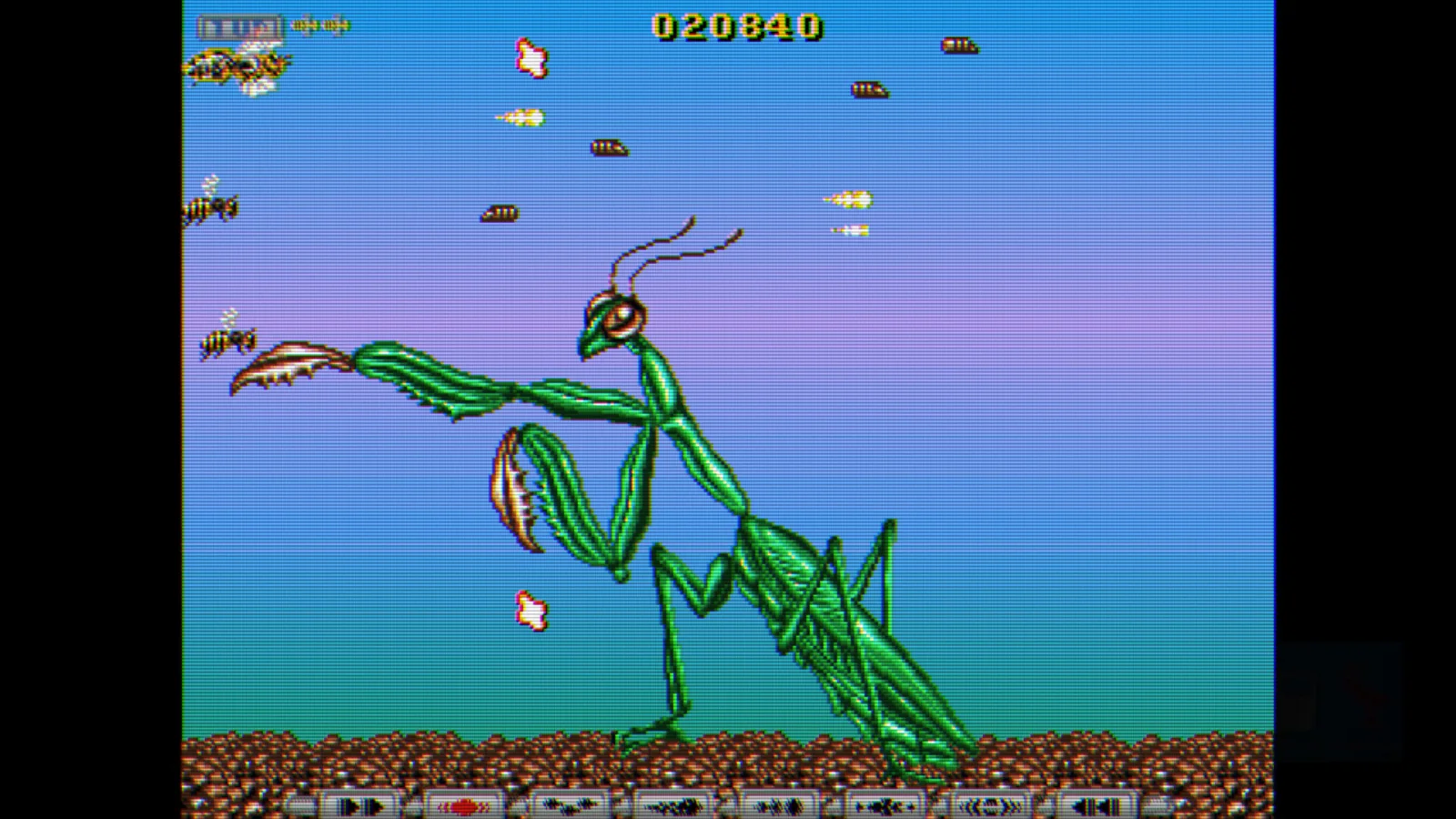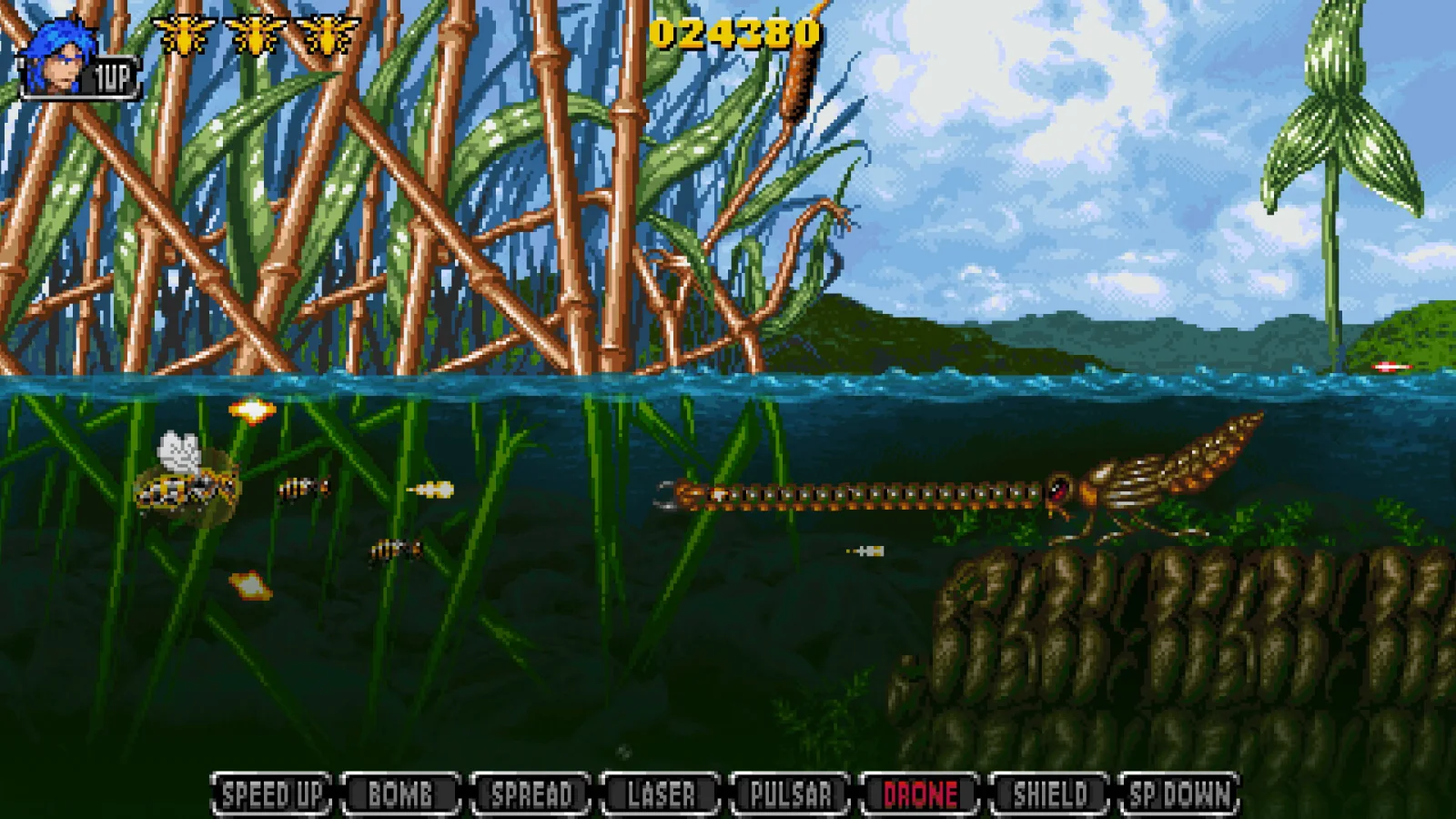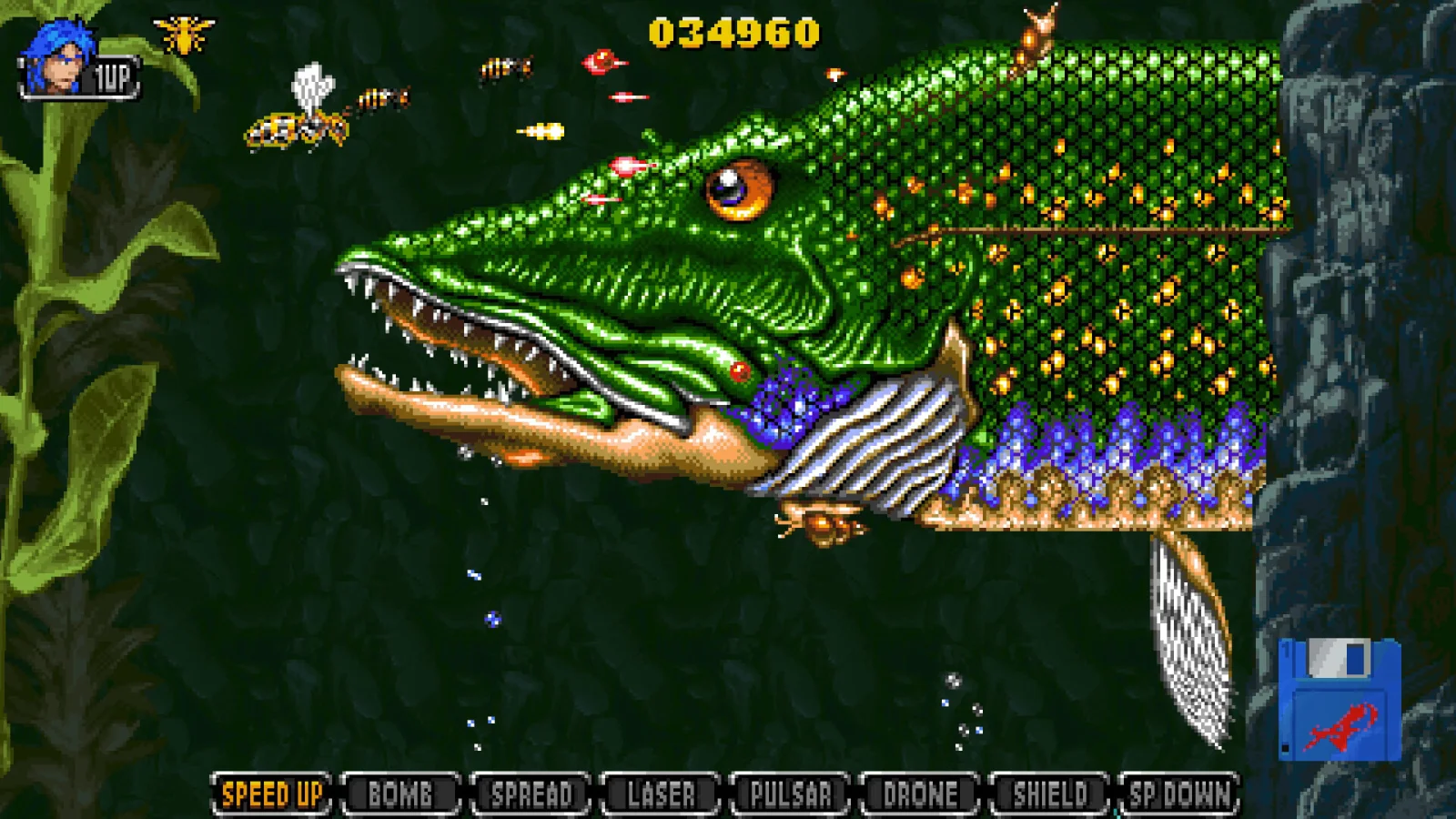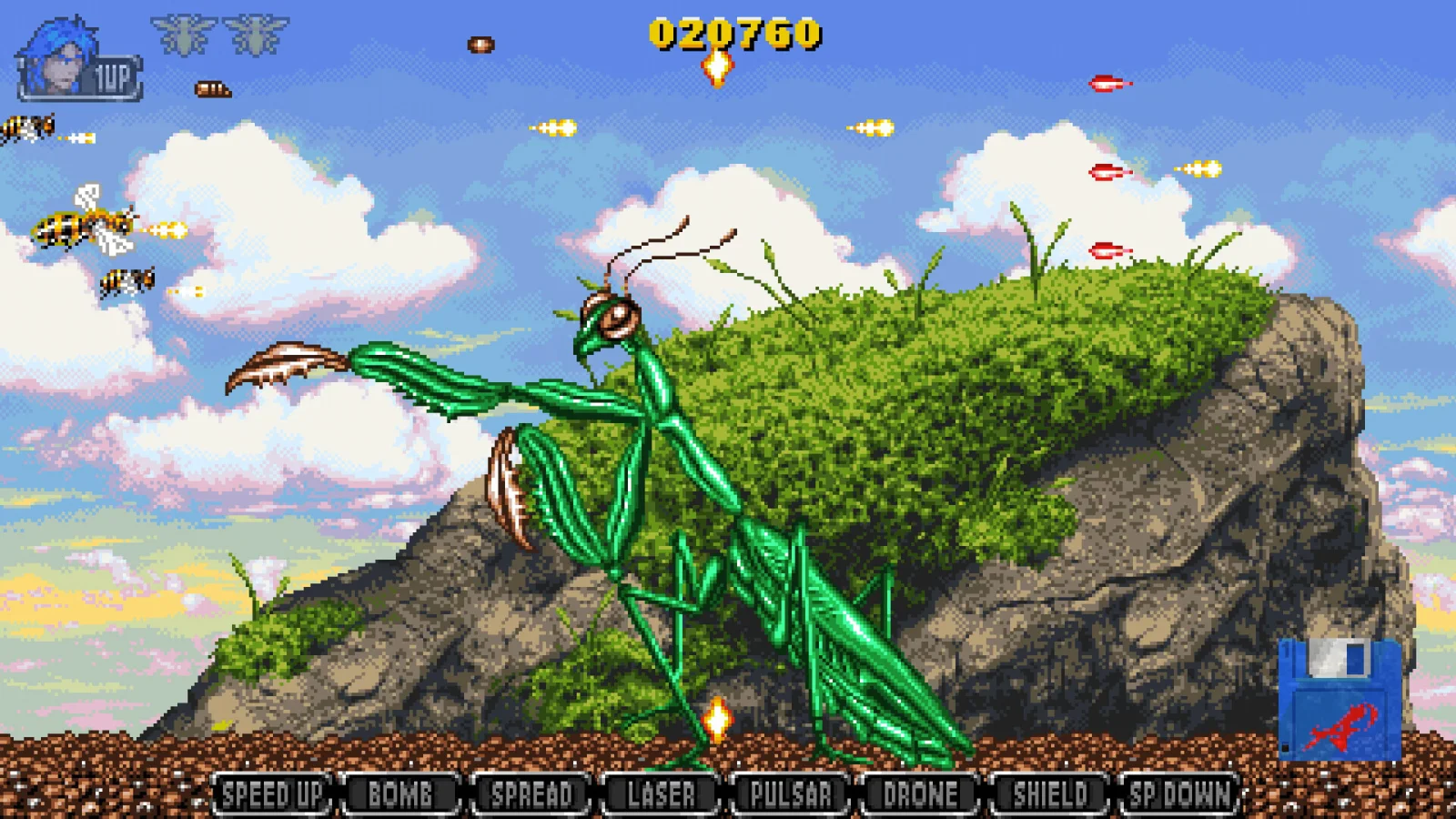
Apidya' Special is a Windows action game developed by Team Apidya and published by ININ, released on August 25, 2026. The store record lists full controller support. Its announced design presents the game as a revival of the 1992 home-computer shoot-'em-up Apidya, rebuilt for a new release while retaining a stated connection to the earlier game.
There are two useful layers to that description. The release date, Windows availability, developer, publisher, Action classification, and full-controller-support label establish the basic release record. The wider feature set describes the project’s intended design: a rebuilt pixel-art remake with alternate presentations, new audio material, several themed worlds, events, co-op, and modernized difficulty options. Those announced elements make for a detailed picture of what Apidya' Special aims to offer, while leaving questions of controls, balance, clarity, and final execution open.
A released PC action game with a legacy-game foundation
Apidya' Special is no longer an upcoming release. It is available for Windows PC, and the release metadata identifies it broadly as Action. That category does not explain the full rule set, but the game’s own description frames it specifically as a retro shoot-'em-up. The project is therefore positioned within a form where movement, targeting, hazards, enemy patterns, and visual readability are likely to be central concerns.
The historical connection is not incidental to the pitch. Apidya' Special is described as a remake of Apidya, a 1992 home-computer game. The announced goal is an “authentic” version that has been completely rebuilt rather than emulated. That distinction signals an attempt to create a fresh production instead of merely running an older release through contemporary hardware and display options.
A remake has to answer a difficult design question: what should remain recognizably tied to the earlier game, and what should be revised for a different technical context and a new audience? A project can preserve the broad identity of an older work through its visual motifs, music, pacing, world structure, or core action, yet alter its presentation and supporting systems substantially. The announced material places Apidya' Special in exactly that territory. It promises continuity, but it also presents new art, new sound work, widescreen display support, co-op, and difficulty settings as part of the package.
That makes fidelity a useful subject for later examination rather than a settled result. “Faithful” may mean close adherence to an older game’s structure, its feel, its audiovisual character, or a narrower set of recognizable elements. The announced design does not provide a feature-by-feature map of every inherited and altered component. For returning players, the practical question will be how the game defines that relationship in motion. For newcomers, the more immediate question may simply be whether its action communicates itself clearly without knowledge of the 1992 original.
A rebuilt pixel-art presentation
The announced remake is described as a 24-bit pixel-art production, built from the ground up. It is also said to combine original assets with all-new pixel art, additional sound effects, and remixed music. The project draws on a previously abandoned 1990s console-port effort, according to the design description.
These details suggest a restoration-minded approach that is not limited to preserving old files in their original form. Original assets can carry forward recognizable shapes, colors, or visual reference points, while new pixel art can expand, reinterpret, or recompose the look around them. Additional sound effects and remixed music similarly point toward an audio identity that revisits prior material rather than treating it as fixed.
There is a meaningful creative tension in that approach. Pixel art can be historically evocative without being visually frozen in a historical production pipeline. A new screen format can make room for contemporary display expectations without necessarily abandoning the compact framing associated with older home-computer games. The success of that balance depends on details not established by a feature list: sprite contrast, animation timing, background density, effect intensity, and the relationship between the player character, incoming threats, and the playfield.
Those are especially important concerns for a shoot-'em-up. In a visually elaborate scene, attractive art and legible art are related but not identical aims. Color, movement, parallax, and filters may all contribute atmosphere, but they can also affect how quickly a player identifies hazards. Apidya' Special’s announced presentation offers multiple ways to approach that issue, though the practical character of each option remains a question for direct examination.
Two display modes and optional CRT effects
Apidya' Special announces two visual presentations: an HD widescreen mode with new parallax effects, and an original home-computer 4:3 mode. The latter is presented as a mode that looks, plays, and sounds like the 1992 version. The game also announces optional CRT-style effects, including a simulated shadow mask, scan lines, phosphor bloom, and bloom.
The two-mode approach is potentially more interesting than a simple visual toggle. Widescreen and 4:3 are different frames for reading an action game. They can change the amount of visible space around the player, the perceived spacing of backgrounds and objects, and the visual rhythm created by movement from one edge of the display to another. New parallax effects may further change the sense of depth and motion in the widescreen presentation.
At the same time, an older aspect ratio may be meaningful to players who value a presentation closer to the original home-computer context. A 4:3 option is not automatically a museum piece, just as a widescreen option is not automatically a modernization victory. Each could serve different visual preferences. What matters is how the game’s action reads under both conditions: whether enemies, projectiles, scenery, and effects remain distinguishable, and whether the alternate presentations feel like deliberate versions of the same game rather than mismatched compromises.
The announced ability to switch seamlessly between the two modes could make those differences easier to compare. If it works as described, players could move between the alternate presentations without treating their choice as a permanent commitment. That would suit a project that openly places historical presentation beside a new screen format.
The optional CRT effects add another layer of choice. Scan lines, shadow masks, and phosphor bloom are attempts to evoke qualities associated with older display hardware. Some players may want that stylized texture; others may prefer a cleaner image. The available information establishes that the effects are optional, but does not describe the range of settings or their impact on clarity. Their purpose is clear as an aesthetic gesture, while their practical use will depend on individual displays and preferences.
Music, sound, and a newly recorded soundtrack
The announced audio plan includes remixed music, additional sound effects, and exclusive new studio versions of the soundtrack by composer Chris Hülsbeck. The description identifies these studio versions as previously unreleased.
For a legacy-focused remake, soundtrack work can do more than provide background atmosphere. Music can help preserve the identity that longtime players associate with an older game, while a new recording can establish a different sense of scale, texture, or energy. The sound-effect additions matter as well, since action games use audio for feedback: firing, impacts, warnings, enemy appearances, and major encounters can all be easier to read when sound supports the visual field effectively.
The announcement does not specify track sequencing, mix behavior, audio settings, or how the newly recorded material is distributed across the game. Those are relevant implementation questions, particularly in a genre where music and effects must coexist under pressure. Still, the proposed combination is notable in design terms. It does not describe a soundtrack treated solely as archival material; it describes a score being actively revisited as part of the remake.
Different players may approach that choice from different directions. Someone seeking the closest possible historical sound may focus on the older-game connection, while someone looking for a modernized production may value the studio versions and remixes. Neither preference is resolved by the announcement itself. The important established point is that Apidya' Special frames audio revision as a major part of its remake concept, not a minor technical update.
Five announced worlds and changing conditions
The game announces five themed worlds: Meadow, Pond, Sewers, Cyber, and Lair. They are described as containing up to five levels each, with 20 unique bosses and hidden special stages. It also announces randomized in-game events, including an example called Night Mode that introduces new enemy sprites.
Names such as Meadow, Pond, Sewers, Cyber, and Lair establish a broad thematic range. They indicate a structure that moves through distinct locations rather than presenting one uniform visual environment. The available description does not define how the worlds are ordered, how their levels are arranged, or whether their themes correspond to particular mechanical changes. Those questions matter because themed stages can serve several purposes: visual variety, escalating difficulty, altered enemy behavior, distinct hazards, or a mix of all four.
The announced maximum of five levels per world and total of 20 unique bosses provide useful scale markers, but counts alone do not settle how the content is paced. A boss can be a brief punctuation point, a major endurance test, a puzzle-like encounter, or an opportunity for a new mechanic to be introduced. Hidden special stages likewise raise questions about discovery. Their presence establishes optional material in the announced design, while leaving their conditions, placement, and rewards unspecified.
Randomized events are another element that could make repeated sessions differ from one another. The Night Mode example implies an event capable of changing enemy sprites, but the announcement does not define frequency, triggers, duration, or its broader effects on the playfield. If such events alter visual conditions or enemy presentation in a way that remains readable, they could create a fresh point of adaptation. If they are primarily cosmetic, their role may be more atmospheric. Both possibilities remain open because the stated feature does not detail its operation.
The wider design question is whether the game’s visual variety, boss content, hidden stages, and events reinforce one another. Distinct worlds can make a shoot-'em-up feel like a journey through changing conditions, while secrets and variable events can offer reasons to look beyond a single fixed route. But that outcome depends on how the announced pieces fit together, not merely on their number.
Co-op and controller support
Apidya' Special announces full co-op, with a second player controlling another bee. Separately, the store record lists full controller support. Taken together, those details indicate that cooperative play and controller use are central parts of the release information, though they answer different questions.
The controller-support label does not provide an input layout or describe customization. It does, however, establish that full controller support is identified for the game. In an action-focused release, that matters because response, control communication, and comfort can shape how players approach its moment-to-moment demands.
The co-op announcement raises a different set of design considerations. Two-player action can change how a game distributes attention across the screen, how players handle threats, and how moments of pressure are shared. It can create room for coordination, but it can also make visual density more demanding. The supplied information does not establish whether the mode is local, online, or both, nor does it describe joining rules, shared resources, player failure, or balance adjustments. These are open details, not evidence that any particular option is unavailable.
What the announcement does make clear is that the remake is not framed only as a solitary revival. A second controllable bee is part of its stated feature set. The eventual significance of that addition will depend on how clearly the game supports two players in the same action space and how it handles the practical rules around cooperation.
Modernized difficulty settings
The announced design also includes modernized difficulty settings, described as an effort to make the game enjoyable across generations. That is a substantial statement of audience intent. A remake of an older action game may attract returning players with established expectations as well as newcomers who have no prior familiarity with its history. Difficulty options are one possible way to acknowledge that difference.
The available material does not say what those settings change. It does not establish adjustments to damage, enemy behavior, player resources, speed, checkpoints, continues, or any other individual parameter. It also does not describe how difficulty interacts with co-op or whether settings can be changed during a playthrough. A difficulty label alone cannot define the broader accessibility of a game.
Even so, the decision to announce modernized settings is meaningful. It frames Apidya' Special as a project that wants to preserve a legacy while recognizing that audiences may enter it with different levels of familiarity. The key design question will be whether the options are communicated clearly and create choices that respect both challenge-seeking players and players who primarily want to explore the game’s worlds, music, and presentation.
What the announced design leaves to examine
Apidya' Special has a clear factual baseline: it is a released Windows action game by Team Apidya and ININ, and it lists full controller support. Its announced feature set goes considerably further, outlining a from-scratch pixel-art remake, original and widescreen display modes, CRT effects, reworked audio, five worlds, bosses, hidden stages, randomized events, co-op, and modernized difficulty settings.
The remaining questions are largely questions of implementation. How does each visual mode communicate hazards? How do the new audio elements function during intense action? What do the randomized events actually alter? How are co-op rules structured? What do the difficulty settings modify? These are specific points to investigate rather than gaps that can be filled with assumptions.
For another neutral example of coverage that separates announced systems from demonstrated outcomes, see this Tower Tactics II PC preview.
For now, Apidya' Special’s announced design is defined by a deliberate blend of historical reference and revision. It presents an older shoot-'em-up as the basis for a rebuilt release, then surrounds that basis with alternate display choices, newly described audiovisual work, cooperative play, variable events, and adjustable challenge. That is a detailed direction for the game; the particulars of how that direction operates remain the important next questions.