Dragons have been part of Magic: The Gathering from the game’s earliest days, but Commander is the format that lets the creature type indulge its biggest instincts. A 100-card singleton deck can accommodate mana acceleration, expensive flying threats, legendary favorites and enough spectacle to make a normal curve look like it needs airport clearance.
That freedom comes with a meaningful decision: the commander determines which colors, engines and payoff cards a Dragon deck can use. Some leaders reduce the costs of the entire tribe before they ever reach the battlefield. Others create copies, produce a growing air force, or turn every attack into a chance to deploy another oversized creature without paying its mana cost. There is no one universally correct choice, especially when deck budget and preferred play pattern matter, but these five commanders each establish a clear, powerful direction.
They also illustrate why a card’s appeal to Commander players and collectors can be linked without being identical. Reprints affect supply, premium treatments can draw attention, and narrow product availability may matter to collectors. None of that guarantees future prices. It does, however, help explain why it is worth identifying the specific printing, art and treatment before treating one version as interchangeable with another. The same basic care applies across hobbies; the familiar cycle of deciding to buy one small collectible has a way of becoming a larger project quickly.
The Ur-Dragon: the five-color tribal benchmark
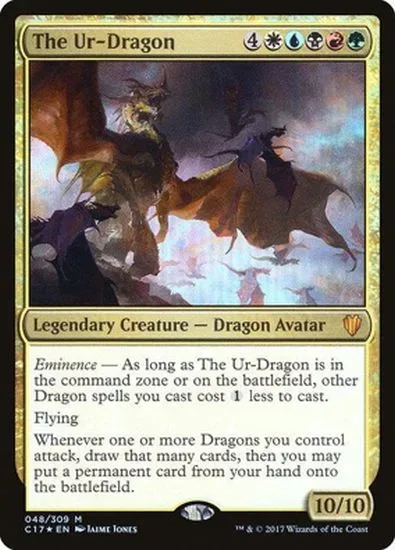
The Ur-Dragon, a mythic rare from Commander 2017, is the broadest Dragon commander option here. Its printed cost is nine mana, and it is a 10/10 Dragon Avatar, but judging the card solely on the likelihood of casting it misses the feature that makes it so influential: Eminence.
While The Ur-Dragon remains in the command zone or is on the battlefield, other Dragon spells its controller casts cost one less. That reduction starts working immediately, without requiring the commander to resolve or survive a turn cycle. In a deck where many creatures are naturally expensive, turning each one into a slightly more realistic spell is an enormous structural benefit. It can make a Dragon-heavy list feel less like a pile of seven-mana dreams and more like a deck that steadily develops its board.
Eventually casting the commander remains rewarding. Whenever it attacks, its controller draws a card for every attacking Dragon, then may put a permanent card from hand directly onto the battlefield. A crowded attack therefore refills resources and can add another permanent without paying for it. It is a huge ceiling, although the five-color identity asks a deck to solve the demanding practical problem of consistent mana.
That access is also its great appeal: every Dragon color is available. The Ur-Dragon debuted with art by Jaime Jones and later received a Commander Masters reprint, a factor that has helped keep its supply more attainable than might be expected for such a central tribal staple. For players who want maximum card access and a command-zone discount, it remains the obvious reference point.
Miirym, Sentinel Wyrm: make every arrival count twice
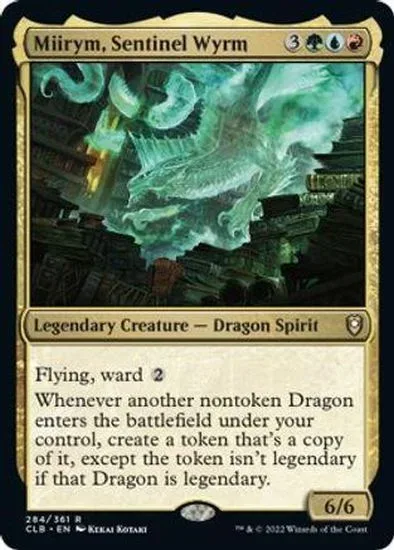
Miirym, Sentinel Wyrm goes in a more explosive direction. The rare from Commander Legends: Battle for Baldur’s Gate costs six mana and has a 6/6 flying body with ward. Its essential text says that whenever another nontoken Dragon enters under its controller’s control, a token copy enters as well. Crucially, that copy is not legendary.
That exception dramatically expands what Miirym can do. Legendary Dragons can be duplicated without immediately colliding with the legend rule, and every Dragon with an enters-the-battlefield ability supplies that effect again. Attack triggers can also be doubled once both versions can swing. The outcome is a commander that transforms individual Dragon plays into two-for-one threats and can compound advantage at an alarming pace.
Ward is not a full shield, but it creates an additional tax for an opponent trying to disrupt the engine. Since Miirym is responsible for all those copies, that protection matters. The tradeoff is color identity: Miirym is in blue, red and green, leaving white and black Dragon options out of the deck. That restriction is meaningful, yet the available Temur card pool still supports ramp, draw, interaction and a deep bench of desirable Dragons.
The regular version features art by Kekai Kotaki. A showcase treatment from the same release, illustrated by Jeff Miracola, is a notable alternative for collectors seeking something beyond the base printing. Miirym is for the player who sees one Dragon enter and immediately asks why that occasion should happen only once.
Lathliss, Dragon Queen: mono-red’s accessible swarm plan
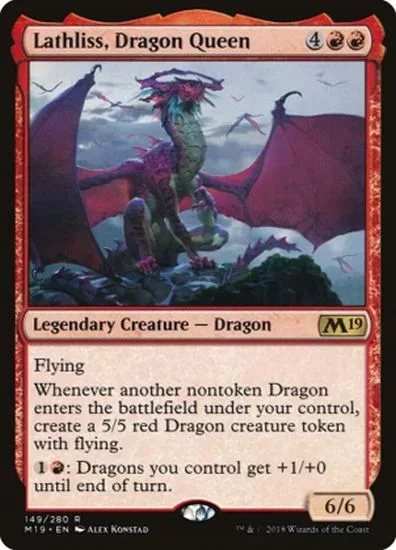
Lathliss, Dragon Queen is a rare first printed in Core Set 2019, and her simplicity is a major strength. For six mana, she provides a 6/6 flying Dragon. Whenever another nontoken Dragon enters under her controller’s control, Lathliss creates a 5/5 red Dragon creature token with flying. Her activated ability lets her controller pay two mana to give all Dragons +1/+0 until end of turn.
The lesson is straightforward and brutal: play a Dragon, get another Dragon, then convert a wide board into extra damage. The tokens are Dragons themselves, so they benefit from the team pump and contribute to a battlefield that can become threatening much faster than individual six- and seven-mana creatures suggest. Lathliss does not need elaborate copying rules or a five-color mana base to establish this plan.
Her mono-red color identity is perhaps the most practical distinction. A basic Mountain-focused mana base is easier to assemble than a carefully tuned five-color suite, leaving more deckbuilding attention for ramp, card flow, removal and the actual Dragons. That does not make every mono-red choice cheap, but it avoids the immediate land-base burden attached to broader color identities.
Alex Konstad illustrated Lathliss’s original printing. Subsequent appearances in Jumpstart, Foundations and the Tarkir: Dragonstorm Commander decks have made the regular version comparatively accessible. That repeat-printing history is useful context for anyone collecting: a recognizable marquee card can still be a sensible starting point when supply has been refreshed.
Ureni of the Unwritten: Temur attacks that add more Dragons
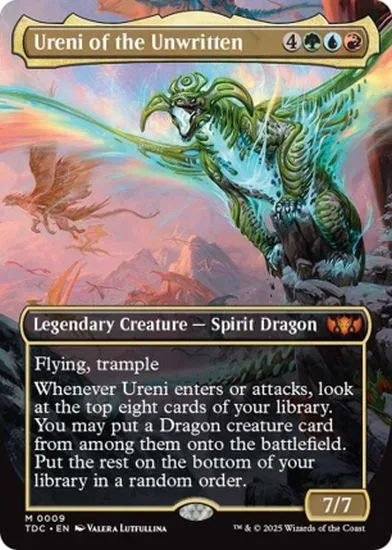
Ureni of the Unwritten is the most combat-forward choice among these commanders. This mythic rare from Tarkir: Dragonstorm Commander costs seven mana for a 7/7 creature with flying and trample. When Ureni enters, and again whenever it attacks, its controller looks at the top eight cards of their library and may put a Dragon creature card from among them onto the battlefield.
The key distinction is that the selected Dragon does not merely go to hand. It enters play. In a deck designed around expensive creatures, that repeatable deployment effect gives every attack the potential to expand the board at no additional mana cost. It also rewards careful construction: the more reliably the top eight cards contain Dragons worth finding, the more consistently Ureni’s ability delivers.
Trample ensures that small blockers cannot indefinitely neutralize its own combat damage, while the growing collection of free Dragons can pressure the table from the air. Its Temur identity offers green ramp, blue support and red’s traditional Dragon depth, creating a focused alternative to The Ur-Dragon’s all-colors approach.
Ureni is one of the two commanders in the Temur Roar deck from the Tarkir: Dragonstorm Commander release. Art by Valera Lutfullina appears on the card, which was also included in Collector Boosters for that release. As stated, Ureni has not received a reprint. Limited product association can be relevant to collector attention, but availability, reprint decisions and demand can all change, so rarity should not be confused with a promise of value.
Smaug the Magnificent: Treasure counts become damage
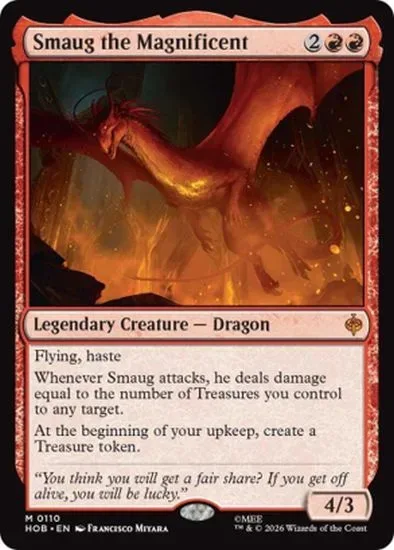
Smaug the Magnificent is not primarily a Dragon-typal commander. Instead, the mythic rare offers a red Treasure strategy wearing the very appropriate face of a Dragon. It costs only four mana for a 4/3 with flying and haste, making it the least expensive commander on this list to cast.
At the beginning of its controller’s upkeep, Smaug creates a Treasure token. Whenever it attacks, it deals damage equal to the number of Treasures that controller has to any target. The design encourages a deck packed with ways to create Treasures, then turns the accumulated hoard into scalable direct damage. Because the target can be a player, the attack trigger can become a genuine closing tool rather than merely a way to clear creatures.
Smaug headlines The Hobbit, released in August 2026 as the first Tolkien set legal in Standard. The main-set illustration is by Francisco Miyara. A gold headliner version illustrated by Ted Nasmith is described as limited to roughly 500 copies and available only in Collector Boosters. That is a distinctly different collecting lane from choosing the base game piece for a Commander deck, and it is worth keeping premium cards protected and organized once they enter a collection. The general principles in building a collection you can find and enjoy translate well even when the shelves become binders and deck boxes.
For Dragon players, Smaug is less about filling a deck with every famous flying lizard and more about building an economy that weaponizes its own wealth. For red Commander fans who prefer haste, incremental resources and a potentially enormous attack trigger, that is a compellingly different kind of fire-breathing finish.
Choosing the commander before choosing the hoard
These five cards cover distinct priorities. The Ur-Dragon supplies universal Dragon access and a permanent cost reduction. Miirym focuses on multiplying nontoken Dragons and their abilities. Lathliss makes a direct, mono-red board-building plan attractive. Ureni turns attacks into opportunities to place more Dragons directly onto the battlefield. Smaug leaves typal synergy behind in favor of Treasure production and damage.
The best selection is therefore not just a question of raw power. It is a question of what the deck should do when it is working: cast discounted threats, duplicate legendary favorites, swarm with tokens, cheat out colossal creatures, or count a mountain of Treasure before pointing damage at a target. Once that decision is made, the other 99 cards have a far clearer job.