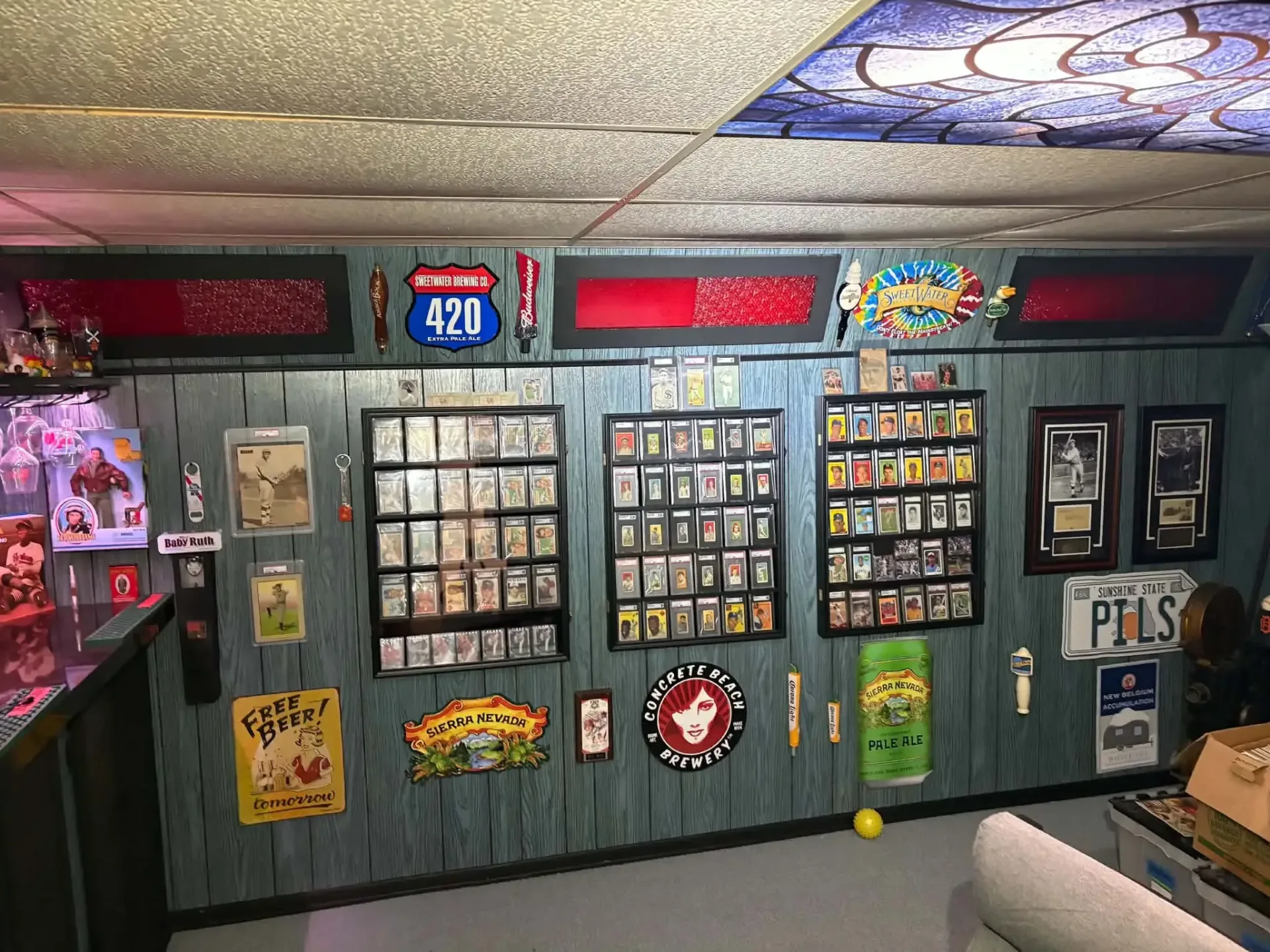
There is a familiar contradiction at the heart of card collecting: the more a card means to its owner, the more likely it may be sealed into a storage solution and rarely seen. Protection matters, particularly for graded cards and prized raw singles, but a collection stored entirely in boxes, drawers, cases or safes can become an archive rather than a visible part of a collector’s space.
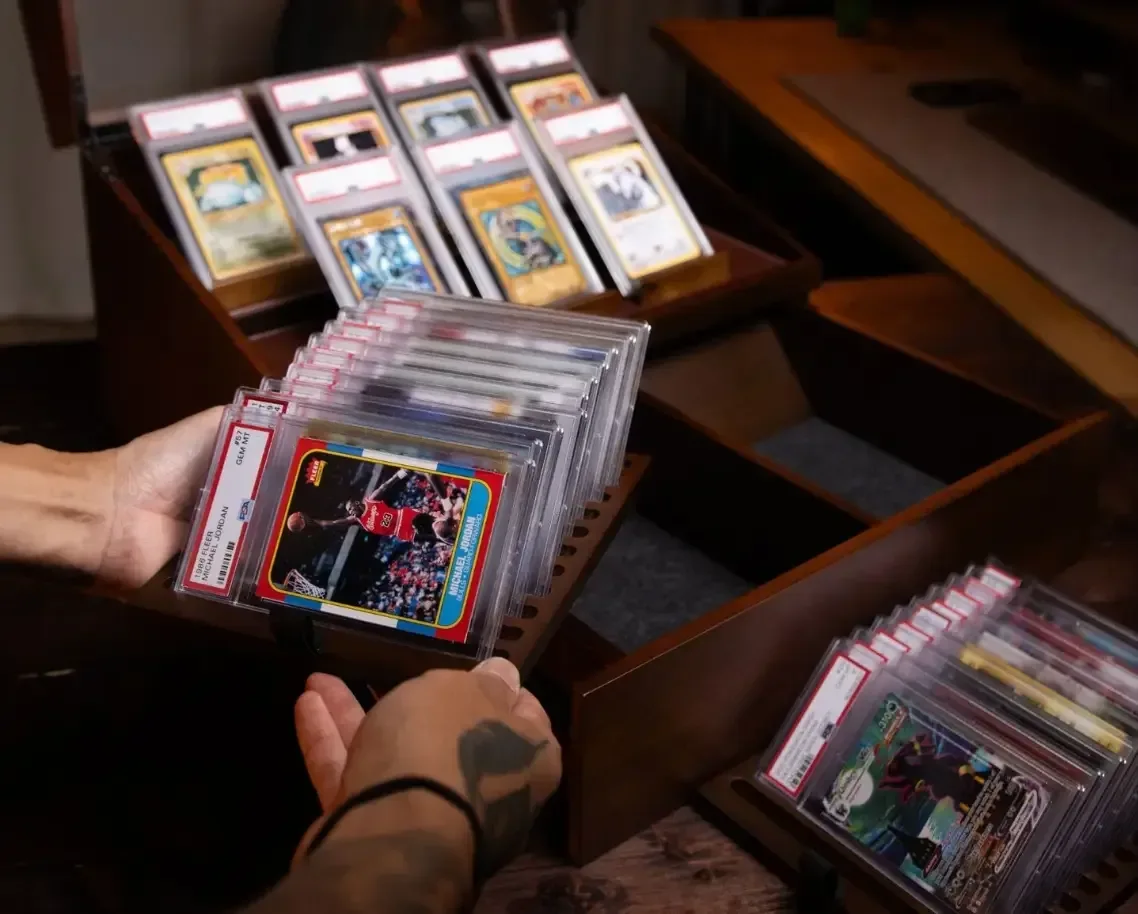
Holme & Hadfield is making a case for a different role for at least a small portion of that collection. Its new Trade Deck is a premium tabletop display made for sports cards and trading card game cards. Rather than trying to hold hundreds or thousands of cards, it centers on selection: seven cards on a raised stage, with room for 22 more below.
The handcrafted unit costs $395 and is positioned as furniture-like display hardware, not a low-cost replacement for a binder or bulk-storage box. It weighs more than 15 pounds, uses wood and metal hardware, includes a lifetime warranty, and places a clear distinction between storage capacity and presentation. For collectors whose favorite cards are meaningful because of a player, character, theme, set, milestone or personal memory—not merely a market price—that distinction may be the point.
A display built around a deliberate short list
The Trade Deck’s upper display stage holds seven cards beneath a cover stated to block 99.7% of UV rays. The company says the top section accommodates PSA, BGS, CGC and SGC slabs, along with ungraded cards placed in toploaders or magnetic holders. A slab is a card enclosed in a rigid, tamper-evident holder after it has been authenticated and, often, graded by a third-party service. A toploader is a rigid plastic holder commonly used to protect raw cards, while a magnetic holder is a reusable rigid case that closes with magnets.
For more context, explore Mark Ruffalo Condemns Approved Paramount-Warner Bros. Deal, Vows Opposition Will Continue.
Below the seven-card display is a drawer with two removable trays for 22 additional cards. Those lower trays are sized for PSA slabs. That is an important practical qualifier for collectors with mixed holder types: the display stage is intended to support several widely used formats, but the storage trays have been designed around one specific slab footprint.
The product’s capacity also makes its purpose unusually clear. This is not a solution for cataloguing an entire collection. It is a rotating gallery for a small group of cards, plus an adjacent reserve of 22 that can be swapped in as a collector’s priorities change. A collector could group cards by a favorite athlete, a run of matching designs, a team, a character, a grading label or a specific collecting goal. Equally, they could ignore value altogether and display cards that simply make them happy.
That philosophy reflects a question many collectors already answer informally: which cards would they choose if they could only leave seven out? The answer might include a major card, but it does not have to. A personal favorite can have a far stronger claim to display space than a more expensive card with little emotional connection.
From watch displays to card collecting
Co-founders Ian Holme and Phil Hadfield have spent roughly six years developing premium displays across several collecting categories. The company began with watch displays and later expanded its work to knives, coins, pens and other collectible items, serving more than 150,000 customers. The Trade Deck is its first product designed specifically for sports cards and TCG cards.
The move stems from an observation that applies across hobbies: collectors invest time and money in acquiring objects, then frequently put them somewhere they cannot enjoy them day to day. Phil Hadfield described the issue in terms of the disconnect between a collection’s importance and the way it is organized or shown. In the card world, that disconnect can be especially pronounced. The hobby has strong preservation habits—sleeves, holders, grading, boxes and safes—but far fewer standardized ways to make selected cards part of a desk, shelf or room.
Holme & Hadfield’s visit to the National Sports Collectors Convention reinforced its interest in the category. The founders encountered the scale of the hobby and the intensity with which people collect, while also seeing an opening for display products that better reflect what standout cards mean to their owners. Hadfield’s comparison is simple: cards can be treated like small pieces of art, meant to be shared and seen rather than perpetually hidden.
That should not be confused with a claim that every card belongs on a tabletop, or that traditional storage is no longer useful. Large collections, lower-value inventory, duplicate cards and cards not currently being featured still need practical organization. The Trade Deck’s premise is narrower: dedicated display and conventional storage can serve different jobs. One preserves access and volume; the other turns a few selected cards into visible objects.
What collector feedback shaped
Before developing the product, Holme & Hadfield surveyed more than 550 card collectors. The company says 94% of respondents were unhappy with their current storage or display arrangements. That result is company-provided survey feedback rather than an industry-wide measure, but it helps explain why the Trade Deck does not try to be a catch-all storage case.
The notable takeaway was that collectors were chiefly looking for a way to show their favorite cards, rather than asking for another method to store everything. The seven-card stage grew from that feedback. The number is small enough to require curation, yet large enough to create a theme or tell a story across several cards.
This is also where the product’s 22-card lower capacity becomes useful. Keeping a small rotation close to the display means a collector can refresh the stage without returning to long-term storage each time. A display could change when a new card arrives, when a favorite player’s season changes, or when a collector shifts from sports cards to a TCG character-focused arrangement. The concept treats a card display as active rather than permanent.
Protection, presentation and the limits of each
The UV-blocking cover is one of the Trade Deck’s most consequential listed features. UV, or ultraviolet light, is a portion of sunlight and other light sources that can contribute to fading and material deterioration over time. A cover that blocks 99.7% of UV rays is therefore relevant to displaying collectible cards. It is a protective feature, but it does not mean display eliminates every risk or replaces the care collectors already take with valued cards.
Collectors should view a display’s listed UV protection as one part of an overall preservation approach. The supplied specifications do not make broader claims about factors such as room placement, handling, humidity, temperature or physical security. The Trade Deck is presented as a display unit with a cover and drawer, not as a safe or vault. Owners deciding what to keep on view can therefore weigh personal enjoyment against their own comfort level for the cards involved.
The difference matters because display can alter how a collection is used. A card that is visible gets revisited. It can prompt conversation, inspire a collector to complete a visual theme, or simply offer a moment of appreciation that a card in long-term storage cannot. But the cards selected for display remain individual choices. The product does not argue that the seven highest-value cards should occupy the stage; it leaves room for taste, sentiment and visual cohesion.
A premium niche with potential to expand
At $395, the Trade Deck is clearly aimed at collectors willing to pay for materials, design and a more permanent presentation piece. It is not competing with budget storage products on capacity. Its value proposition is the experience of having selected cards visible and organized in a dedicated object that looks more like decor than a show-floor accessory.
Holme & Hadfield sees cards as a potentially major part of its business. The company is also exploring future wall-mounted card displays and higher-end options that could add lighting or increased security. Those possibilities are exploratory rather than announced product specifications, but they point to a broader category: card display systems that make a collection part of a room’s design.
For now, the Trade Deck is a compact expression of that idea. It asks collectors to make an edit rather than expand a storage inventory—choose seven cards to see, keep 22 ready to rotate, and give the rest of the collection the protection and organization it needs elsewhere. In a hobby built around finding the next card, that invitation to spend more time with the cards already owned may be its most distinctive feature.