An autograph is not automatically one category in the sports-card market. The same athlete’s signature can carry radically different value depending on the card beneath it, the point in the athlete’s career connected to that card, the number of copies available and whether collectors see it as a landmark piece rather than a later addition to a large autograph supply.
Recent examples involving Michael Jordan, Tom Brady and Derek Jeter underline a useful collecting principle: the strongest premium often belongs to scarce cards tied directly to an athlete’s playing years. That does not mean every autograph signed after retirement is undesirable, nor that a later-signed card cannot become enormously valuable. It means collectors should separate the date a card was issued, the date it was signed and the quantity produced before drawing conclusions from the presence of ink alone.
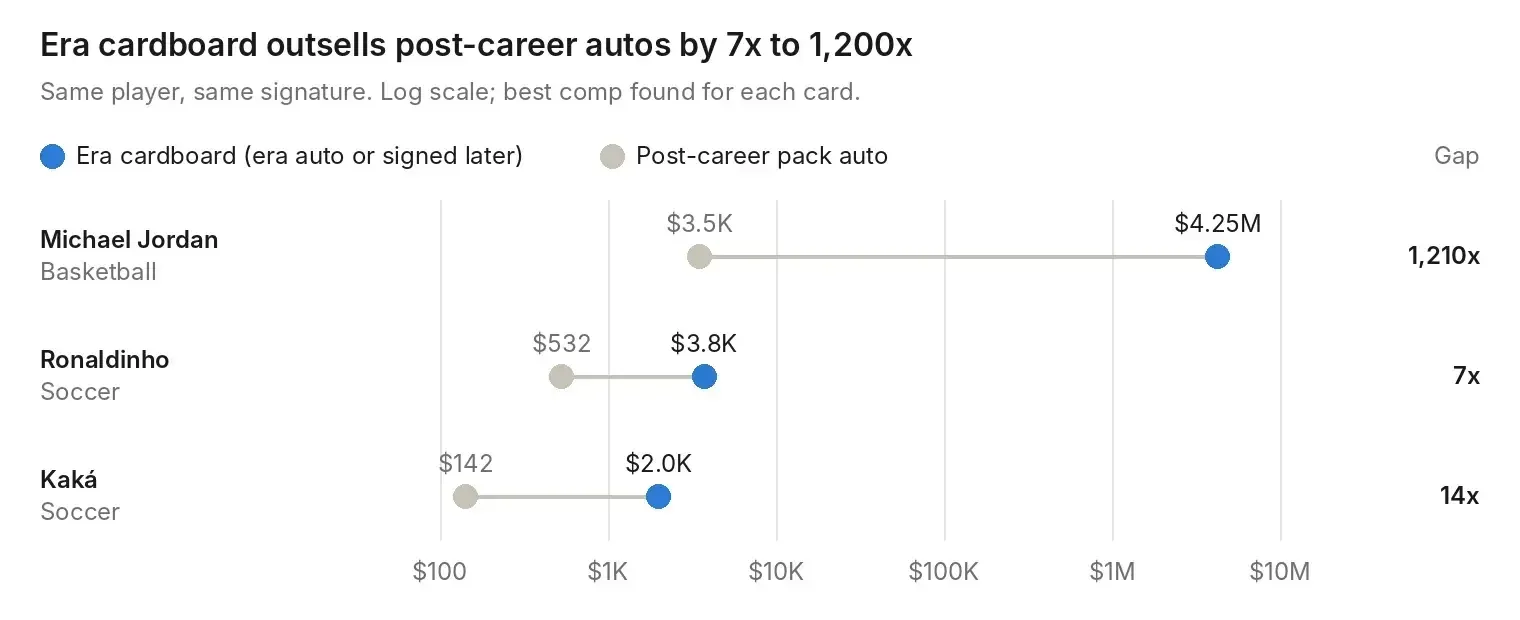
The difference can be immense. Across examples cited for Ronaldinho, Kaká and Jordan, era-card autographs outperformed post-career pack autographs by approximately 7 times, 14 times and more than 1,200 times, respectively. Those are not interchangeable comparisons or a universal price guide. They are, however, a clear sign that autograph collecting has layers.
The key distinction: card era, signing date and supply
A playing-day autograph is generally understood here as an autograph card issued during a player’s active career. A post-career autograph is one released after retirement. But the most revealing category may sit between those two labels: an era card signed later.
For more context, explore Netflix Admits U.S. Viewing Softness as Peter Rice Takes Over Content Leadership.
That is an older card from a player’s active years which is subsequently autographed, often through a sanctioned buyback program. Its signature may be new, but its cardboard remains attached to the player’s original era. Collectors can therefore be responding to two different things at once: the visual and historical appeal of the vintage or rookie-era card, plus the autograph itself.
Supply is the other indispensable part of the equation. A post-career autograph numbered to a very small total can be a major collectible. Conversely, a card issued during a player’s career does not automatically become a grail merely because it is old. The argument is not that retirement-era ink has no value. It is that plentiful post-career autograph output can struggle to compete with scarce, era-linked cards that already have a compelling place in the player’s story.
Michael Jordan shows both ends of the market
Jordan offers an unusually sharp illustration because the market includes colossal results for both categories, yet the gulf between certain examples is still dramatic.
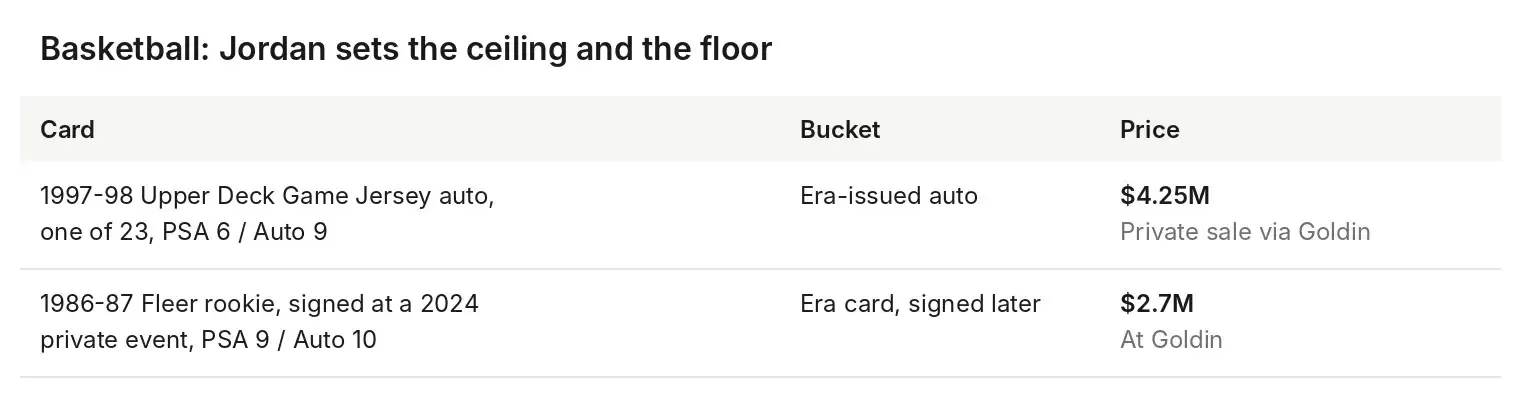
A 1997-98 Upper Deck Game Jersey Autographed Michael Jordan, numbered to 23 and graded PSA 6, sold privately through Goldin for $4.25 million in April 2026. The card dates to Jordan’s Chicago Bulls playing career, and its tiny production run is central to its importance. The card is not being valued only as a signed item. Its issue date, player association, jersey-card format and population all contribute to the result.
Compare that with a 2006 Upper Deck Trilogy Auto Focus Jordan graded BGS 10 Pristine Black Label with a 10 autograph grade. That later card recently sold for $51,600. It is an impressive figure by ordinary standards, and its top-tier grading makes it especially notable, but it operates in a different value tier from the scarce 1997-98 card.
There is an important caution in that comparison. One sale does not prove that every 1990s Jordan autograph will defeat every card produced after he retired. Other later Jordan autographs have sold from roughly $25,000 to $810,000, including a 2006 Exquisite Collection Patches Michael Jordan PATCH 1/1. A 1/1 is a card designated as the only copy of its specific version, and that level of scarcity can significantly change the calculation.
Jordan also demonstrates why collectors should not treat “signed later” as a disqualifier. Upper Deck’s 2006 buyback of a 1986 Jordan rookie card involved only 23 signed copies. The signature was added after the card’s original release, but the card itself is still a 1986 rookie. That combination—an iconic early card and an extremely restricted autograph supply—can make a later signing feel much closer to an era-autograph collectible than to a routine post-career issue.
What the Jordan examples actually suggest
- Scarcity can elevate a later-issued autograph substantially.
- A famous card from the player’s active era can retain much of its appeal even if its autograph was added later.
- High numerical grades and autograph grades are meaningful details, but they do not erase differences in issue year, historical context and print run.
- Collectors should avoid treating a player name and an autograph as sufficient description of a card.
Tom Brady: rookie-card status and active-era ink
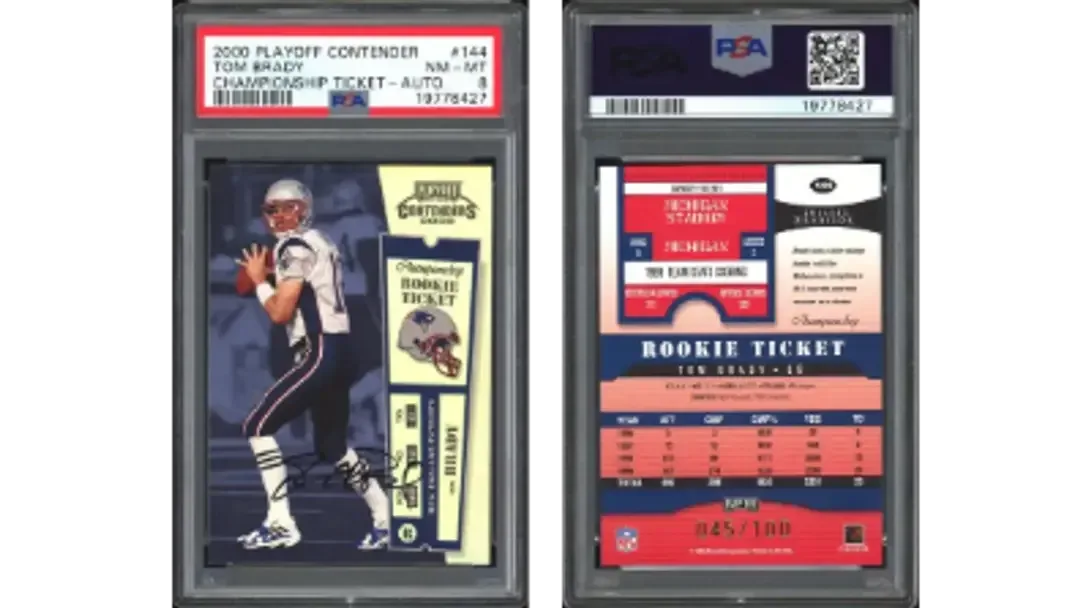
Brady’s market supplies an especially clean example of why rookie status matters. The 2000 Playoff Contenders Championship Ticket #144, numbered to 100, is described as Brady’s only NFL-licensed numbered rookie card with an on-card autograph from his playing days. A PSA 8 copy last sold for $854,000 on October 17.
Several identifiers matter in that description. “Rookie card” connects the item to Brady’s first NFL season. “On-card autograph” means the player signed the card itself rather than a separate sticker later attached to it. “Numbered to 100” establishes a fixed, limited production quantity. And the NFL licensing gives the card an official league connection. The market response reflects the convergence of those attributes, rather than one attribute in isolation.
Brady’s retirement news also shows the difference between a short-term catalyst and a card’s longer-term collecting case. Following his first retirement announcement, his collectible sales reportedly rose 198% and rookie-card sales rose 233%. Those figures show how major career news can concentrate attention on a player. Yet the continuing strength of playing-era cards suggests collectors were not simply buying any Brady item with a signature.
Even an unsigned example offers context for how event-driven demand can affect a landmark card. Brady’s 2000 Bowman Chrome rookie in PSA 10 has sold at points between $3,000 and $10,000, then nearer $30,000 after his 2021 Super Bowl win. That movement does not establish a guaranteed path for future prices. It does illustrate a practical point: a player’s major moments can change attention and demand, while the card’s role in that player’s career narrative remains a separate, lasting factor.
Baseball’s buyback model makes the nuance clearer
Topps Archives Signature Series is a direct example of the era-card-signed-later concept. The product buys back original Topps cards from a player’s career, has retired players sign them on-card, numbers the cards and encases them. Each card is numbered to 99 or fewer. A 2025 box was listed in the market at about $68.25.
For collectors, this format makes careful reading essential. A signed buyback could be an original card from an important season, but its autograph and its serial numbering may be much newer than the card. That is not a flaw; it is simply the product’s design. Buyers assessing one should identify the original issue, the player’s place in that season, the specific buyback numbering and the quantity of comparable signed cards that may exist.
Jeter illustrates the risk of looking only at a player’s name or Hall of Fame stature. He retired after the 2014 season and entered a multi-year autograph arrangement with Topps in fall 2016. His rookie cards rose ahead of his 2021 Hall of Fame induction before dropping more than 50% from their peak. The movement is a reminder that even blue-chip players can experience demand swings around milestone events.
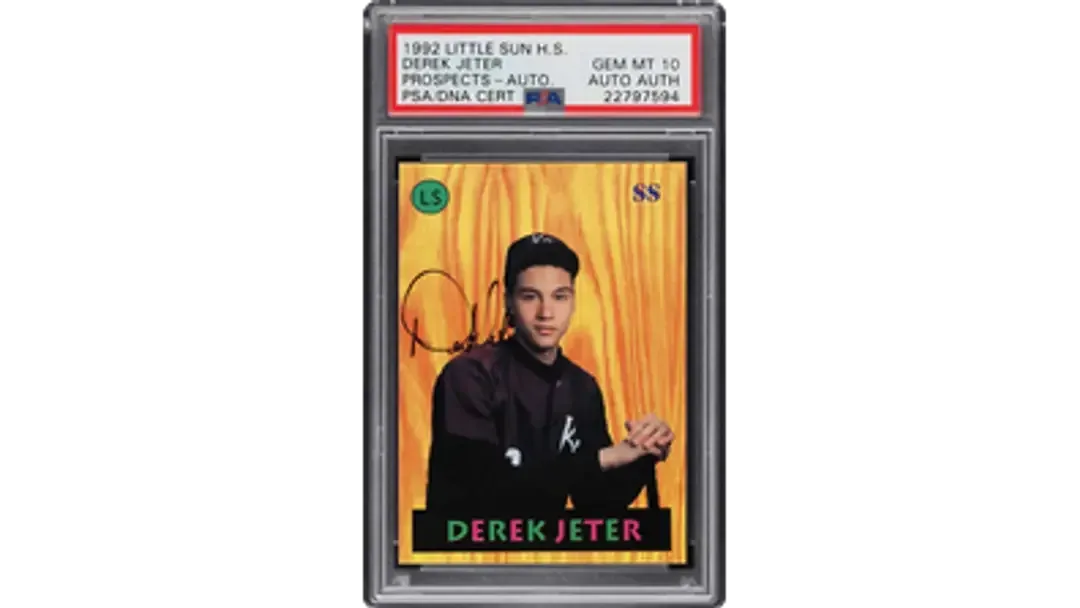
At the same time, Jeter’s scarcest era autographs retain a special status. The 1992 Little Sun High School Prospects autographed card is among the most prized examples. Its appeal stems from more than the signature: it comes from an early point in Jeter’s story and exists in a scarce form. The example supports a wider collecting lesson that an autograph can be meaningful because of when the underlying card was made, not merely when the pen touched it.
A practical checklist before buying an autograph card
Collectors do not need to assume that later autograph cards are bad purchases. They do need to know what they are buying. A disciplined checklist can prevent a signed card from being evaluated as though every autograph has identical scarcity and historical weight.
- Identify the original card year. Was the card issued during the player’s active career, after retirement, or originally issued earlier and signed through a later buyback?
- Check the card’s role. Is it a rookie, a key early-career issue, an era-specific release or simply a later design? Rookie status and association with a celebrated season can matter greatly.
- Read the numbering precisely. A card numbered to 23, 100 or 99 or fewer signals a defined limit, but a serial number alone does not reveal how many similar autographs the athlete has signed in other products.
- Distinguish on-card from sticker autographs. An on-card signature is written directly on the card. That is a concrete production detail, not a blanket guarantee of value.
- Separate the grade from the card’s identity. PSA and BGS grades describe condition under their respective systems; an autograph grade speaks to the signature. These can affect desirability, but they are not substitutes for scarcity and context.
- Use sales as examples, not promises. The Jordan, Brady and Jeter figures show how particular cards have traded. They do not mean similar cards will reach the same results.
The real divide is often volume
The most useful takeaway is not “never buy a post-career autograph.” There can be good reasons to collect one: a favorite player, an attractive design, a low-numbered version or a comparatively accessible way to own authenticated ink. The sharper concern is volume. When a retired player’s autographs arrive across many releases and in significant quantities, individual cards may lack the scarcity and distinct event connection that support the top end of the market.
By contrast, the most powerful cards in these examples stack multiple reasons for collectors to care. Jordan’s $4.25 million result involved a playing-era card numbered to 23. Brady’s six-figure PSA 8 sale involved a numbered, on-card, NFL-licensed rookie autograph from 2000. Jeter’s most celebrated autograph example is an early card linked to his pre-major-league history. None can be reduced to “an autograph of a famous athlete.”
That is the practical distinction behind the premium. In sports cards, the ink may be genuine in every case, but collectors often place the greatest weight on the story the card could tell before it was ever signed.