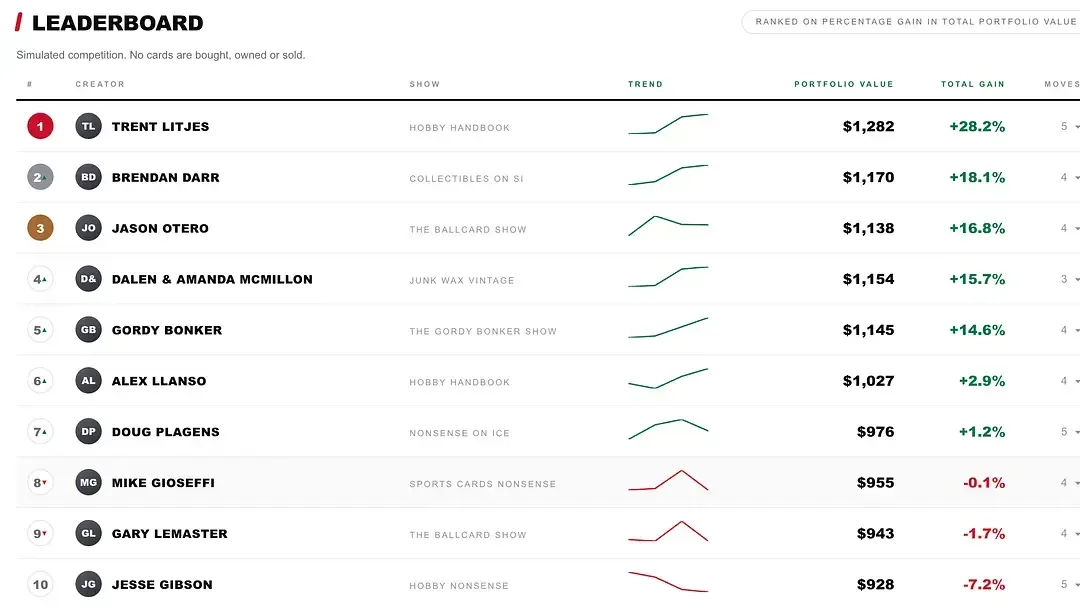
The SCN Challenge’s Week 3 standings have put Trent back in first place, but the bigger story may be the ruling that reshaped a waiver move before it could really begin. The season-long competition asks football card collectors and fans to manage player-card portfolios through the Super Bowl, blending fantasy-football-style decisions with changing collectible values.
That setup makes every week a mix of on-field expectation, limited roster moves and market interpretation. A player’s upcoming schedule can become part of a manager’s thesis, but the contest is not simply measuring touchdowns or wins. It is measuring how the selected cards move in value. In Week 3, the leader benefited from multiple cards rising at once, while a valuation discrepancy turned another entrant’s planned Jaxson Smith-Njigba play into a forced swap.
Trent’s portfolio has the broadest early momentum
Trent sits atop the table after Week 3 and was not making a waiver move at the time of the update, preserving that position. His biggest boost has come from a 2025 Panini Prizm Tyler Shough Silver Auto, graded PSA 9, which is up 60% across the competition’s first three weeks.
That one result is significant, but it is not carrying the entire portfolio alone. Trent has four cards showing gains of more than 20%, with just one holding a negative return. In a contest based on a group of cards rather than a single pick, that kind of distribution matters. It reduces dependence on one player or one card suddenly reversing course.
For more context, explore Denis Villeneuve Once Thought Dune: Awakening’s Name Might Sound Too Much Like Star Wars.
PSA 9 refers to a card that has been professionally graded as Mint on PSA’s 10-point scale. The grade is part of the collectible’s identity in a market contest: a graded copy should not automatically be treated as interchangeable with a raw, ungraded version, even when the card itself is otherwise the same. That distinction sits at the center of Week 3’s waiver dispute.
The manager in second place has seen every card in the portfolio gain value, yet remains behind Trent because that manager’s Tyler Shough card is up 16.8%, rather than the 60% return attached to Trent’s copy. It is a useful reminder that player selection is only part of the equation. The specific release, parallel, autograph status and grade can cause two cards tied to the same player to perform very differently.
Jason Otero occupies third after slipping from the top spot. His portfolio was not moved around at waiver time: the named hero cards remained a Caleb Williams Optic Red Pandora PSA 10 and a Matthew Stafford Topps Finest PSA 10. Standing pat preserves flexibility, but it also means accepting whatever the existing cards do while rivals look for a quicker rise elsewhere.
Related coverage includes SCN Challenge Week 3: Trent Leads as Waiver Decisions Shape the Card Market Race.
A waiver transaction ran into a valuation problem
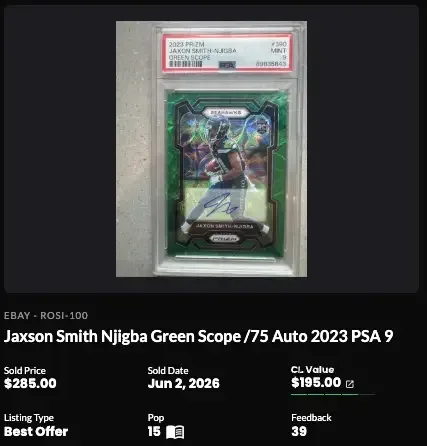
The most complicated Week 3 development began with a move made after Week 2. The second-place manager dealt a Caleb Williams Purple Shock PSA 10 for a 2023 Jaxson Smith-Njigba Prizm Green Scope Auto /75 PSA 9. At the time of the swap, the values appeared close: $200 for the Caleb Williams card and $195 for the Smith-Njigba card.
The issue emerged once the Smith-Njigba card was added to the contest collection on Card Ladder. Its listed Card Ladder Value rose to $685. After a review, the contest’s commissioner, referred to as the “Benevolent Dictator,” ruled that the card could not stay in the portfolio because the value being applied to raw copies was substantially higher than the value of the PSA 9 copy.
The card therefore had to be replaced. Crucially, that correction does not count against the manager’s five allowed moves for the season. Even so, it changed the strategic plan. Smith-Njigba had been intended as a short-term selection, based on his hot start and an upcoming run of favorable matchups. The manager instead needed another card with potential to move promptly while remaining within the contest’s valuation framework.
Why raw-versus-graded pricing can cause trouble
A raw card is one that has not been authenticated and assigned a numerical condition grade by a grading company. A graded card is sealed in a holder with that company’s stated grade. In ordinary collecting, a PSA 9 is often discussed separately from an ungraded card because buyers are pricing both the visible condition and the certainty created by third-party grading.
In a portfolio game, a database value can add another layer. If a platform associates a card entry with sales or listings that do not precisely match the graded copy under consideration, the resulting figure can distort a contest transaction. That does not establish that the PSA 9 itself sold for $685. It means the value displayed after the card was loaded did not fit the intended comparable pricing, and the organizers chose to correct the roster.
It is a practical warning for any value-based collecting league. A participant should verify more than the player name and the broad card description before finalizing a move. The exact checklist details matter:
- the set and year;
- the parallel or color variation;
- whether the card is autographed;
- the serial numbering, such as /75;
- whether it is raw or graded; and
- the grading company and numerical grade, when graded.
Those checks will not eliminate changing market values, but they can reduce the chance that a roster move is built around an unsuitable comparison. The Week 3 ruling also shows why contest organizers need a clear mechanism for handling an error without treating it as a normal strategic transaction.
The replacement bet is Patrick Mahomes
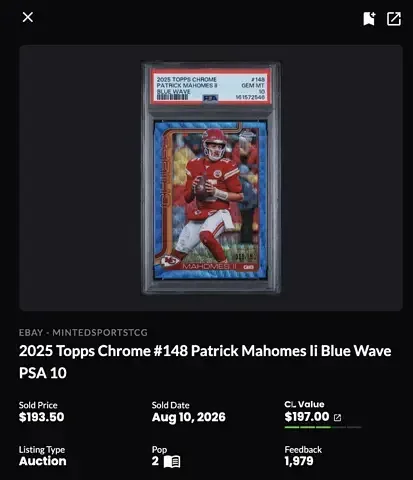
With Smith-Njigba removed, the manager selected a 2025 Topps Chrome Patrick Mahomes Blue Wave /150 PSA 10. A Blue Wave is a parallel design variation, while “/150” indicates that the card is serial-numbered within a 150-card print run. The PSA 10 grade identifies it as Gem Mint under PSA’s standards.
The pick is still valued below the Caleb Williams card that was originally traded away, but the case for Mahomes is explicitly short term. The Chiefs’ next games are against the Raiders and Chargers before the schedule becomes more difficult. The idea is that strong performances over those next few weeks could improve demand for the card quickly enough to benefit the portfolio.
There is at least one market reference point in the thesis: a true-blue version sold for $400 near release. The stated hope is that a productive stretch could bring the Blue Wave closer to $300. That is an expectation, not a completed result, and it is important to keep the two separate. A sale of a different parallel establishes neither a fixed price nor a guarantee of future movement for this PSA 10 Blue Wave.
Still, the selection illustrates the contest’s fantasy-sports logic. A manager is not required to believe a card will be the best long-term football collectible. The objective can instead be to identify a near-term catalyst, use limited moves carefully and get out before the case changes. Upcoming opponents are only one variable in that process, but they can shape the timing of a swap.
Week 4 puts pressure on the bottom of the standings
At the other end of the leaderboard, Jesse Gibson remains in last and needs the markets for C.J. Stroud or Jordan Love to recover. Gary LeMaster and Mike Gioseffi are the only other competitors currently in negative territory.
LeMaster needs his Matthew Stafford card to rebound, while Gioseffi is looking for a substantial recovery tied to Drake Maye. Among the names in the field, Jordan Love and Drake Maye are down the most at this stage. Their disappointing early performance has been followed by weaker card-market results in the competition.
The next round therefore presents several distinct tests. Trent must show that a diversified run of gains can hold together. The Mahomes manager must see whether a short-window schedule bet can offset the disruption of the voided Smith-Njigba transaction. And the entrants in negative territory need evidence that their selected cards can reverse direction rather than merely decline at a slower rate.
For collectors following along, the useful lesson is less about declaring any one player a sure thing and more about recognizing the layers in a card’s value. Player performance, scarcity, card design, grade, recent comparable sales and the rules of the league can all pull the number in different directions. Week 3 made that especially clear: even a move that began with two nearly equal figures can look entirely different once the exact card and its valuation entry are scrutinized.