NFL card markets have a habit of behaving like a two-minute drill: everything speeds up, nobody has the full picture, and every new development can change the play call. Two weeks into the 2026 season, that volatility is concentrating around quarterbacks. Jayden Daniels and Jaxson Dart now carry major injury uncertainty, Caleb Williams appears to have avoided a more serious outcome, and strong early performances have put Brock Purdy and Tyler Shough on the upswing.
For collectors, the practical lesson is not that every Sunday result demands an immediate buy or sell. It is that the market is pricing several distinct things at once: player health, expected playing time, team momentum, media narrative, scarcity within a rookie class, and the particular card being traded. A headline about an elbow or a breakout win may move attention quickly, but sustained card value generally needs a clearer case than one dramatic week.
Daniels’ elbow makes the risk impossible to ignore
Daniels dislocated his elbow in Washington’s loss to Dallas. It was his third dislocation in roughly 10 months, making this more consequential than an ordinary short-term absence. There is no stated return timetable. If he does not require surgery, a four-to-five-week return has been presented as a possibility, but that is conditional rather than a certainty.
The repeated nature of the injury is the key market issue. A single injury can be treated as a frustrating interruption to production. Repeated injuries to the same area encourage collectors to consider longer-term durability risk. That does not establish that Daniels’ career will be permanently changed, but it explains why the conversation may extend beyond the number of games he misses.
His recent card history shows how sharply an injury narrative can affect a premium modern rookie issue. Daniels’ rookie Silver Prizm graded PSA 10 had been selling in the $800 to $900 range before an injury last November, then reached a low point of $570 by the end of that season. PSA 10 refers to a card assessed as Gem Mint by Professional Sports Authenticator; collectors often pay substantial premiums for that top grade, particularly on widely recognized rookie cards. Silver Prizm is a parallel version of a standard Prizm card rather than simply the base issue, another factor that can increase collector demand and price sensitivity.
That earlier move is context, not a price forecast. The circumstances are not identical, and sales can vary based on timing, card appeal, supply, and buyer interest. Still, it gives collectors a concrete reference point for why another extended absence could put pressure on Daniels’ flagship graded rookie. Washington’s 0-2-looking early form and broader concerns around the team’s direction add another layer: quarterback cards frequently rise and fall with the perceived strength of the team around the player.
What to watch with Daniels cards
- Medical clarity: Whether surgery is needed and how a recovery timetable develops will matter more than initial speculation.
- Actual completed sales: Asking prices can be loud; transactions are the clearer evidence of what buyers are paying.
- Card specificity: A Silver Prizm PSA 10 should not be treated as a stand-in for every Daniels card. Base cards, lower grades, numbered parallels and autograph cards can react differently.
- Washington’s performance without him: A rough stretch may magnify pessimism, while a competitive team can help cushion it.
Collectors holding Daniels cards may therefore want to distinguish between a personal collection decision and a short-term market decision. The former can be about attachment to a player or set. The latter is exposed to a stream of health and performance updates that may arrive before the market has settled on a consensus.
Dart’s reported season-ending outlook is a different kind of shock
Jaxson Dart’s situation appears more severe in the immediate term. He is expected to undergo surgery and likely miss the rest of the season. An injury that removes a quarterback from the field for most or all of a season takes away the weekly opportunities that normally create card-market catalysts: wins, highlights, statistical milestones and the possibility of a late-season playoff chase.
That does not automatically mean every Dart card has the same outcome. The supplied information does not provide sale figures for his cards, so it would be wrong to pretend there is a precise market move already established. But the basic collecting dynamic is straightforward: when the player cannot add on-field evidence for months, buyers have fewer immediate reasons to chase the market upward. Attention can shift to healthy quarterbacks with games on the schedule every week.
Dart’s longer-term evaluation will have to wait for the recovery process and a return to the field. That wait is precisely the challenge for collectors who bought into an early-career quarterback thesis. In a market driven heavily by momentum, a lost season can turn a rapid narrative into a holding pattern.
Caleb Williams, meanwhile, appears to have come through his injury scare relatively unscathed. That contrast is useful. Injury news is not a single category. A scare that does not lead to a lengthy absence is materially different from repeated dislocations or surgery with a likely season-long recovery. Treating all three situations as one broad “QB injury dip” would overlook the details buyers are likely to prioritize.
Purdy’s efficient start is restoring a familiar argument
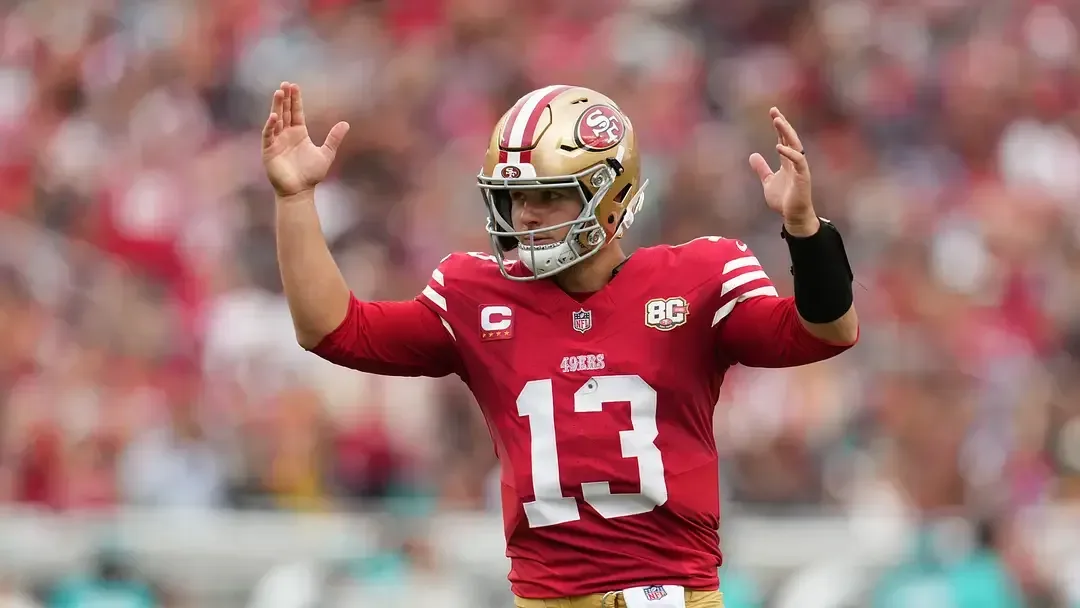
At the other end of the mood board, Purdy and San Francisco are 2-0 after a dominant win over Miami. Purdy threw for nearly 300 yards and two touchdowns, missing on only two pass attempts. Through two games, he has six total touchdowns and an 80% completion rate. The sample is extremely small, and both contests were effectively decided by halftime, but early efficiency is nonetheless feeding a positive market narrative.
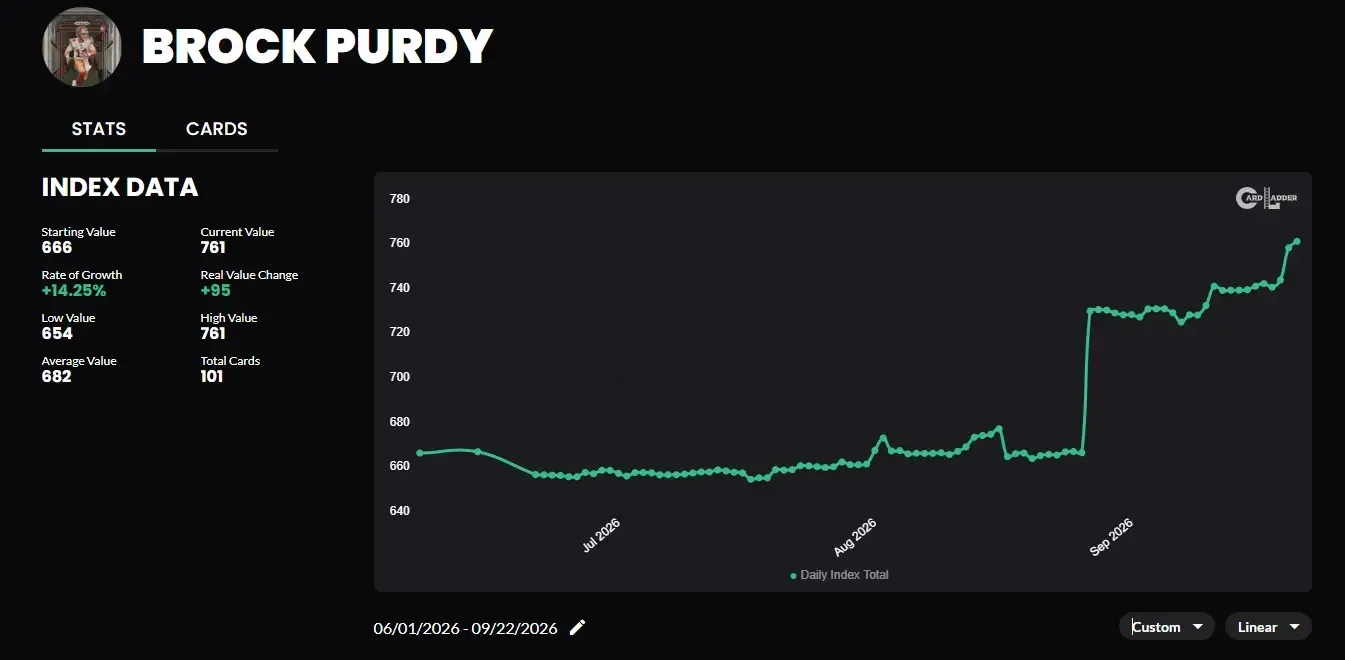
Purdy’s card catalog has reportedly risen by close to 15% since June. His rookie Prizm PSA 10 has moved close to $250 since the summer. Those figures reflect why collectors often view winning quarterbacks on high-profile teams as one of the hobby’s quickest-moving segments: good play can create a feedback loop between coverage, fan interest, confidence in postseason potential and card demand.
The next game against Arizona is another opportunity for the story to grow, though it is not a guarantee of another market jump. What Purdy needs for a more durable rise is not merely a hot September. A continued playoff push would be the more meaningful support for a market trying to revisit the highs associated with his 2022-23 run.
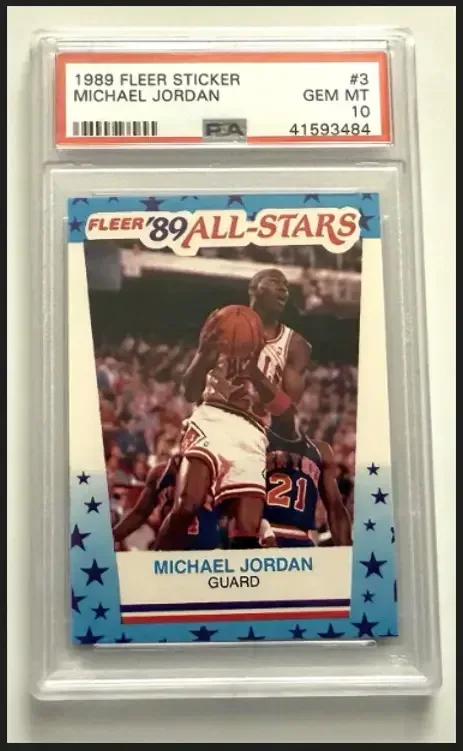
The comparison with other premium graded sports cards is useful only at the most general level: a recognizable card in a top grade can attract outsized attention when a player’s story catches fire. That same grade-driven dynamic has appeared in the basketball market, including the sale discussion around a 1989-90 Fleer Jordan sticker graded PSA 10. The players, eras and markets are not interchangeable, but the importance of exact card identification and condition is.
Purdy’s ceiling, and the necessary caveat
The bullish case is visible: San Francisco has started 2-0, Purdy is producing efficiently, and his cards already have a demonstrated history of responding to team success. The caution is equally clear. Two games do not establish a full-season level, and the early game scripts limited the pressure on San Francisco. A collector buying after a sharp run is paying not just for the statistics already recorded, but for the expectation that the team and quarterback can keep delivering them.
That is why it helps to separate market momentum from long-term conviction. Momentum is the speed and direction of buyer attention right now. Conviction is the belief that a player’s achievements, role and collector base justify holding through inevitable fluctuations. Purdy has momentum; whether the season turns that into stronger conviction remains the open question.
Shough has the opportunity that other young QBs lack
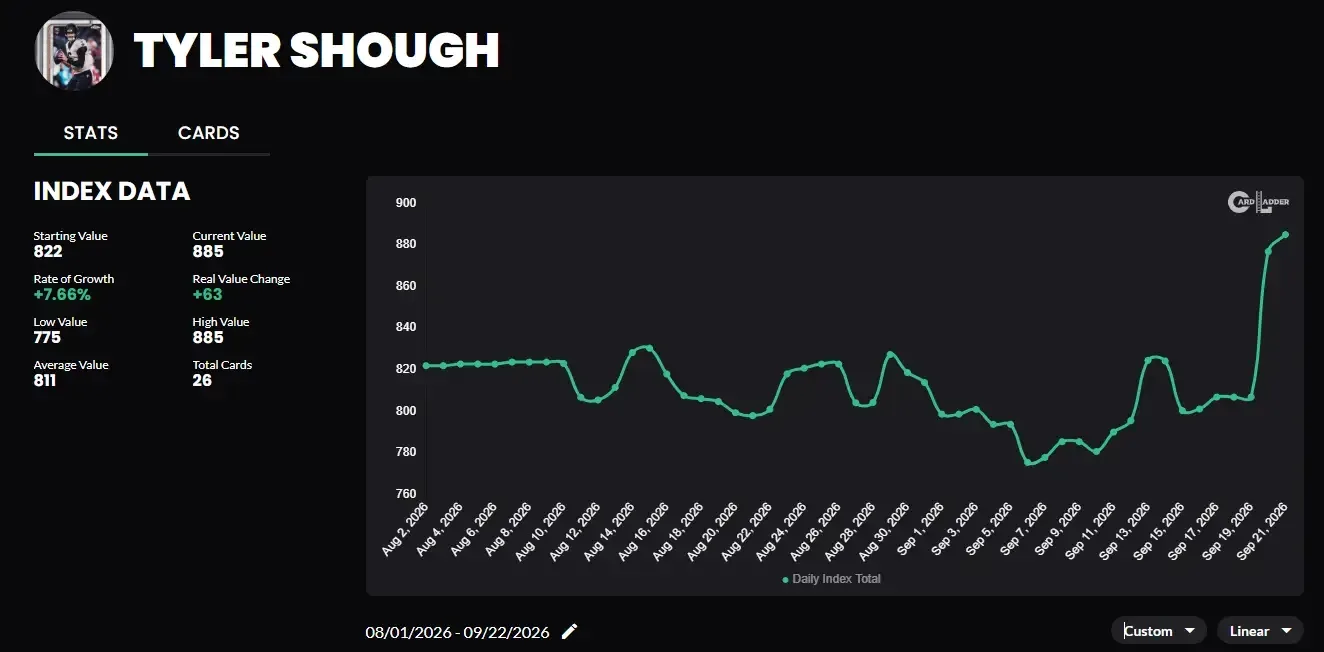
Tyler Shough’s early season has generated a different kind of surge. His market rose after New Orleans’ near-comeback against Detroit in Week 1, despite his poor play for much of that game, and it received another boost after an impressive Week 2 victory at Baltimore. The contrast shows that collectors do not always isolate every snap. Comeback drama, a memorable result and the appearance of a developing quarterback story can all affect demand.
Shough is 26 and was selected in the second round of the 2025 draft. The case for his cards is being helped by an unusually quiet immediate alternative market among recently drafted quarterbacks. No. 1 overall pick Fernando Mendoza has not played in 2026, while Carson Beck and Shedeur Sanders have also yet to see the field. When several speculative rookie options lack game action, a quarterback who is starting and winning can receive a larger share of collector attention.
The Saints’ divisional setting further strengthens the optimistic view. New Orleans is considered the early favorite in the NFC South, described as the league’s weakest division through two weeks. That could give Shough frequent chances to build statistics and keep the Saints in the race. The schedule has been framed as largely favorable outside three NFC North matchups and a potentially difficult Bengals game.
But “favorable” is not the same as settled. Shough’s prospect profile was regarded as risky, and a fast market rise makes the next performances more important, not less. If the Saints keep winning and Shough continues to produce, collectors will have more evidence for the breakout case. If either side slips, a market that climbed quickly can reassess just as quickly.
A practical checklist for collectors during a volatile September
- Name the exact card. Set, parallel, serial numbering, autograph status and grade matter. “Rookie card” is not enough detail for a meaningful comparison.
- Track sales rather than chatter. A visible listing indicates hope; a completed sale indicates what a buyer actually accepted.
- Do not treat injury reports as final verdicts. Daniels’ status depends on medical developments, while Dart’s expected surgery and likely absence create a separate, longer pause.
- Understand the catalyst you are buying. Purdy’s is team success and sustained efficiency. Shough’s is opportunity, victories and a thin young-quarterback field. Those are not identical theses.
- Plan for the reversal. Football cards can react to one game, but the season will supply many more. A position that only works if every remaining week goes perfectly is a fragile one.
Week 2 has not decided the 2026 quarterback-card market. It has, however, made the divides clearer. Daniels and Dart now face the hard work of recovery, with their cards exposed to uncertainty and lost playing time. Purdy has a strong start and a talented team turning his established market back upward. Shough has seized a live opportunity while several other young quarterbacks remain off the field. For collectors, the sensible move is to follow the details, respect the difference between a headline and a trend, and remember that in football cards, the next drive can be a plot twist.