Backup quarterbacks can turn the football-card market into a very fast-moving proposition. A player who had little immediate path to snaps can suddenly become a starter because of an injury, a trade or a change in form elsewhere on the depth chart. That new visibility can bring collector attention quickly, particularly when a team still has something to play for late in the season.
Four quarterbacks sit in especially different versions of that situation: Baltimore’s Joe Fagnano, Cleveland’s Shedeur Sanders, Minnesota’s Carson Wentz and the New York Giants’ J.J. McCarthy. Their cards do not represent one uniform type of opportunity. Fagnano has a tiny licensed-card footprint. Sanders has already shown he can command substantial sales during a starting stretch. Wentz has an older, well-established premium rookie-card market attached to a chance at renewed relevance. McCarthy has moved from a depressed market into a new team situation with collectors again taking notice.
That distinction matters. Playing time may be the shared catalyst, but the available cards, the player’s history and the specific card being considered all shape what a burst of attention can mean. A starting opportunity can create demand; it does not guarantee a lasting card-market reset.
Joe Fagnano: a scarcity story begins with a college-uniform card
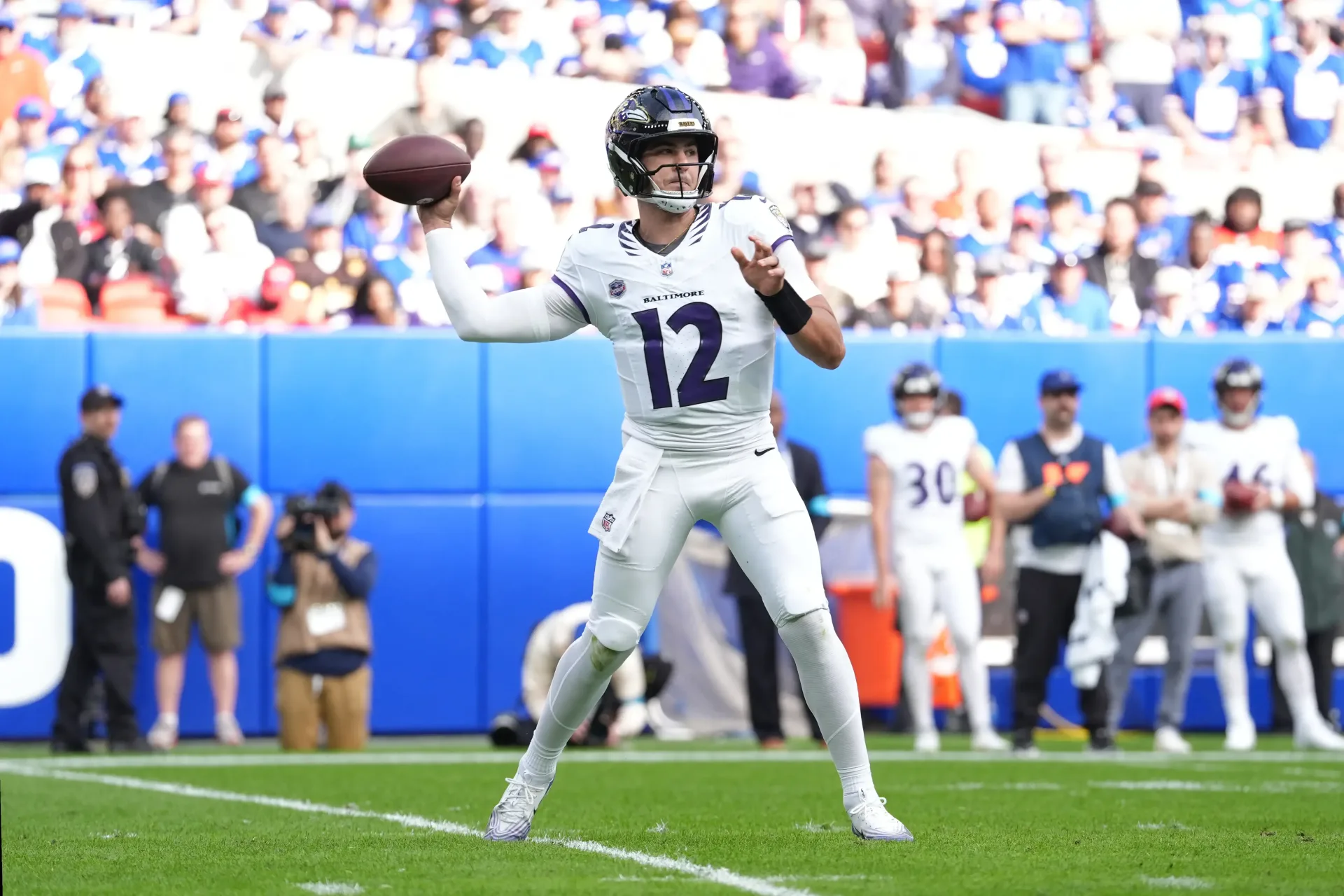
The Ravens are expected to turn to 25-year-old undrafted rookie Joe Fagnano for the foreseeable future. Lamar Jackson is injured and may miss the rest of the season, while Tyler Huntley is also sidelined. For collectors, the most unusual part of Fagnano’s case is not simply that an unfamiliar quarterback may start—it is how limited his officially licensed card selection currently is.
Fagnano has one officially licensed card on the market: 2026 Upper Deck World of Sports No. 107, pictured in his UConn Huskies uniform. The set includes athletes from a selected group of colleges and universities. His base card has sold from $35 to $80 in the past two weeks.
That price range is a useful reminder that even a base card can command attention when a player’s supply is extremely thin and his NFL role changes suddenly. A base card is the standard, non-numbered version of a card in a set, rather than a limited parallel, autograph or memorabilia edition. Usually, collectors have many base options to choose from. Fagnano’s current situation is different: a single licensed issue means the conversation begins with the one card that exists.
There is also an important limitation. The World of Sports card depicts Fagnano as a college player, not as a Raven. That does not prevent it from becoming relevant to collectors following his NFL opportunity, but it makes this an unusual bridge between college imagery and pro-football attention. A buyer interested specifically in an NFL-uniform rookie card may be waiting for products that are not part of the currently described market.
For Fagnano, the first thing to watch is not whether one sale reaches the high end of the recent range. It is whether multiple sales continue to occur as his opportunity develops. Repeated completed sales give a clearer signal than a single ambitious listing or an isolated result. His card has scarcity on its side, but its long-term appeal remains tied to a player only now entering a larger NFL role.
Related coverage includes Four NFL Quarterback Card Markets to Watch as Playoff Stakes Rise.
Shedeur Sanders: the market has seen the starter effect before
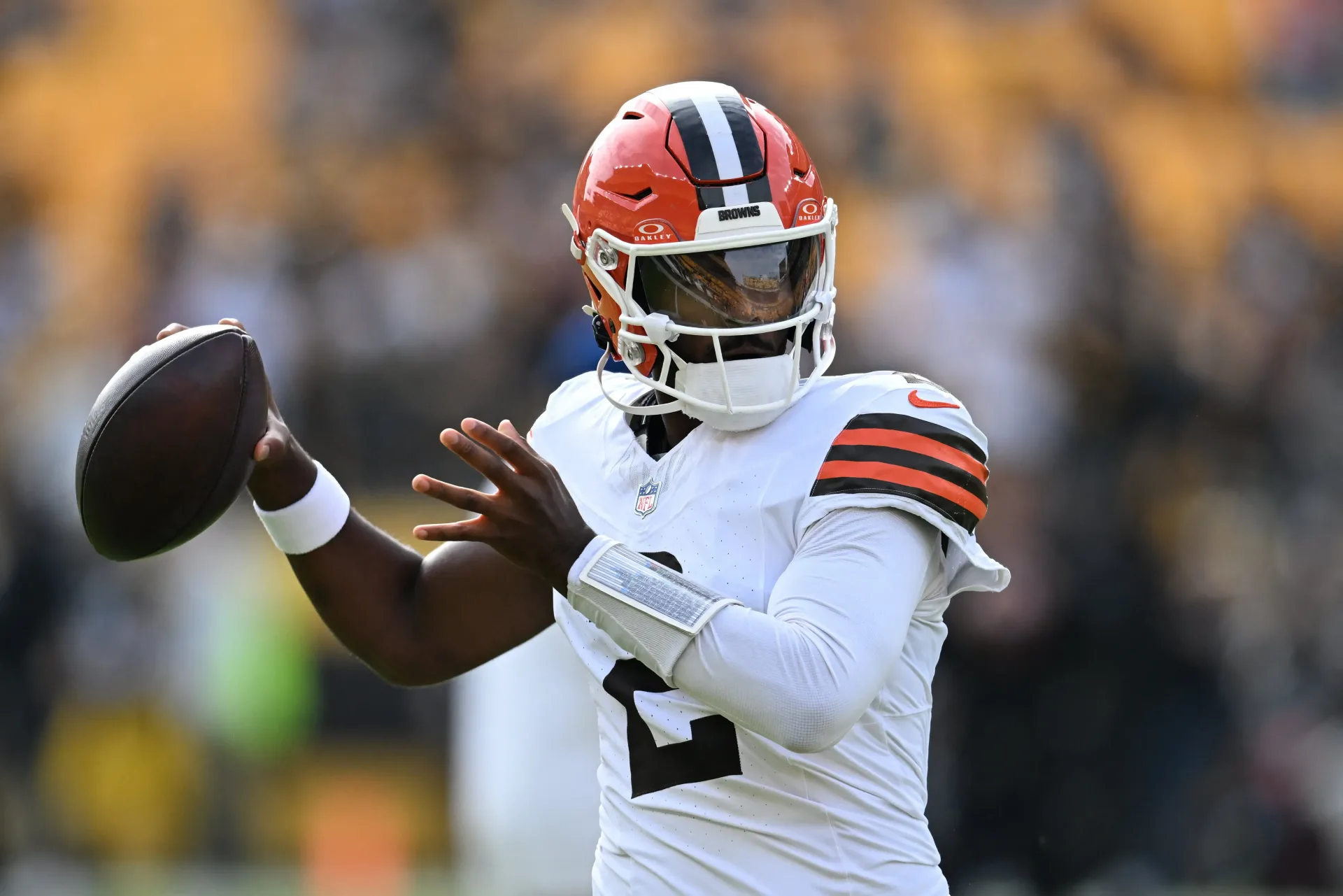
Sanders is back in the Browns’ starting role because Deshaun Watson is unable to play due to injury. Unlike Fagnano, Sanders brings a very recent example of how a starting job can affect collector behavior. He went 3-4 as Cleveland’s starter last season, and multiple cards sold for more than $10,000 during that run.
That prior activity does not establish a floor for every Sanders card, nor does it mean the same sale levels will return. It does, however, give the market a reference point that Fagnano does not have. Collectors already know that a meaningful group of buyers responded when Sanders was under center, and Cleveland remains in playoff contention.
The key word is contingent. Sanders’ interest could be influenced by several connected developments: how long he holds the job, the Browns’ playoff position and how prominently his performances register with the broader football audience. The source material supports each of those as relevant circumstances, but none turns a card purchase into a predictable outcome.
For collectors looking at Sanders cards, card-level precision is especially important. A headline about five-figure transactions says little on its own about the total market. It does not tell a buyer whether the sale involved a low-numbered parallel, an autograph, a premium set, a desirable grade or some combination of all four. Comparing an ordinary card to a high-end sale without matching those details is an easy way to mistake attention around a player for equivalence between two very different pieces.
The practical takeaway is to identify the exact card before drawing conclusions: set, year, parallel, serial number if present, autograph status and condition. The player may be the reason a market gets searched, but the card’s individual characteristics explain why one example can sell at a radically different level than another.
Carson Wentz: an established premium rookie card meets a fresh start
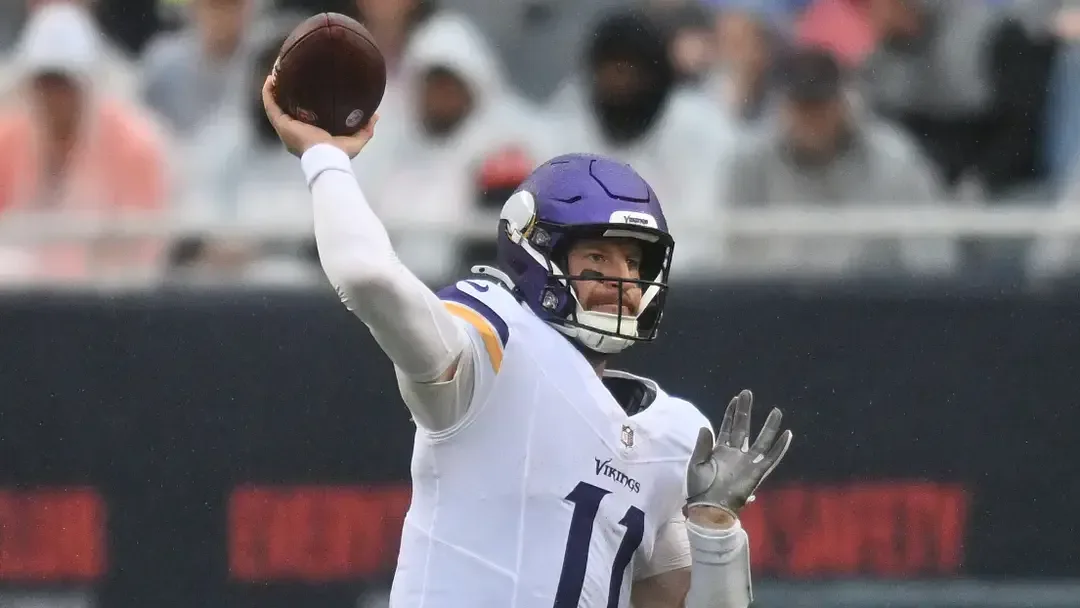
Wentz will start for Minnesota against the Buffalo Bills after serving as an efficient backup for the Vikings across the past two seasons. Kyler Murray has struggled with health and effectiveness, creating the opening. The collector angle is less about a newly discovered player than it is about whether an earlier chapter of Wentz’s hobby profile can regain momentum.
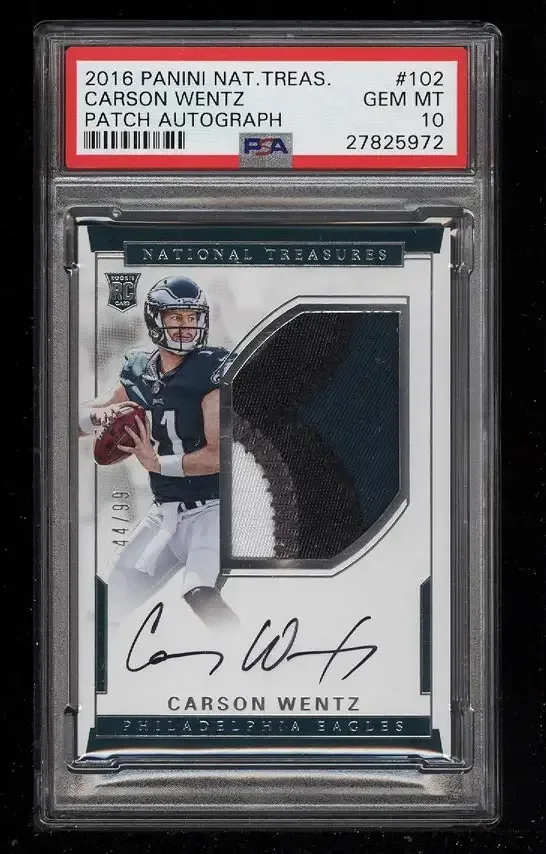
In November 2017, before a season-ending knee injury that December, a PSA 10 copy of Wentz’s 2016 Panini National Treasures Rookie Patch Autograph, numbered to 99, sold for $6,891.98. That single historical result captures why Wentz remains an interesting name when he returns to a starting assignment: he has already been associated with a premium tier of modern quarterback collecting.
Several terms in that card’s description carry real weight. RPA means Rookie Patch Autograph, a format combining a rookie designation, an autograph and a patch component. “/99” means the edition is serial-numbered to 99 copies. PSA 10 identifies a top grade from Professional Sports Authenticator, with the numeric grade describing the evaluated card’s condition. These are not interchangeable details. The result cited was for a graded, limited, autographed rookie patch card from National Treasures—not a blanket value for Wentz’s 2016 cards.
The 2017 sale is therefore historical context, not a ready-made comparison for today. A return to the lineup can renew searches and discussion, but it cannot erase the difference between the circumstances then and now. For collectors, Wentz is a useful case study in why peak-era prices should be read carefully. They show what a particular card achieved in a particular moment; they do not promise that the same point is automatically reachable again.
Those who want to follow the category beyond football can also see how specific formats and limited presentation shape collecting interest in this recent collectibles blind-bag release. Across categories, scarcity and format can matter as much as name recognition—but they remain only parts of a much larger demand picture.
J.J. McCarthy: a trade has changed the conversation
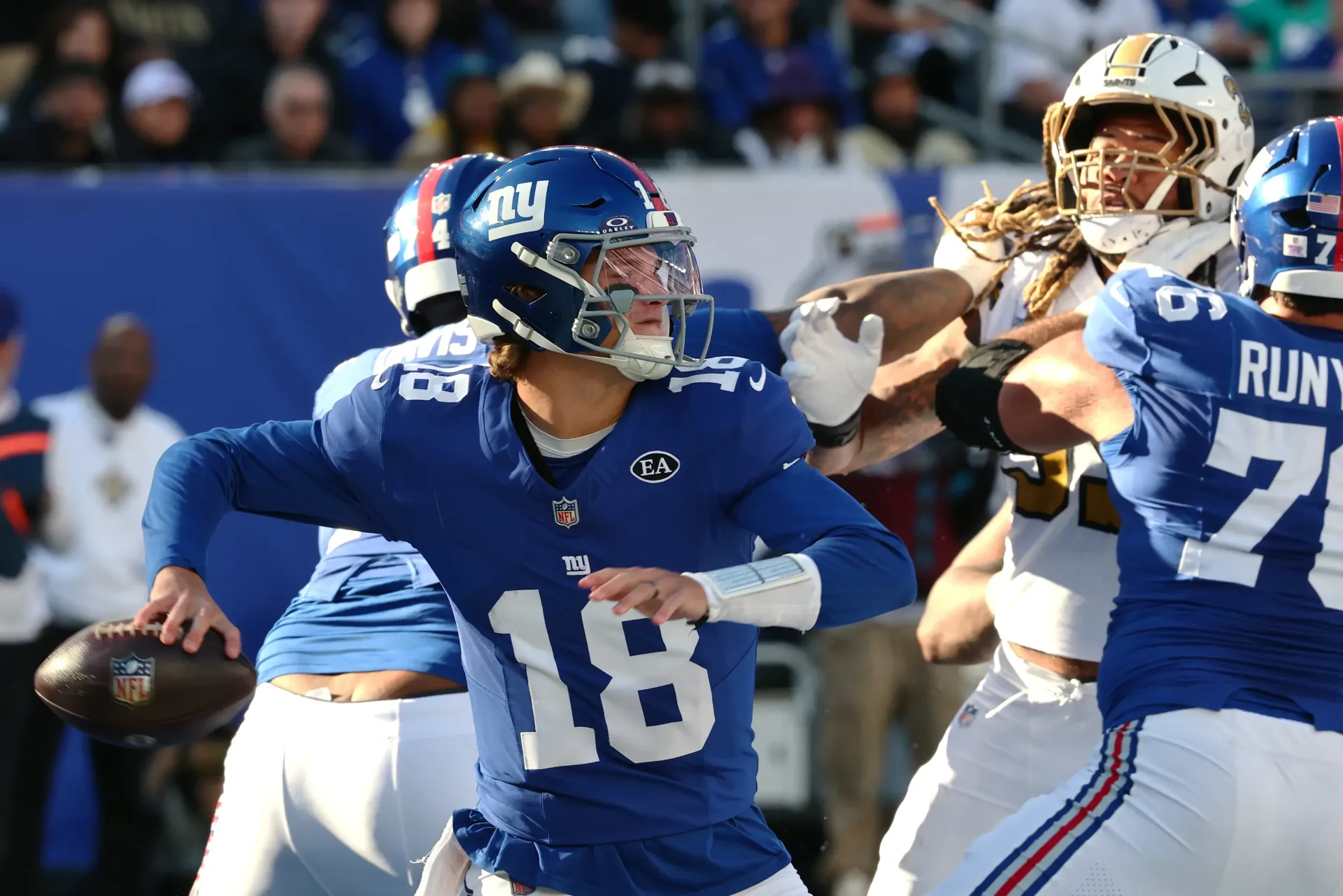
The Giants’ season appeared to be in serious trouble after Jaxson Dart suffered a knee injury. The club then acquired McCarthy from Minnesota, where he had been the Vikings’ backup, and his play has given New York a lift. Before the trade, collector interest had reached an all-time low. Now he has returned to the hobby radar.
That sequence makes McCarthy the clearest example here of a market narrative being reshaped by a transaction as well as on-field opportunity. His rookie cards, including numbered autographs, have been attracting buyers at what are described as relatively reasonable levels. A PSA 10 copy of his 2024 Prizm Deca Signatures Gold Shimmer First Off The Line Rookie Auto sold for $2,800 earlier in the week.
Again, the wording is the value of the comp. This is a 2024 rookie autograph, with Gold Shimmer and First Off The Line identifiers, in a PSA 10 slab. A slab is the sealed plastic holder used by a grading company after authentication and grading. “First Off The Line” denotes a product configuration or designation associated with an early release. These traits make the $2,800 sale specific evidence about one high-end McCarthy card, not a shortcut for pricing every rookie card with his name on it.
Still, the sale illustrates why McCarthy may be worth monitoring. He has a new team, an on-field role that has revived attention and an existing rookie-card supply that collectors can evaluate across different price levels. His case also has a different emotional pattern from Wentz’s: it is not principally about revisiting a past hobby peak, but about an interest level that had cooled and may now be rebuilding.
How to read the quarterback bump without overreading it
All four situations point to the same central truth: opportunity drives attention, while card specifics determine where that attention lands. Late-season football creates urgency because every start can alter a team’s outlook and a player’s national profile. But collectors are better served by separating a compelling storyline from a confirmed, durable market change.
- Track completed sales, not asking prices. A listed card reflects a seller’s hope; a completed transaction records what someone actually paid.
- Match the card precisely. Compare the same year, set, parallel, numbering, autograph status and grade whenever possible.
- Do not use a premium comp as a blanket player price. The Wentz and McCarthy examples are graded, high-specification cards. Sanders’ five-figure results likewise require card-by-card context.
- Recognize the supply difference. Fagnano’s lone licensed card creates a much different market than the deeper rookie-card selections available for the other quarterbacks.
- Keep the timeline in view. A backup’s value narrative can shift rapidly with performance, team results and health. The same speed that attracts attention can also reverse it.
Fagnano, Sanders, Wentz and McCarthy are not interchangeable speculation plays. They are four separate collecting stories created by four separate football circumstances. The more carefully collectors distinguish scarcity from established demand, historical peak sales from current transactions, and premium cards from standard issues, the better they can understand what a quarterback’s new opportunity is actually changing.