Randy Moss built a football legacy on moments that made defensive backs look like they had loaded into the wrong difficulty setting. His combination of speed, reach and late-ball tracking helped make “Mossed” part of the sports vocabulary, while his career totals—156 receiving touchdowns and 15,292 receiving yards—help explain why collectors still treat his cards as centerpieces rather than nostalgia-bin material.
That collector interest has accelerated considerably. Across the last six months, Moss’ tracked card index rose 63.37%, the fifth-largest increase among football players represented by at least 20 cards in the database used for the measure. Over a full year, the index gained 75.03%.
Those broad figures are compelling, but the individual sales tell the more useful story. High-grade examples of major 1998 rookie cards have moved substantially, premium refractors have broken beyond prior ranges, and scarce modern Moss cards in Minnesota Vikings imagery have also established fresh highs. At the absolute top end, cards limited to six copies or a single copy have pushed into five and six figures.
The result is not one isolated sale or one niche within the Moss catalog. It is a multi-tier run, spanning accessible base rookies, shiny late-1990s parallels, insert-driven modern cards and one-of-one patch issues.
A broad rise, with rookie cards doing heavy lifting
The market’s largest visible gains are concentrated in important rookie-era issues from 1998, particularly examples that carry PSA 9 or PSA 10 grades. A PSA slab is the sealed holder associated with a third-party grade; in practical collecting terms, the grade makes an otherwise similar card easier to compare in a sales record. The source data here shows that the strongest movement has been at the high end of those graded populations, not merely among raw, ungraded copies.
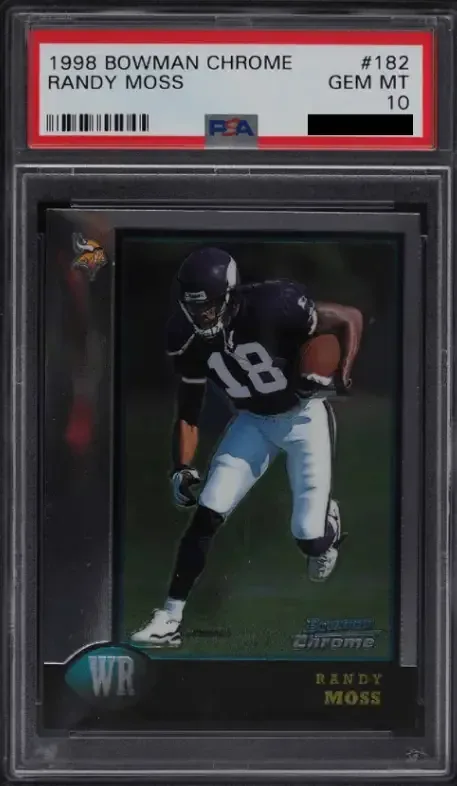
Seven Moss cards reportedly doubled in value over the past year. The standout is the 1998 Bowman Chrome #182 rookie card in PSA 10, up 163% across that period. A copy could be found at roughly $150 last September; more recently, sales have cleared $400.
That is a meaningful move because it turns a card once priced in the realm of a relatively approachable flagship rookie into an item where condition is now doing enormous financial work. The player and card did not change. The distinction is the combination of a familiar rookie-card design, chrome presentation and a top-grade label. For collectors who own copies of this card, the lesson is simple: condition details and authentication status deserve attention before any sale or trade. For collectors looking to buy, a PSA 10 should not be treated as a stand-in for every copy of Bowman Chrome #182.
Another 1998 chromium rookie, Topps Chrome #35 in PSA 10, rose from $255 to $478.50. It also reached a two-year high of $626 on September 10. The difference between a recent sale and a two-year peak is worth keeping in view. A peak establishes what at least one buyer paid at one moment; it does not automatically establish a permanent floor for every subsequent transaction.
Still, the card’s near-doubling is consistent with the larger Moss pattern. These are not only prices for an unusual regional issue or a difficult-to-identify parallel. They are results for recognizable rookie cards tied directly to a player whose impact remains culturally legible decades after his debut.
Refractors show why exact card identification matters
Refractor cards are a parallel style that collectors distinguish from their base-card counterparts, and the sales data shows how dramatically that distinction can matter. Moss’ 1998 Finest Refractor #135 in PSA 10 sold for $2,400 on September 21. That was more than twice the $999 and $1,004 paid for two copies in April, just days apart.
The PSA 10 base version also climbed 132.37%, moving from $120.50 to as high as $380. The parallel and the base card therefore both moved up, but they occupy very different price tiers. That is an important practical divide for anyone researching a collection: a name, year and card number may not be enough. Collectors need to verify whether a card is base or refractor, its grade, and the timing of comparable sales before treating a headline price as relevant.
The 1998 Topps Chrome Refractor in PSA 10 provides an even clearer example of a market breaking out of a familiar range. It has hit $5,999 twice in the past six months after spending the preceding four years generally selling between $2,500 and $3,000. Two sales at the same upper level do not guarantee a straight line upward. They do, however, show buyers were willing to reset the visible ceiling well above the range that had prevailed for years.
In other words, the Moss surge should not be reduced to “all cards are up by the same amount.” The supplied results show different levels of enthusiasm for different configurations: base cards have risen, top-grade chrome rookies have risen harder, and refractors have produced some of the most dramatic premium-price signals.
Modern Moss cards are joining the run
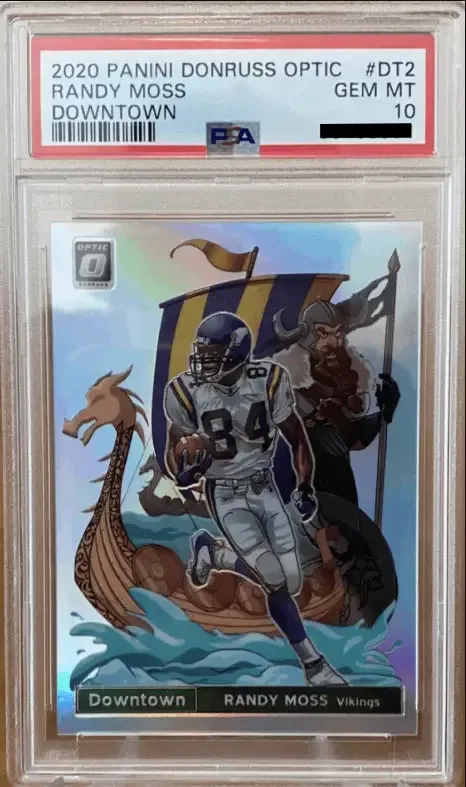
The story is not confined to 1998. A PSA 10 2020 Panini Optic Downtown #D12—showing Moss in a Vikings uniform—was the only modern Moss card cited with an increase of 50% or more. Its two latest sales became consecutive all-time highs, at $2,365 and $2,427.
That matters because modern and rookie-era cards can attract different kinds of collecting attention. The 1998 cards draw their appeal from Moss’ entry into the NFL and from late-1990s product lines. The 2020 Downtown instead gives buyers a later, design-forward interpretation of the player. Both can be desirable, but they are not interchangeable categories and should not be evaluated as though they share identical scarcity or buyer motivations.
The sales record also illustrates a potential trap in using an early pull price as a permanent reference point. A PSA 10 version of the Optic Downtown reportedly sold for as little as $300 when first pulled; the latest results sit above $2,400. That past low price is useful context, not a promise that copies bought now will continue to rise at the same pace.
There are signs elsewhere in the hobby that swift early enthusiasm can cool, as seen in recent movement in Pokémon TCG 30th Celebration cards. Moss’ results are strong, but collectors should separate a recorded trend from a guarantee. Sports-card values are transaction-based: they reflect what a buyer paid for a particular copy at a particular moment.
At the top, scarcity becomes the whole conversation
Over the last 12 months, 41 Moss cards sold for more than $10,000. Two of his three highest recorded card sales arrived within the most recent five-week span described by the market data.
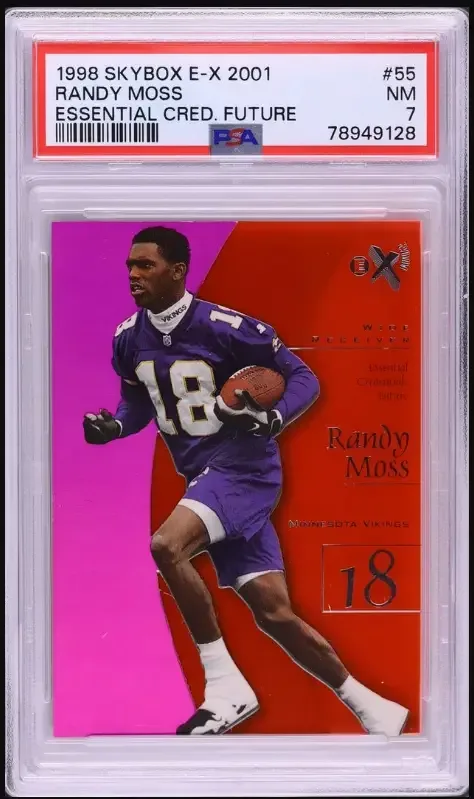
The leading result was a 1998 Skybox E-X2001 Essential Credentials Future #55, graded PSA 7, which sold for $144,000 on August 28. Only six copies of this Credentials Future parallel exist. In this tier, the grade still matters, but the card’s extraordinarily limited supply is the defining fact. A PSA 7 on a card numbered to six is a very different value proposition from a PSA 10 base rookie: neither should be read through the same supply-and-demand lens.
The $144,000 sale also places Moss among rare company for this particular 1998 Credentials type. Only Derek Jeter, Ken Griffey Jr. and Peyton Manning have seen cards from that year’s Credentials line sell for more across all sports. That comparison is a useful marker of the card’s result, not a reason to assume every Moss parallel belongs at an equivalent price level.
One-of-ones, cards issued with a stated print run of one, have produced more major numbers. Moss’ 2025 Absolute Kaboom! Horizontal Green #23 was accepted in an eBay best-offer deal at $31,000, then later sold for $48,742 after being relisted. Since it is the same unique card, this is one of the cleanest examples in the data of a direct price change for a specific physical item rather than a comparison between different copies.
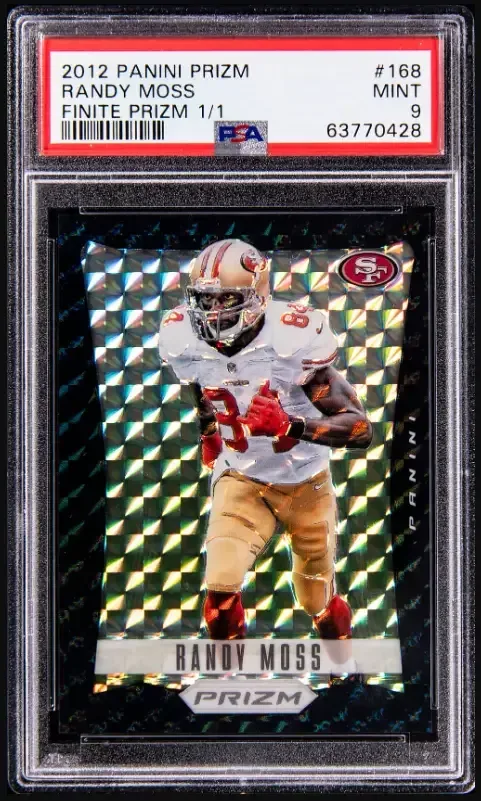
Another unique Moss card, the 2012 Panini Prizm Finite Prizm #168 in PSA 9, ended a March 15 auction at $56,120. It comes from the final stretch of Moss’ playing career, after he returned to the NFL in 2012 and reached the Super Bowl with San Francisco. The sale underlines that collector demand is not limited to his earliest or most famous Vikings-season cardboard. High-end buyers can place major value on rarity even when the card represents a less immediately remembered chapter.
A Brady connection adds another collecting lane
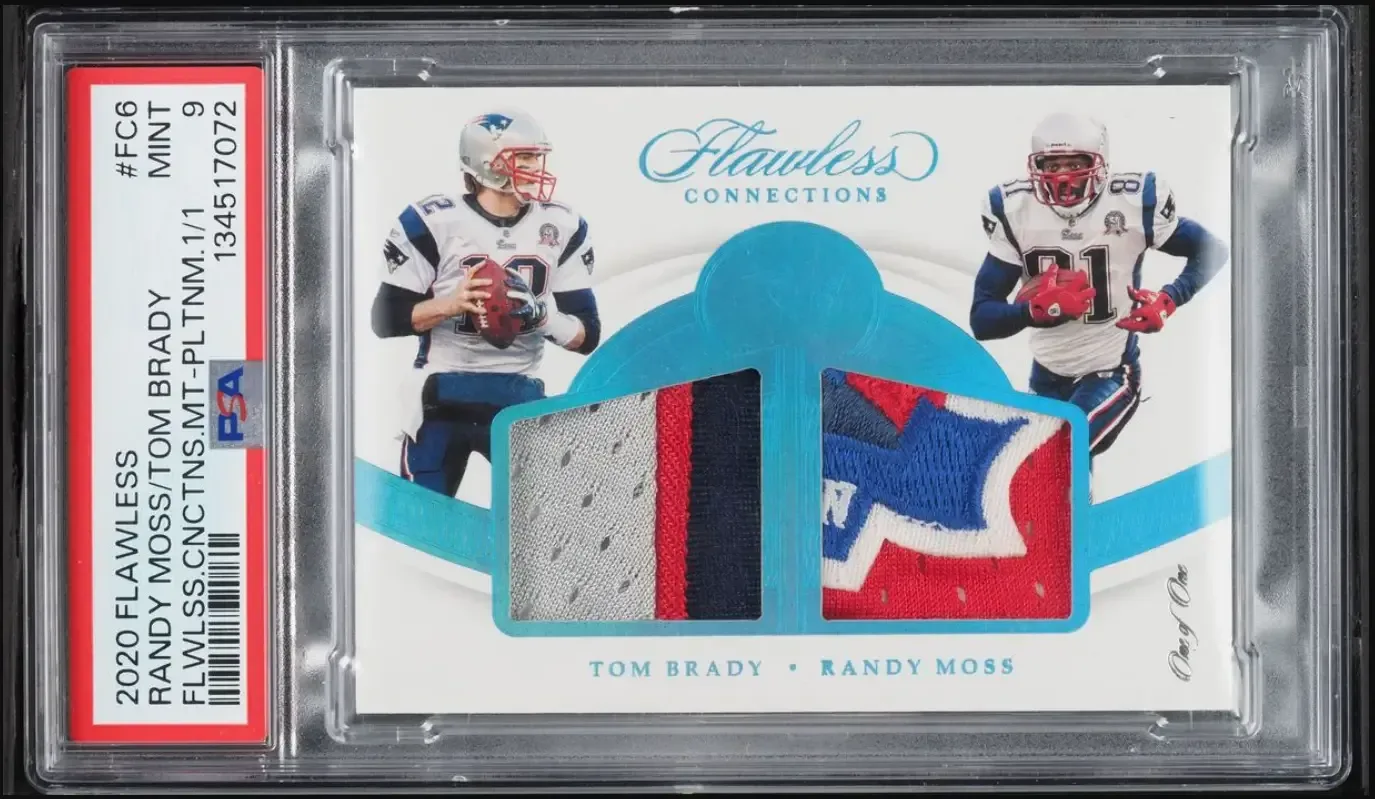
A 2020 Panini Flawless Connections Platinum one-of-one combines Moss with former New England quarterback Tom Brady. The card includes a four-color Moss jersey swatch and a Brady patch, and sold for $22,200 on September 13.
Dual-player memorabilia cards can appeal to overlapping collector groups. Here, the attraction is not only Moss individually; it is also the pairing of a celebrated quarterback-receiver connection, a one-of-one designation and incorporated patch material. That combination makes the sale difficult to use as a simple comp for a solo Moss card. It is best understood as its own collecting lane within the wider Moss market.
What the numbers actually say
The evidence supports a clear conclusion: Randy Moss cards have enjoyed a notable surge, led by high-grade 1998 rookies and refractors while extending into modern inserts and ultra-scarce premium issues. A 63.37% six-month index increase and 75.03% one-year rise are substantial, and the specific sales back them up with multiple new highs.
It does not support the simpler claim that every Moss card has risen identically or that any purchase is automatically a bargain. A PSA 10 Bowman Chrome rookie, a PSA 10 Topps Chrome Refractor, a six-copy Credentials Future parallel, and a Brady-Moss one-of-one patch card each answer to different combinations of grade, scarcity, design, player association and buyer pool.
For collectors, the sensible takeaway is more satisfying than a generic chase: know the exact card, identify its version, respect the importance of the grade, and compare it with truly similar prior sales. Moss spent his career turning small margins into highlight-reel separation. His card market is currently doing something similar—but the fine print on the card itself still decides how wide that separation can be.