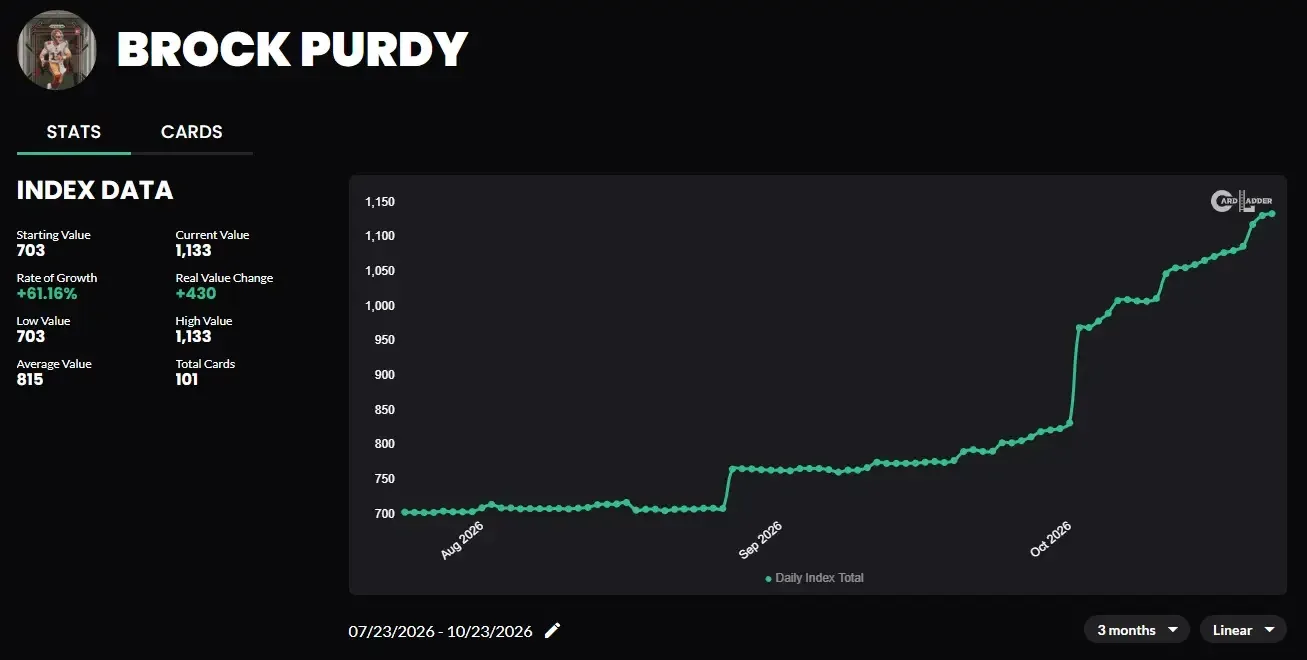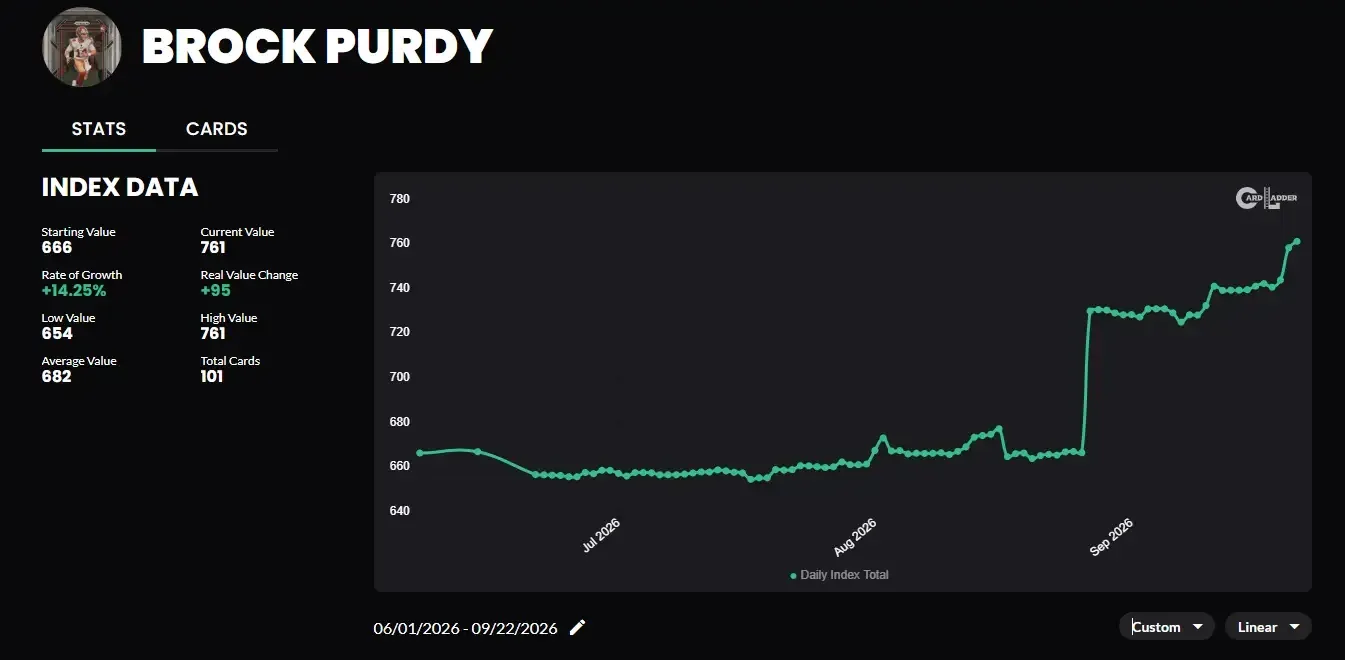
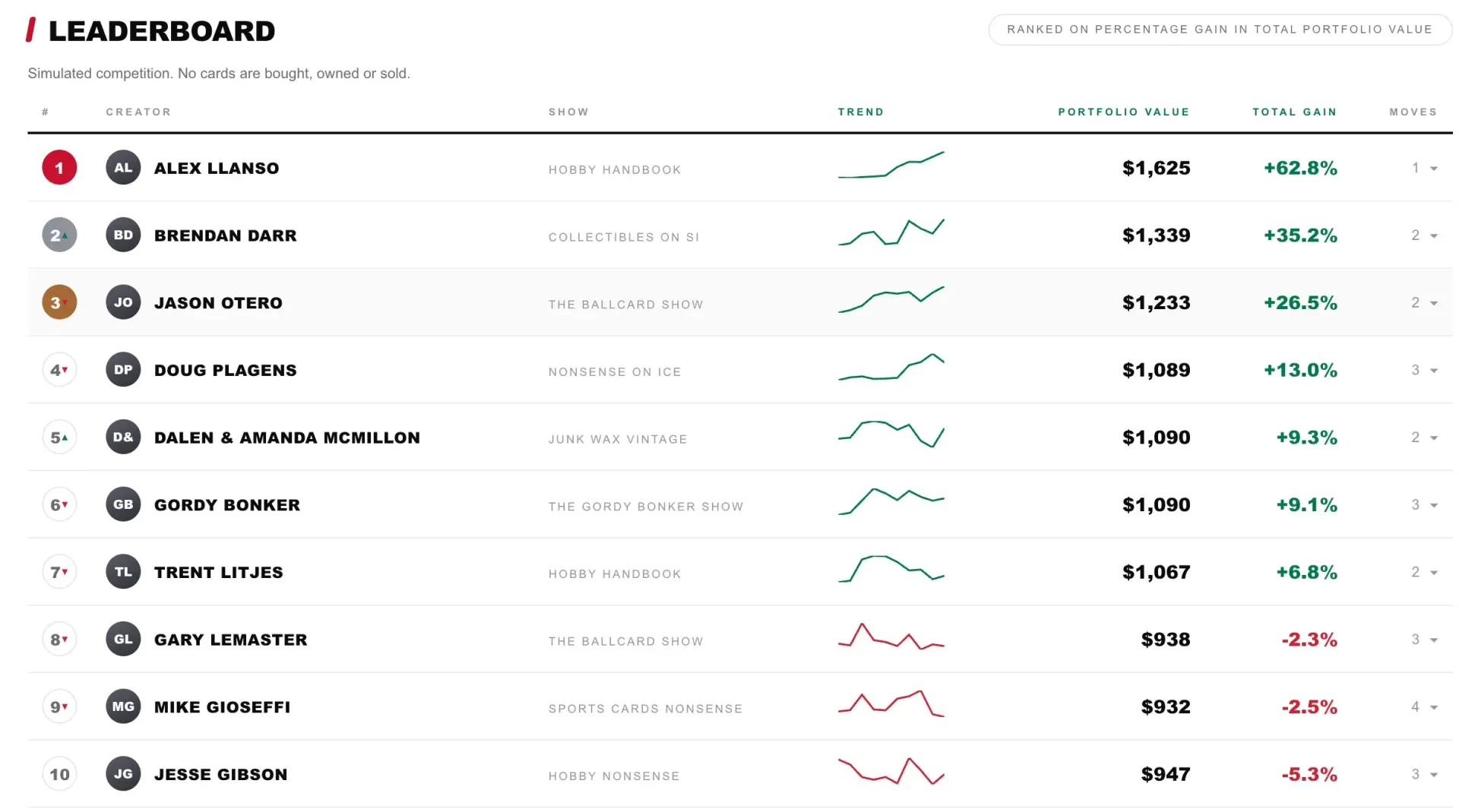
Brock Purdy has become the clearest focal point of a midseason reshuffle in the SCN Challenge, a fantasy-style competition in which 10 card-focused creators manage card portfolios. As the league enters Week 10, multiple competitors have shifted toward quarterbacks, and Purdy has been one of the most conspicuous targets.
The broader standings have not been radically remade in recent weeks. Alex Llanso, known as Clever Cuban Cards, still holds a substantial lead after selling a Tyler Shough card and reinvesting in a Josh Allen card. The contest’s current narrator sits second, while Jason Otero of The BallCard Show and PTN complete the top three. At the other end, the bottom three have also begun to separate, increasing the pressure on trailing entrants to make roster moves that can alter their card values.
The interesting development is not merely that transactions returned after four quiet weeks. It is that managers are arriving at a similar answer: quarterbacks. That consolidation has put Purdy, Jordan Love, Joe Burrow and Allen at the heart of the league’s strategic conversation, with running backs and more volatile prospects used as the funding source for several swaps.
Purdy joins the quarterback-heavy approach
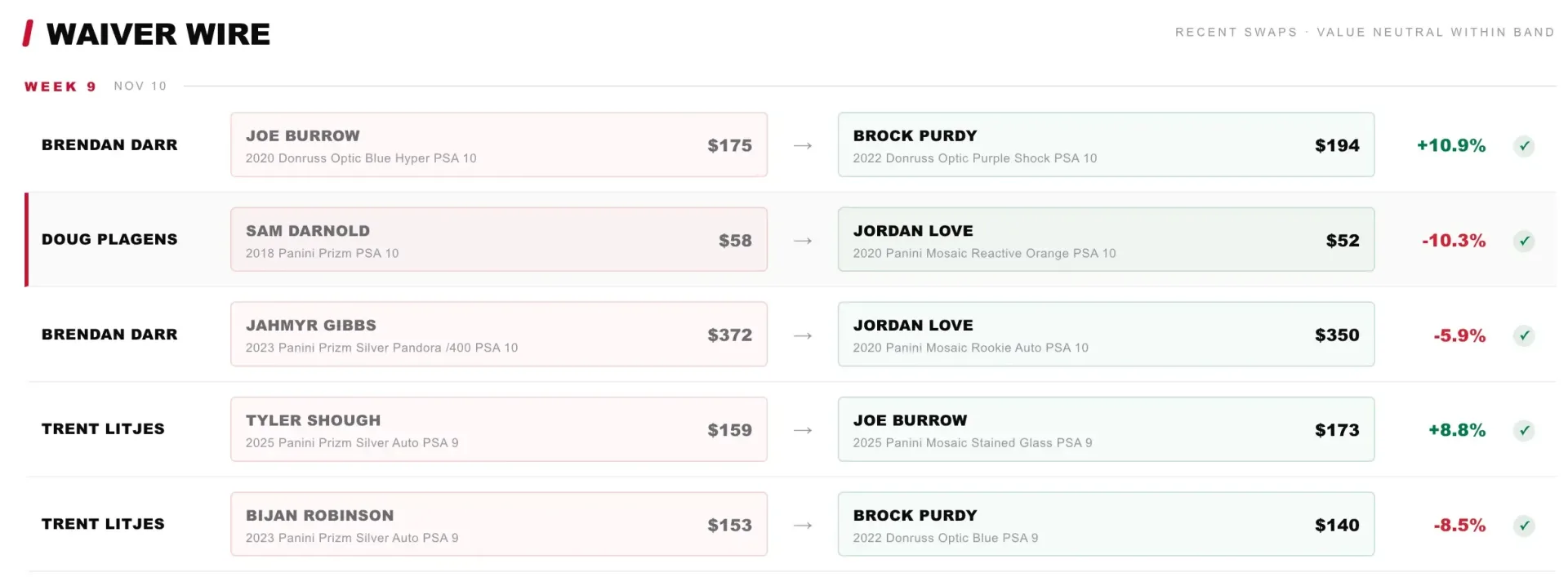
The narrator’s most visible move was trading a 2020 Optic Joe Burrow Blue Hyper PSA 10 for a 2022 Optic Brock Purdy Purple Shock PSA 10. Trent made a related bet, moving from a Tyler Shough Prizm Autograph to a Burrow card while also replacing a Bijan Robinson card with a Purdy card.
For more context, explore The Horror Game Awards 2026 Sets November 20 Worldwide Stream as REANIMAL Leads Nominations.
That means Purdy is not just an isolated personal pickup. Two participants independently added him during an active waiver period, suggesting that the card is being viewed as a useful football-driven position within this particular format. The wider midseason trading picture similarly centers on quarterbacks, but the league activity also shows why collecting strategy can become crowded quickly: when several managers favor the same player type, the advantage may depend on card selection and purchase timing rather than the player choice alone.
The cards matter as much as the names. The newly acquired Purdy is a 2022 Optic Purple Shock graded PSA 10. “PSA 10” identifies a card that received the top numerical grade from Professional Sports Authenticator, while Purple Shock refers to a parallel, or alternate version of a card differentiated from the standard release by its design treatment. A graded parallel is not interchangeable with every other Purdy card; its prices should be read against sales of the same year, product, parallel and grade wherever possible.
One $75 sale changes the immediate picture
The Purdy pickup came with an immediate valuation complication. Three recent recorded sales for the 2022 Optic Purple Shock PSA 10 were $194, $200 and $220. But a confirmed sale at $75 appeared the day after the purchase, and it reduced the card’s value as tracked by Card Ladder.
That discrepancy is a useful reminder of what a comp is and is not. In card collecting, a comp is a comparable completed sale used to estimate a card’s market value. It is evidence of a transaction, not an automatic declaration of a stable market price. A string of sales near $200 supplies one type of evidence; a single $75 transaction supplies another. Neither should be ignored, but they do not necessarily deserve identical interpretive weight.
Here, the low sale has a specific detail attached to it: it was listed at $75 and sold after the seller accepted a best offer. The final amount was therefore a real completed transaction, but the available information does not establish why it landed so far below the other recent sales. It could reflect an unusually eager seller, a buyer finding a favorable listing, a difference not visible in a headline comparison, or any number of other circumstances. The provided details do not permit a definitive explanation.
What can be said is that the sale matters operationally. Automated and semi-automated card valuation tools often incorporate recent public transaction data. A low confirmed sale can therefore have an immediate effect on a portfolio’s tracked number, even if collectors believe it is an outlier compared with surrounding results. That distinction is particularly important in a competition where standings react to recorded values rather than only to a manager’s long-term confidence in the athlete.
Why an outlier can hurt even if the thesis stays intact
The Purdy manager still needs two things that do not always move together: strong on-field results and a recovery in the card’s observed market value. A positive game can improve enthusiasm around a quarterback, but it does not guarantee that the next comparable Purple Shock PSA 10 will sell at the level of the earlier $194, $200 and $220 results.
Conversely, the $75 sale does not by itself prove that all roughly $200 sales were mistaken. A small group of recent sales can be sensitive to listing methods, timing and the circumstances of individual buyers and sellers. The prudent reading is that a collector has conflicting data: several higher sales, then one sharply lower confirmed sale. For a fantasy-card portfolio, the short-term accounting impact may be immediate. For a buyer assessing the card outside the contest, more matching sales would be needed before confidently calling either range the settled level.
Jordan Love is the other major destination
Purdy was not the only quarterback to gain attention. The narrator also exchanged a 2023 Prizm Jahmyr Gibbs Pandora /400 PSA 10 for a 2020 Mosaic Jordan Love Silver Autograph PSA 10. Doug Plagens likewise exited a Sam Darnold card after a bounce-back sale left him in the green and added a Jordan Love card.
The stated logic behind the Love move was to capitalize on a large Gibbs sale, lock in that gain and move into a quarterback before the card market fully reflected Love’s rising MVP odds. In plain terms, this is an attempt to rotate from an asset that has already appreciated into one thought to have a near-term catalyst. An MVP race is such a catalyst because it gives collectors a recurring sports narrative around which attention can build. Still, the league’s transactions show a forecast, not a guarantee that the market will react as anticipated.
There is also a meaningful product distinction in the Love acquisition. It is an autograph from 2020 Mosaic and carries the Silver designation. An autograph creates a different collecting proposition from a non-autographed parallel, and collectors should avoid making loose price comparisons across categories simply because both cards feature quarterbacks or carry top grades. The card’s set, autograph status, parallel, grade and condition all shape what makes a useful comparable sale.
Why managers are leaving non-quarterbacks behind
The move away from certain non-quarterbacks has been explicit. The narrator sold out of Gibbs after what was described as a huge sale. Trent left Bijan Robinson despite calling him a standout running back. The narrator also acknowledged that returning to Gibbs could be appealing during the fantasy football playoff stretch, while being more difficult from a cardboard perspective.
That contrast gets to the central tension in a card-based football contest. On-field fantasy value and hobby value overlap, but they are not the same thing. A running back can be enormously useful to a fantasy lineup while quarterback cards draw more collector focus because quarterbacks dominate awards narratives, playoff storylines and team identity. The participants’ choices indicate that they see the quarterback market as a stronger place to concentrate at this stage, rather than a verdict that elite running backs cannot produce card gains.
The resulting roster construction has become notably quarterback-heavy. Many competitors have adopted a five-quarterback strategy, and the narrator moved to a fifth quarterback after earlier successes with non-quarterbacks. Concentration can be efficient when a single position is driving hobby attention, but it reduces diversification. If the group has the same catalyst in mind, several portfolios can rise or fall on similar news, performances and sales trends.
Standings pressure is shaping the waiver wire
Transaction volume also reflects where competitors sit. The top three are opening a gap, while the bottom three are falling away from the middle. In that context, a conservative hold may not be enough for teams trying to reach the podium places. Trent’s slide to seventh after previously being among the podium contenders is an example of how quickly a contest position can change even when the leaders remain relatively stable.
Llanso’s lead remains a separate lesson in execution. The available account credits a Tyler Shough sale followed by reinvestment in a strong Josh Allen card. The sequence illustrates a basic portfolio decision: selling into a favorable moment and reallocating proceeds. It does not prove that every prospect-to-established-quarterback swap will work, but it explains why competitors may be watching quarterback cards so closely now.
Practical takeaways for collectors watching the sales
- Match the card precisely. A Purdy card is not a single market. Compare the same product, year, parallel and PSA grade whenever data permits.
- Read a comp in context. A $75 accepted-offer transaction is relevant, but it should be considered alongside the three recent $194 to $220 sales rather than treated as self-explanatory.
- Separate a portfolio score from a long-term opinion. A value tracker can react immediately to a low sale, while collectors may wait for additional sales before changing their view of a card’s typical market range.
- Know the difference between sports appeal and card-market appeal. A player’s fantasy football usefulness does not automatically produce the same level of hobby demand.
- Watch concentration risk. A five-quarterback approach aligns a portfolio with the position’s upside, but makes it more dependent on the same class of players and narratives.
There is one more wrinkle in the Purdy debate. Some competitors have acknowledged market “shenanigans” intended to influence sales, prompting suspicion around unusual transactions. That concern should remain a caution rather than an accusation: the facts supplied establish a low completed sale, not who caused it or why. The actionable point is simpler. In a market where a single unusual result can move a tracked value, collectors and fantasy-card managers should inspect the details behind the number before treating it as the whole story.
For Week 10, Purdy now represents both sides of the hobby’s appeal and its uncertainty. He is the player several managers want exposure to, yet the particular Purple Shock PSA 10 at the center of one swap has been pulled down by a jarring low sale. Whether the next matching transactions return nearer to the recent $194-to-$220 range, remain closer to $75, or land between them will matter not just for one competitor, but for how persuasive the league’s growing Purdy conviction ultimately looks.