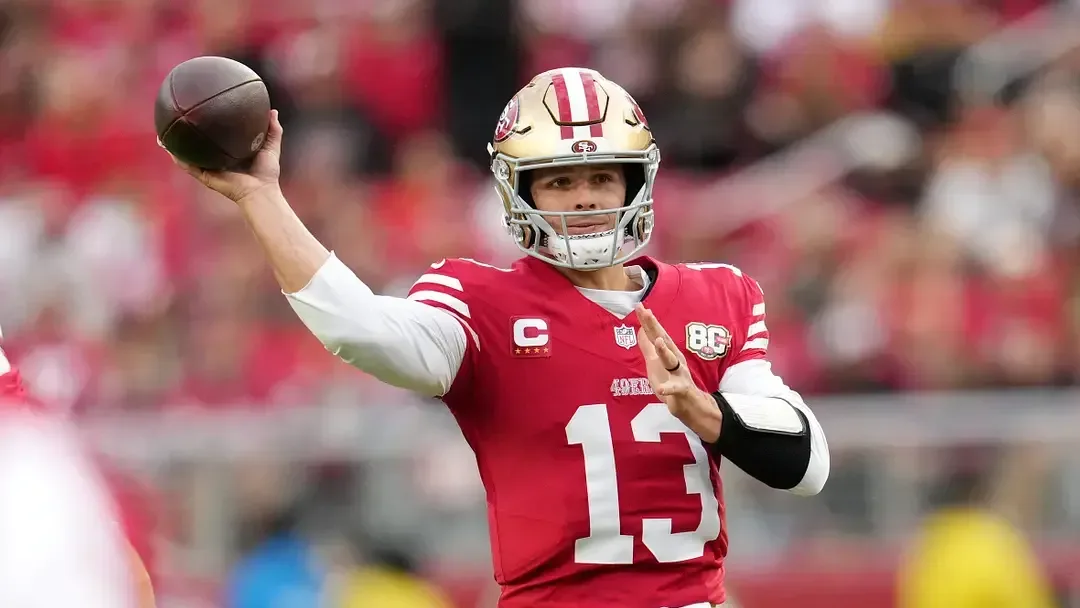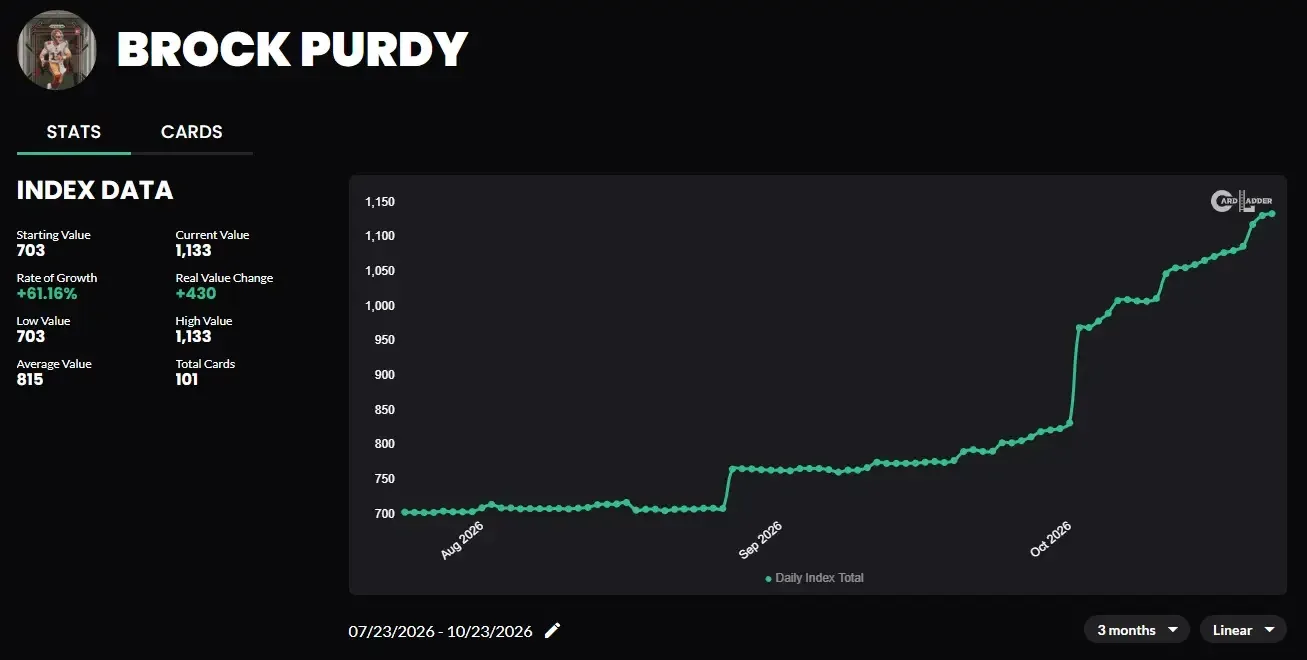
Brock Purdy’s 2026 on-field turnaround is spilling into the trading-card market. The San Francisco 49ers have opened 6-0, and Purdy has thrown for 1,460 yards and 14 touchdowns through those six games after an injury-affected 2025 season. Tracked pricing for several of his key rookie cards has risen sharply over roughly the last three months, illustrating the familiar, fast-moving relationship between a quarterback’s current narrative and collector demand.
The important caveat is equally familiar: a rising chart is not a permanent stat boost. Purdy’s market is responding to a small collection of highly visible catalysts—team success, individual production and his return to the field after a disrupted year. Those forces can keep reinforcing one another, but they can also reverse quickly when performance, health or sentiment changes.
The on-field case behind the movement
Purdy’s six-game totals put the current attention in context. He is already at 1,460 passing yards and 14 touchdowns in 2026. In nine games during 2025, he recorded 2,167 yards and 20 touchdowns. That means his present pace could bring him near those prior-season totals within the next few games, assuming he remains available and maintains similar production.
That contrast matters in sports cards because collectors are rarely reacting only to a box score. They are reacting to a story. Purdy was the final selection of the 2022 NFL Draft—an identity widely associated with the “Mr. Irrelevant” label—and his 2022 Panini Prizm cards are rookie-year issues. A 6-0 start and productive passing numbers give that story renewed momentum after 2025 created uncertainty.
For more context, explore What Anker PowerIQ Means on a Charger—and Why the Biggest Wattage Number Isn’t the Whole Boss Fight.
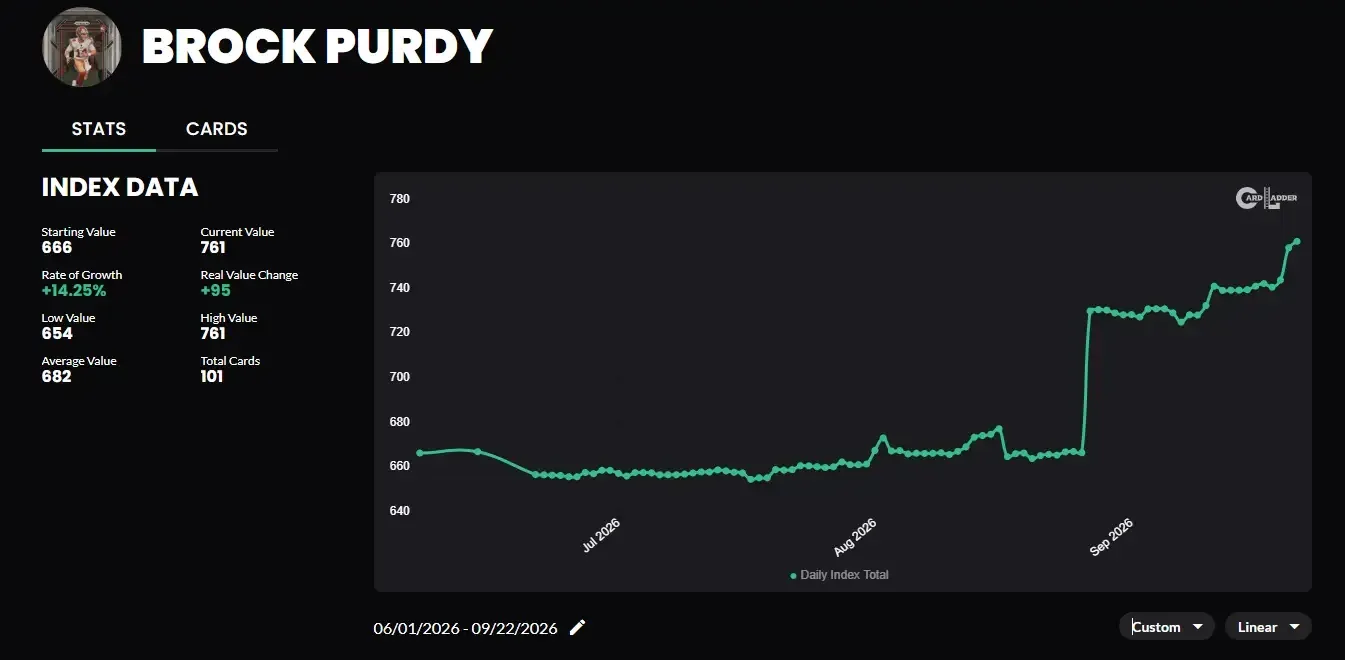
The timing in the available market data suggests that the return-to-action angle may have been a meaningful trigger. The broader Purdy sales index was relatively flat from late July into late August, then moved upward after the preseason period in which he played on August 20. It is not possible to prove from a chart alone that one game caused the move. Still, it is a reasonable explanation for why collectors may have reassessed cards tied to a quarterback coming off an injury-plagued season: they had fresh evidence that he was back on the field.
What the broader sales index says—and what it cannot say
Card Ladder data places Purdy’s sales index at 1,130, up from 703 over the stated three-month window. That is an increase of about 60.7%, which supports the description of growth exceeding 60%.
An index is useful because it looks beyond a single card sale. In practical terms, it is meant to summarize a player’s market movement across tracked transactions rather than asking one auction result to carry the whole argument. That makes it a better temperature check than a one-off headline sale, especially for a player with cards across multiple products and scarcity levels.
Related coverage includes Brock Purdy Card Market Climbs as 49ers Start 6-0.
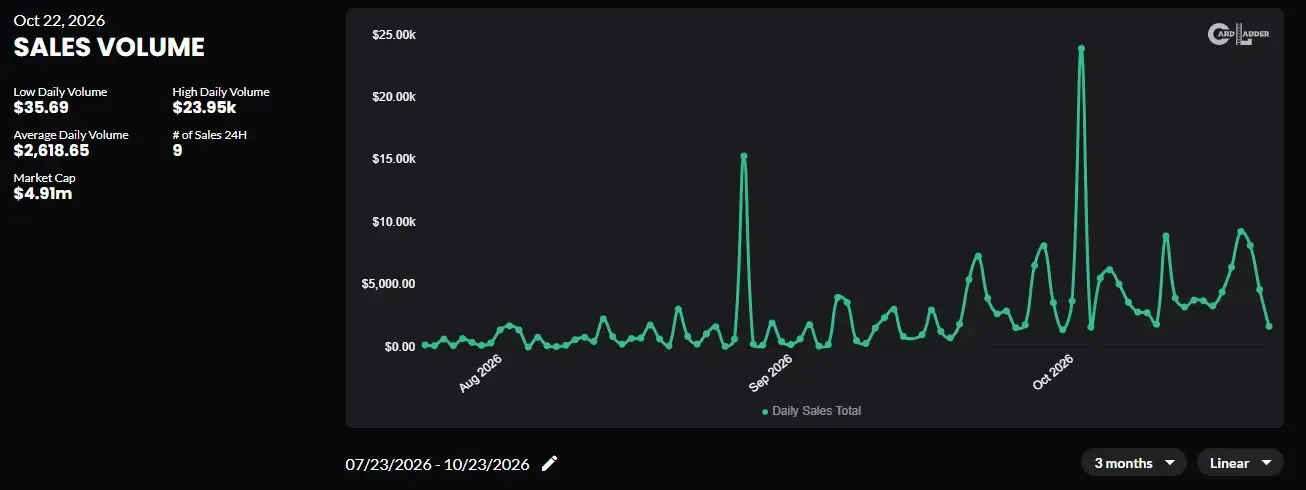
But collectors should not treat an index as a promise of what every Purdy card is worth. A player-level measure can rise while individual cards behave very differently. Base cards, parallels, graded copies and cards with distinct populations can attract different buyer pools. Sales volume also matters. The tracked volume chart has moved up and down rather than traveling in a clean line, even as its lower range appears to have trended higher over the past two months.
That distinction is useful for anyone checking a listing. A rising market can mean more buyers are participating, more transactions are being recorded, higher-quality cards are changing hands, or some combination of those factors. It does not automatically mean a particular raw card, a lower grade or an obscure parallel should be priced as though it were the market’s most liquid benchmark.
The base Prizm PSA 10: a familiar modern benchmark
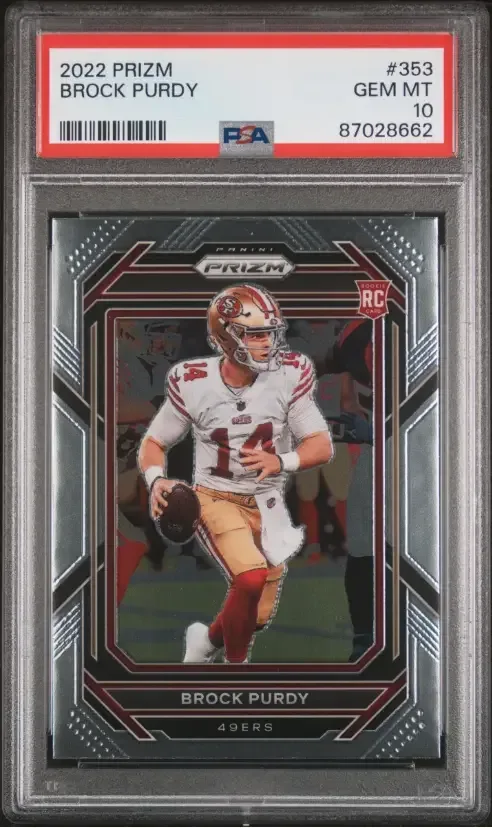
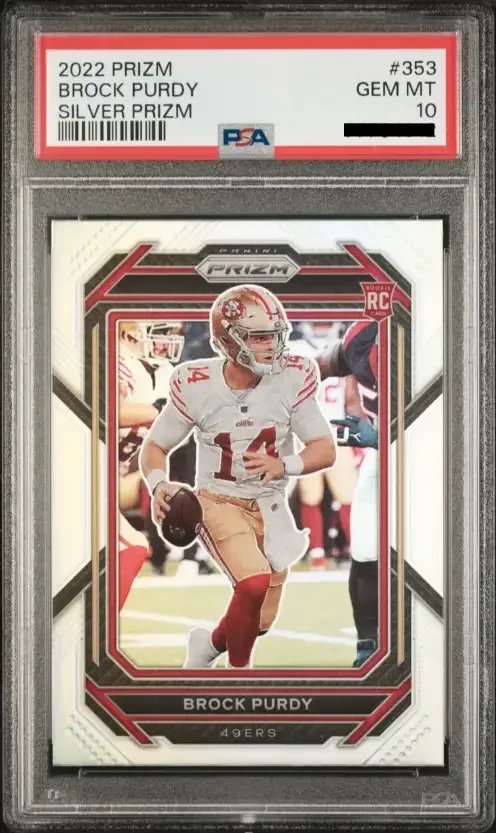
The clearest individual example is Purdy’s 2022 Panini Prizm rookie card in PSA GEM MT 10 condition. For many modern players, a PSA 10 base Prizm rookie functions as a common reference point because it combines a recognizable flagship-style brand, rookie-card status and a standardized third-party grade.
PSA 10 is a grade indicating a GEM MT example under PSA’s grading scale. The label helps buyers compare cards with a common condition standard, although it does not erase the need to verify the exact card, certification and sale history. Base refers to the standard version of a card rather than a parallel variation such as Silver.
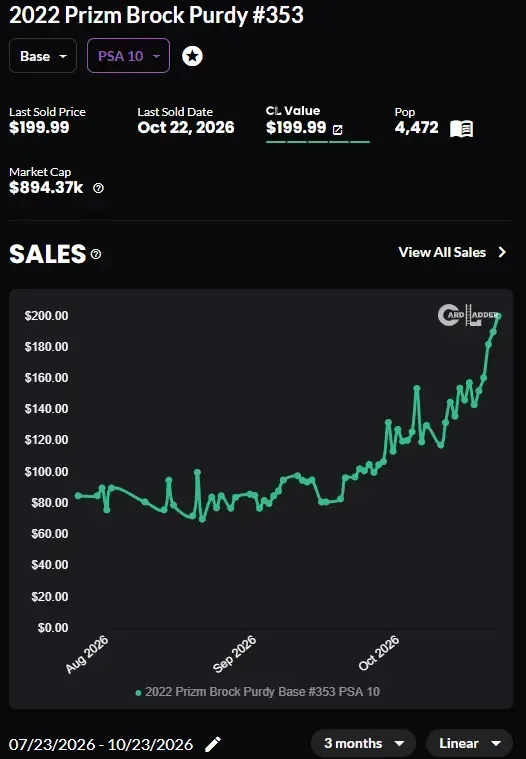
The recorded pricing movement is substantial. A sale a little above $80 was noted around two months earlier, while a documented sale dated October 22 reached $199.99. Using $80 as a rough starting point, $199.99 is about a 150% increase. Since the earlier price is described only as “just over” $80, the exact percentage will be slightly lower than 150% if that sale was above $80—but the broad point remains: the tracked sale level rose dramatically.
Base cards can sometimes move more violently in percentage terms than higher-priced variants. That does not inherently make them better or worse cards. A lower dollar starting point means a relatively modest absolute price move can become a large percentage jump. In this case, roughly $120 of movement turns an approximately $80 card into a roughly $200 card, a major change for buyers watching recent comps.
The Silver Prizm PSA 10 tells a different percentage story
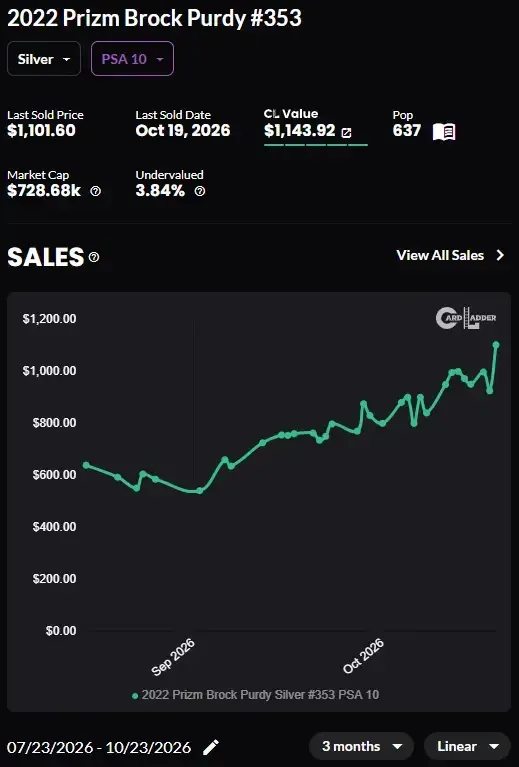
Purdy’s 2022 Panini Prizm Silver rookie card in PSA GEM MT 10 has also climbed. The available sales record places the card around $600 three months earlier, followed by an October 19 sale at $1,101.60.
Silver Prizm identifies a parallel version rather than the base card. Parallels are variations within a set, often differentiated by finish, color or other design treatment. They are typically evaluated separately from base cards because collectors do not view the versions as interchangeable.
The Silver’s dollar increase is larger than the base card’s: approximately $501.60, based on the cited $600 starting level. Percentage-wise, however, the calculation needs a replay review. Moving from $600 to $1,101.60 is an increase of roughly 83.6%, not 50%. It is fair to call the new sale price nearly double the earlier level, but “nearly double” and “50% growth” cannot both describe those two figures.
This is more than nitpicking a calculator. Percentage claims can change how collectors interpret momentum. The base PSA 10 appears to have delivered the larger percentage gain from its cited starting point, while the Silver PSA 10 still posted an enormous rise of roughly 84% from the stated numbers. Both observations can be true without flattening the two cards into one market story.
How collectors can read the Purdy data responsibly
For collectors, the lesson is not simply “buy because the line is green.” The useful takeaway is to identify exactly which card is moving, in what condition, and against which comparable sales.
- Match the card precisely. A 2022 Panini Prizm base rookie and a 2022 Panini Prizm Silver rookie are distinct versions. PSA 10 prices should not be used as direct values for raw copies or other grades.
- Check the date range. The cited base-card comparison references a sale from roughly two months earlier and an October 22 transaction, while the broader index uses a three-month window. Those measurements provide context, but they are not identical time periods.
- Separate dollar growth from percentage growth. The Silver added more dollars from the cited prior sale; the base card gained more on a percentage basis. Neither measurement alone settles which card is more desirable for a particular collection.
- Watch transaction activity as well as sale highs. Sales volume has been uneven. A high sale is more informative when it sits alongside repeated, comparable transactions than when it stands alone.
- Remember the football dependency. The market case presently rests heavily on Purdy’s health, production and the 49ers’ success. Those are active variables, not completed achievements.
There is also a basic difference between collecting and treating cards as a short-term trade. Someone building a Purdy collection may be comfortable choosing a favorite design or rookie issue and accepting market swings. Someone buying solely because recent comps rose is taking on a different risk: demand may be pricing in continued success before that success is secured.
The current data supports a clear conclusion without overselling it. Purdy’s card market has gained meaningful ground during an unbeaten 49ers start, his return after a difficult 2025, and a productive six-game stretch. The player-level index rose by more than 60%, while tracked PSA 10 sales for the 2022 base Prizm and Silver Prizm rookie cards moved considerably higher.
It does not establish where prices go next. The cleanest reading is that collectors have become more engaged with Purdy’s rookie cards as the season has developed. Whether that attention turns into a sustained market level will depend on the same things that started the run: availability, performance and the 49ers continuing to give the quarterback meaningful games to play.