Drake Maye’s card market is confronting the part of quarterback collecting that can make a hobby feel like a two-minute drill: every result is scrutinized, every interception becomes a talking point, and a price chart can suddenly seem more dramatic than a stadium scoreboard.
New England’s 13-10 loss to Seattle in the 2026 season opener brought that tension forward quickly. Maye threw three interceptions in the fourth quarter, following a Super Bowl loss to the Seahawks in February in which he threw two picks. Two difficult games do not settle the question of what kind of NFL quarterback Maye will become. They do, however, put a spotlight on the gap between long-term belief and the immediate expectations built into his cards.
The sensible reading is not that collectors need to treat every Maye card as an emergency sell. It is that his market entered the new season with considerably more optimism already baked in than it had at the beginning of 2025. That changes what a rebound can do, what a slow start can cost, and why the particular card a collector owns matters so much.
A flagship rookie card shows how quickly expectations moved
The most useful temperature check is Maye’s 2024 Panini Prizm Base Rookie Card in PSA 10 condition. It is not a scarce one-of-one trophy, and it is not an ultra-low-numbered insert. That is precisely why it is helpful: flagship graded base rookies tend to provide a clearer look at broad collector demand than singular high-end cards whose prices can be shaped by a small number of determined bidders.
During New England’s strong 2025 run, the card reportedly climbed from about $35 at the start of the season to roughly $225 when the Patriots secured a playoff place in late December. At the height of last season’s postseason excitement, examples sold for more than $400. More recently, a PSA 10 sale reached as low as $120.50 over the past month, though the approaching season had produced a modest uptick in the preceding week.
That path is a reminder that percentage gains and price-entry points are inseparable. A collector who bought at $35 had a very different experience from one who purchased amid the playoff surge at more than $400. The latter buyer does not merely need Maye to play better; the market would need to restore a great deal of excitement before that card approaches its prior peak again.
For anyone tracking modern sports cards, the underlying lesson is familiar: a young quarterback’s market often rises before his case is fully proven. Once it has risen, good performances may maintain an elevated level rather than trigger another equally explosive jump. In other words, the hobby’s reward for a bounce-back can be more restrained when the price already reflects a meaningful amount of anticipated success.
The next stretch offers both risk and opportunity
New England’s schedule does not offer a leisurely reset. Pittsburgh visits in Week 2, followed by road games at Buffalo and Jacksonville. Each of those clubs reached the playoffs last season, making the stretch a demanding test after an opener that already left Maye’s decision-making under a microscope.
Related coverage includes Drake Maye Card Market Faces Early Pressure After Rough Start to 2026.
Offensive circumstances could compound the issue. A.J. Brown, described as the Patriots’ new No. 1 receiver, is dealing with an ankle injury. If he misses substantial time, the challenge of quickly correcting course becomes more complicated. Collectors do not evaluate quarterbacks in a vacuum, even if card labels famously leave out inconvenient details such as protection issues, receiver health, opponent quality, and the general chaos of an NFL Sunday.
There is a potentially friendlier portion of the schedule after Buffalo, with Las Vegas, Miami, and the New York Jets on the horizon. Those games may give Maye and New England a chance to steady the season. That does not guarantee improved performance or card prices, but it means the early narrative is not permanently locked by the Seattle result.
Maye is also not the only member of the 2024 quarterback class whose hobby value has been volatile. Jayden Daniels and J.J. McCarthy have experienced notable declines tied to changes in play, team performance, and injury. The broader message is that collectors of recent quarterbacks are often buying into an evolving story rather than a finished résumé. The volatility is not an accident around the edge of the market; it is a core feature of the market.
Why the biggest Maye sales tell a different story
It would be a mistake to use the recent price of a PSA 10 Prizm base rookie to define every segment of Maye’s catalog. His highest-end cards occupy a different tier, where rarity, design, grading, and buyer competition can matter as much as any one game.
The leading recorded Maye sale is a 2024 Panini National Treasures NFL Shield 1/1 graded PSA 9, which sold for $164,700 in a Goldin auction in November 2025. A National Treasures Shield one-of-one is the sort of centerpiece card that does not have a true like-for-like substitute. Its appeal extends beyond the weekly behavior of a widely available base rookie, because the next collector cannot simply wait for another identical copy to surface.
Another six-figure result came in April 2025, when a 2024 Panini Prizm Black Finite Prizm 1/1 in BGS Gem Mint 9.5 sold for $109,800 through Goldin. Other major sales include a 2024 Panini Absolute Kaboom! Vertical Gold numbered to 10 in PSA 10, which sold for $90,000 at auction, and a 2024 Donruss Downtown Black 1/1 in PSA 9, which brought $72,000 at auction.
Those numbers are substantial, but they should not be treated as a universal price guide for regular Maye rookies. A one-of-one NFL Shield and a Prizm Black Finite one-of-one are scarce collectibles with a completely different supply profile. Likewise, a Kaboom! Gold limited to 10 and a Downtown Black one-of-one cater to collectors pursuing iconic inserts and premium visual appeal. Their markets can still move with Maye’s career arc, but they need not move in step with a high-population Prizm base PSA 10.
What collectors can watch without overreacting
The immediate test is whether Maye’s on-field play improves, particularly in turnover-heavy situations. Yet a useful hobby read should look at more than one box score or a single auction result. Collectors can separate signal from noise by watching several points together:
- Quarterback performance: Turnovers draw attention, but sustained accuracy, productive drives, and wins are more meaningful than one isolated highlight or mistake.
- Team trajectory: New England’s record, postseason outlook, and offensive consistency will shape the enthusiasm around its young quarterback.
- Receiver health: Brown’s ankle situation may affect the offense and how buyers contextualize Maye’s results.
- Comparable rookie markets: Movement for Daniels and McCarthy can offer context for whether buyers are cooling on one player or on the young-quarterback segment generally.
- Card tier: A mass-market graded base rookie, a numbered parallel, an autograph, and a one-of-one should not be expected to behave identically.
- Completed sales rather than wishful listings: Actual transactions are more useful than ambitious asking prices when judging a market’s direction.
The difference between collecting and chasing a weekly market is especially important here. Someone who wants a Maye rookie for a Patriots collection may see lower prices as a chance to buy a card they like. Someone who bought at a playoff-era peak hoping for a rapid return has a much narrower path, because the card’s prior surge already captured a powerful wave of confidence.
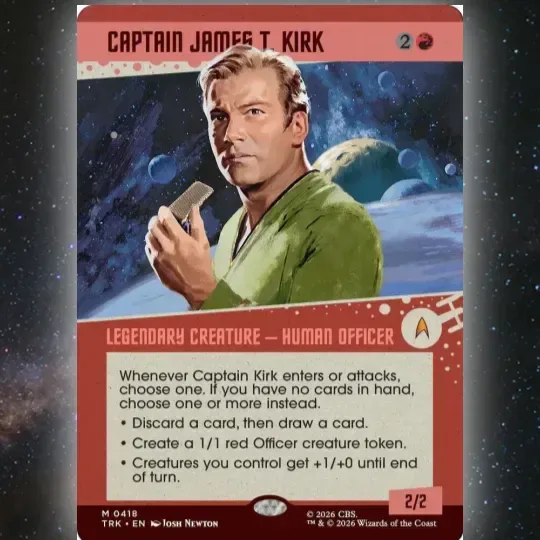
Sports-card collecting also increasingly sits alongside other major trading-card conversations, from premium sports releases to pop-culture crossover products such as Magic: The Gathering’s Captain Kirk card. The categories share a common truth: collectible value depends on the intersection of scarcity, demand, condition, and cultural momentum. In sports, the player’s performance adds a particularly relentless variable to that formula.
Maye’s market remains a bet on the longer arc
The current pressure on Maye’s cards is understandable. Back-to-back losses to Seattle, capped by three fourth-quarter interceptions in the 2026 opener, are not the kind of events that generate instant hobby momentum. The recent low of $120.50 for a 2024 Prizm Base PSA 10 also illustrates how far the card has come down from playoff-season highs.
Still, the available sales history argues against flattening the entire market into one verdict. Maye’s high-end one-of-ones and premium inserts have already demonstrated that collectors will pay serious money for elite examples. Meanwhile, the more accessible flagship rookie has a different set of pressures, including a larger supply and buyers who may be more reactive to short-term football results.
Maye has an arduous opening run ahead, a receiver injury worth monitoring, and a chance for the schedule to become more manageable after Buffalo. His card market is not free from downside if the Patriots stumble further. But it also is not a final referendum after two rough losses. For now, the story is less about panic than recalibration: collectors are weighing a talented young quarterback’s long-term possibility against a market that had already priced in plenty of hope.