Magic: The Gathering’s forthcoming Star Trek crossover has already given tabletop fans a particularly appropriate meeting of worlds: Brandon Sanderson, a longtime Magic and Star Trek enthusiast, has singled out a new Captain James T. Kirk card as an especially sharp piece of character design.
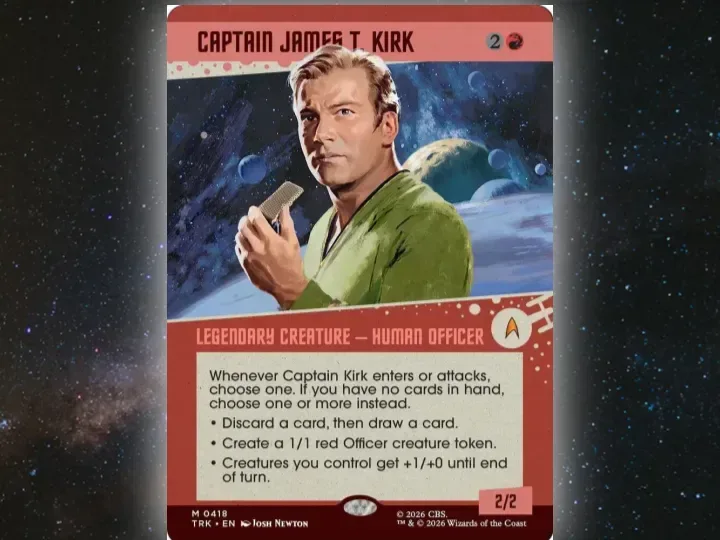
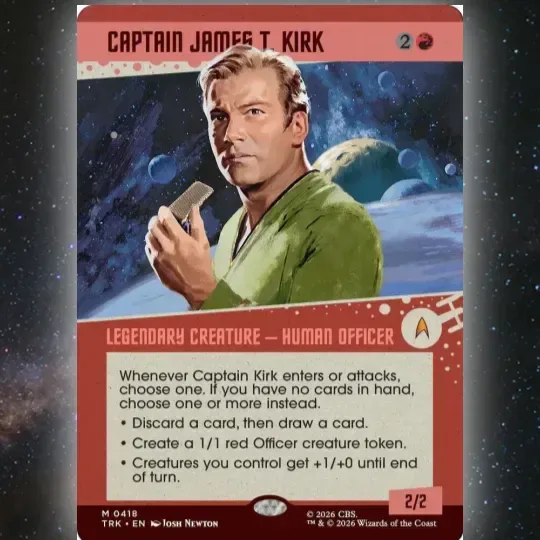
Sanderson discussed several cards from the release with co-host Dan Wells on a recent podcast. The standout for Sanderson was a mono-red Captain James T. Kirk card based on William Shatner’s portrayal from the original Star Trek series. Their verdict was concise: it was “a perfect Kirk.”
That reaction was not simply about recognizable artwork or the appeal of seeing the Enterprise captain translated into a trading-card-game frame. Sanderson’s attention was on how Kirk’s game text appears to convey the character. In other words, this was praise for the age-old Magic trick of turning personality into rules text—and, ideally, doing so without requiring a player to negotiate with a hostile alien computer first.
A Kirk card built to find a way forward
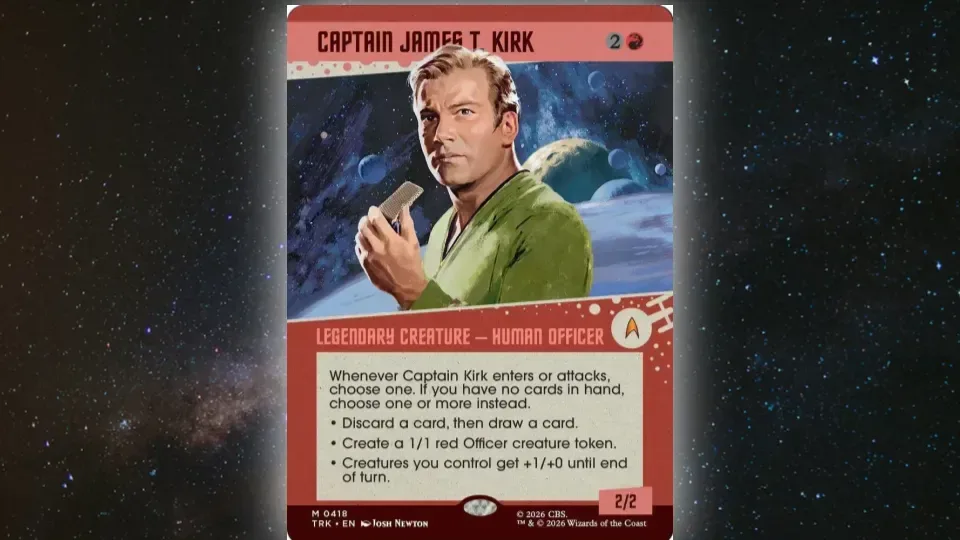
Sanderson highlighted several features of the card’s design. Its abilities can draw a card, and one option involves discarding a card and then drawing another. Crucially, the card can still supply a card when its controller has no cards in hand. That led Sanderson to frame the mechanic as Kirk creating options when none seem available.
For more context, explore PlayStation’s Physint Exit and Wolverine’s Reception Put Its PS5 Strategy Under a Microscope.
“If you have no options, he gives you them,” Sanderson said while describing the card’s function.
That is a clean thematic fit for Kirk. The original-series captain is often associated with bold decisions, improvisation and finding the improbable third answer when a situation insists there are only two. A card that replenishes an empty hand—or lets a player exchange an existing card for a fresh one—puts that sense of resourcefulness directly into play.
The design also apparently makes a red shirt and can strengthen the player’s team with a rousing speech. Those details add more than a single joke or reference. They point toward a version of Kirk who is both the captain at the center of the action and the person rallying everyone around him. In Magic terms, card flow, token creation and team-wide support can cover a surprising amount of Starfleet ground.
Related coverage includes Brandon Sanderson Calls Magic: The Gathering's New Captain Kirk Card a 'Perfect Kirk'.
There is an appealing bit of color-pie logic in the choice, too. Red is Magic’s color of impulse, emotion, action and living in the present moment. Kirk is hardly reducible to reckless enthusiasm—he is also a commander and diplomat—but a mono-red interpretation naturally emphasizes the captain’s willingness to act decisively under pressure. The card’s ability to turn a stalled hand into a new possibility makes that decision feel deliberate rather than merely chaotic.
What is known about this version of Captain Kirk
The Kirk Sanderson discussed is one of multiple Magic cards depicting Shatner’s original-series incarnation of the character. It is part of the base set, rather than being identified as a card exclusive to one of the Commander decks currently available for preorder.
That distinction matters to collectors and players trying to understand where a favorite character might appear. Base-set placement means the card is intended to be opened from the main product pool, but it does not settle its eventual rarity or frequency. With the Star Trek sets not scheduled to arrive until later in November, the card’s scarcity has not been made clear here.
For now, the most useful takeaway is straightforward: this is not being presented as a Commander-deck-only Kirk. Anyone planning to collect the set will still want to watch the full card list, rarity information and product details as the release gets closer. A familiar captain may be ready to boldly go into a binder, but the exact route there remains unknown.
Why character-first mechanics matter in crossover sets
Universes Beyond cards face a tricky assignment. They must work as Magic cards, satisfy fans of the guest property and avoid reducing a decades-spanning character to a single gag. The best designs tend to make the player feel as though they are doing the thing the character is famous for doing.
That is why Sanderson’s response is noteworthy. His description did not focus on raw power or a proposed tournament role. Instead, it focused on the experience created by the effects: Kirk solves an impossible problem, produces a red shirt and inspires the crew. Even without a complete evaluation of the card’s place in formats, that is a strong endorsement of its thematic construction.
It also illustrates why a famous crossover card can be more memorable than a name pasted onto a generic creature. A Kirk who helps rebuild a hand has a recognizable narrative shape. A Kirk who rallies a team supports the captain image. A red-shirt-making effect embraces one of Star Trek’s most durable pop-culture associations. Put together, those components sound designed to deliver a tiny episode of classic Trek at the table.
Magic has long used mechanical identity to express a character’s outlook, skills or story role. Crossover releases raise the stakes because the audience brings its own established understanding of every major name. The reward, when the translation clicks, is a card that appeals to both people who know every rule interaction and people who simply know that an Enterprise captain should probably have an answer when the situation gets weird.
Sanderson’s Magic connection keeps speculation alive
Sanderson talking enthusiastically about Star Trek and Magic is unsurprising on its own. Both interests have been recurring topics for him, and a new Star Trek release gives those interests a convenient overlap. Still, his comments have once again prompted discussion about whether his own fictional universe could eventually make its way into Magic through a Universes Beyond collaboration.
There is no announced Cosmere Magic set in the information available, and the discussion should remain firmly in the realm of possibility rather than expectation. Yet the theory has persisted for understandable reasons. Sanderson has a visible interest in tabletop adaptations and Magic, and he previously had an opportunity to exclusively reveal a new card from Tarkir: Dragonstorm in March 2025. Fans have also discussed a custom Stormlight Archive set he created.
Those points do not confirm a future product. They do, however, explain why every Magic-related Sanderson conversation gets examined with the intensity normally reserved for decoding a prophecy written on a cave wall. The Cosmere’s expansive settings, distinctive magic systems and large cast make it easy to imagine why players would be curious about the prospect.
The timing has added more fuel to that curiosity. An Apple TV adaptation is in development, while a large Stormlight board game is expected to head to Kickstarter later this year. Neither project establishes a Magic collaboration, but both show continued activity around Sanderson’s worlds beyond the books themselves.
For collectors, crossover announcements can be exciting precisely because they bring separate fandoms together. They can also be a reminder to distinguish evidence from enthusiasm. Sanderson’s favorable read on Kirk is evidence that he likes the card’s design; it is not confirmation that a Cosmere set has been scheduled, designed or announced.
November is the next major waypoint
Magic’s Star Trek sets are due later in November. Until then, the available picture of this particular Captain Kirk is compelling but incomplete: a base-set version of the original-series captain, colored red, with effects centered on creating options, generating a red shirt and boosting allies through a speech.
That may already be enough to win over fans who value theme as highly as efficiency. Kirk has spent generations escaping no-win scenarios, usually with a bridge crew behind him and a dramatic musical sting nearby. Giving him a Magic card that helps a player recover from an empty hand is an appropriately compact translation of that legacy.
Whether the card becomes a frequent pull, a Commander favorite, a casual-table staple or simply a must-have piece for Trek collectors will have to wait for more set information. But Sanderson’s reaction captures the early appeal: this is a Kirk design that appears to understand why Kirk is Kirk. For a crossover card, that is a very good place to start.