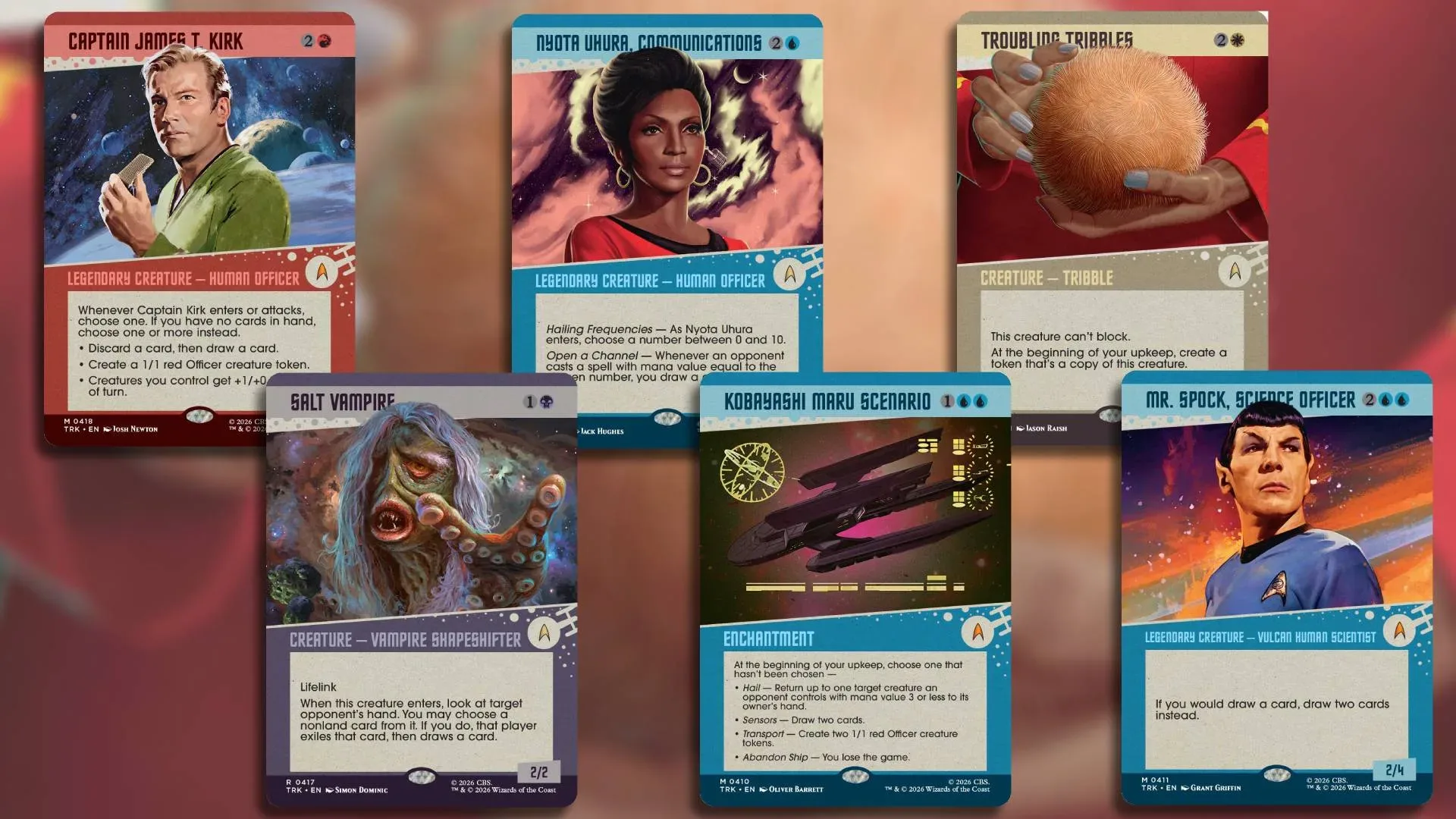
Magic: The Gathering is heading to the final frontier on November 13 with a Star Trek-themed Universes Beyond release built around the franchise’s 60th anniversary. The set reaches from the original 1960s series through Star Trek: Strange New Worlds, includes multiple portrayals of characters played by different actors, and gives the Borg, Starfleet crews, famous vessels and even Data’s cat Spot room on the card file.
This is not merely a cosmetic reskin of familiar Magic ideas. The release introduces several named mechanics and makes Spacecraft a major part of its identity. The result looks aimed at two overlapping audiences: Magic players looking for new deck-building tools and Trek fans who want particular eras, characters, visual styles and ships represented. That breadth also puts the set squarely in the expanding crossover conversation around games, an issue recently visible in the debate over Fortnite’s Nikki Freeman crossover.
For Magic players, the useful question is how the mechanics translate Trek concepts into gameplay. For collectors, it is how the unusually broad range of treatments—including actor-signed cards limited to 250 copies of each—might shape interest in particular pulls. Here is what has been shown so far, and what each major system means in practical terms.
Release timing and scope
Pre-release events begin November 6, one week before the November 13 launch. The set’s material spans television and film incarnations across Star Trek’s long history. Lower Decks appears to have a comparatively small presence, with a couple of non-cartoon art treatments, while other eras receive a wider selection of cards and artwork.
That franchise coverage is central to the release’s approach. Rather than anchoring every gameplay theme to one crew or one time period, the mechanics divide Trek’s broad ideas into familiar Magic categories: cooperation for the Federation, expansion and exploration for Strange New Worlds, conversion and control for the Borg, and large artifacts for famous spacecraft.
It is also a set with a conspicuously large menu of visual variants. Borderless lands, extended-art cards, Klingon-focused designs, promos and Commander cards are all part of the lineup alongside the main treatments. The breadth matters because a card’s gameplay version and its collectible version may be different decisions for different buyers. A player may simply need a functional copy; a collector may be interested in a specific frame, illustration or exceptionally scarce signature.
Beam Me Up turns a creature into a return ticket
Beam Me Up is a new keyword ability tied to moving a creature back to its owner’s hand. When that happens, the ability permits an instant or sorcery card to be cast from the graveyard. In plain terms, the graveyard—Magic’s usual destination for used spells—can temporarily become a second chance to use a spell.
The creature returning to hand can create additional value of its own. A creature that leaves and is later cast again can trigger its “enters” ability again. “Enters” is short for an effect that happens when a permanent enters the battlefield. Returning a creature also removes Auras attached to it, since those attachments do not accompany it back to hand.
Related coverage includes Magic: The Gathering's Star Trek Set Reveals Massive Card Lineup and New Mechanics.
That creates a mechanical interpretation of teleportation that is more tactical than it first sounds. A player may choose to Beam Me Up a creature not just to reuse a spell, but also to preserve the creature from a problem on the battlefield, reset an entry effect, or clear an Aura. The supplied examples establish the core pattern without revealing every Beam Me Up card, so the eventual strength of the package will depend on its individual spell costs and enablers.
Face a Dilemma rewards modal choices
Face a Dilemma gives a Star Trek name to selecting from a card’s listed options. In Magic terminology, such a card is “modal”: it has multiple modes, and its controller chooses one when the relevant effect occurs. The set treats that decision itself as an event that other cards can notice and reward.
Seven of Nine is one example. Her card lets its controller draw an extra card whenever they choose from modes or spells elsewhere. The implication is clear: a deck packed with cards offering meaningful options can turn routine flexibility into card advantage. Card advantage is the broad Magic term for having access to more cards and therefore more potential actions than an opponent.
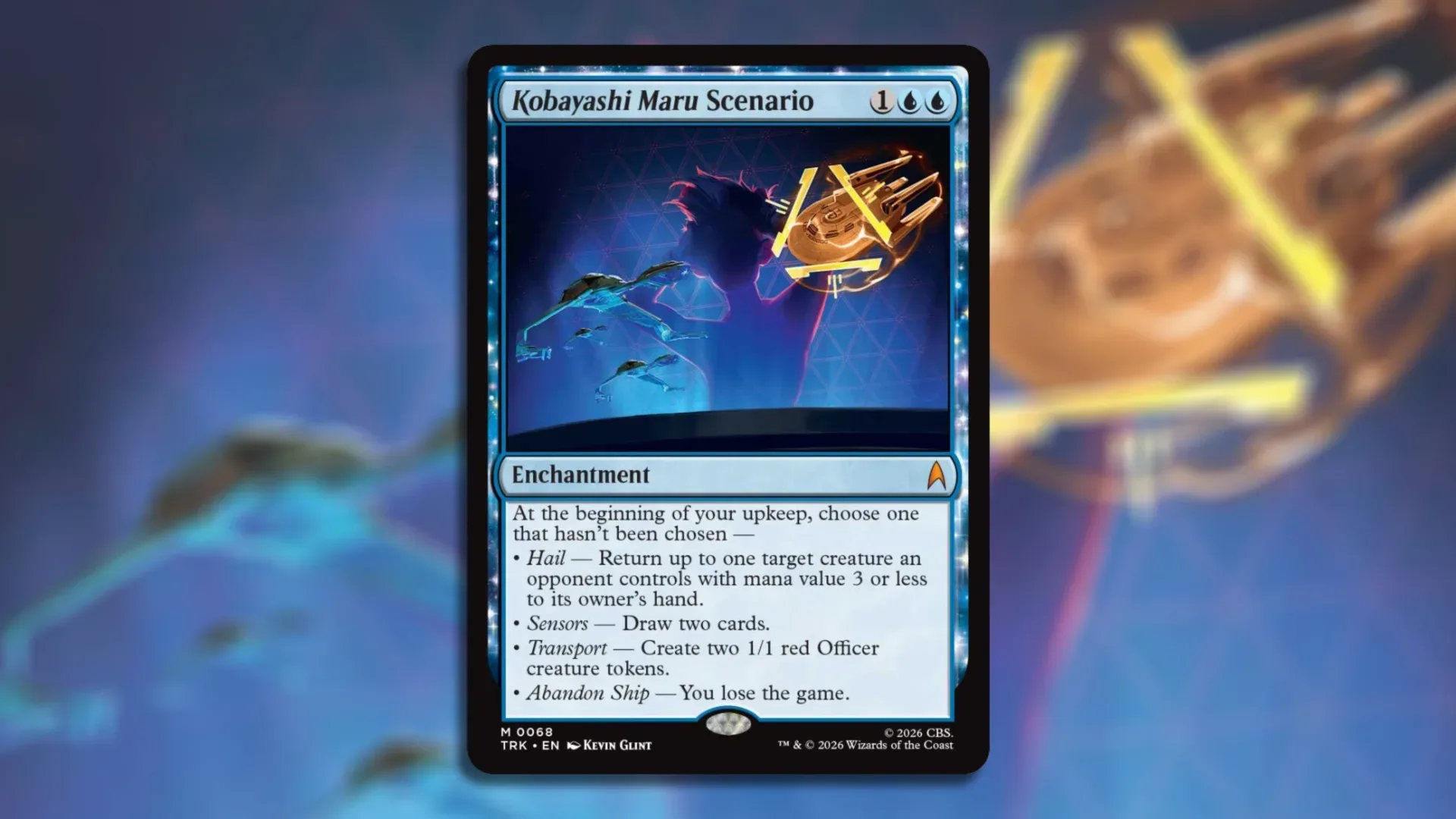
The Kobayashi Maru Scenario enchantment demonstrates the theme with a suitably unforgiving menu at the beginning of upkeep:
- Hail: Return up to one opposing creature with mana value 3 or less to its owner’s hand.
- Sensors: Draw two cards.
- Transport: Create two 1/1 red Officer creature tokens.
- Abandon Ship: Lose the game.
“Upkeep” is the early phase of a player’s turn where ongoing effects often occur. “Mana value” is a card’s total mana cost expressed as a number, while a token is a game piece created by an effect rather than represented by a conventional card in the deck. The final Kobayashi Maru option is plainly a losing choice, but its inclusion serves the reference and underscores the theme: every dilemma does not offer four equally sensible answers.
In play, Face a Dilemma should make deck construction and sequencing more involved. A decision card normally offers adaptability; cards like Seven of Nine add a further payoff for making that choice at all. Players will have to weigh the immediate best mode against the value of triggering their other permanents.
Federation and Strange New Worlds reward variety
Federation rewards a battlefield containing multiple non-Borg creatures. Captain Jonathan Archer’s Federation ability can give a creature +X/+X until end of turn, where X equals the number of non-Borg creatures its controller has. A creature’s power is the combat damage it deals, while toughness is the amount of damage it can take at once; +X/+X raises both figures for the turn.
The mechanic’s theme is direct: a larger and more varied crew strengthens the whole. The restriction is equally direct. Borg do not count as Federation participants, preserving a clean gameplay and story distinction between unity among allied species and the Borg’s assimilating collective.
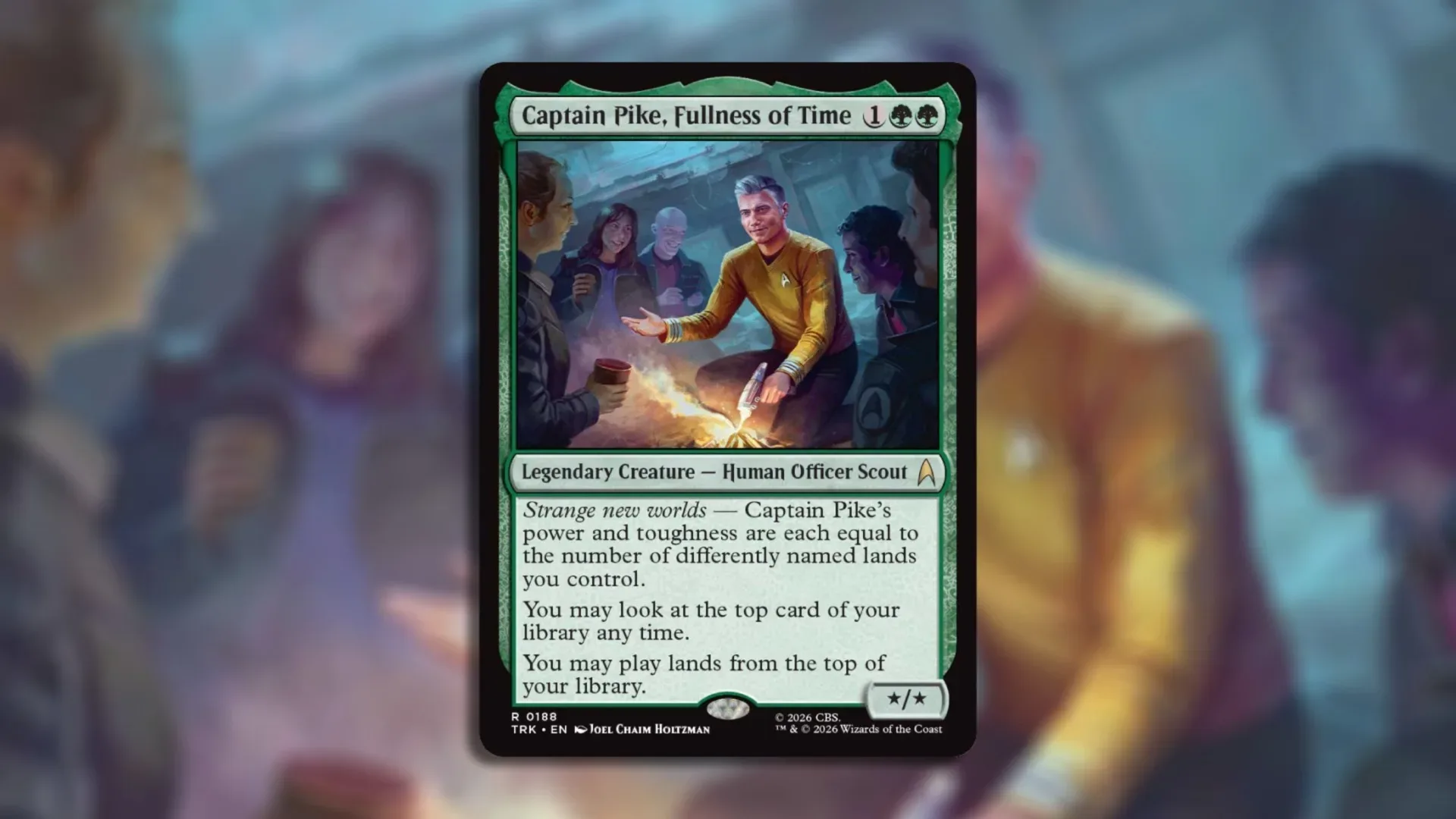
Strange New Worlds instead asks players to diversify their lands. Lands are the cards that generally produce mana, Magic’s resource for casting spells. Captain Pike, Fullness of Time has power and toughness marked */*, meaning those values are defined by an ongoing condition rather than printed as fixed numbers. In Pike’s case, that number is the count of differently named lands, referred to here as strange new worlds.
A Forest, an Island, a Federation Outpost and Quark’s Bar would make Pike a 4/4, even if the player had more than one copy of one of those lands. The key is different names, not raw land count. That distinction encourages a deck to explore a broader mix of locations rather than simply accumulating a single favorite basic land.
Both mechanics make the set’s themes legible without requiring players to know Trek lore. Federation favors a populated board of non-Borg creatures. Strange New Worlds favors a varied manabase—the selection of lands used to provide a deck’s colors and mana. The latter may be especially relevant for players considering how many colors and named locations they can support consistently.
Spacecraft require a crew before launch
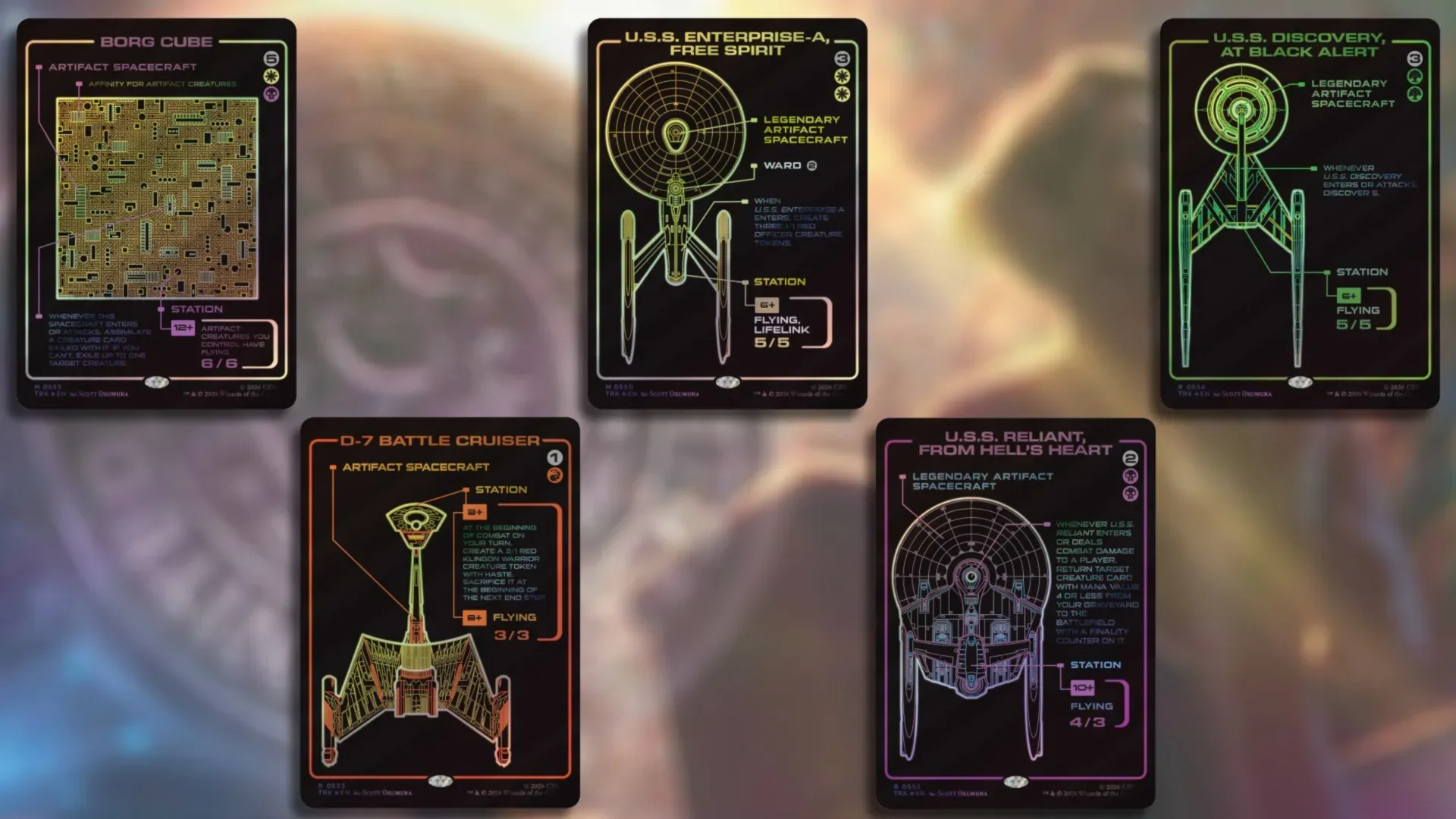
Spacecraft use the station mechanic, which previously appeared in Edge of Eternities. These cards begin as artifacts, a Magic card type commonly associated with objects and machines, rather than as creature cards. They can become artifact creatures after enough station has been accumulated.
To station a Spacecraft, its controller taps untapped creatures. Tapping means turning a card sideways to show it has been used and generally cannot be used again for a similar cost until it untaps. The tapped creature’s power is added to the Spacecraft as station counters. Crucially, the required total can be built over multiple turns, so a player is not required to commit the whole crew in one burst.
The revealed examples show substantially different thresholds and rewards:
- U.S.S. Discovery, at Black Alert needs station 6 or more. It gains flying and becomes a 5/5 artifact creature.
- Borg Cube needs station 12 or more. It becomes a 6/6 and gives a player’s other artifact creatures flying.
- Starship Enterprise needs station 16 or more. It becomes a 4/6 and lets its controller draw cards equal to the damage it deals.
Flying is an evasion ability that restricts what can block a creature. The Enterprise’s damage-triggered card draw is particularly notable because it makes a successful attack replenish options. At the same time, station introduces a real opportunity cost: creatures tapped to crew a spacecraft are not freely available for other tap-based actions and ordinarily cannot attack that turn. The threshold numbers suggest the bigger vessels are projects a player builds toward, rather than automatic early-game attackers.
The Borg’s plan is assimilation
Assimilate gives the Borg their own distinct gameplay identity. It allows a player to take control of an opponent’s creature, assimilate that card and put a +1/+1 counter on it. A +1/+1 counter permanently increases that creature’s power and toughness by one for as long as it remains on the battlefield.
Unlike Federation’s communal scaling, Assimilate transforms an opponent’s resource into the Borg player’s asset. It is a fitting division of mechanical space: the Federation counts its non-Borg forces, while the Borg benefits by incorporating a rival creature into its own side. The exact limits and costs of particular Assimilate cards have not all been laid out here, but the headline effect makes the play pattern easy to understand.
Collectible treatments range from LCARS to signed Headliners
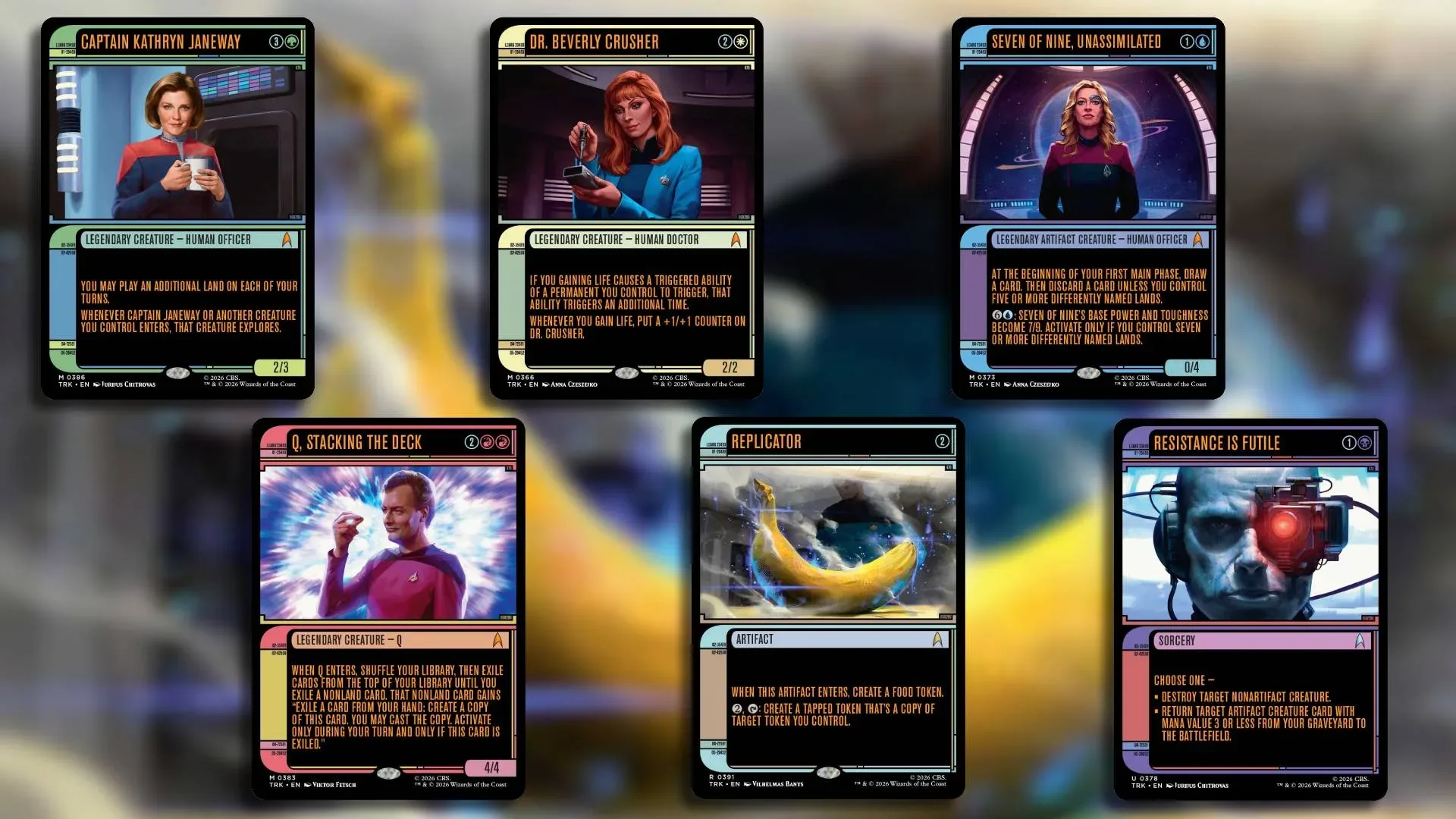
The visual side is no less expansive. LCARS frame cards apply the distinctive computer-interface look to variant artwork, including a Replicator card. Classic Enterprise treatments lean into a retro presentation, with the Salt Vampire among the highlighted cards. Schematics give Spacecraft cards technical blueprint-style designs, an especially appropriate match for vehicles that must be stationed before becoming creatures.
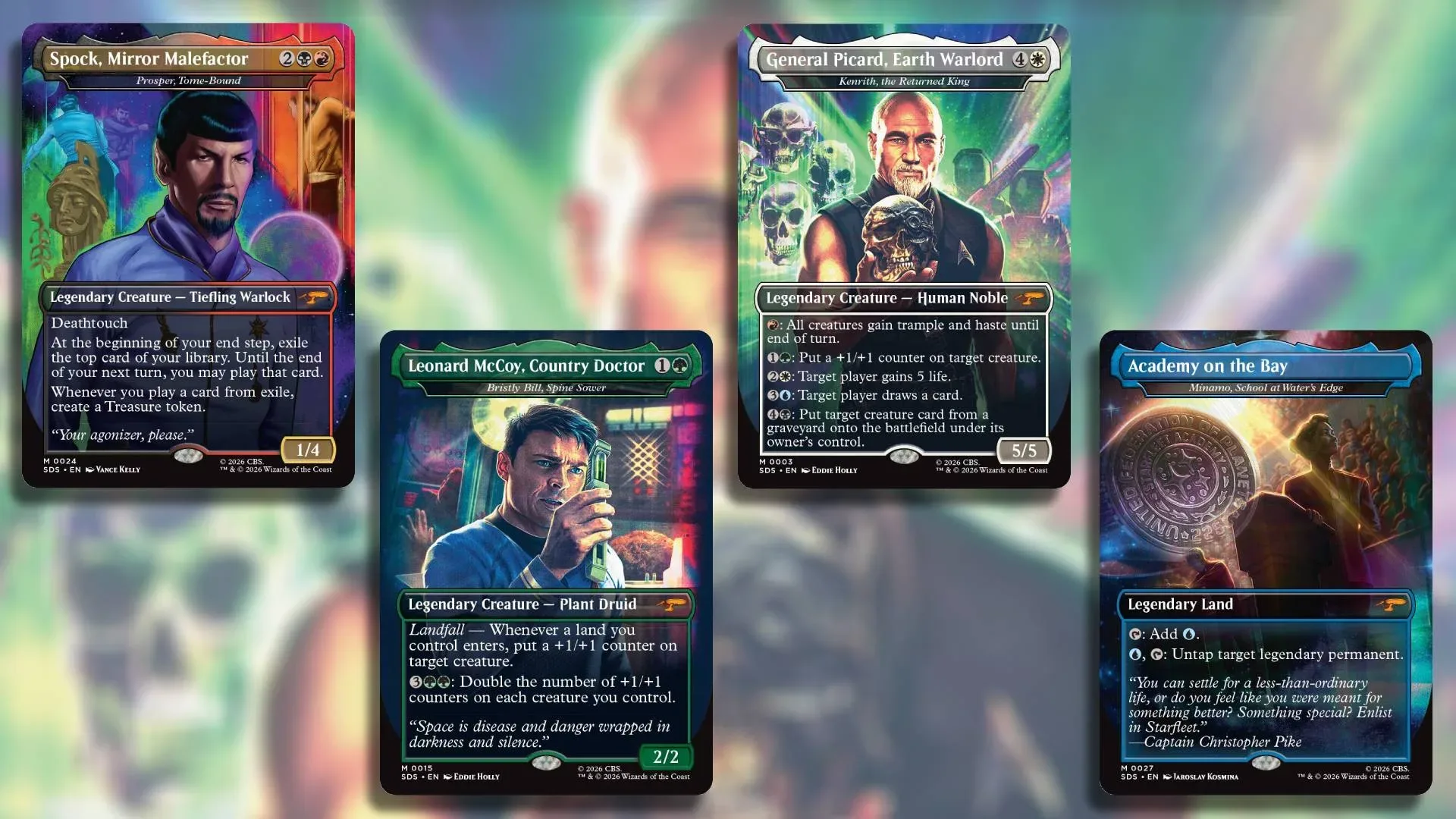
Borderless Stardate cards focus on major moments from Star Trek history, including a mirror-universe Spock. Borderless treatments remove the usual card-edge artwork boundaries to give the illustration a larger visual role. The set also includes Klingon designs, extended art, borderless lands, promotional cards and Commander cards.
Commander is Magic’s multiplayer-oriented format built around a legendary creature serving as a deck’s commander. Its dedicated cards often matter to players who prefer that format, but the revealed selection also supplies character-focused pieces for franchise collectors. Spot’s appearance is a small but telling example of the set’s willingness to go beyond starship captains and galaxy-scale threats.
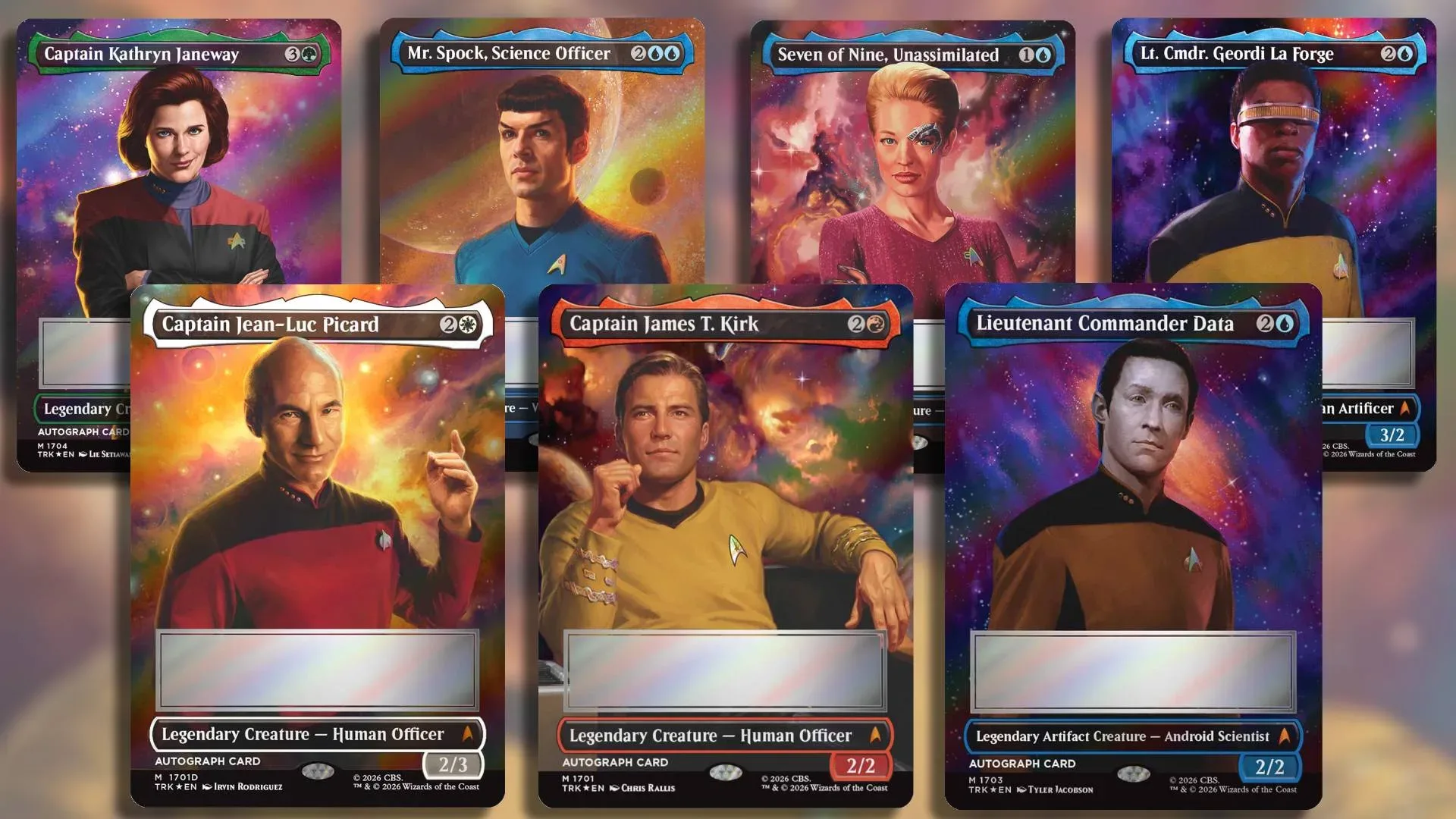
The most limited treatment is the signed Headliner series. Only 250 copies of each are being printed, they are exclusive to Collector Boosters, and each is hand-signed by the actor depicted. Ethan Peck-signed Spock is among the examples shown. Those conditions make these cards substantially scarcer than standard versions and likely to draw intense collector attention. That does not tell buyers what any individual card will be worth, but it does make the difference between a play copy and a signature chase card unusually stark.
With gameplay spanning recursive spells, decision triggers, diverse lands, crewed spacecraft and creature theft, the Star Trek release is shaping up as a mechanically busy crossover rather than a single-theme novelty. Its November pre-release window will be the first opportunity for players to see how naturally those systems fit together across actual decks—and whether the set’s many Trek eras feel as unified at the table as they do in its card gallery.