John Elway’s most compelling cards divide neatly between two collecting worlds: the broadly recognized rookie card that anchors a player collection, and the scarce 1990s inserts that turn a familiar Hall of Fame quarterback into a high-end chase. His 1984 Topps #63 is the essential starting point, while Metal Universe Precious Metal Gems and Flair Showcase’s one-of-one Masterpiece treatment show how much rarity and condition can reshape the market around a retired star.
That split is visible in the sale results for five defining Elway cards. A signed 1984 Topps rookie with perfect PSA card and autograph grades reached $111,182 in June 2026. Meanwhile, a PSA 9 copy of the 1997 Metal Universe Precious Metal Gems Red /150 sold for $47,500 in November 2025, and a 1998 Precious Metal Gems /50 numbered to Elway’s jersey number sold for $17,100 despite receiving a PSA 7.
The numbers are useful reference points, not universal price guides. A result can reflect a card’s grade, whether it is signed, its serial number, the particular auction venue and the bidders present at that sale. Especially with cards carrying tiny reported graded populations or fixed print runs, there may not be enough comparable transactions to treat one record as a guaranteed market floor.
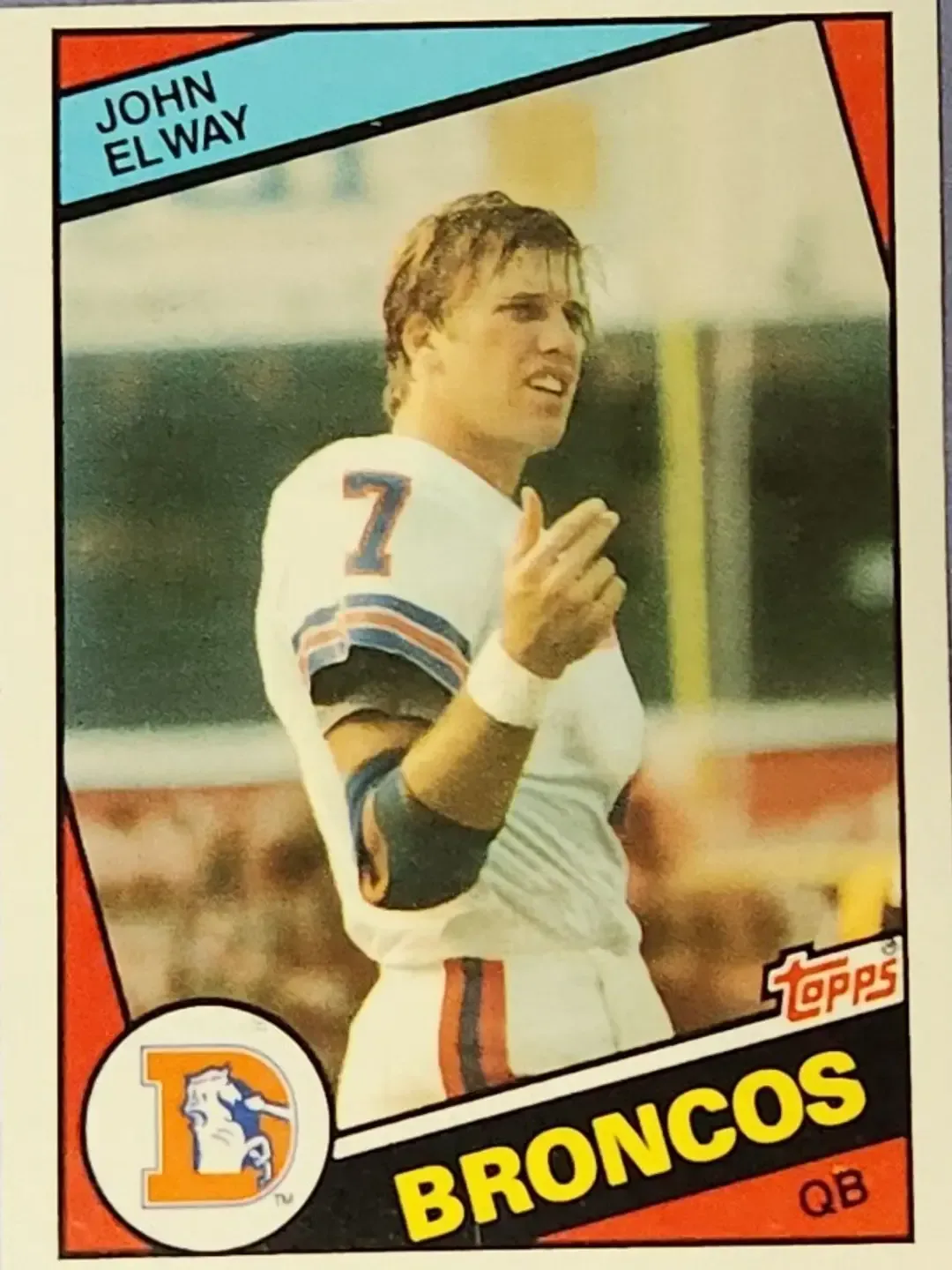
1. 1984 Topps Football John Elway #63
The 1984 Topps John Elway #63 is the foundational card on this list: his rookie card and the issue most likely to sit at the center of an Elway-focused collection. Its visual identity is unapologetically tied to Denver, using orange corners, a light-blue name field and yellow team lettering. That color combination gives the card a strong presence before scarcity or grading even enters the equation.
For more context, explore Sylvester Stallone Says Decades of Doing His Own Stunts Came at a Brutal Cost.
The largest cited result is a PSA 10/Auto 10 copy that sold for $111,182 on June 6, 2026. This dual designation matters. PSA 10 refers to the card’s condition grade, while Auto 10 is a separate assessment of the autograph. The realized price therefore should not be read as the value of every 1984 Topps Elway—or even every PSA 10—because the signature and its top autograph grade are material parts of that specific card’s appeal.
A different benchmark came from an unsigned BGS 10 that sold for $50,000 on November 8, 2021. The reported population figures are 188 PSA 10s and 19 BGS 10s. Population reports count examples graded at a stated grade by a particular company; they are not a complete census of every surviving card, nor are grading standards interchangeable across companies. Still, the figures illustrate why collectors should identify both the grading company and the exact label details when comparing listings.
For collectors, this is the card where player significance, rookie-card status and condition meet most directly. It is also a reminder that “rookie card” does not automatically mean every copy is expensive. The six-figure sale belongs to an autographed, dual-perfect example, while the unsigned BGS 10 is itself a distinctly high-grade and scarce version.
Related coverage includes The Five John Elway Cards That Define His Market.
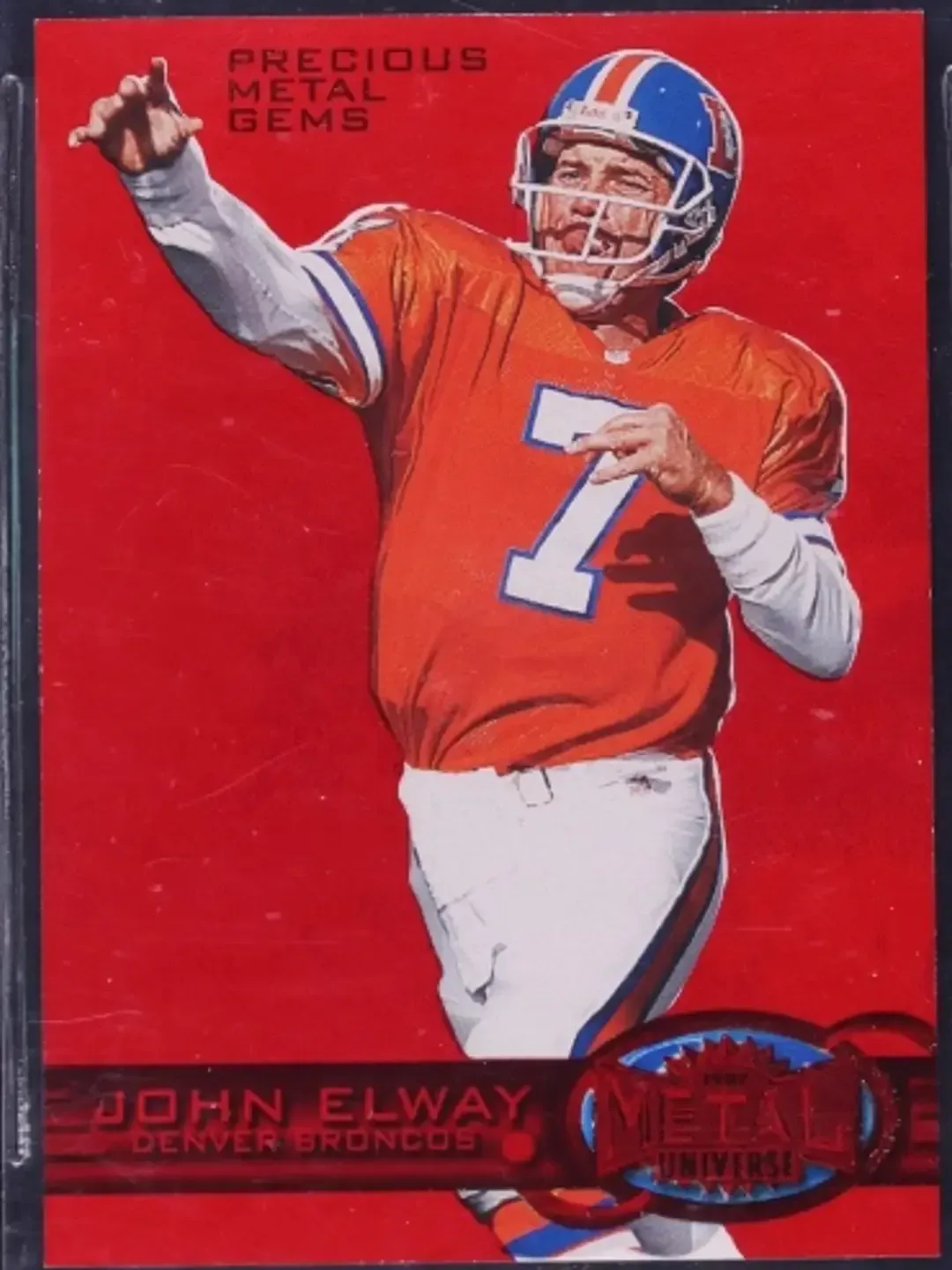
2. 1997 Metal Universe Precious Metal Gems Red /150 John Elway
The 1997 Metal Universe Precious Metal Gems Red John Elway is the premium 1990s rarity in this group. It is limited to 150 copies, a crucial distinction from the plentiful base-card logic that governs many older player collections. PMG is shorthand for Precious Metal Gems, an insert parallel line whose limited numbering is central to collector demand.
A PSA 9 Red /150 sold for $47,500 on November 30, 2025. Just two PSA 9 examples are reported in the population count supplied for this card. A small population can make high-grade copies difficult to locate, but it is not identical to a print run: the /150 numbering describes the intended total for the Red parallel, while the PSA count only represents copies submitted to PSA and assigned that grade.
The same 1997 issue also demonstrates why parallel color and stated scarcity must be handled precisely. A BGS 8 example of the Green /15 version sold for $45,600 on December 20, 2024. Green /15 is a different, much more tightly numbered parallel than Red /150. It is tempting to treat the two results as a simple price ladder, but their grades differ, their sales occurred at different times, and the versions are not interchangeable. The comparison is most useful as proof that collectors evaluate both rarity tier and condition, rather than as a prediction of what either card must sell for next.
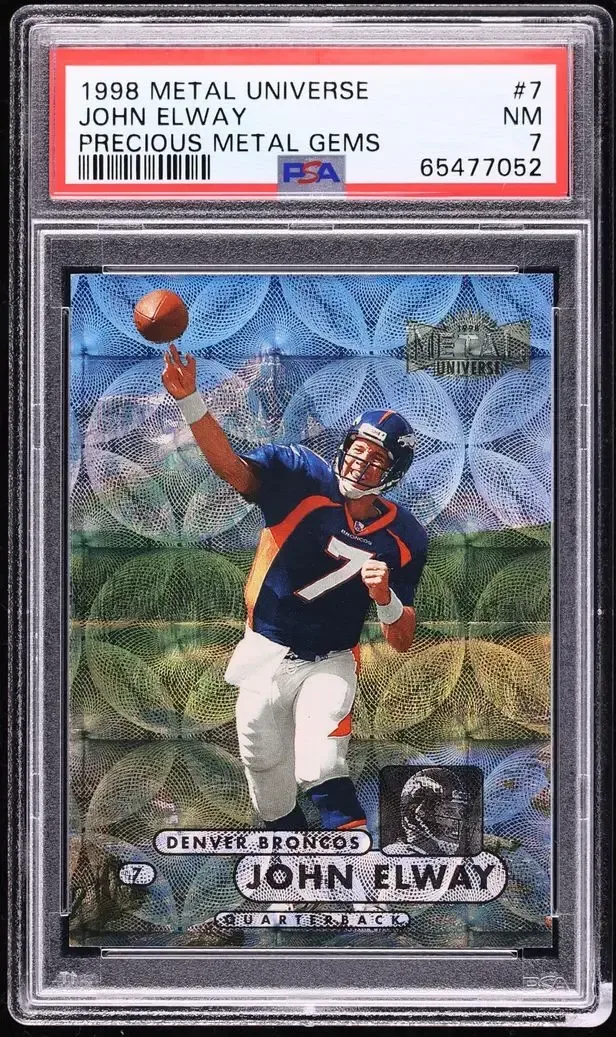
3. 1998 Metal Universe Precious Metal Gems /50 John Elway
Elway’s 1998 Metal Universe Precious Metal Gems /50 shifts the formula again. This version is serial-numbered out of 50, and the cited card is numbered 7/50, matching Elway’s jersey number. It also carries a PSA 7 grade—the same number as the card’s serial-number match—which gives the example a memorable numerical identity beyond its standard checklist entry.
That PSA 7, serial-numbered 7/50 copy sold for $17,100 on September 26, 2025. The reported PSA 7 population is six. A seven-grade result is not normally described as gem mint; the card’s relevance here comes from the convergence of a limited run, Elway’s 7/50 jersey-number serial and an especially recognizable late-career release, rather than a top numeric condition grade.
“Jersey-number match” is collector shorthand for a serial number that matches the athlete’s jersey number. It can add appeal because it makes one copy within a numbered run feel more personal to that player. But it is a preference-based premium, not a formal grading category, and its impact may vary significantly from buyer to buyer. The sale provides a concrete example of a collector treating that match as meaningful, not a universal rule for every numbered Elway card.
The 1998 timing supplies another layer of context. The card arrived after Elway’s first Super Bowl victory and during the period that ended with a second Lombardi Trophy. That career moment, paired with a low-numbered PMG format, helps explain why a PSA 7 example can still command a substantial result.
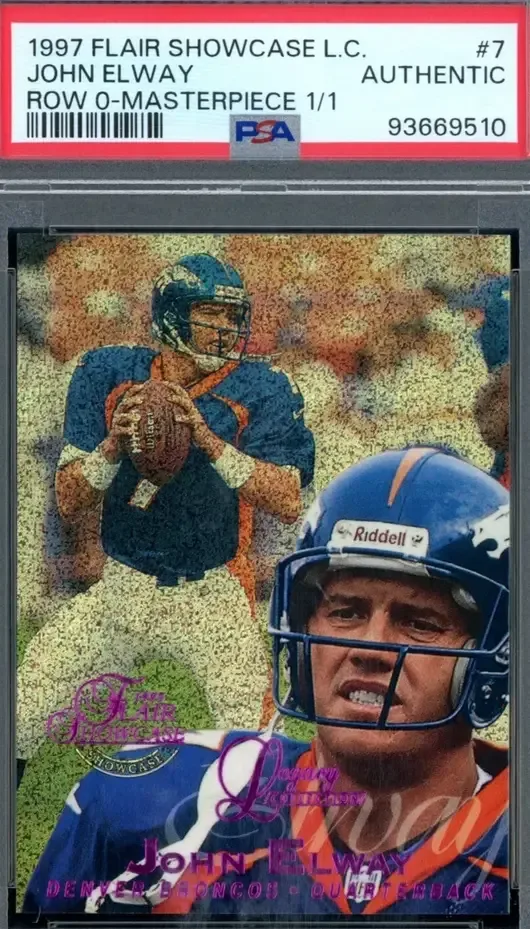
4. 1997 Flair Showcase Legacy Row 0 Masterpiece 1/1 John Elway
Scarcity does not get more literal than a designated one-of-one. The 1997 Flair Showcase Legacy Row 0 Masterpiece John Elway is a 1/1, meaning that the issue identifies it as the sole copy of that exact version. The cited example was encapsulated by PSA with an Authentic designation and sold for $13,366 on September 30, 2024.
An Authentic label is different from a conventional numeric condition grade. In practical terms, the supplied sale identifies the card as authenticated in its PSA holder, rather than presenting it as, for example, a PSA 7, 9 or 10. That distinction is worth preserving in marketplace comparisons: an authenticated one-of-one should not be casually stacked against numerically graded cards as if the labels convey the same condition information.
The card also captures Elway in Denver’s then-new uniform design. The era was a successful one for the Broncos, who reached the 1998 and 1999 Super Bowls and won both Lombardi trophies. For an Elway collector, that makes the card more than a print-run curiosity: it is tied to the visual and competitive identity of the final championship stretch of his playing career.
One-of-one cards create a special challenge for anyone trying to estimate value. There cannot be a direct same-card comparison unless the identical card returns to market. The $13,366 result is therefore a historical transaction for this particular authenticated copy, not a reusable price template for every rare Elway issue.
5. 1985 Topps John Elway #238
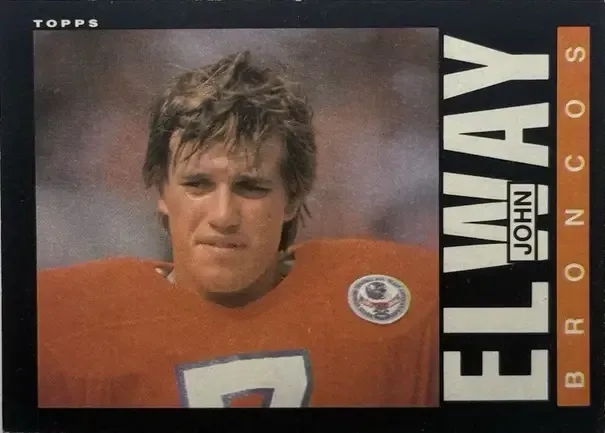
The 1985 Topps #238 offers a different route into Elway’s early NFL years. It is his second-year Topps card, with a design that makes heavy use of block lettering and multiple typographic treatments. That makes it a useful companion to the 1984 rookie: it remains an early-career card, but it is judged more by grade scarcity and visual appeal than by rookie-card status.
A PSA 10 sold for $12,600 on September 27, 2026. Earlier in the same year, another PSA 10 sold for $7,950 on April 4. The reported PSA 10 population is 21, a small figure that helps frame why gem-mint copies can behave differently from lower-grade examples.
The gap between those two results also makes a practical point about card-market reading. Two sales of the same card in the same grade are valuable evidence, but neither one independently defines a permanent price. They establish a recent range of observed transactions—$7,950 and $12,600 in this case—while leaving open questions about presentation, bidder competition and the precise timing of each listing.
How to Read This Elway Card Market
These five cards show that an Elway collection can be built around several distinct priorities. The 1984 Topps #63 is the classic rookie-card centerpiece. The 1985 Topps #238 is an early-career, condition-sensitive follow-up. The 1997 and 1998 PMGs put the emphasis on numbered rarity, while the Flair Showcase Masterpiece appeals through its one-of-one status and championship-era imagery.
- Separate card version from grade: Red /150, Green /15 and /50 are different scarcity tiers, even when they share a product family.
- Read labels exactly: PSA 10/Auto 10, PSA Authentic and BGS 10 each communicate different information.
- Treat populations narrowly: a grading-company population report is not a count of all copies in existence.
- Keep sale context attached to the number: autograph status, serial numbering and grade can be decisive.
- Do not confuse rarity with a fixed price: a 1/1 has no true direct comp, and even two sales of the same graded card can vary widely.
The through-line is Elway himself, but the market is not driven by player legacy alone. The strongest results are attached to a specific combination of card identity, rarity, condition and, in the case of the rookie-card record, autograph quality. Collectors weighing any of these cards should compare the exact issue and certification details rather than relying on the player name or a headline sale in isolation.