Sports cards have a peculiar talent for ignoring the script. A quarterback can rank fourth in passing yards, fourth in QBR, and first in passing touchdowns while his team sits at 5-2—and yet one of his graded cards can still be headed down the hill with the confidence of a shopping cart that has spotted a slope.
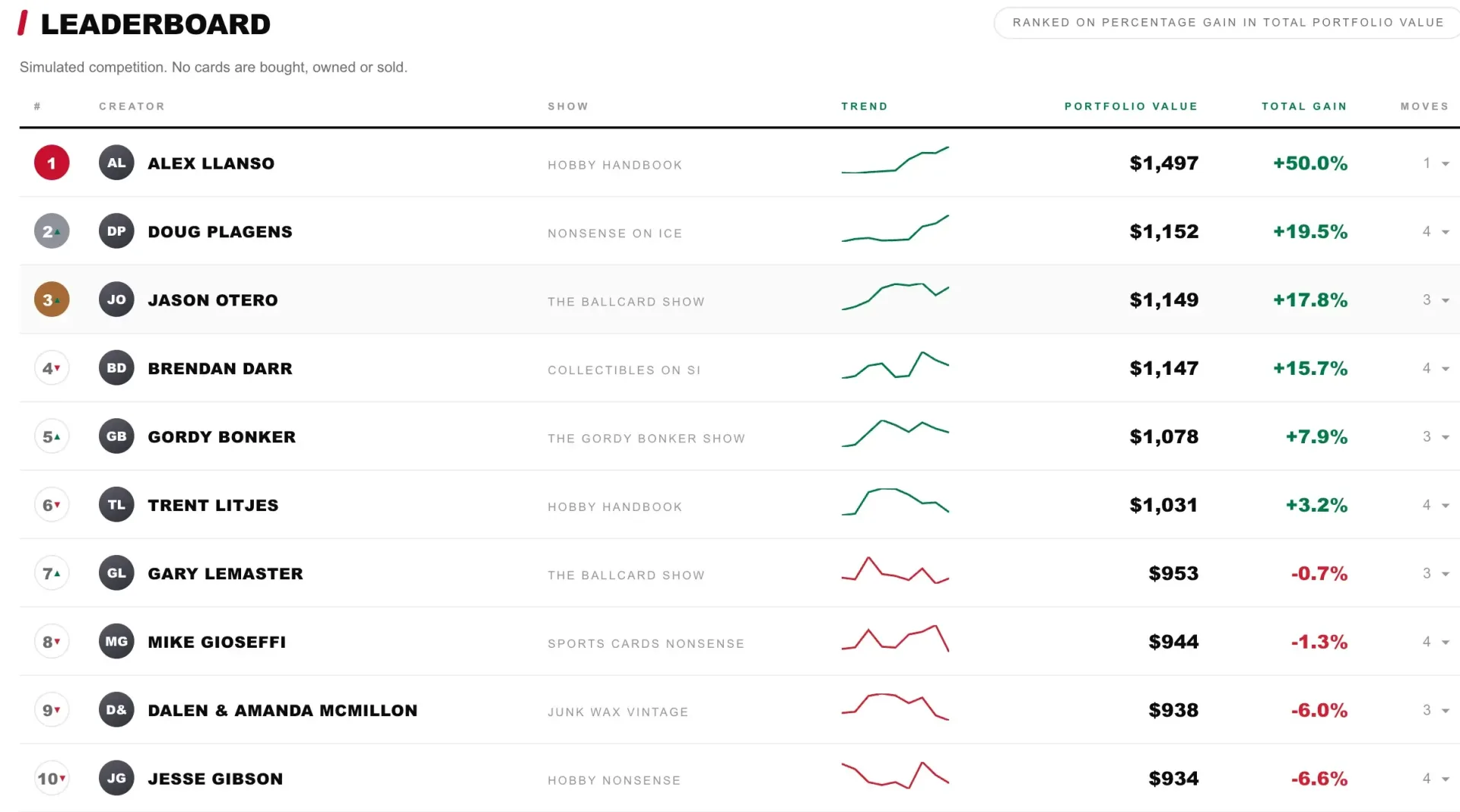
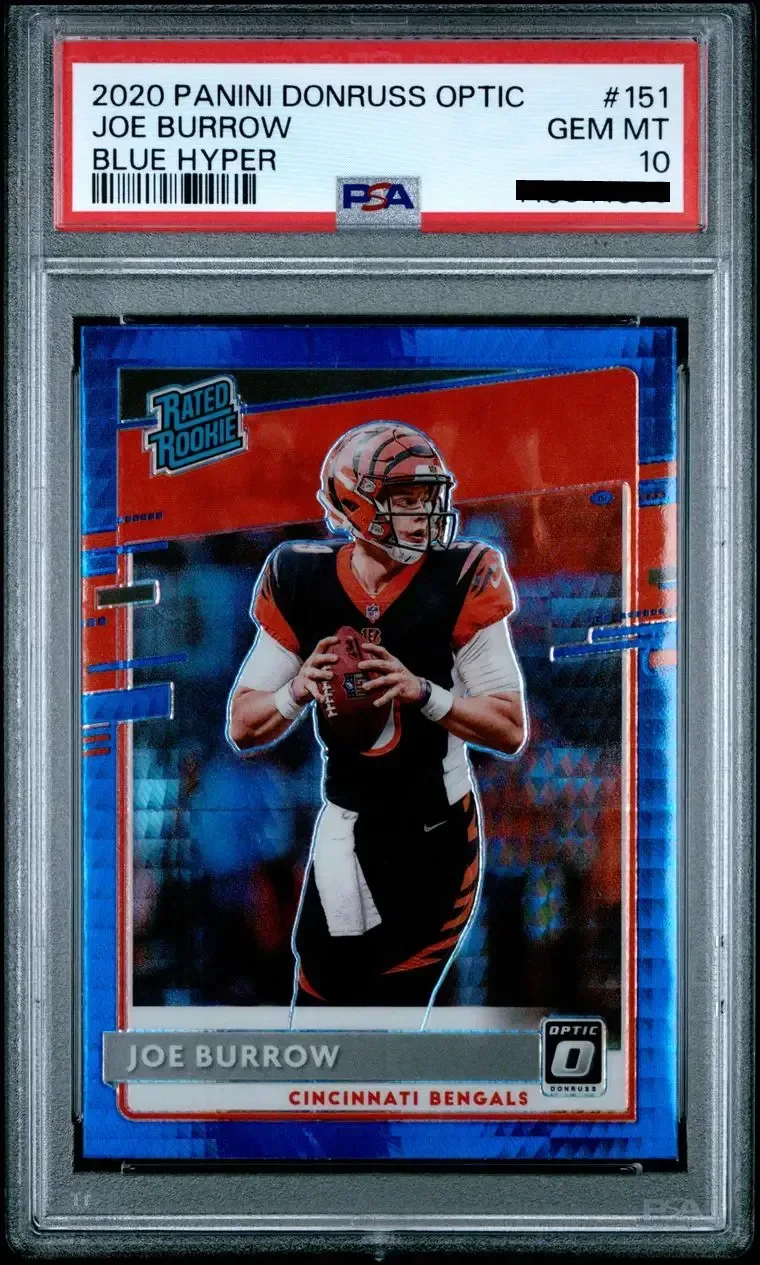
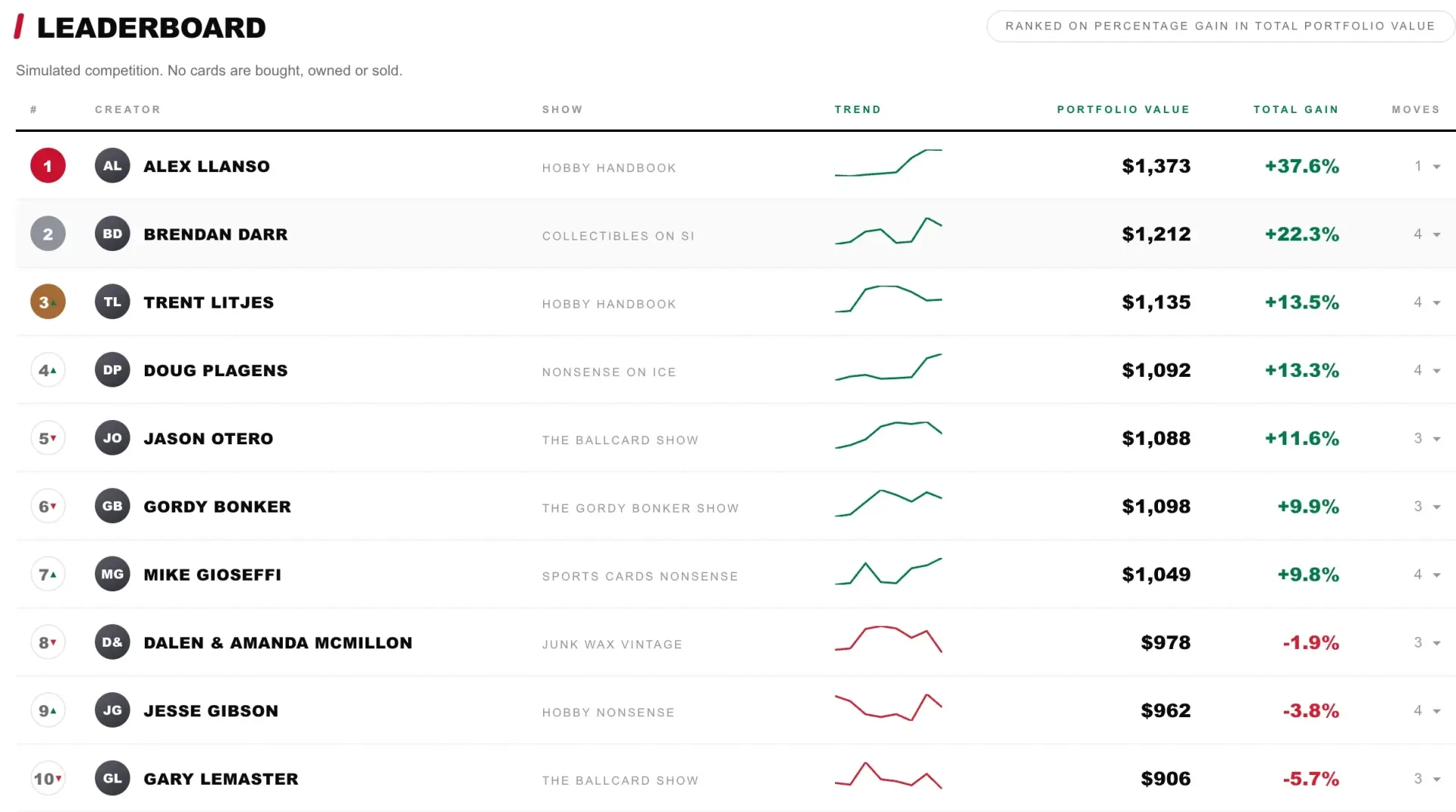
That is the uncomfortable premise behind the latest SCN Challenge update. The season-long, fantasy-style card competition gives 10 hobby creators portfolios of five cards apiece and tracks their movement through the Super Bowl. In Week 8, the most conspicuous disconnect belongs to Joe Burrow: strong on-field results and MVP consideration on one side, a tumbling 2020 Donruss Optic Blue Hyper PSA 10 on the other.
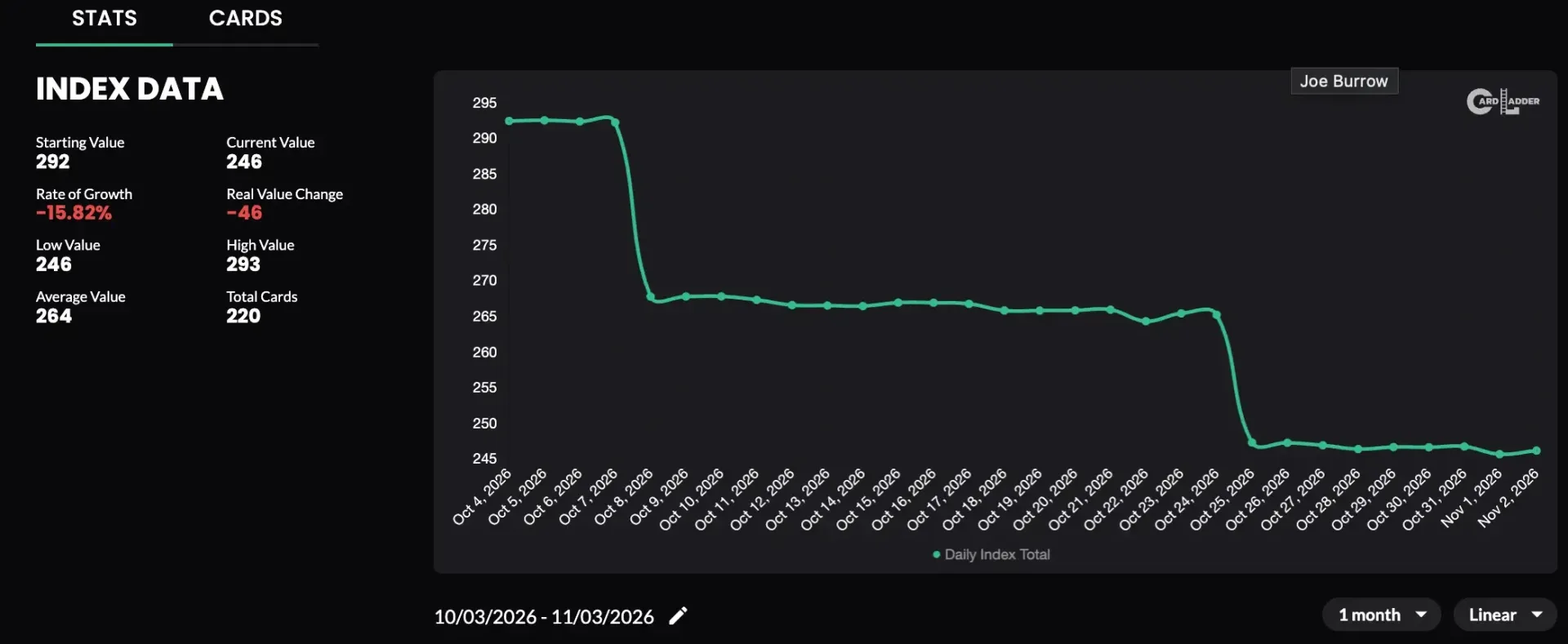
The card is down 30.8%, while Burrow’s broader market is down 15.82% over the past month. That does not prove the market is mistaken, nor does it mean a rebound is inevitable. It does underline a reality collectors can lose sight of when football Sundays get exciting: a player’s performance is only one input in a card’s price.
A leaderboard where timing has been the real MVP
Alex “CleverCubanCards” Llanso remains first after Week 8 and has opened a substantial gap. The foundation of that lead was an exceptionally well-timed sale of a 2025 Tyler Shough Gold Leather /50 PSA 10, completed before a Shough sell-off. The reported profit exceeded 250%, and the proceeds moved into a Josh Allen Red/White/Blue Rookie Prizm.
For more context, explore Final Fantasy VII Remake Intergrade and Rebirth Drop to About $8 Each on Switch 2.
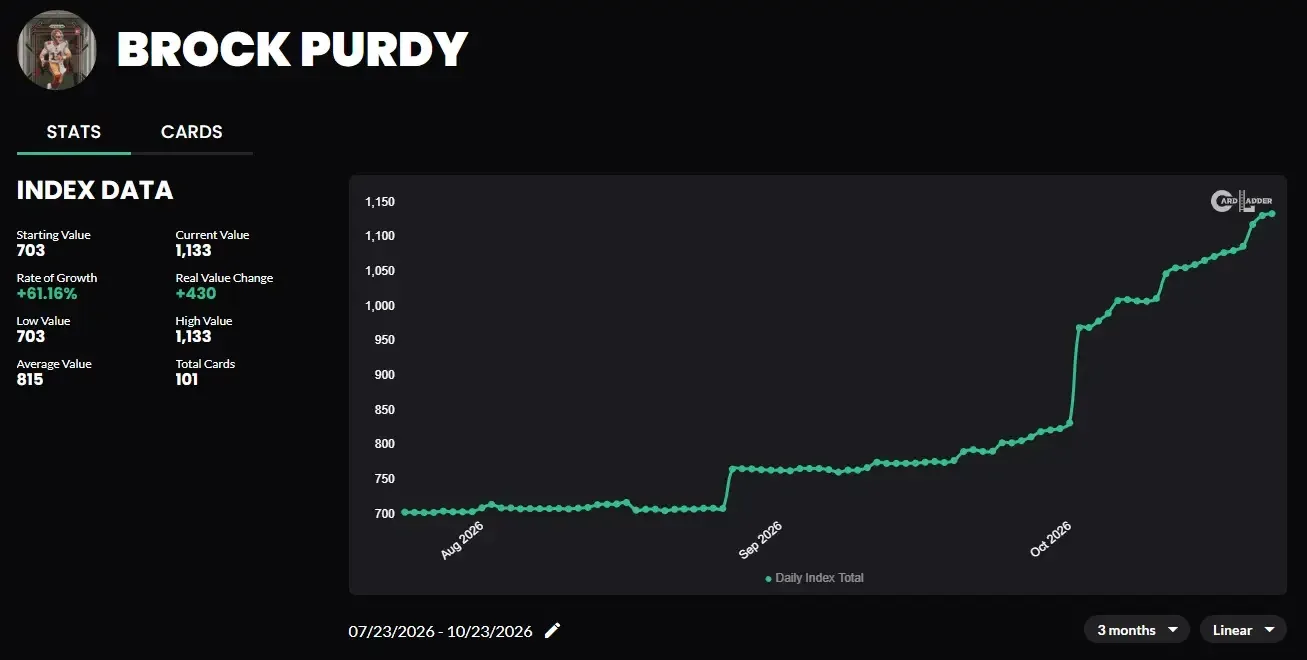
That earlier exit remains important because it illustrates what a five-card portfolio format rewards. The challenge is not solely a referendum on identifying talented players. It is also a test of timing, liquidity, confidence, and when to rotate from one card into another. Llanso’s subsequent Brock Purdy position has helped as Purdy moved nearer the top of MVP odds, turning one well-timed sale into a lead that has proved difficult to chase.
Week 8 also produced major movement elsewhere. Doug Plagens rose sharply after a Sam Darnold rookie card gained 83.7% for the week. Jason Otero also climbed behind continued growth in a 1997 Peyton Manning Metal Universe PSA 9 rookie card, which is now up 297% for the season.
At the other end, Trent Litjes fell from third to sixth as values continued to slide for a 2025 Tyler Shough Prizm Silver Auto and a 2023 Bijan Robinson Prizm Silver Auto. The owner of the Burrow card slipped from second to fourth despite gains in a 2025 Topps Chrome Patrick Mahomes Blue Wave /150 PSA 10. In a compact portfolio, one declining position can negate a winner with startling efficiency. The spreadsheet does not care that your other card showed up wearing a cape.
For readers following the broader competition, the challenge’s latest Burrow-focused update reflects just how much attention this one position is receiving.
Why Burrow’s card slump looks so strange
The case for patience is easy to articulate. Burrow is third in the MVP market, Cincinnati is a half-game behind Pittsburgh in the AFC North, and Baltimore—an important division and wild-card rival—has lost Lamar Jackson for the rest of the season. The football case has momentum, and the player’s statistical line has the sort of shape collectors often expect to energize demand.
But “often” is doing some heavy lifting there. A sports-card market does not move as a single synchronized meter that rises every time a quarterback throws a touchdown. Individual cards trade in individual transactions, with individual buyers and sellers making decisions at different times. The last 10 reported sales of the Burrow Blue Hyper PSA 10 ran from $105 to $249, with sales at $125, $150, $163, $175, $182.50, $182.50, $185, $232.50, and $249 in between.
That is a notably wide spread. It makes it difficult to turn a headline number into a simple answer about the card’s “true” value. It also shows why collectors should be cautious when treating a single sale as a definitive market reset. A $105 transaction and a $249 transaction may be sales of the same named card and grade, but they do not automatically carry the same meaning for demand at every price point.
What the card description actually tells us
The full label matters. 2020 Donruss Optic identifies the product and year. Blue Hyper identifies a parallel, meaning a version visually distinct from the standard card. Parallels are a central part of modern-card collecting: they give collectors a more specific version to pursue, but that specificity also means their pricing can behave differently from a player’s overall market.
PSA 10 is the top numerical grade on PSA’s 10-point scale. A graded-card price is therefore not just a bet on Burrow. It is a bet on this particular Optic parallel, in this particular grade, at a particular point in the season. The card can have robust interest while still experiencing uneven individual sales. Conversely, a player’s broad market can soften even as a different card of that same player finds demand.
That distinction is especially relevant in a portfolio challenge. “Joe Burrow is good” and “this Burrow card should rise this week” are related propositions, but they are not identical ones. The first concerns football. The second requires buyers to arrive for a very specific collectible at prices above recent transactions.
The ceiling, the floor, and the awkward middle
The recent run of sales suggests neither a clean collapse nor a clean recovery. There is a visible upper range, including the $249 sale and several sales above $250 earlier in the year. At the same time, the low end of the recent sequence is far below that level. The meaningful question is not simply whether a buyer once paid near $250. It is whether enough buyers will consistently support that range again.
For a collector, that is the difference between a market with a memorable high sale and a market with repeatable demand. Repeated transactions in a relatively tight band can offer a clearer signal than a few dramatic outliers. When prices are scattered, the temptation is to select the number that best supports the desired narrative: the bargain hunter points at the low sale; the holder points at the high sale; the neutral observer opens a spreadsheet and discovers that spreadsheets do not provide emotional support.
The owner has elected not to make a waiver-wire move this week, choosing to wait through the volatility. Within the rules and purpose of a fantasy-like portfolio contest, that is a coherent decision: selling after a sharp decline locks in the loss, while holding preserves exposure to a possible turnaround if buying interest catches up with Burrow’s season.
It is still a decision with risk. Market weakness can persist longer than collectors expect, and positive on-field developments do not obligate the market to react immediately—or at all. Patience is a strategy, not a prophecy.
What collectors can take from the roller coaster
The Burrow situation offers a practical checklist for anyone evaluating a volatile card without pretending that the next sale is predictable.
- Separate player performance from card performance. Great football can strengthen a collecting thesis, but it does not guarantee higher prices for every issue, parallel, or grade.
- Read the exact card, not merely the player name. Product, parallel, year, and grade are part of the asset being evaluated.
- Look at multiple sales. A range from $105 to $249 says more about present uncertainty than any lone result could.
- Recognize portfolio concentration. With only five cards, a large decline in one position can dominate the standings even if another card is gaining.
- Know whether you are collecting, competing, or trading. Those are different goals. A collector may welcome an opportunity to own a preferred card; a challenge participant is judged by the timing and value movement of the position.
There is another lesson in the Week 8 standings: fortunes changed on cards tied to very different player narratives. Llanso’s lead benefited from selling Shough before a downturn and shifting capital. Plagens surged on a Darnold rookie card. Otero’s Peyton Manning Metal Universe PSA 9 continued its season-long climb. Litjes absorbed declines in Shough and Robinson cards. No single rule neatly explains all of those moves, which is precisely why card-market certainty is usually more expensive than it looks.
Burrow’s Blue Hyper remains the week’s clearest tension point because the fundamental football story is so favorable. Yet the current data calls for precision rather than celebration or panic. The card has declined, the broader Burrow market has declined over the month, and recent sales have been highly variable. Those are observable facts. A bounce, a continued slide, or a period of choppy stability are possibilities—not conclusions contained in the scoreboard.
For now, the SCN Challenge has a front-runner with a commanding lead, a few dramatic risers, and one quarterback card stubbornly refusing to cooperate with the highlight reel. The season still has room to change the math. Until then, the Burrow position is a reminder that in modern sports cards, even an MVP-caliber campaign cannot personally tackle market volatility.