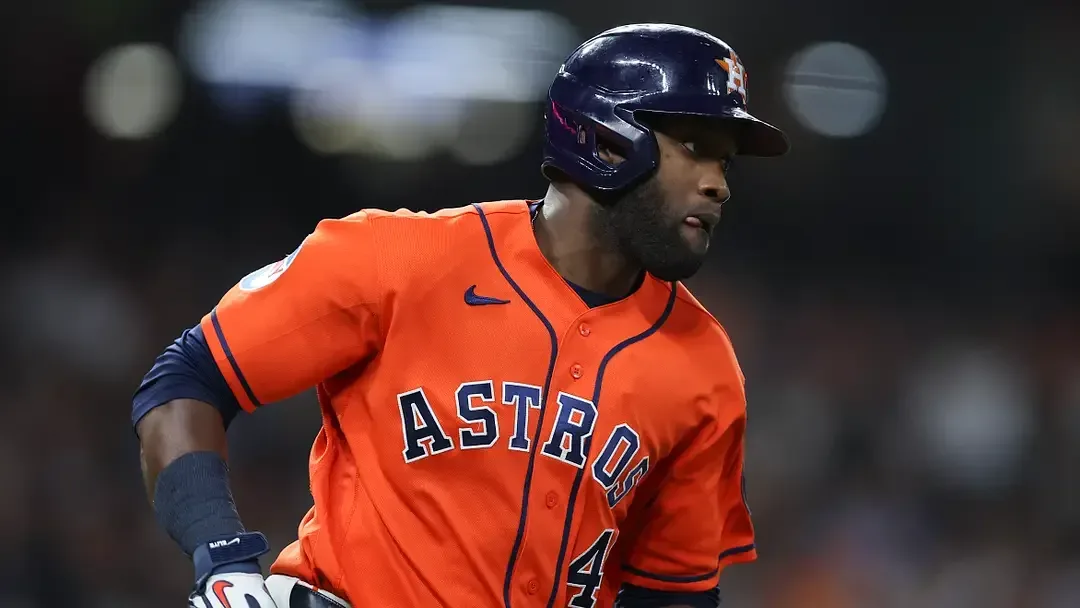
Yordan Alvarez’s path to hobby prominence has an unusual timing wrinkle: he debuted in Major League Baseball in 2019, but the key rookie cards highlighted in his market arrived in 2020 products. That makes the 2020 release year central for collectors looking for his rookie-era autographs, even though Alvarez appeared in only two games that season amid a COVID-19 diagnosis and surgery.
His broader baseball résumé gives those cards plenty of context. Alvarez has won Rookie of the Year, made four All-Star teams, earned ALCS MVP honors and won a World Series ring. With the 2026 regular season nearing its finish, he is also positioned as the heavy favorite for his first American League MVP award. That does not settle a card’s value, but it helps explain why scarce, signed examples from his rookie-card year remain the focus.
Recorded sales data identifies three standout cards, all graded PSA GEM MT 10 and all featuring Alvarez autographs. The highest historical sale is a 2020 Bowman Rookie Red Refractor Autograph numbered 1-of-5, which reached $10,000 in June 2023. It is followed closely by a 2020 Topps Chrome Update Sapphire Edition Red Refractor Autograph numbered 2-of-5 at $8,700, then a 2020 Stadium Club Chrome Shimmer Refractor Autograph at $8,500.
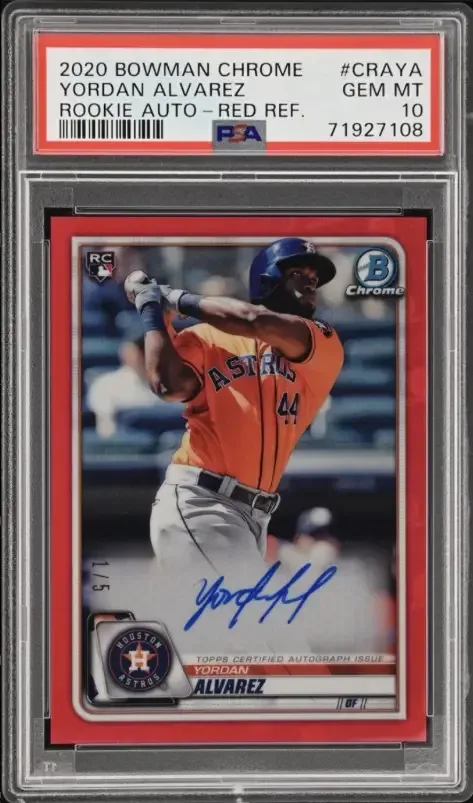
The headline sale: 2020 Bowman Rookie Red Refractor Autograph
The leading result belongs to the 2020 Bowman Rookie Red Refractor Autograph, serial-numbered 1-of-5 and graded PSA GEM MT 10. One copy sold for $10,000 on June 3, 2023, establishing the highest recorded sale among the Alvarez rookie cards in this group.
The card’s appeal is relatively easy to parse. It combines rookie status, a red refractor parallel, an exceptionally small stated print run and an autograph that appears to be signed directly on the card. Its photo shows Alvarez from the waist up after a swing, while the blue-ink signature sits over the white gradient above his name.
What “1-of-5” means: the serial number denotes that this particular copy is one of five cards produced in that parallel. It does not, by itself, mean every copy is identical in condition, eye appeal, autograph placement or later market performance. But it establishes a hard supply limit that separates it from more common versions.
There have been three recorded sales of this exact Bowman card. The most recent came on August 9, 2025, at $4,500. That gap is important for anyone reading a $10,000 result as a current price guide. A prior peak sale is a documented point in a card’s history, not a promise that the next transaction will match it. With so few copies and only three recorded sales for this specific card, individual results can vary sharply.
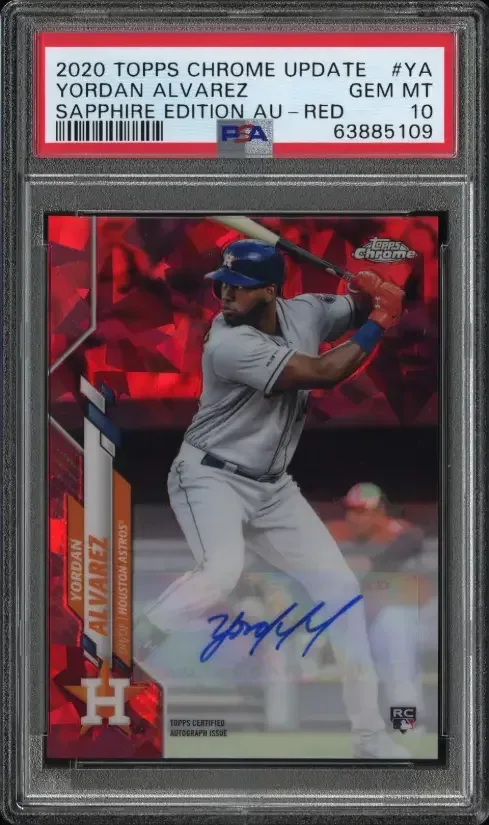
No. 2: 2020 Topps Chrome Update Sapphire Edition Red Refractor Autograph
The second-largest result is $8,700 for a 2020 Topps Chrome Update Sapphire Edition Red Refractor Autograph, numbered 2-of-5 and graded PSA GEM MT 10. The auction sale took place on October 24, 2022.
Related coverage includes Yordan Alvarez’s Top Rookie Card Sales Lead With $10,000 Bowman Red Auto.
Visually, the card follows the general Topps Chrome presentation but adds the Sapphire crackle pattern and red tint associated with the parallel. Like the Bowman Red, it is limited to five copies. Its listed value is $9,189.55, which is above its documented 2022 sale price, though collectors should keep a clear distinction between a listed value and a completed transaction. The latter tells us what a buyer paid at a particular point; the former is an estimate rather than evidence of a guaranteed sale.
The notable trade-off is the autograph format. This card uses a sticker autograph rather than an on-card signature. A sticker auto is a signature placed on an adhesive label and then applied to the card during production. An on-card autograph is signed directly onto the card stock. Preferences vary, but the format can matter to collectors evaluating otherwise similar scarce cards. Here, the Sapphire Red still achieved a strong result despite that distinction, underscoring how much its low numbering, rookie timing and top grade contribute to its appeal.
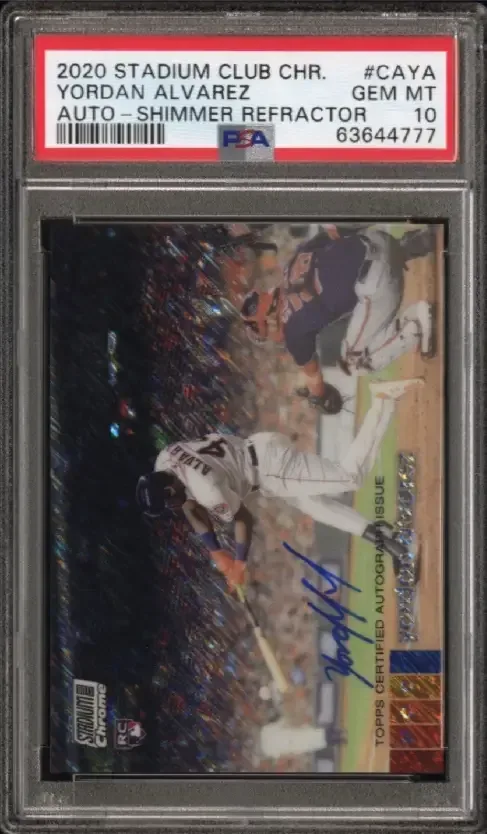
No. 3: 2020 Stadium Club Chrome Shimmer Refractor Autograph
Third on the list is the 2020 Stadium Club Chrome Shimmer Refractor Autograph, graded PSA GEM MT 10. It sold through a best-offer transaction for $8,500 on August 15, 2026. Its listed value is currently $7,521.
Unlike the two red cards above, the supplied details do not identify this Shimmer Refractor as numbered to five. Its draw comes from a different mix of attributes: an autograph, the Stadium Club Chrome name and an action-centered photo. The horizontal image catches Alvarez mid-swing with the baseball visible in frame, and the blue signature is placed between the bat and his front leg.
Stadium Club and Stadium Club Chrome are especially associated with photography that takes less conventional angles on the game. For collectors who care about an image as much as a parallel’s color or serial number, that can be meaningful. The $8,500 sale also shows that a card need not share the exact red, five-copy formula to sit near the top of this small Alvarez rookie-card sales group.
How to read the three results
All three cards share several traits that make direct comparisons tempting: each is a 2020 Alvarez rookie card, each is autographed, and each carries a PSA GEM MT 10 grade. Yet they are not interchangeable. The Bowman and Sapphire examples are red refractors numbered to five; the Bowman appears to have an on-card autograph, while the Sapphire uses a sticker. The Stadium Club Chrome card emphasizes a distinctive image and Shimmer Refractor treatment instead.
PSA GEM MT 10 is the grade assigned to each example cited here. In practical collecting terms, the shared grade helps narrow one major variable—condition—but it does not erase the differences in design, autograph format, scarcity or the circumstances of each sale. A best-offer deal, for example, is negotiated rather than the result of an open auction’s visible final bid. That does not make it less real, but it is useful context when comparing transactions.
The narrow record also argues for restraint. Three headline sales are useful markers, but they do not create a complete market map. The $10,000 Bowman result occurred in 2023, the $8,700 Sapphire auction in 2022, the Stadium Club sale in 2026, and the same Bowman later sold for $4,500 in 2025. The dates, sale formats and individual cards differ. Treating them as a single rising or falling line would smooth over information that matters.
Why the 2026 pennant race matters without rewriting the sales history
At the time reflected here, Houston has six games remaining, sits one game behind Texas in the division race and is three games out of a Wild Card place. Alvarez is described as the overwhelming AL MVP favorite and was close to a Triple Crown, the achievement of leading the league in batting average, home runs and RBI.
That late-season attention puts a brighter light on Alvarez’s rookie-era catalog, but it should not be confused with a fresh sale of any of these three cards. The established record remains: $10,000 for the Bowman Red Auto, $8,700 for the Topps Chrome Update Sapphire Red Auto and $8,500 for the Stadium Club Chrome Shimmer Auto.
For collectors, the practical takeaway is to identify precisely which version is being offered before attaching one of those numbers to it. Check the product line, parallel, serial numbering, autograph type, PSA label and sale date. Those details separate a true comparison from a card that merely shares Alvarez’s name and rookie-year designation. Physical-card ownership also differs materially from the digital-item terms being debated in the NBA 2K VC ownership dispute: collectors evaluating an Alvarez card are assessing a specific, tangible item with its own condition and transaction history.
Alvarez may add another major award to an already decorated career, and Houston’s push for October baseball remains unresolved. The three cards at the center of this snapshot offer a grounded way to follow the collecting side: focus on the exact card, use completed sales as dated evidence, and avoid treating estimates or old highs as certainty.