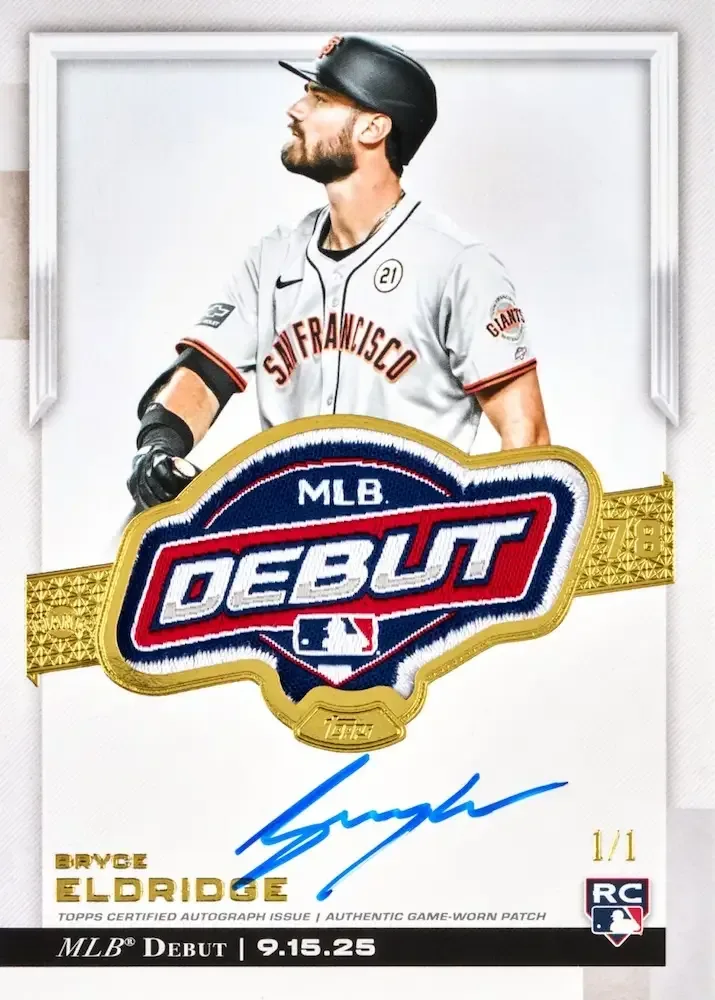
2026 Topps Chrome Update Baseball is scheduled to arrive on Dec. 9, and its defining chase is changing shape. The product will again include Rookie Debut Patch Autographs, the one-of-one cards pairing an autograph with the patch a player wore in his first Major League Baseball game. But the total will fall below 200 for the first time since the program’s debut year.
That is a notable reversal for a premium card type that had expanded rapidly. There were 91 Rookie Debut Patch cards in 2023, followed by 251 in 2024 and 270 in 2025. The 2026 checklist is not limited to the patches, however. It also includes returning autograph themes, team triple autographs, unusual dual-signature pairings, and several limited insert chases. For collectors, the product’s appeal is therefore broader than the headline one-of-one—even if the patches will understandably dominate attention.
What a Rookie Debut Patch Autograph actually is
A one-of-one, often abbreviated 1/1, means a card has a stated print run of one. Here, the card’s appeal comes from the combination of three elements: a particular player, an autograph, and a game-used debut patch tied to that player’s first MLB appearance. That is very different from an ordinary rookie card or a standard autograph: the patch creates a direct link to a specific career milestone, while the autograph turns the item into a signed relic card.
The format arrived in 2023 and has quickly become one of the most watched pursuits in modern baseball cards. A smaller overall count does not make every individual patch automatically more valuable; player demand, career results, collector interest, condition and the eventual buyer pool all matter. Still, fewer than 200 total cards means there will be fewer debut-patch targets spread across the set than in either of the prior two years.
Team distribution also gives collectors a clearer picture of where the checklist is concentrated. The Miami Marlins and Chicago White Sox lead with 13 Rookie Debut Patch cards apiece. The Chicago Cubs have the fewest, with two. That split may matter to team collectors deciding whether they want to chase sealed product, target particular cards later, or concentrate on the non-patch portions of the release.
Jacob Misiorowski is the central name in the chase
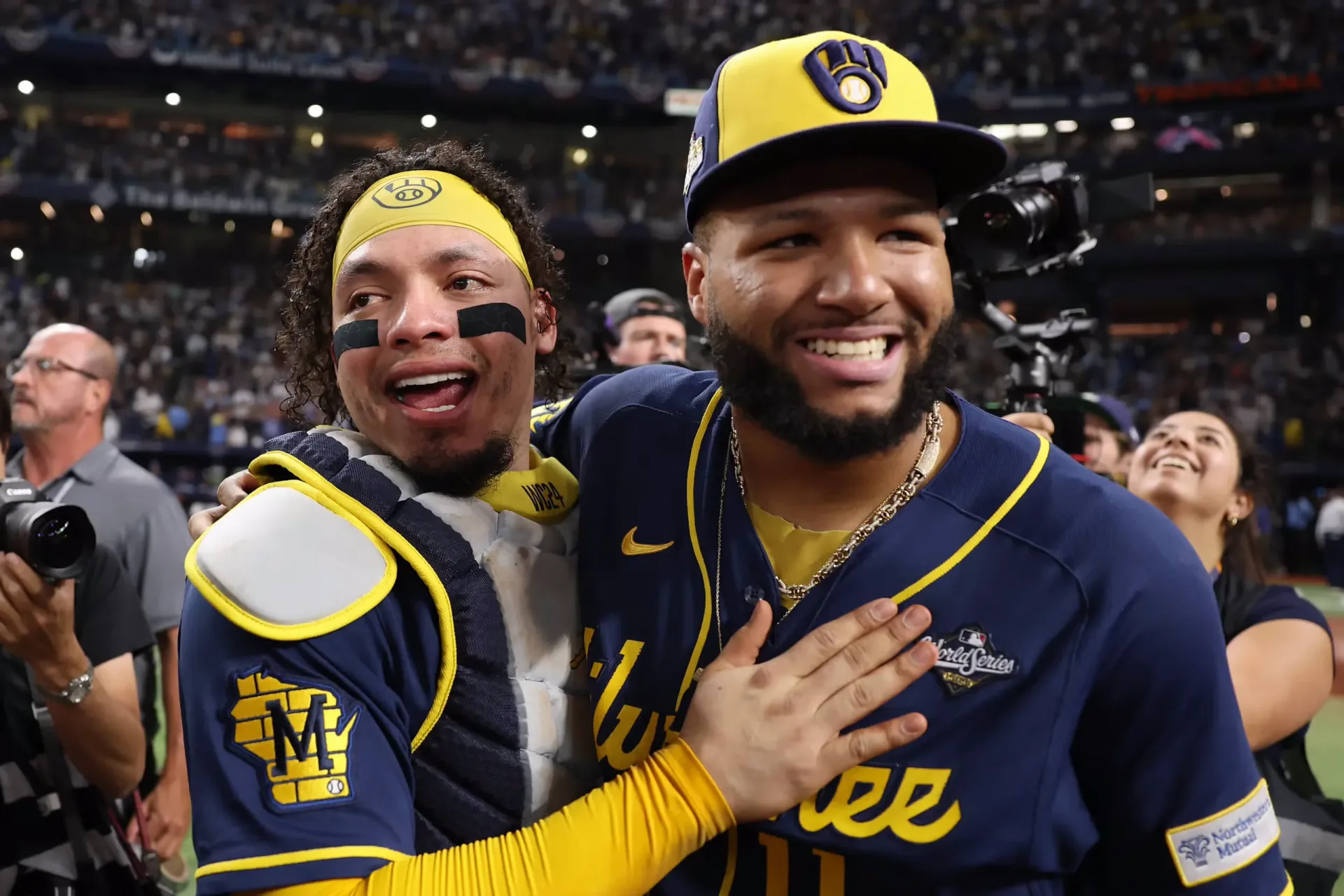
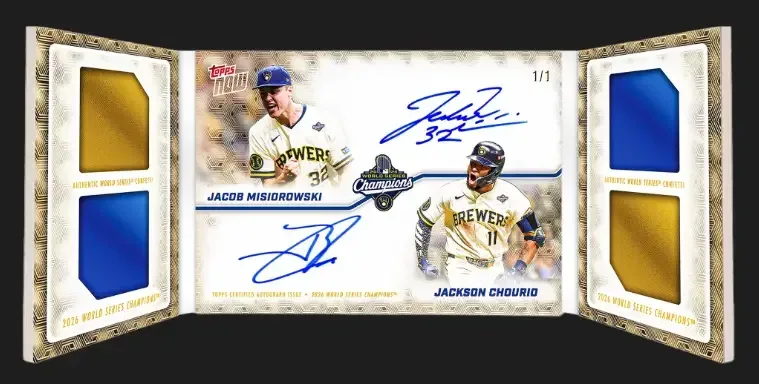
Jacob Misiorowski’s Rookie Debut Patch Autograph is positioned as the marquee card in 2026 Topps Chrome Update Baseball. He enters the release as a World Series champion, is described as being close to a National League Cy Young win, and has already become one of the hobby’s most sought-after players. Those ingredients put unusual focus on a single card before it has even surfaced.
The scale of recent Rookie Debut Patch sales explains why. Paul Skenes’ 2024 debut patch sold for $1.11 million last year. Nick Kurtz’s patch was last season’s next-largest cited result at $516,000. Those outcomes establish the ceiling that collectors will inevitably discuss around Misiorowski, but they should be read as prominent comparables rather than a valuation guarantee. A seven-figure sale is an outcome, not a preset price tag for the next major rookie.
There is a practical distinction worth keeping in mind: a sealed box or pack offers a chance at a card, while a specific single offers certainty about which card is being acquired. The Rookie Debut Patch Autographs are one-of-ones, so a collector whose goal is one particular player faces an inherently limited target. Conversely, collectors who simply enjoy the design and rookie class have more routes into the product through standard cards, inserts, and other autograph formats.
Related coverage includes 2026 Topps Chrome Update Baseball Cuts Rookie Debut Patch Total.
The checklist’s rookie patch group extends well beyond Misiorowski. Kevin McGonigle and Sal Stewart, identified as likely Rookie of the Year winners, are included, as is Cam Schlittler, identified as the expected American League Cy Young winner. Other named patch subjects are Munetaka Murakami, Parker Messick, Chase DeLauter, Travis Bazzana, Roman Anthony, Nolan McLean, Konnor Griffin, Jac Caglianone, Kazuma Okamoto, Trey Yesavage, Carson Benge, JJ Wetherholt and Bryce Eldridge.
That breadth is important because it gives the set multiple player-driven storylines rather than a single all-or-nothing hit. A collector following one club, an international star, a newly established award contender, or a developing rookie can find a separate reason to follow the release. It also means the eventual conversation around 2026 will not be limited to whether Misiorowski’s card reaches the Skenes benchmark.
Autographs offer plenty beyond the patch cards
The broader autograph lineup includes returns for Radiating Rookies, Autumn Ascensions, Lava Lamp, and 1991 Topps Chrome autograph cards. These are distinct autograph subsets rather than Rookie Debut Patch cards, giving the product multiple visual styles and subject combinations. For collectors who prefer signatures but do not want their entire interest centered on a relic card, that distinction is meaningful.
Triple autographs are planned for most teams, with one especially high-profile card bringing together Roger Clemens, Nolan Ryan and Paul Skenes. The concept is straightforward: three player signatures share one card. In a product built around modern rookies, that particular trio bridges multiple eras of pitching interest.
The dual-autograph checklist likewise leans into relationships and cross-generational pairings. Justin Crawford and Carl Crawford appear together as a father-son duo. Ichiro and Munetaka Murakami form a Japanese legends pairing. Other listed combinations are Pete Alonso with Cal Ripken Jr., Mason Miller with Trevor Hoffman, JJ Wetherholt with Albert Pujols, and Mike Trout with Nolan Ryan.
These cards serve a different collecting purpose than a single-player rookie patch. A dual or triple auto can appeal to fans of a franchise, position, era, family connection, or national baseball tradition. That makes them useful checklist alternatives for people who want a defined player pairing rather than the open-ended chase for a scarce rookie relic. Collectors who follow the wider sports-card market can also see how player performance and card demand do not always move in lockstep in this recent look at a Joe Burrow PSA 10 card.
New inserts widen the 2026 checklist
Inserts are themed cards that sit apart from a product’s core base-card lineup. They can be limited, visually distinctive, retail-specific, or built around a particular concept. 2026 Topps Chrome Update Baseball will include Mickey and Friends, Major League Minis, and Alter Ego Super Heroes. The latter debuted last year as a 10-card chase that reimagined leading players as comic-book-style heroes.
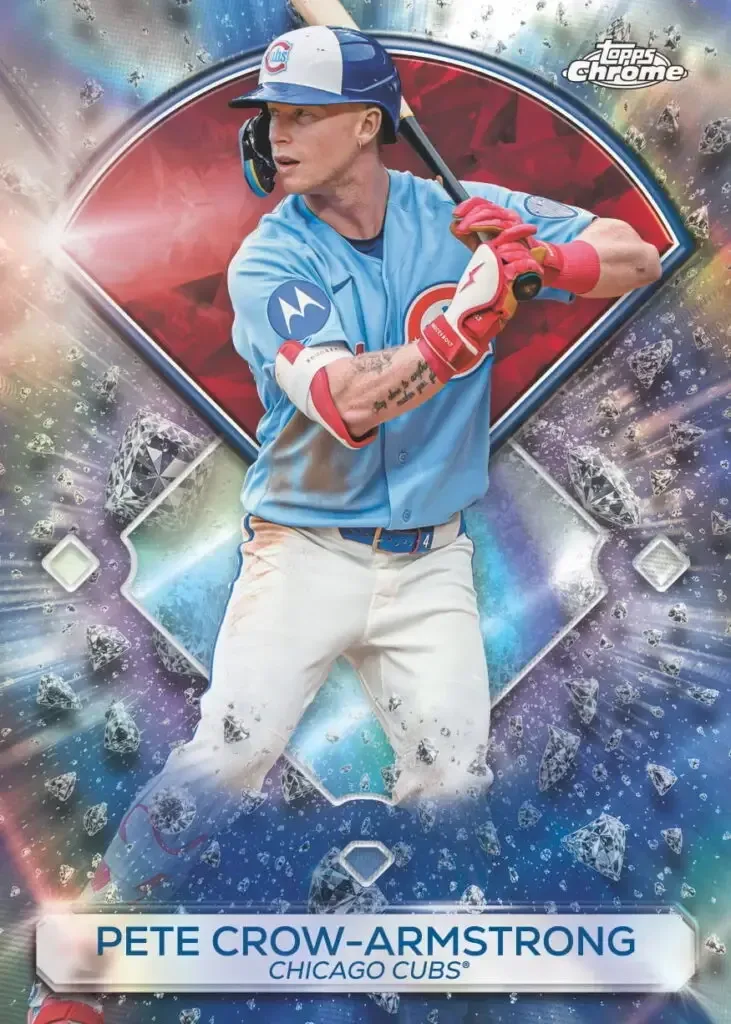
Two new insert programs are named for 2026. Glass Canvas is a retail-exclusive insert with 20 past and present players, including six leading rookies. “Retail-exclusive” means the insert is assigned to retail product rather than every form of the release, an important detail for collectors choosing where to look. The other newcomer is Diamond Impact, a 30-card insert mixing top rookies and veterans.
Those additions give the set a less intimidating route for collectors who do not expect to land a one-of-one. The rookie patches may set the news cycle, but insert themes can define the look and feel of a binder, team collection, or player collection. They can also bring veteran stars into a release whose headline narrative is naturally rookie-heavy.
What the reduced patch count means—and what it does not
The clearest confirmed change is numerical: the Rookie Debut Patch Autograph total is below 200, after two consecutive years above 250. That makes the 2026 release more selective in this one centerpiece category. It does not, by itself, reveal pack odds, total product output, or the future market value of any individual card. Those are separate questions, and collectors should avoid treating the reduced patch total as an answer to all three.
What is clear is that the set remains structured around several layers of interest. At the very top are the one-of-one debut patches, led by Misiorowski and supported by a substantial group of rookie names. Below and alongside them are themed autographs, duals, triples, and inserts that include veterans, legends and new talent. That combination is why Topps Chrome Update remains a major late-season baseball-card release: it is not one checklist lane, even when one card type commands most of the spotlight.
Pre-orders have begun ahead of the Dec. 9 release. For collectors planning their approach, the most useful first step is to identify the exact lane they enjoy: a player, team, autograph theme, rookie class, retail-only insert, or the Rookie Debut Patch chase itself. The full checklist is the practical tool for verifying which names appear in each category before committing to a particular pursuit.