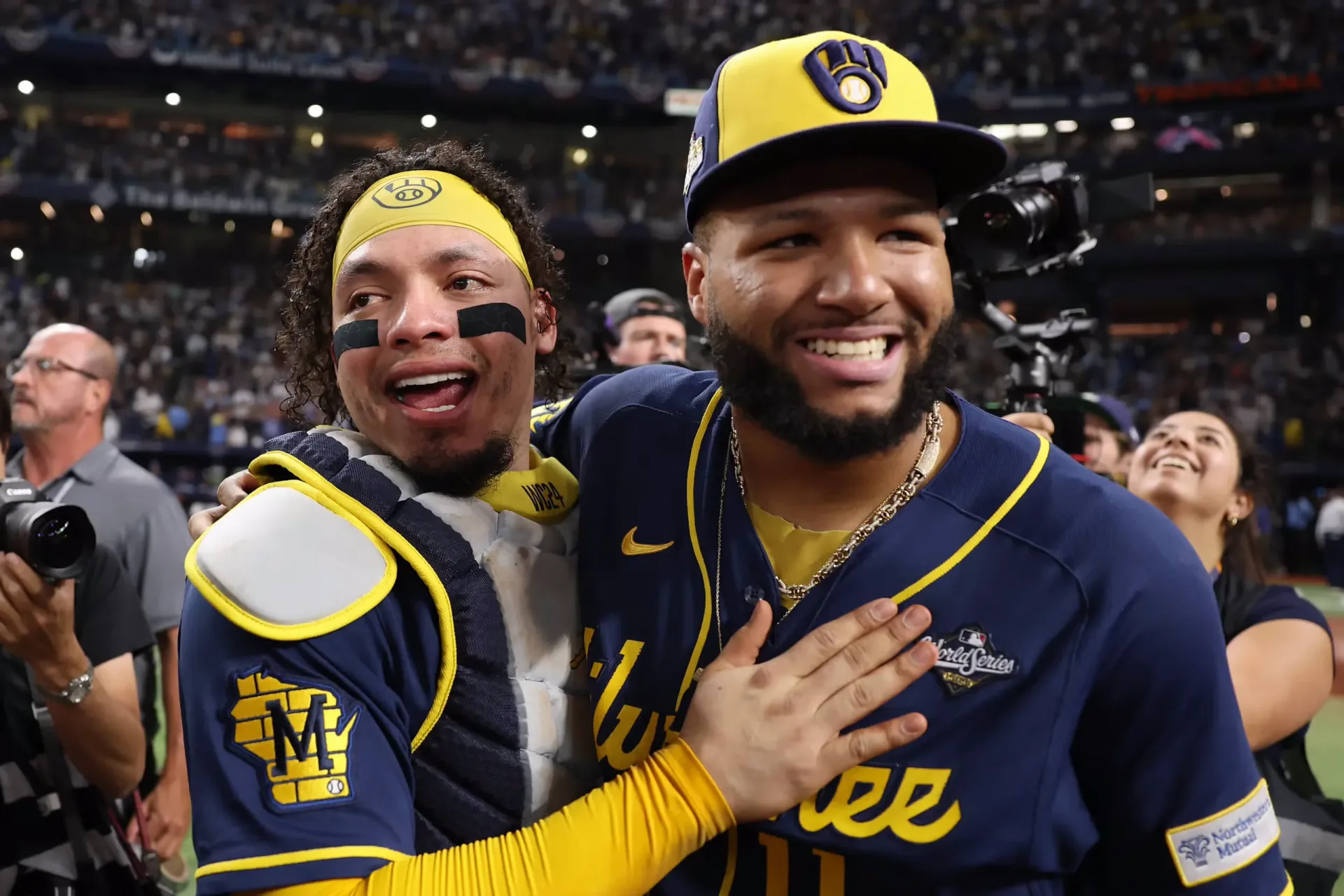
Milwaukee’s first World Series championship has given the baseball-card market two sharply different, but equally compelling, collecting stories: World Series MVP William Contreras and dominant young starter Jacob Misiorowski.
Contreras, 28, supplied the headline performance. The catcher batted .381 in the series, threw out four attempted base-stealers and earned World Series MVP honors. Misiorowski, 24, made a powerful case of his own from the mound, winning both of his starts while recording a 0.84 ERA and 0.75 WHIP in the series. Their cards were already available across multiple Bowman and Topps products, but the championship has focused far more collector attention on scarce autographs, serial-numbered parallels and one-of-one issues.
The result is not one uniform price jump across every card. Instead, the clearest movement is concentrated in cards with the hobby’s familiar high-end signals: certified autographs, tiny print runs, rookie-year connections, premium patches and third-party grades. That distinction matters for collectors considering what the eye-catching sales actually say—and what they do not say—about a player’s wider catalog.
A historic title gives the cards a bigger story
Milwaukee’s championship carries unusual franchise and city history. The club began as the Seattle Pilots in 1969 before relocating to Milwaukee in 1970, making this its first World Series title. For the city, the wait reaches back even further: the Milwaukee Braves won the 1957 World Series before eventually moving to Atlanta in 1965.
That context adds a layer beyond individual statistics. A catcher who wins MVP while helping deliver a first title for the present franchise is connected to a landmark moment that collectors can easily identify on a card label, autograph or game-used relic. Misiorowski’s two victorious World Series starts place him in the same championship narrative, even though the MVP award went to his batterymate.
There is also a Contreras family parallel. William’s older brother, Willson Contreras, was the catcher for the Cubs when Chicago ended its own 108-year championship drought in 2016. Willson was a rookie call-up that season and batted .282 with 12 home runs in 76 games, although he had a much rougher World Series at the plate, going 2-for-19. A decade later, William turned his World Series opportunity into a defining performance of his own.
William Contreras: the MVP premium is showing up in scarce cards
Before the championship, Contreras was not short on cards, but some collectors viewed him as comparatively under-collected relative to his ability. The recent completed sales point to a familiar response after a signature October performance: the biggest attention has gone to cards where scarcity is immediately legible.
- An autographed 2021 Topps Chrome Superfractor rookie card, numbered 1/1 and graded BGS 8.5, sold through a Buy It Now listing for $4,229.
- A signed 2021 Topps Inception insert with a Nike logo patch, graded BGS 9 with a 10 autograph grade, sold for $3,499 via Buy It Now.
- An ungraded, autographed 2026 Topps Update 1/1 designed in the style of the 1991 Topps set brought $1,600 on 10 bids.
- An ungraded signed 2026 Topps Update Gold 1/1 reached $1,583 across 25 bids.
- A signed 2018 Bowman Chrome Orange Refractor, numbered 2/25 and graded BGS 9.5 Gem-Mint, sold for $1,404 on 35 bids.
- A PSA 9 2021 Topps Inception Silver Signings 1/1 sold for $1,400. Contreras inscribed it “Killer the Beast,” a reference to two of his nicknames.
- An ungraded 2023 Topps Chrome Sapphire Padparadscha 1/1 sold for $1,325 on 22 bids.
Several elements overlap in these sales. A Superfractor is generally a one-of-one card in a Chrome-style parallel hierarchy, while a card marked #1/1 has a stated print run of one. Neither term automatically makes every one-of-one interchangeable with another, however. Set, year, autograph status, condition, image, memorabilia component and collector taste can all create substantial variation.
Related coverage includes William Contreras and Jacob Misiorowski Cards Surge After Brewers’ World Series Win.
The same principle applies to the orange card numbered 2/25. A refractor is a parallel with a reflective finish; an orange version commonly denotes a lower-numbered tier within a product’s parallel lineup. Here, the card combines a 25-copy serial number, an autograph, an early Bowman Chrome issue and a BGS 9.5 grade. That is a different package from an ungraded modern 1/1, even when the latter has a smaller stated print run.
Collectors should also read the sale format carefully. Buy It Now transactions show a completed fixed-price purchase. Competitive auction results reveal the number of bids but still describe one sale, at one point in time. A headline result can establish that a buyer paid that amount for that precise card; it does not establish a fixed value for every Contreras card, every copy of that parallel or even another copy with a different grade.
Where the wider Contreras catalog fits
More than 25,000 Contreras items are listed on eBay, a reminder that the market is much broader than the handful of premium cards above. That volume gives collectors room to choose a lane rather than treating a World Series MVP as an automatic reason to chase the highest-priced card available.
A collector interested in the on-field milestone may prefer a 2026 issue connected to the title season. Someone building an early-career run could focus on Bowman or 2021 rookie-era releases. An autograph collector may decide that a clean on-card signature matters more than a particular parallel color. And a collector who favors memorabilia cards may be drawn to the Inception Nike-logo piece, with the important caveat that its appeal comes from the combination of patch, autograph, grade and 1/1 designation—not merely from any one feature in isolation.
That focus on personal collecting goals can be especially useful amid a sudden surge. Recent sales show active demand at the premium end; they do not require collectors to assume that every listing carries the same level of interest or that a listing price will become a completed sale.
Misiorowski’s market is built around performance and prospect pedigree
Misiorowski arrives at the market from a different direction. Listed at 6-foot-7, he paired a fastball that regularly exceeds 100 mph with a breaking ball capable of troubling elite hitters. His 2026 regular season—16-5, a 1.80 ERA, 0.80 WHIP and 252 strikeouts in 174 2/3 innings—provided the performance foundation. Two World Series wins strengthened the championship case.
ERA, or earned run average, measures earned runs allowed per nine innings; a lower figure is better. WHIP stands for walks plus hits per inning pitched and is likewise generally read as a lower-is-better measure of baserunners allowed. Together with his strikeout total, Misiorowski’s season provides a concrete explanation for why collectors are viewing his cards through a high-ceiling lens.
His recent premium-card sales are on another scale from Contreras’ reported results:
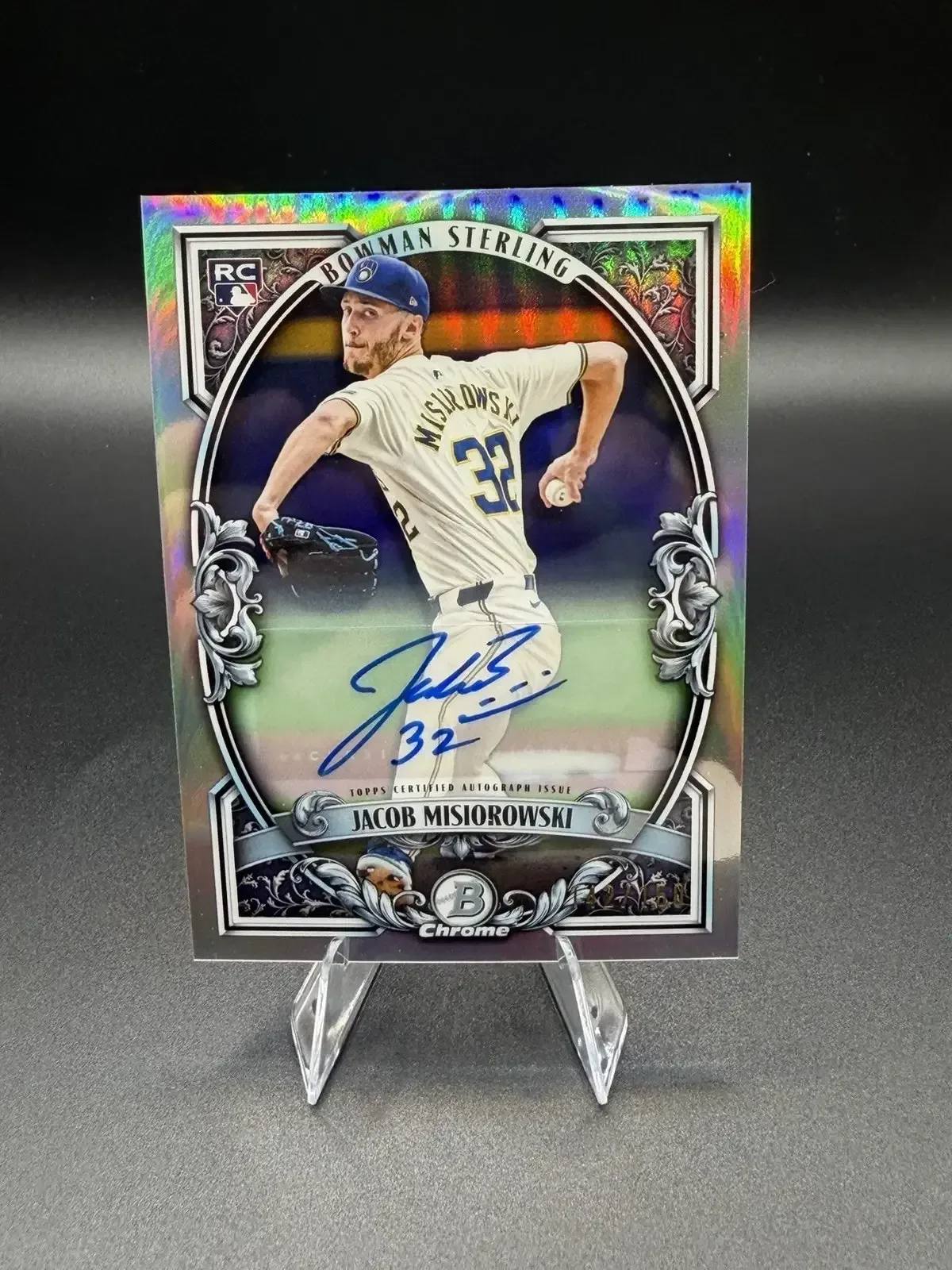
- A signed 2023 Bowman Orange Refractor, numbered 17/25 and graded PSA 10, sold via Buy It Now for $37,995.
- Three more PSA 10 copies of that same Orange Refractor sold for $27,995 for number 3/25, $26,000 for 7/25 and $25,000 for 14/25.
- An autographed 2026 Topps Chrome Black Superfractor 1/1, graded PSA 9, sold through Buy It Now for $32,000.
- A signed 2022 Bowman Gold, numbered 38/50 and graded PSA 10, sold for $20,000. Another PSA 10 copy, numbered 8/50, brought $18,200 on four bids.
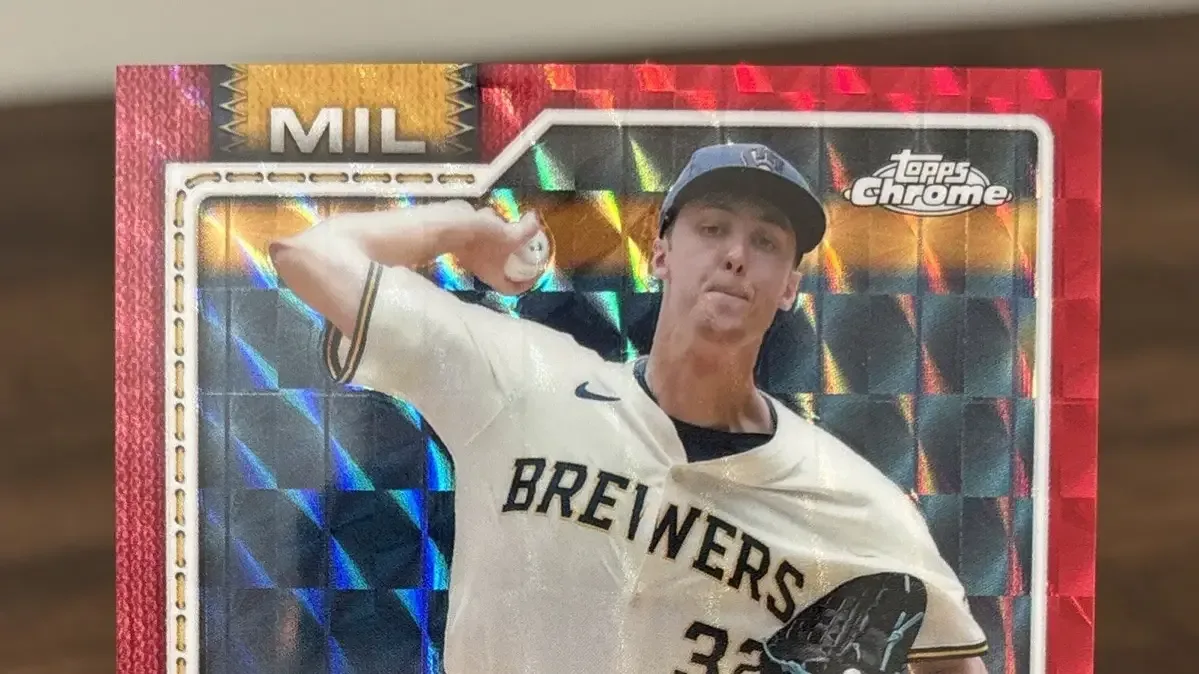
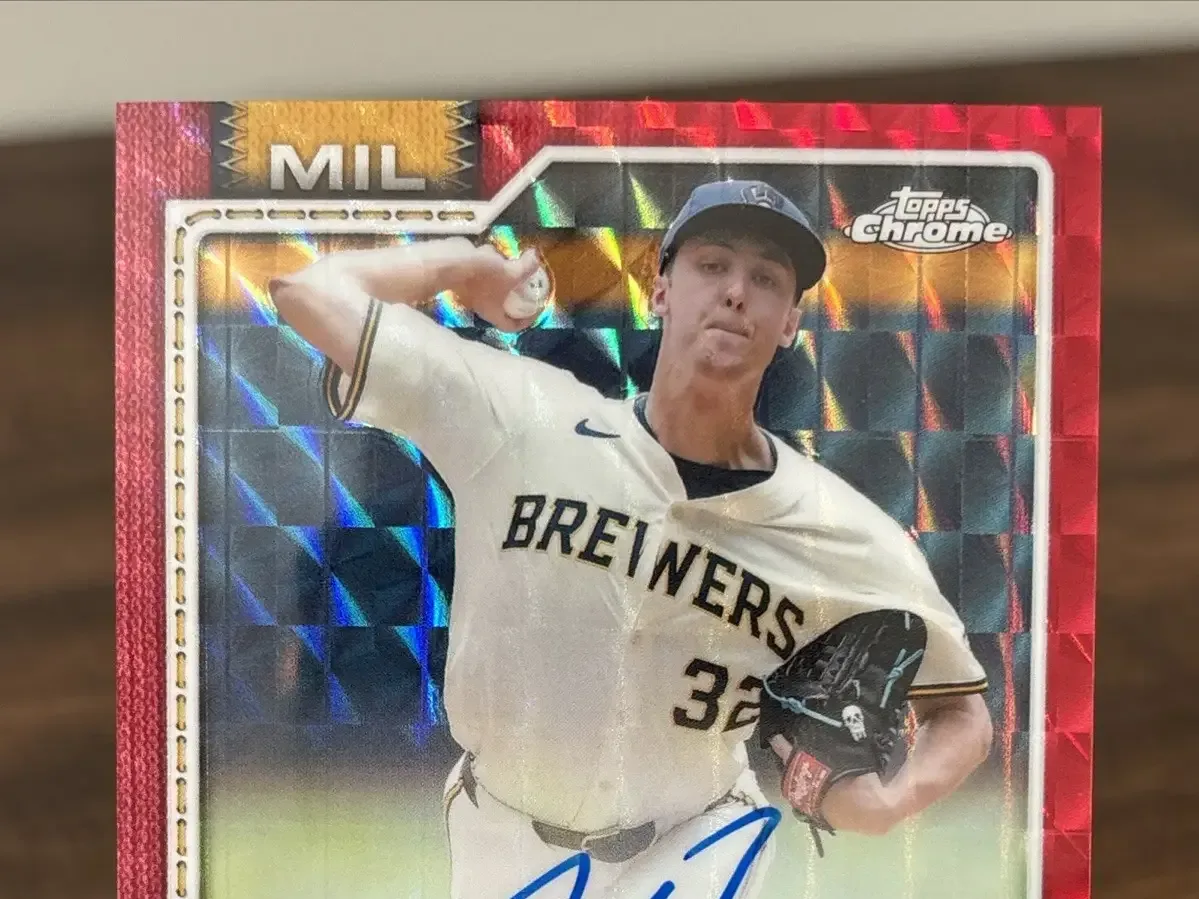
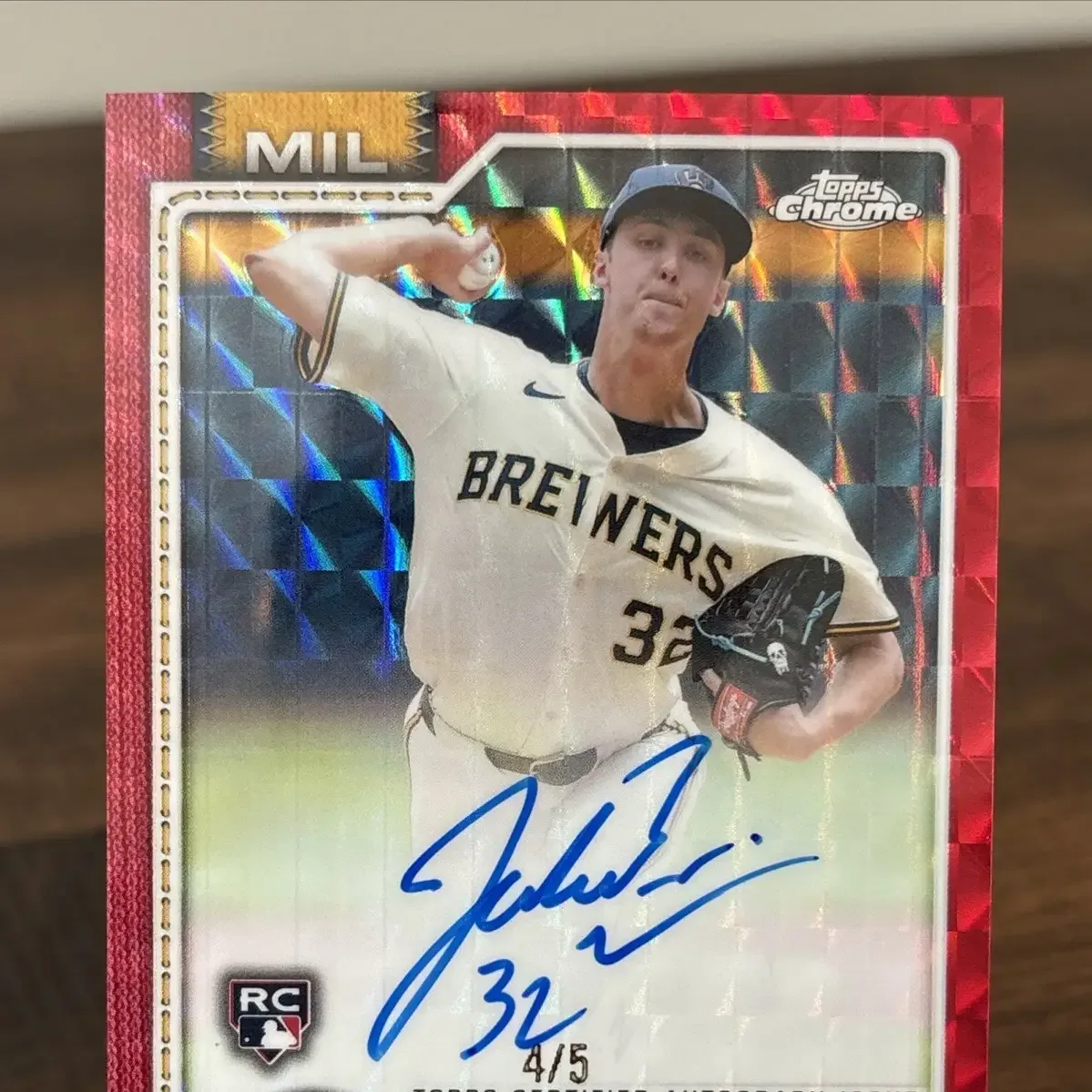
- An ungraded 2026 Topps Chrome Red Geometric Refractor, numbered 4/5, sold through Buy It Now for $14,500.
- A PSA 10 2026 Bowman Chrome Anime card, numbered 9/10, sold via Buy It Now for $10,500.
Those Orange Refractor outcomes are particularly notable because four different copies, all PSA 10s, changed hands at $25,000 or more. That does not erase the differences among serial numbers or sale methods, but it is more informative than a lone blockbuster result: it shows multiple buyers completing purchases within a comparatively narrow high-end range for the same limited parallel and grade.
Why the grade and serial number are not footnotes
A PSA 10 is the top numerical grade issued on PSA’s 1-to-10 scale. A BGS 9.5 Gem-Mint is a top Beckett tier. Grading evaluates the individual card’s condition, rather than certifying that every copy of a particular card is alike. Centering, edges, corners and surface can separate one copy from another, which is why the PSA 10 examples of Misiorowski’s Orange Refractor deserve to be compared with care rather than casually grouped with all 25 copies.
Serial numbers establish stated scarcity, but they are not a complete ranking system. A Gold card numbered to 50, for example, has more copies than a Red Geometric card numbered to five, yet demand can still differ based on the product, visual design, autograph, grade, player trajectory and how many examples are actually available. The reported sales show buyers assigning major value to several different Misiorowski formats, from prospect-era Bowman releases to current Topps Chrome cards.
There are more than 55,000 Misiorowski items listed on eBay, so the expensive sales should be viewed as the top layer of a much larger catalog. For collectors who cannot or do not want to participate at five-figure levels, that is meaningful. A player can have exceptional high-end cards without every base card, insert or less scarce parallel becoming scarce by association.
What collectors can take from the post-title spike
The immediate lesson is that championship visibility can accelerate demand, especially when it arrives with an MVP award, standout World Series pitching and an historic team achievement. Contreras and Misiorowski also illustrate two separate market hooks: the catcher’s MVP and first-title legacy, and the pitcher’s combination of overpowering stuff, elite season line and postseason victories.
The practical lesson is more measured. Compare identical cards where possible, check whether a reported number was a completed auction or Buy It Now purchase, and distinguish between a card’s asking price and a completed sale. Confirm the serial number, autograph status and grade before treating one comp as relevant to another. A 1/1 may be singular, but it is also difficult to price because there may be no exact prior sale for comparison.
For collectors who enjoy the broader mechanics of limited print runs, inserts and graded condition across different franchises, our trading-card coverage of other collectible releases offers a reminder that every category has its own supply, fandom and scarcity signals.
Milwaukee’s title has made Contreras and Misiorowski central figures in the baseball-card conversation. The completed sales establish real demand for their most desirable cards. The next question for collectors is not simply whether prices rose, but which specific card best fits the story they want to preserve: an MVP catcher’s rare rookie auto, a title-season one-of-one, a prospect-era pitcher parallel, or a more accessible card that still marks a remarkable championship run.