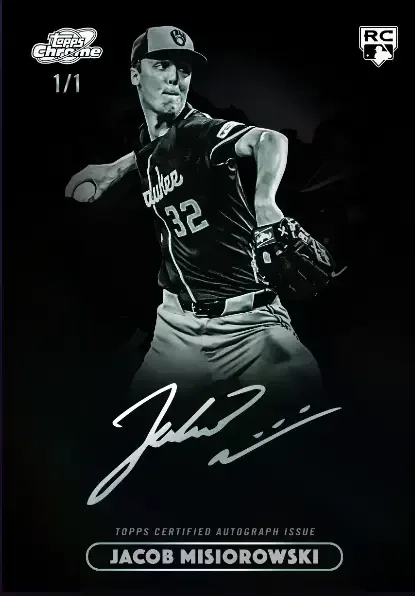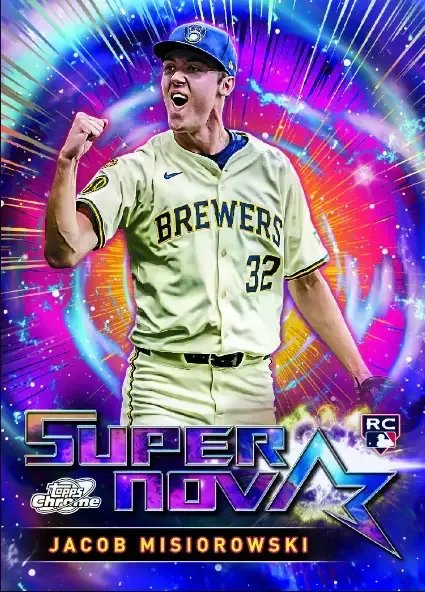
Topps Chrome Cosmic is set to add a collectible race to its usual pack-opening chase. A new Super Nova program gives collectors a route to a Black Hole Autograph 1-of-1 refractor, but the reward is not simply waiting in a pack for someone to pull it.
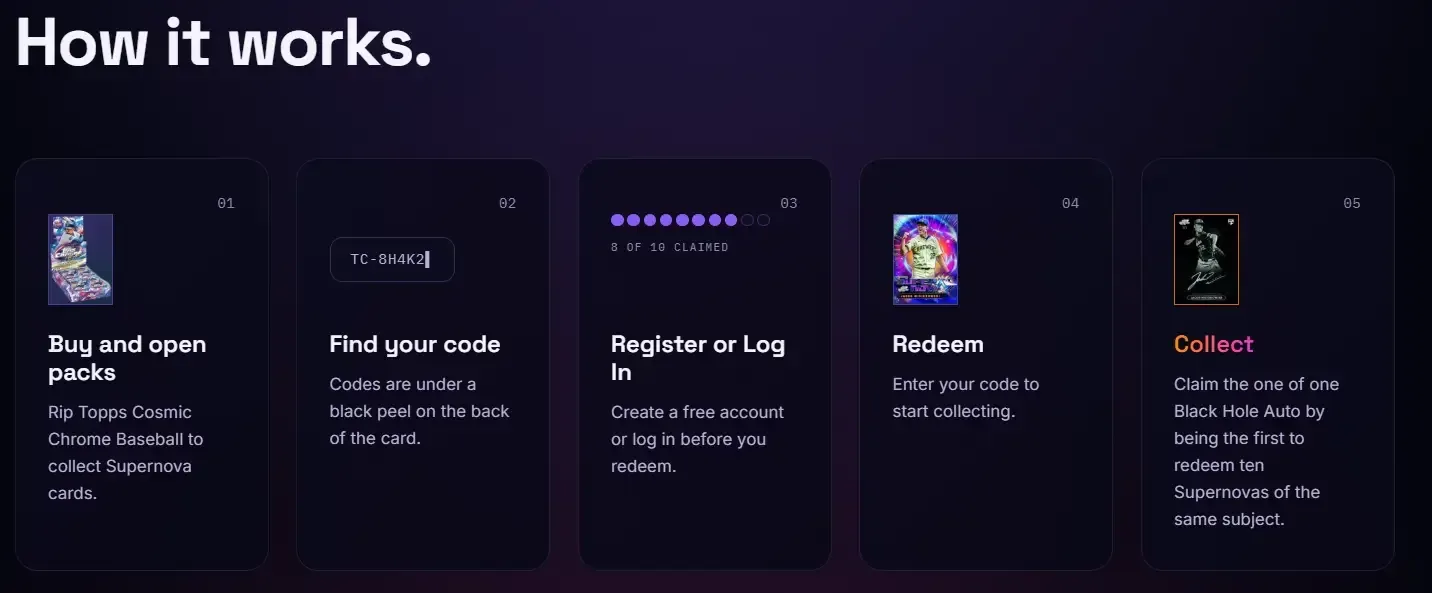
The premise is straightforward but demanding: collect 10 Super Nova inserts for the same player, reveal and enter the codes attached to those cards, and become the first participant to complete the requirement for that player. The winning collector can redeem the group for a one-of-one Black Hole Autograph of the corresponding player.
That turns a familiar card objective—building a run of the same insert—into a timed contest with a single grand reward. It also means that finding one Super Nova card is only the beginning. A collector needs nine more of the same subject, must register them properly, and must ultimately satisfy an ownership-verification step.
How the Super Nova-to-Black Hole chase works
Super Nova cards in the program carry a black peel. Collectors remove that peel to expose a code, then enter the code through Topps Ripped’s monitoring page. The page is intended to track each participant’s progress and show a player-specific leaderboard.
For more context, explore Claressa Shields Turns Gervonta Davis’ Outfit Criticism Into a Push for New Single ‘Party’.
For each eligible player, the first collector to register 10 Super Nova cards is positioned to claim the related Black Hole Autograph 1-of-1. Registration alone is not the end of the process. The collector also has to verify that the physical cards are in hand. Details on the required verification are expected to be sent by email.
The distinction matters. This is not described as a redemption in which a collector quietly accumulates cards and sends them in whenever convenient. The leaderboard creates a competitive order of completion, while the verification requirement is designed to connect the logged codes to actual cards held by the claimant.
A one-of-one, often written as 1/1, is a card produced as a single copy within its stated card version. In this case, the Black Hole Autograph is the unique prize attached to each player’s Super Nova race. An autographed refractor combines a player signature with a refractor-style card finish, a term generally used for cards with a reflective, light-shifting surface treatment.
Related coverage includes Topps Chrome Cosmic Super Nova Chase Offers Black Hole 1-of-1 Autos.
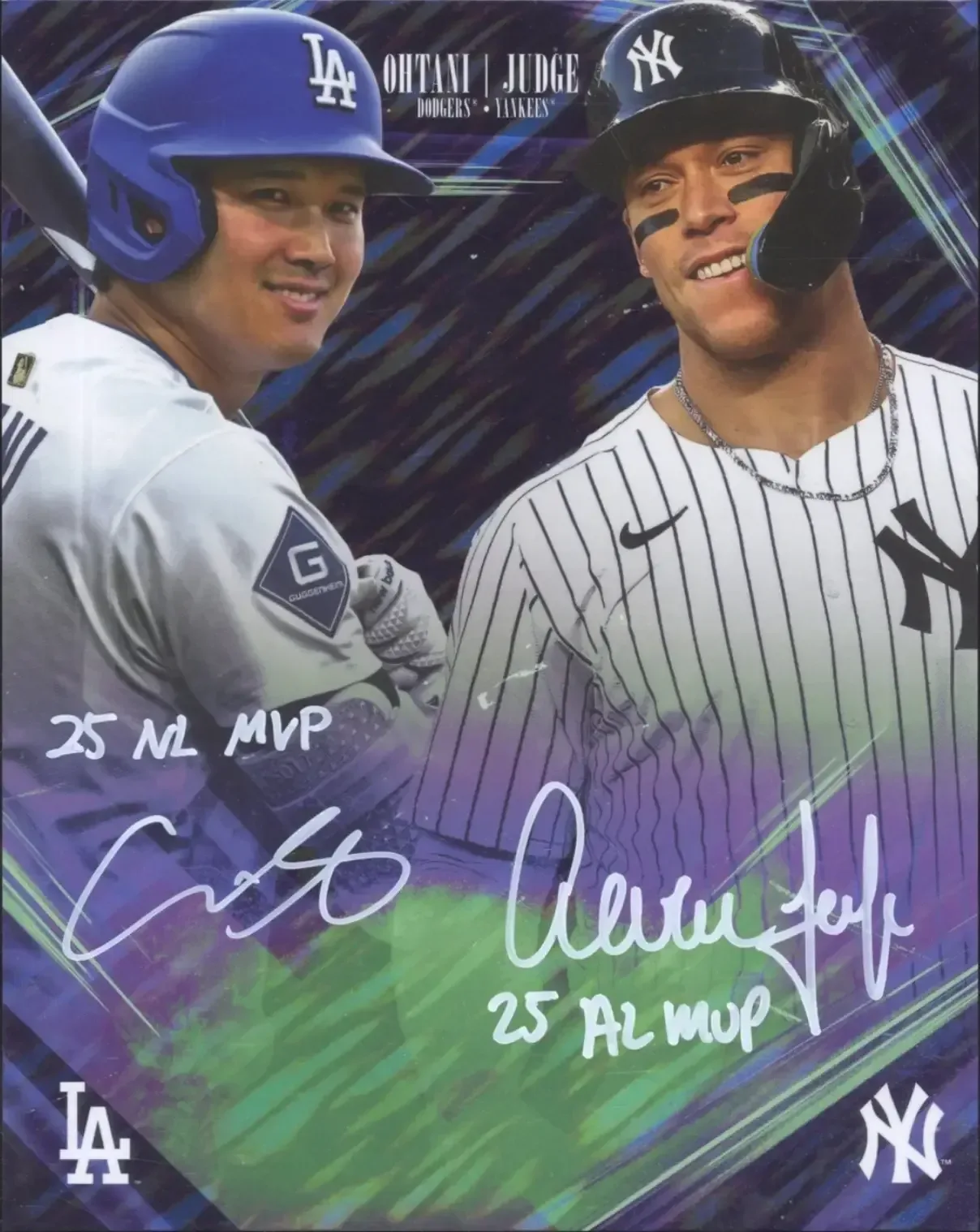
The program includes 25 player-specific targets. Each is its own race. Collectors pursuing Aaron Judge are not competing for the same Black Hole card as collectors pursuing Jacob Misiorowski, for example; they are trying to be the first to reach 10 registered Super Novas of their chosen player.
The 25 players in the program
The listed player pool spans established stars, current young talent and newer names, giving collectors several different collecting lanes rather than one universal checklist. The eligible players are:
- Aaron Judge
- Juan Soto
- Vladimir Guerrero Jr.
- Freddie Freeman
- Bobby Witt Jr.
- Mike Trout
- Shohei Ohtani
- Ronald Acuña Jr.
- Francisco Lindor
- Paul Skenes
- Bryce Harper
- Elly De La Cruz
- Julio Rodríguez
- Gunnar Henderson
- Junior Caminero
- Yoshinobu Yamamoto
- Nick Kurtz
- Trey Yesavage
- Chase Burns
- Nolan McLean
- Jacob Misiorowski
- Samuel Basallo
- Roman Anthony
- Jac Caglianone
- Munetaka Murakami
That design makes the player selection more than a checklist detail. Every card a collector acquires must match exactly within that player’s Super Nova group. Ten Judge Super Novas can pursue the Judge Black Hole Autograph, but mixing nine Judge cards with one Ohtani does not complete either player’s requirement.
Scarcity changes the challenge
The Super Nova inserts are not numbered on the cards, but the reported print run is 50 copies per player. If that figure holds across the full list, there are only 50 opportunities to acquire any one player’s qualifying Super Nova.
On paper, a 10-card requirement from a 50-card supply means the eventual winner needs one-fifth of a player’s entire Super Nova population. In practical terms, that is a substantial concentration task. The collector who gets to 10 does not merely find a rare insert; they assemble a large share of all copies made for that player.
There is an important wrinkle: the program is first to complete, not highest total at the end. A collector with eight registered cards could be close, but another participant who reaches 10 first takes the one-of-one prize. The leaderboards therefore make speed, tracking and communication central to the chase.
That could put particular attention on single cards that might otherwise be treated as a conventional short-print insert. A Super Nova card may have value as a collectible on its own, but its potential role in someone else’s 10-card completion target gives it additional strategic significance. The relevant question becomes not just “Which player is on the card?” but also “How many copies of that player have already been accumulated and registered by competing collectors?”
At the same time, a leaderboard can only show logged progress. It cannot necessarily reveal every unregistered copy that remains in a collection, is being held for trade, or has yet to surface. That uncertainty is part of the program’s tension: a collector may see an apparent path to 10 without knowing how many competitors are one step away from finishing.
What collectors should do before making a move
For collectors interested in the chase, the mechanics reward careful handling and recordkeeping as much as pursuit. The black peel and its code are critical to the registration process, so a card should be examined closely before its code is exposed. Once the code is entered, keep the card protected and retain clear records of where and when it was acquired.
Because physical ownership must be verified after a participant reaches 10, avoid treating the online total as a substitute for possession. The program information says the successful collector will need to establish that the cards are physically in hand, with additional verification instructions coming by email. Until those requirements are detailed, collectors should be cautious about arrangements where a card is not immediately available to them.
It is also sensible to distinguish the two things being collected. The Super Nova cards are the qualifying pieces. The Black Hole Autograph is the eventual one-of-one redemption reward. A collector who participates may value the Super Novas themselves, the possibility of winning the reward, or both—but the program’s rules make the first 10 properly logged cards the decisive factor.
Collectors should also monitor the official program page for any clarification about code entry, leaderboard status, verification and redemption steps. The supplied program details state a July 31, 2026 deadline and say the initiative runs for nearly 10 years or until all one-of-ones have been redeemed. Those points appear difficult to reconcile with the supplied November 2026 timing for the Chrome Cosmic release information, so the final official terms and dates deserve particular attention before anyone assumes how long a given player race remains open.
A redemption format built around participation
The Super Nova chase fits alongside other Topps and Fanatics approaches that turn cards into more than static collectibles. One cited example is Bowman’s Red Rookie Redemption program, in which select rookie cards with a red RC logo can be redeemed for Fanatics Fancash if the player wins Rookie of the Year. The potential payout can increase with additional player achievements, creating a choice between redeeming immediately and holding the card.
Topps has also used Rookie Debut Patch Autographed cards. Those cards include a patch worn by the player in their first professional game and began in baseball before similar concepts were used in other sports as licenses expanded.
The Super Nova initiative differs from those examples in a key way: it is fundamentally a completion race. The outcome is not tied to a future award vote or an athlete’s career milestones. It is tied to whether one participant can gather 10 qualifying cards of a specific player before anyone else, complete the digital logging process, and pass the physical-card verification stage.
For the wider market, the program creates an unusual situation in which copies of an unnumbered insert can become highly consequential because of a separate, limited redemption. The card’s printed numbering is not what establishes its scarcity here; the reported 50-copy supply and the 10-card threshold do. That is why understanding the checklist, the code process and the leaderboard is as important as recognizing the card design.
Topps Chrome Cosmic collectors now have a chase that is equal parts insert hunt, set-building exercise and race-management problem. The Black Hole Autographs may be the headline prizes, but the pivotal cards are the Super Novas: the 10 matching pieces required to reach them first.