The 1980s were a decisive decade for baseball cards. The hobby’s focus moved sharply toward young-player cards, with collectors treating rookies not only as keepsakes but as speculative purchases. That shift helped drive demand, and manufacturers answered it with immense production. The result is a decade that can look contradictory from a modern collecting perspective: many base cards are easy to find, yet particular designs, rookie classes, premium editions and truly high-grade examples remain intensely desirable.
That is why an iconic set is not simply the one with the biggest single sale. A release can matter because it introduced a recognizable visual language, established a brand’s reputation, produced a major rookie, or captured the excesses of the so-called Junk Wax Era. That term refers to the mid-to-late 1980s period when cards were printed in vast quantities. It does not mean every card from the period is worthless; it means supply is a central factor when judging standard issues.
These eight sets best map the decade’s defining ideas: the growing stature of rookies, the emergence of premium factory-set editions, the collecting appeal of errors and variations, and a major late-decade leap in production quality. Values cited here are reported sales for cards in PSA 10, the top grade from Professional Sports Authenticator, unless noted otherwise. A PSA 10 premium is not a promise that every copy is valuable. It is evidence that condition can be the dividing line between a common card and a significant one.
8. 1986 Topps Traded: a factory-set rookie powerhouse
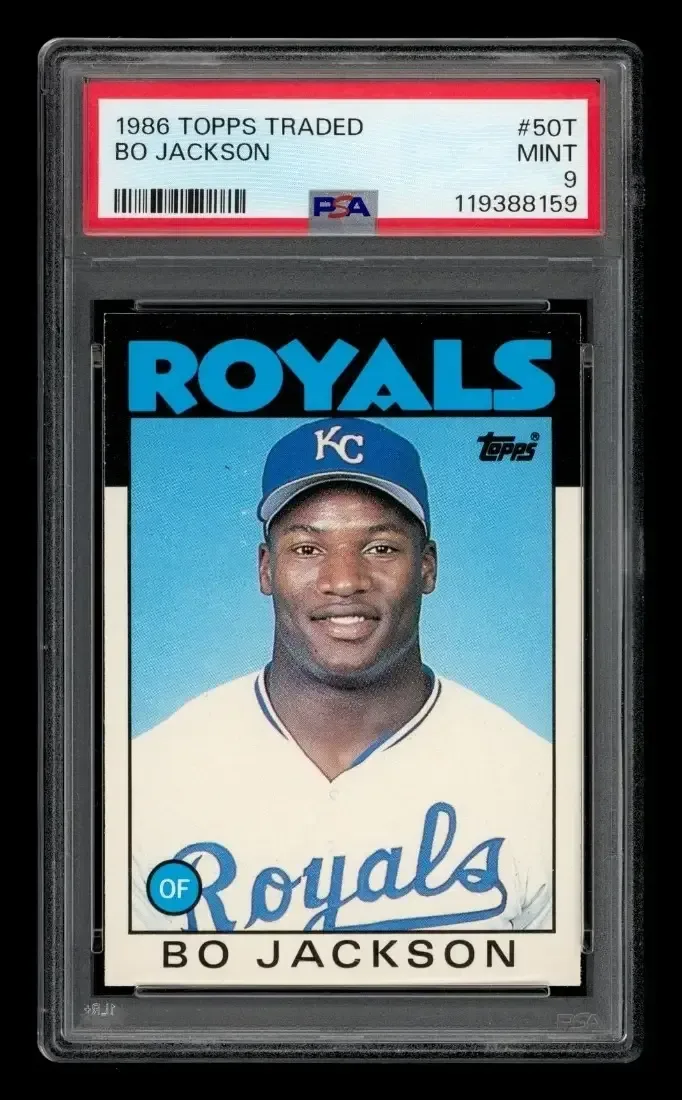
1986 Topps Traded earns its place through sheer rookie strength. Barry Bonds, Bo Jackson and Jose Canseco lead the checklist, joined by Will Clark, Andres Galarraga and Kevin Mitchell. That collection puts several defining names of the following baseball era into one release.
It also had a different distribution model from the regular Topps set. Topps Traded was issued as a factory set rather than sold in packs, making it a distinctive object for collectors who remember the period. Its black-and-white borders are immediately identifiable but present a practical collecting challenge: dark borders make edge and corner chipping conspicuous. In grading language, condition sensitivity means a design or production trait makes flawless copies harder to find. Here, small defects can be especially visible, helping explain demand for top-grade cards.
Reported PSA 10 sales include Bo Jackson #50T at $2,100, Bonds #11T at $881 and Canseco #20T at $264. The more scarce 1986 Topps Traded Tiffany edition pushes the contrast much further. Estimated at 5,000 sets, the glossy Tiffany version was markedly scarcer than typical era cards. Reported PSA 10 sales of Tiffany Jackson, Bonds and Canseco were $25,500, $20,200 and $2,275 respectively.
7. 1989 Fleer: errors, variations and an elite rookie group
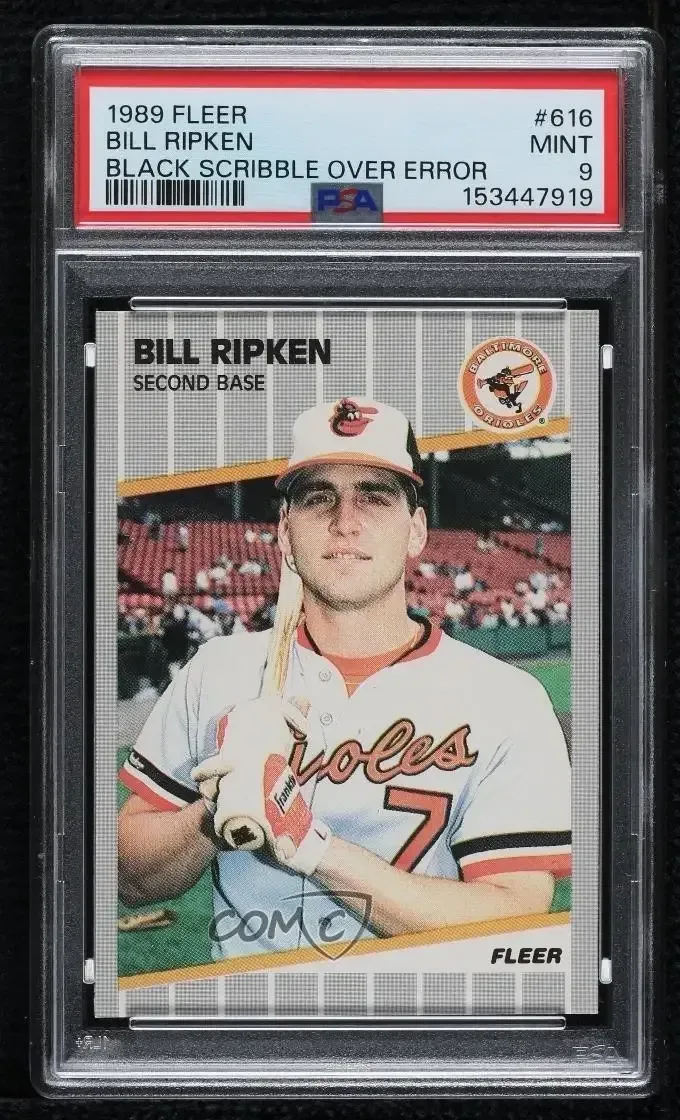
1989 Fleer is a reminder that a set’s story can be as important as its cleanest card. Billy Ripken #616 became an enduring error-card phenomenon because of an obscenity visible on the knob of his bat. Randy Johnson’s rookie has its own famous variation involving a Marlboro advertisement in the background. These are not merely checklist details: they gave collectors a reason to study versions of cards that might otherwise have blended into a massively produced late-1980s release.
The rookie lineup gives the set a sturdier foundation than novelty alone. Ken Griffey Jr., Randy Johnson, Gary Sheffield, Craig Biggio and John Smoltz all appear as rookies. Reported PSA 10 figures include $1,300 for the Billy Ripken FF error, $538 for the Randy Johnson Marlboro variation and $425 for Griffey #548.
Fleer also issued a Collector’s Edition Glossy set in sealed display tins, with an estimated print run of around 30,000. The glossier cards were the scarcer alternative to the base release, and a PSA 10 Glossy Griffey rookie reportedly sold for $8,100. For collectors, it is a useful case study in why “1989 Fleer Griffey” is incomplete shorthand. Base, glossy, errors, variations and grade all matter.
6. 1984 Topps: Mattingly and an unusually memorable layout
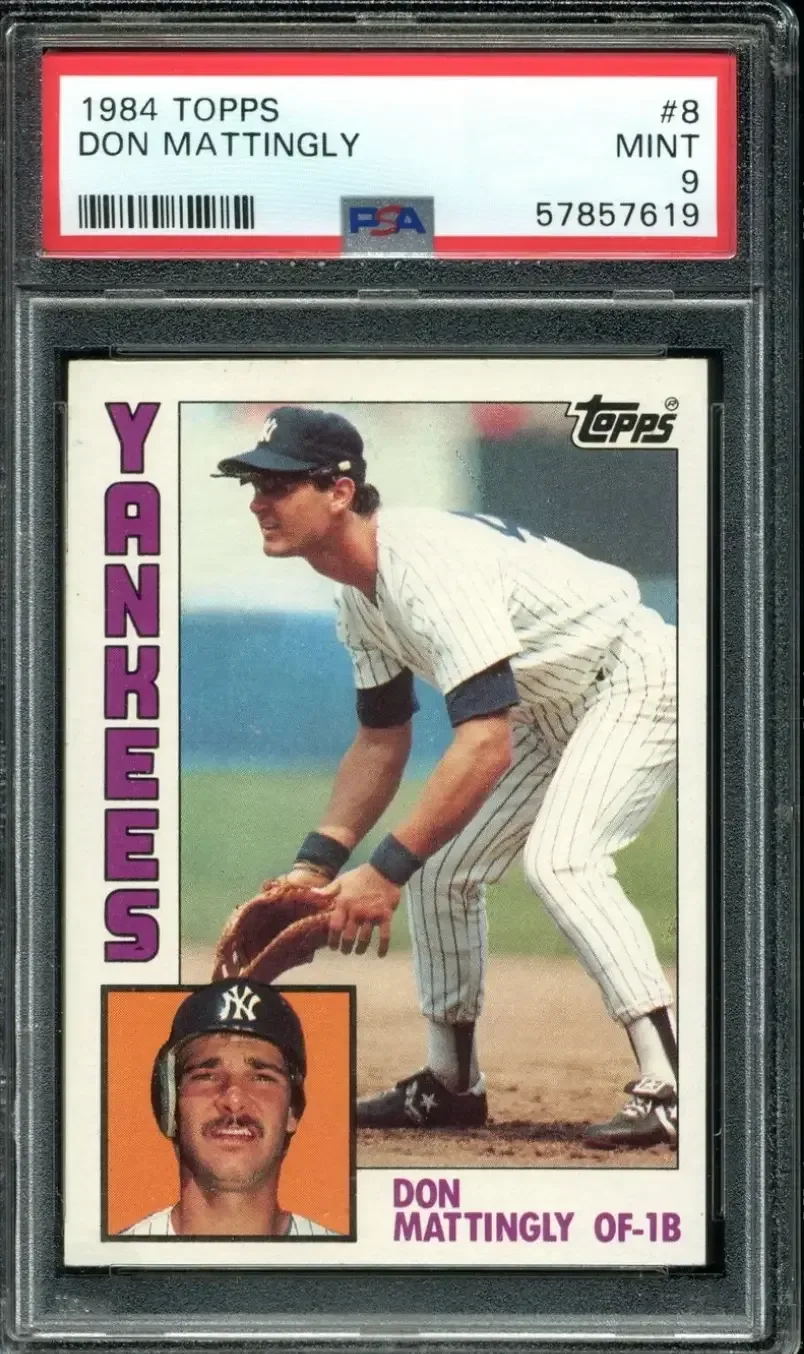
The 1984 Topps set is closely tied to Don Mattingly’s rookie card, #8. As Mattingly became one of the major stars of the middle of the decade, that card became a centerpiece for many collectors. But the set is more than a one-card story. The layout uses vertically placed team names, an action image and a smaller portrait, a combination that makes the issue easy to recognize at a glance.
Reported PSA 10 sales put Mattingly #8 at $2,086, Nolan Ryan #470 at $1,500 and Darryl Strawberry’s rookie #182 at $354. The 1984 Tiffany set, officially branded Collector’s Edition, is equally important to the decade’s broader evolution. It was Topps’s first high-end counterpart to its mass-market base set, issued as factory sets rather than packs and estimated at 10,000 sets. A PSA 10 Tiffany Mattingly last sold for $11,800.
The base-versus-Tiffany divide illustrates a recurring 1980s lesson: the same player and basic card design can exist at very different scarcity levels. Identifying the edition before assigning a value is essential.
5. 1985 Topps: a clean design at the heart of rookie-card fever
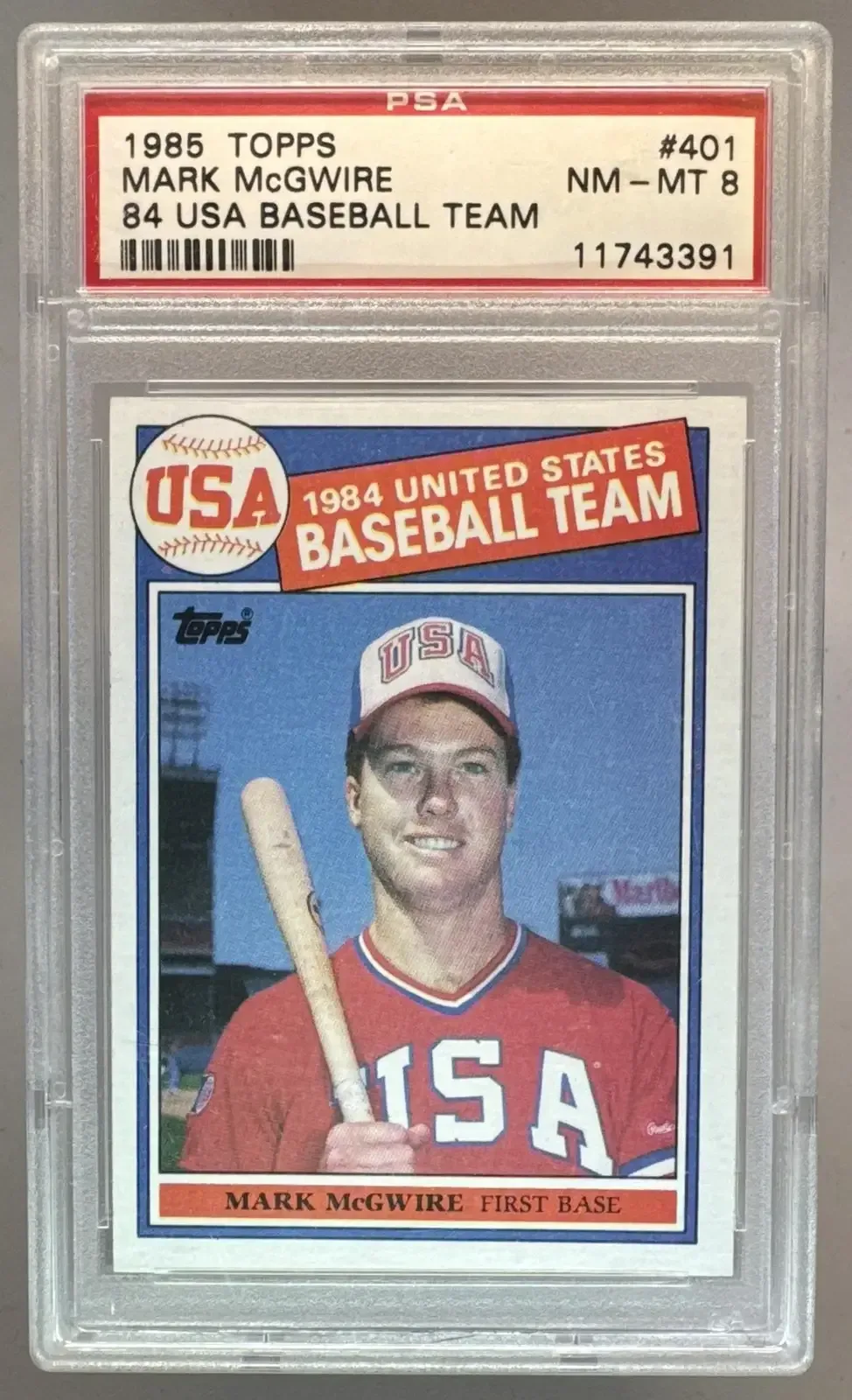
White borders and a colorful team-name banner give 1985 Topps one of the decade’s most enduring designs. The release arrived as rookie cards were increasingly seen as financial assets, and Dwight Gooden’s rookie was a focal point of the collecting world. The checklist also carries Mark McGwire’s Team USA rookie, Roger Clemens, Kirby Puckett and Gooden—an unusually strong group of names.
Among reported PSA 10 prices, McGwire #401 sits at $5,325, Clemens #181 at $2,190, Puckett #536 at $1,737 and Gooden #620 at $1,000. McGwire’s card has had renewed attention at different moments, including the 1998 home-run chase and more recent interest in 1980s and 1990s nostalgia.
As with 1984, Tiffany is the decisive premium version. The 1985 Topps Tiffany set had glossy fronts, brighter colors and an estimated run of about 5,000, compared with several million standard cards. Reported PSA 10 sales of Tiffany McGwire and Clemens were $26,900 and $22,600. The figures underscore two separate drivers of value: limited edition supply and preservation quality.
4. 1983 Topps: star rookies before the overproduction surge
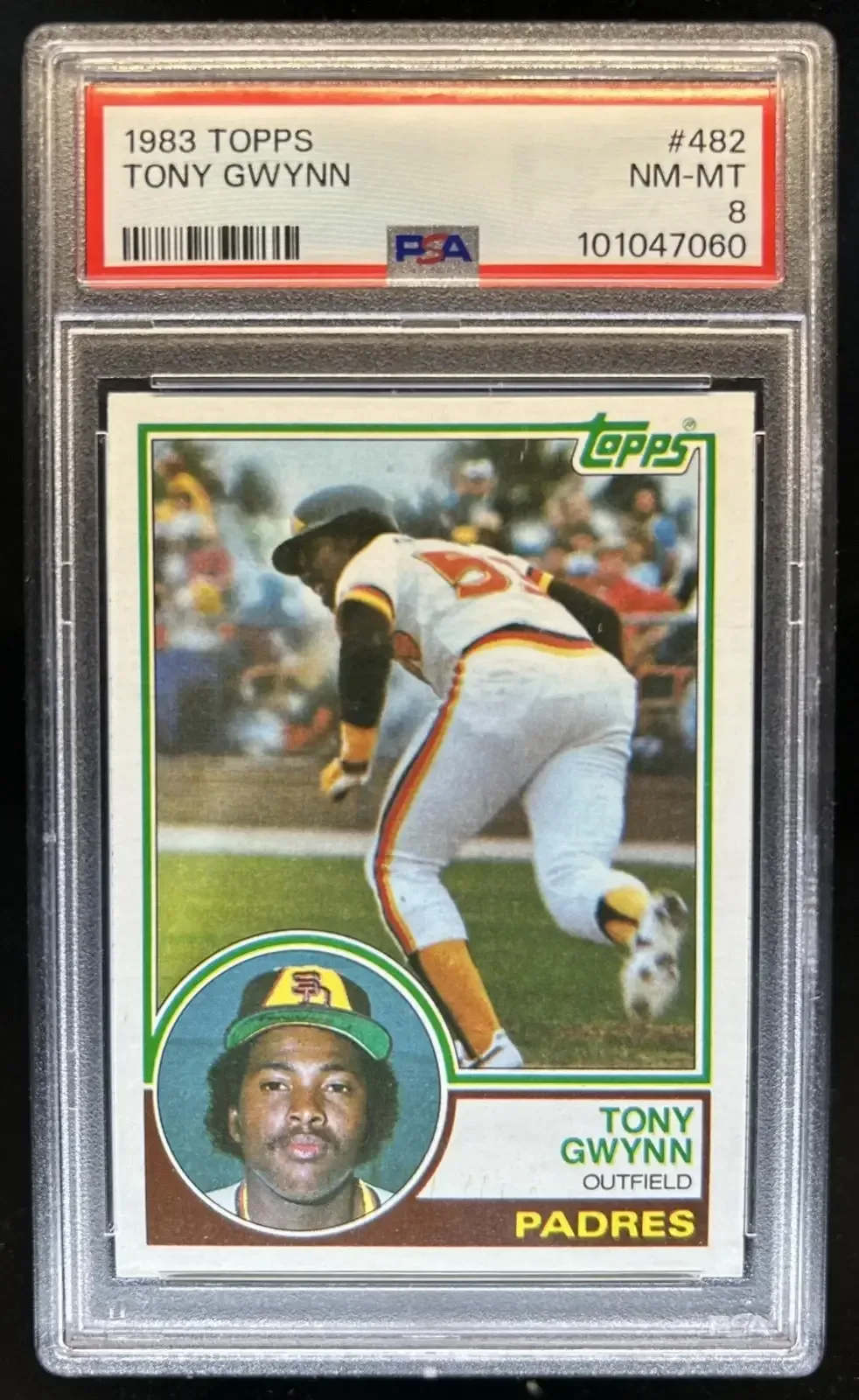
1983 Topps combines an admired design with three major rookie cards: Tony Gwynn #482, Wade Boggs #498 and Ryne Sandberg #83. The small circular secondary photo deliberately recalls the look of 1963 Topps, giving the set a visual identity that feels both retrospective and unmistakably of its own era.
Its timing matters. The release predates the greatest production expansion of the mid-to-late 1980s, which helps explain why its cards have retained more value than many later standard issues. That factor should not be oversimplified into “older equals scarce,” but it is meaningful context when comparing 1983 Topps with the heavily printed products that followed.
Reported PSA 10 sales place Gwynn at $8,655, Boggs at $5,385 and Sandberg at $2,999. The checklist’s strength is unusually clear: all three rookies belong to first-ballot Hall of Famers. For someone building an 1980s rookie-focused collection, it is one of the most concentrated and historically resonant Topps releases.
3. 1984 Donruss: the Rated Rookie era starts here
1984 Donruss helped establish Donruss as a serious alternative to Topps. Its portrait-oriented approach, perceived quality and more limited availability made it especially desirable in its day. Most importantly, it introduced the Rated Rookie branding that remains associated with Donruss.
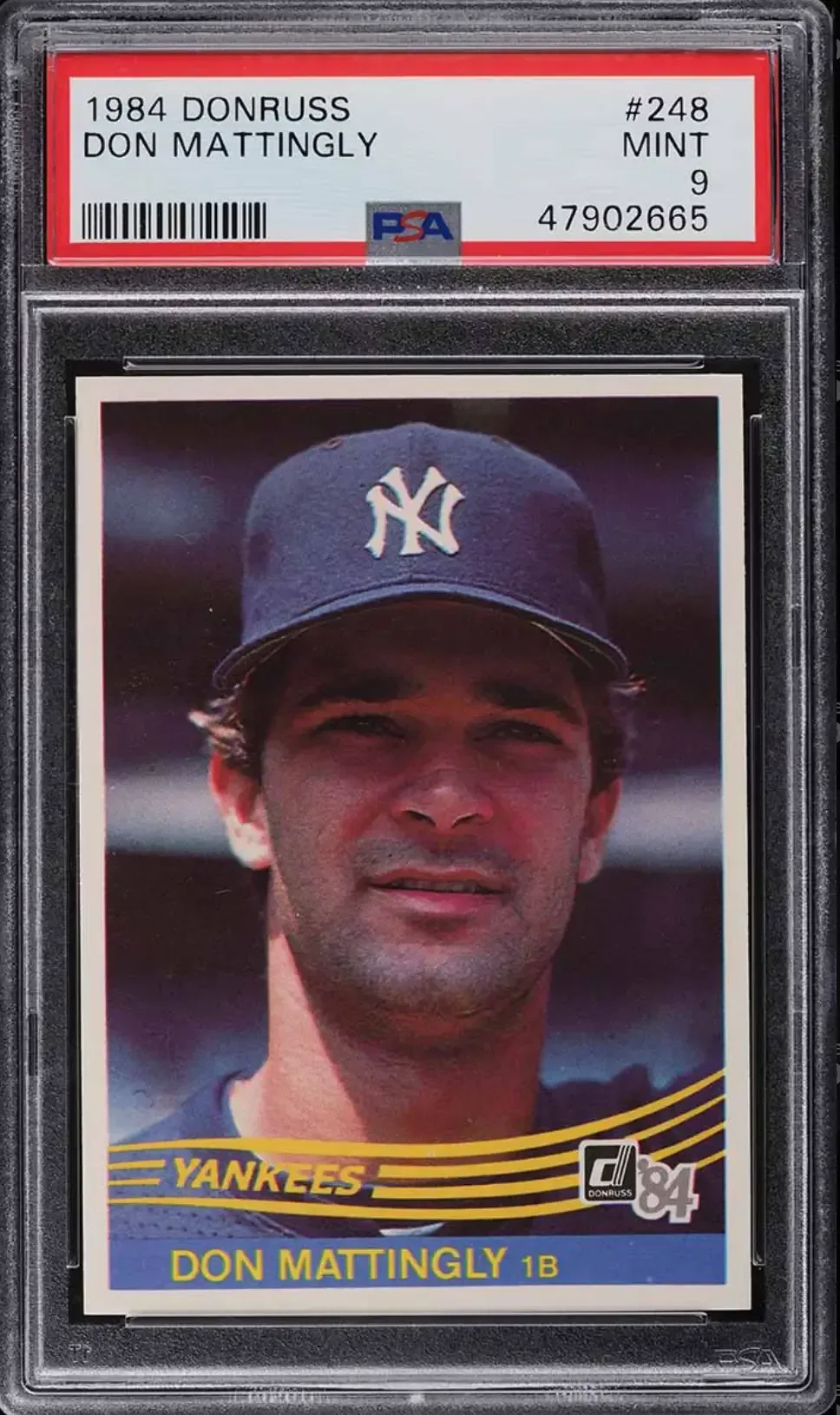
The most important irony is that the set’s defining card—Don Mattingly #248—does not carry the Rated Rookie label. Mattingly had major rookie cards in Topps and Fleer in 1984 as well, but his Donruss issue became the most sought-after of the three and is a strong candidate for the signature card of the decade.
Condition separates copies dramatically. A PSA 9 Mattingly reportedly sold for $380, while a PSA 10 recorded $9,455, nearly 25 times as much. That gap makes grading a central consideration, not an afterthought. Reported PSA 10 prices also include $9,261 for Mattingly, $430 for Darryl Strawberry #68 and $400 for Joe Carter’s Rated Rookie #41. A collector should distinguish between the pleasure of owning a clean raw example and pursuing a grade-driven investment-grade copy; they are related but very different objectives.
2. 1987 Topps: the wood-grain face of Junk Wax
For many collectors, 1987 Topps is the visual shorthand for 1980s baseball cards. Its wood-grain borders drew inspiration from 1962 Topps, but the design became synonymous with the later Junk Wax Era in its own right. It has the aesthetic familiarity and rookie checklist needed for true icon status, even if most base cards are plentiful.
Barry Bonds #320, Bo Jackson #170 Future Stars, Mark McGwire #366, Barry Larkin and Rafael Palmeiro headline an expansive rookie crop. Yet an estimated 2.5 million copies of each card were produced, explaining why ordinary copies commonly remain affordable. Reported PSA 10 results are $1,025 for Bonds, $260 for Jackson and $208 for McGwire.
The 1987 Topps Tiffany edition is the answer for collectors seeking substantially scarcer versions without abandoning the famous wood-grain design. About 30,000 factory sets were produced. That is a high number in isolation, but remarkably limited against the base-set scale. Reported PSA 10 Tiffany sales include $5,800 for Bonds and $1,830 for Jackson.
1. 1989 Upper Deck: premium presentation changes the conversation
1989 Upper Deck stands at the top because it changed the expectations around a mainstream baseball-card release. The company used high-quality white cardstock, elevated photography and holographic seals on the back, moving away from the flimsier cardboard associated with traditional products. Its original 99-cent pack price was more than double the 45-cent price of a 1989 Topps pack, a direct signal that presentation had become part of the product’s appeal.
Ken Griffey Jr.’s #1 Star Rookie is the set’s defining card and one of modern collecting’s most recognizable images. Placing Griffey first on Upper Deck’s inaugural checklist became a consequential decision: the card became the company’s face as well as a hobby landmark. Randy Johnson, John Smoltz and Gary Sheffield add further rookie depth, while the Dale Murphy #357 reverse-negative error supplies a notable variation chase.
Reported PSA 10 prices list Griffey at $5,000, the Murphy reverse negative at $2,000 and Randy Johnson #25 at $307. Griffey’s demand has even encouraged some collectors to assemble runs spanning PSA grades 1 through 10, giving low-grade copies an unusual collecting purpose. One PSA 1 reportedly sold for $140.
The enduring lesson of these eight sets is that 1980s collecting is not a single market. A base card, a premium factory-set version, an error card and a pristine graded copy may share a player and year while serving entirely different collectors. Whether the appeal is Mattingly’s 1984 Donruss rookie, the familiar wood grain of 1987 Topps or Griffey’s Upper Deck debut, the best approach is to learn the edition, understand condition, and collect the specific version that fits the goal. For another corner of the hobby’s broad card landscape, see this look at a Marvel comic-card-related release.
Shop the products
Check current price, model and availability at the retailer.