Josue De Paula’s first major-league appearance gave baseball-card collectors a familiar prospect-market jolt: a promising player reached the Dodgers, attention accelerated, and his most desirable early cards changed hands at serious prices. The more interesting question now is not whether September 2026 produced a spike. It plainly did. It is whether collectors are looking at the beginning of a durable market or a period in which expectations have raced ahead of a still-unsettled role.
De Paula signed with the Dodgers as an international addition in 2022 and made his MLB debut on September 11, 2026. In that initial stint, he batted .323 with one home run and seven RBI. He stayed on the playoff roster, although he had only three plate appearances there. He is also listed fourth on MLB’s Top 100 prospect ranking, behind Jesús Made, Franklin Arias and Leo De Vries.
That is a potent combination for a card market: prospect status, a big-league debut, a strong small-sample offensive line and the visibility that comes with the Dodgers. It does not, however, settle the baseball question. The club’s outfield is currently crowded by Andy Pages, Teoscar Hernández and Kyle Tucker. A collector considering De Paula cards is therefore buying a talented player before his regular playing time is clear—not buying certainty.
The three sales that frame De Paula’s high end
Since De Paula has no rookie cards yet, the central cards in his market are his 2023 Bowman “1st” issues. A 1st Bowman designation identifies a player’s first Bowman prospect card, which often becomes a focal point for collectors well before a conventional rookie-card market forms. Within that group, autograph cards, low serial numbering and strong third-party grades concentrate attention and price.
For more context, explore Three Emerging Filmmakers on Why Short Films Still Matter: Proof of Concept, Imperfection and the Theater Experience.
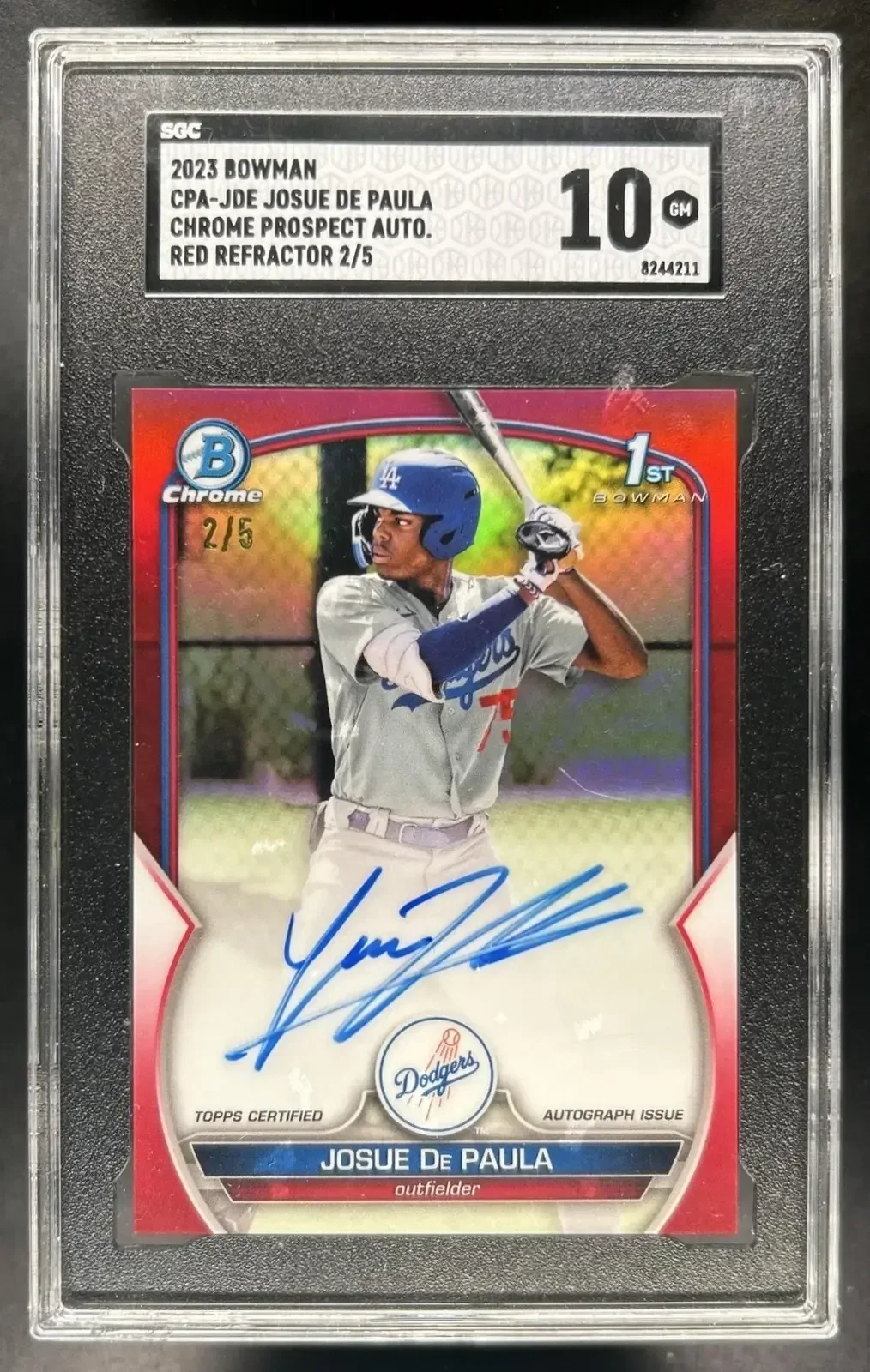
- 2023 Bowman Chrome 1st Auto Red Refractor, SGC 10: sold for $20,100 on August 25, 2026. This stands as De Paula’s highest reported sale.
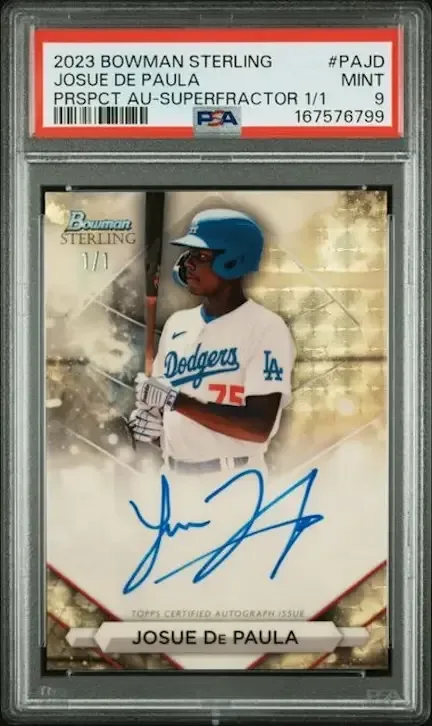
- 2023 Bowman Sterling Prospect Autographs SuperFractor, PSA 9: sold for $17,725 on September 17, 2026.
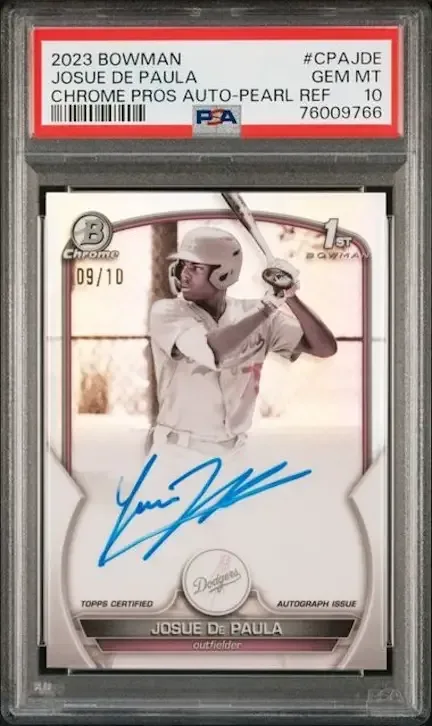
- 2023 Bowman Chrome 1st Pearl Refractor Auto /10, PSA 10: sold for $14,000 on September 10, 2026.
Each card is scarce, but scarcity is expressed differently. A Red Refractor is a color-parallel version of a Bowman Chrome card. A SuperFractor is generally the singular top parallel within that product’s configuration. The “/10” on the Pearl Refractor identifies a print run of 10 copies. An autograph adds another layer of desirability, while the SGC 10, PSA 10 and PSA 9 labels refer to assessments of the card’s physical condition and presentation by grading companies.
Those attributes help explain why these results sit at the top of the market. They should not be treated as a simple price guide for every De Paula card, though. A one-of-one-style SuperFractor sale and a perfect-grade, low-numbered autograph can attract buyers whose priorities are rarity, registry-grade condition or a desire to own a flagship copy. Their hammer prices show demand for the best examples; they do not establish that a more attainable base prospect card carries the same level of demand.
What the player index says—and what it cannot say
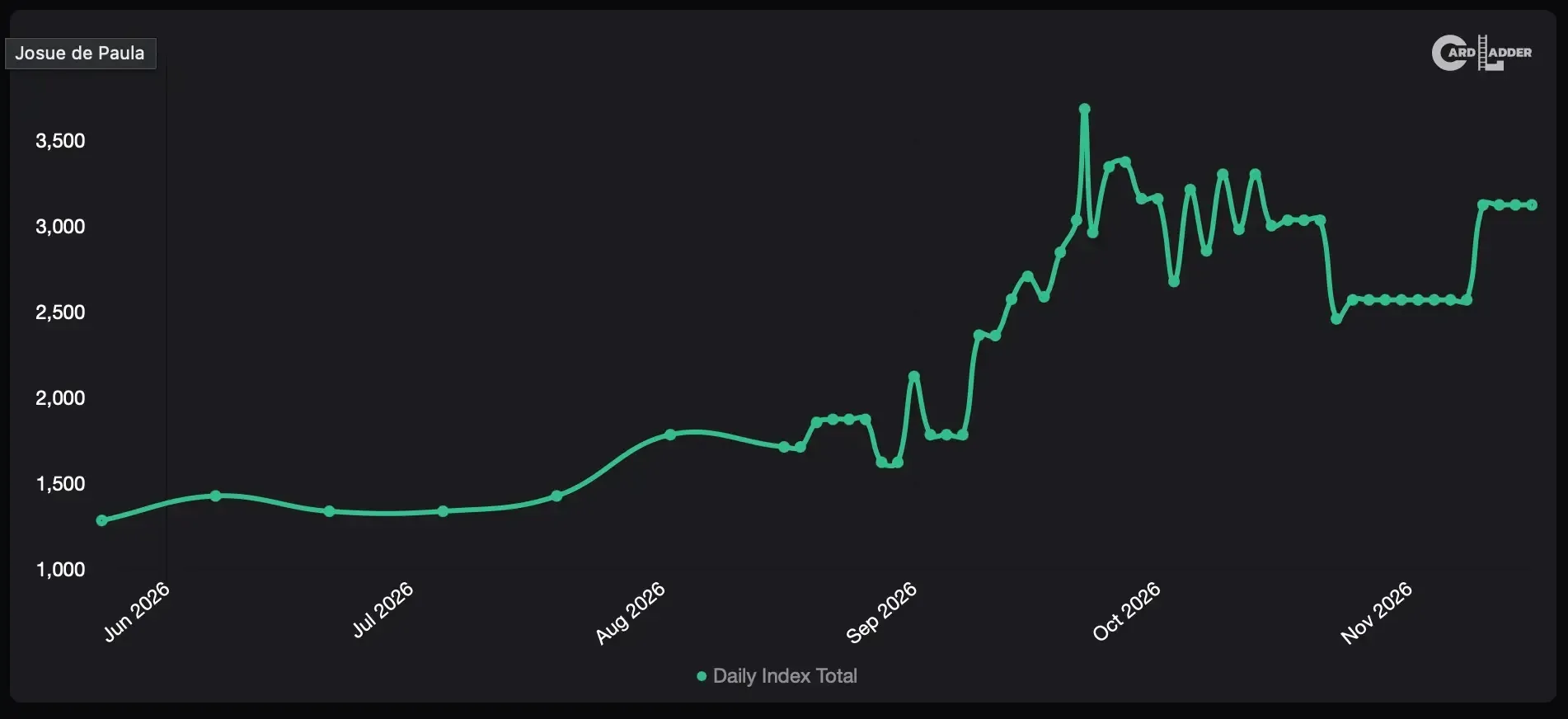
One useful way to visualize the move is De Paula’s player index. The index uses 1,000 as its baseline: 1,300 represents a market 30% above that starting point, while 700 represents a market 30% below it. De Paula began the 2026 season at 1,286. Around his call-up, it climbed to 3,684. It currently sits at 3,125.
In plain terms, the current reading is below the call-up crest but remains far above the opening-season level. That supports a straightforward description: the frenzy has cooled, but the market has not returned to where it began the year.
Analysis: a player index is best read as a directional market tool rather than a promise about the next sale. It can show that the overall appetite for a player’s cards has strengthened or softened. It cannot tell a collector which exact parallel will sell next, how many comparable cards are available at a given moment, or whether a particular asking price is realistic. The spread between a low-numbered autograph and a non-autographed card can remain enormous even when both belong to the same player-index universe.
That distinction matters after a debut. A high-profile promotion can pull new buyers toward a player at the same time. The immediate effect may be strongest in cards that are easiest to recognize: 1st Bowmans, on-card or certified autographs, cards with exceptionally low serial numbers and top grades. When attention later becomes less concentrated, fewer comparable sales can make high-end prices harder to interpret. A collector should separate a verified completed sale from an unsold listing and compare like with like whenever possible: the same set, parallel, autograph status, serial number and grading company.
The roster question is the market question
De Paula’s near-term card narrative is closely tied to the Dodgers’ outfield picture. His talent and ranking make him an obvious name to watch, but Pages, Hernández and Tucker represent a meaningful playing-time obstacle right now. The market can react to an opening before De Paula even adds to his MLB résumé.
Hernández has been mentioned in trade rumors. A trade, if one materialized, could alter the route to a starting outfield job and potentially prompt another burst of attention around De Paula. Yet a rumor and a completed transaction are not the same thing, and neither is the same as a confirmed everyday role. The order of events is important:
- Trade discussion may raise speculation.
- A completed move may improve the perceived opportunity.
- A club decision on the starting outfield would provide more concrete clarity.
- De Paula’s performance once games begin would supply the evidence collectors ultimately want.
That sequence is why this is a high-variance prospect market. A collector could be right about De Paula’s ability and still see card prices move unevenly if the path to at-bats remains blocked. Conversely, a change in roster circumstances can create a price move before the player has had a chance to establish new statistical evidence. For broader coverage of the debut-driven shift and the September sales window, see this De Paula card market watch.
How to approach the market without confusing hype for a checklist
Collectors interested in De Paula do not need to chase the $20,100 benchmark to participate. The top three sales identify the premium end: elite scarcity, an autograph, and graded condition. They also clarify the choices a buyer has to make. Is the appeal De Paula’s earliest Bowman identity? Is it a certified autograph? Is it a particular numbered parallel? Or is it simply owning a card of a highly ranked Dodgers prospect before rookie cards exist?
Answering that question first can prevent a common mistake: treating every card as if it has the same market logic. A collector who values the 1st Bowman marker may prioritize that designation. Someone who values rarity may focus on serial-numbered cards and carefully check the stated print run. A condition-oriented buyer may pay more for a gem-mint grade, while also recognizing that the grading label is part of the specific card’s appeal, not a universal multiplier that can be applied blindly to every raw copy.
A practical due-diligence list
- Confirm the card identity. Check the year, Bowman product, 1st designation, parallel name, autograph status and serial number. Similar-looking Chrome, Sterling and refractor cards can be materially different items.
- Compare completed transactions. A completed sale is evidence of a buyer and seller agreeing on value at a particular time; an active listing is a seller’s target, not proof of market value.
- Match grade to grade. The reported high-end results include SGC 10, PSA 9 and PSA 10 examples. A raw card or lower-grade copy is not directly interchangeable with them.
- Decide whether you collect or speculate. For a personal collection, a card you enjoy at a comfortable cost may be the right result. For a short-term market thesis, the roster and performance risks deserve much more weight.
- Set a limit before shopping. The prospect market can move quickly around call-ups, trades and lineup news. A preset ceiling helps keep a sudden wave of attention from choosing the budget for you.
Why the absence of rookie cards matters
De Paula’s lack of rookie cards places unusual emphasis on prospect-era issues. That is not a flaw; it simply defines this phase of the market. His 2023 Bowman 1st cards are the readily identifiable early targets, and the reported sales show buyers are willing to pay heavily for their most exclusive forms.
But it also means the market will likely gain new reference points when rookie cards eventually arrive. New products can broaden the number of choices available to collectors. In practice, that may divide demand rather than move every older card in the same direction. Early Bowman cards can retain their own appeal because of the “1st” designation, while rookie cards may attract buyers who organize their collections around MLB rookie status. There is no supplied evidence that predicts how that split will resolve for De Paula, so it is better viewed as a future variable than a foregone outcome.
The measured read on De Paula cards
De Paula has already established the ingredients for a compelling modern baseball-card market: a major-league debut at age 21 years and 110 days, a No. 4 overall prospect placement, early offensive success, and a set of 2023 Bowman 1st cards with documented five-figure sales at the premium tier. His September call-up coincided with a sharp player-index rise from 1,286 at the beginning of the season to 3,684, followed by a retreat to 3,125.
The key is not to mistake that evidence for certainty. De Paula’s next price catalyst could be a clarified outfield opportunity, a Hernández trade, or his own on-field performance when the season starts. It could also fail to arrive quickly. For collectors, the sensible focus is card-specific: know which De Paula issue you want, understand why that exact card is scarce, compare genuinely comparable sales, and treat the Dodgers’ crowded outfield as a real risk rather than background noise.