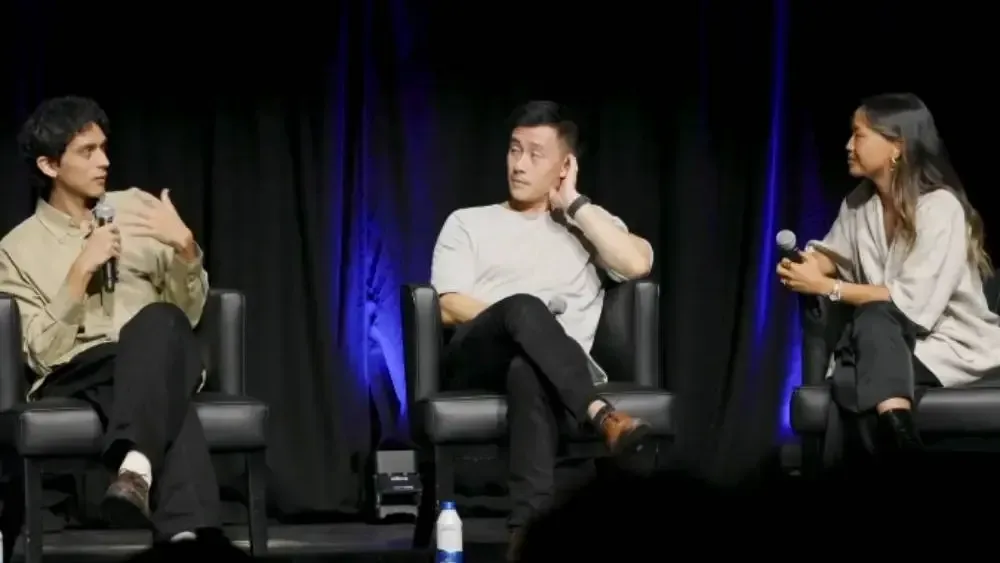
Three short films, three distinct routes into filmmaking and one blunt shared message: making movies requires more than an idea. At a Miami Beach screening held November 10 during Adobe MAX 2026, filmmakers Leo Aguirre, Michael Lei and Mel Mah presented their work and spoke about the emotional, logistical and creative realities that sit behind a finished image on a theater screen.
The Adobe TV & Film Fund-supported creators arrived with projects at very different points in their lives. Lei used a speculative-fiction short to test the foundations of a possible feature. Aguirre brought a supernatural-leaning story about grief, material desire and identity while building toward his first feature. Mah unveiled a dark comic short that draws on her experience in yoga and mindfulness, as she develops a road-trip dramedy intended as her own feature debut.
That variety makes the screening a useful reminder that a short film is not one fixed thing. It can stand as a complete work, a creative calling card, a learning environment for a crew, or a proof of concept: a shorter production used to explore a premise, tone or filmmaking approach before attempting a feature-length version. For artists without unlimited resources, those roles can overlap.
Three shorts with very different questions at their core
Lei’s The Rift centers on a young man believed to have a mysterious condition. He sees the world in daylight, while the people around him—including his father—perceive only darkness. The premise has a clear sci-fi inflection, but its setup also creates room for questions about trust, perception and isolation. Lei described the screening as the film’s first public showing and emphasized the sustaining value of hearing an audience react in the room.
That response is more than a pleasant milestone. A public screening can give a filmmaker a clearer sense of where an audience becomes engaged, surprised or emotionally affected. It does not magically solve the next draft or eliminate rejection, but it can provide a concrete memory of why the long, uncertain parts of the process are worth enduring.
Lei hopes The Rift can lead into a feature. He has carried the broader script through much of the 2020s, and the short allowed the team to make the concept tangible. In practical terms, this is what a proof of concept can offer: an opportunity to find out what the story demands when actors, crew, visuals and time constraints meet in a real production. An ambitious idea may work perfectly on a page but reveal production challenges once it must be staged convincingly.
Aguirre’s Isme is a very different kind of genre-adjacent story. Its protagonist is a volatile teenager in New York City who steals a necklace from a dying woman, setting off an obsession with spiritual consequences. Aguirre frames the film around what people carry in life and what may be carried beyond it. The necklace is not merely an object of plot; it speaks to artifice, self-image and the feeling that a material possession might complete something missing within a person.
That makes the title’s subject matter unusually suited to the compact intensity of a short. Rather than attempting to document every dimension of a character’s life, a single stolen object and a destabilizing fixation can concentrate the central idea. Aguirre also said making Isme taught him how to reduce scale and make the most of available resources, a lesson that fed directly into work on a feature.
Mah’s And That’s The Way The Cookie Crumbles takes a satirical turn. A yoga influencer receives a fortune cookie prediction of imminent death, suffers an existential crisis and begins exposing the contradictions inside the mindfulness business she has built around a life she does not genuinely live. Mah, a yoga and mindfulness teacher herself, described the project as partly autobiographical. But she also stressed the productive distance created by performance: Dia Frampton, playing the lead, brought an interpretation that differed from Mah’s own initial image of the character.
That is an essential collaborative truth in filmmaking. A writer-director can arrive with an exact internal version of a scene, but actors do not function as delivery systems for a pre-recorded idea. Their choices can reveal new dimensions in dialogue and behavior. Mah’s reaction points to the value of leaving room for that discovery, particularly when the work begins close to autobiography.
Control is never as complete as it looks
Mah said there are elements of the short she would now approach differently, alongside elements that came together beautifully. Her broader point was that filmmakers do not have as much control as they might imagine. That is not a claim that preparation does not matter. It is an acknowledgement that a film is assembled through many moving parts: performances, locations, schedules, funding, equipment, collaborators and decisions made under pressure.
For emerging directors, that perspective can be more constructive than either perfectionism or resignation. Perfectionism can prevent a project from being completed; resignation can become an excuse not to plan. The more useful middle ground is to identify what must be protected—the emotional center of a scene, a key relationship, a story’s perspective—and then adapt the surrounding execution when production realities change.
Aguirre’s experience reinforces the point. He described the difficulty of securing money and persuading people to commit assistance to his feature work, while also calling the experience beautiful. His debut feature Verano was supported by Adobe, shot over the summer, and is being targeted for a spring 2027 premiere. Its screenplay was selected for the 2025 Sundance Screenwriters & Directors Lab and received a 2025–2026 Academy Nicholl Fellowship.
Those recognitions matter, but they do not erase the practical work Aguirre described. Development programs and fellowships can provide attention, support and validation, yet a production still relies on people making time, resources being assembled and creative ambitions being calibrated against what can actually be achieved. Readers interested in the policy side of that funding environment can find related context in our look at a proposed U.S. film credit and its potential regional impact.
Why the work cannot be about fame
Lei was especially direct about the scale of the challenge. Film may be among the most expensive art forms because it brings together cast, crew and the resources needed to make a fictional situation believable. Even a short production can demand coordination across departments and a substantial amount of labor. The finished runtime is a poor measure of the effort required to get there.
His advice was equally straightforward: filmmakers need to love the work and want it for the right reasons. In his view, filmmaking is not a reliable route to wealth or celebrity. This is not romantic pessimism. It is a practical test of motivation. If the central aim is recognition alone, the inevitable obstacles—unmade drafts, fundraising problems, delayed plans and rejection—will be difficult to absorb. A deeper attachment to storytelling gives the process a more durable foundation.
Aguirre expressed a complementary version of that stance, arguing that nobody will want a filmmaker’s movie more than the filmmaker does. The point is not to dismiss collaborators; movies plainly need them. It is that the director or writer cannot outsource belief in the project. They must advocate for it, make decisions and keep it moving when external enthusiasm fluctuates.
Mah added a useful corrective to the idea that constant industry immersion is the sole path to better art. Alongside daily script work, she encouraged creators to pursue interests and experiences outside film. Stories concern real life, and a filmmaker needs something lived, observed or felt to bring to them. Her own route began in professional dance, where she learned nonverbal storytelling through movement before making dance films in Los Angeles and ultimately moving into filmmaking.
Her background also helps explain why emotional communication is central to her advice. She argued that art comes from the heart, with the mind serving in support. That does not mean craft is secondary. Screenwriting, editing, budgeting and production planning remain vital. But technique is most meaningful when it helps an audience feel something rather than becoming an end in itself.
Personal histories behind the camera
The three filmmakers’ early movie memories reveal how varied a route into the medium can be. Mah said her father introduced her to films and taught her to edit using Adobe tools. Filmmaking became a passion she felt she could share with her parents, even though her first major artistic discipline was dance.
Lei said his father introduced him to movies after the family emigrated to the United States, using them as part of learning language and culture. The family watched films including Top Gun, Days of Thunder and an annual Christmas viewing of The Godfather, based on his father’s delightfully unconventional definition of a Christmas movie. Lei identified a later, sharper turning point: watching the 2002 Oscars in New York after September 11, when an opening monologue about the importance of movie storytelling struck him during a painful period for the city.
Aguirre grew up in El Paso, while his grandparents lived across the border in Mexico. Summers there included watching the golden-age Mexican films his grandfather watched. He initially imagined an acting path, but after a theater workshop he became more interested in working for the screen and then in being behind the camera.
These accounts do not offer a single blueprint, and that may be their strongest shared lesson. One artist comes through dance, another through family movie nights and a formative public moment, another through borderland family connections and theater. The common element is not a standardized education or one defining title. It is sustained attention: the repeated experience of seeing stories, feeling their effects and slowly recognizing a wish to make them.
What comes next
Mah is developing This Way to Home, a road-trip dramedy starring Ken Jeong. Filming is scheduled for spring 2027. The project was selected for Gold House’s Gold Pitch program at the Toronto International Film Festival and has secured CAN$1 million in production financing from Telefilm Canada. The project’s progress illustrates the long runway between an idea and a shoot: development, pitching, program selection, financing and scheduling all precede the point where cameras begin rolling.
For all three artists, the theatrical setting remains meaningful. They were encouraged by the 2026 theatrical box-office recovery, described as the industry’s best year since COVID. Mah remains optimistic that audiences will continue to seek the particular experience of sitting quietly together and responding to the same story in real time.
That optimism is not a prediction that every film will find a massive audience, nor is it a dismissal of other ways viewers encounter work. It is a statement about the unique social dimension of a theater. Lei’s response to the first public showing of The Rift offers the clearest example: a live audience supplied a form of confirmation that can carry an artist through the solitary and discouraging stages still ahead.
The Miami Beach event therefore stood for more than three individual premieres. It showed short filmmaking as a place to take risks, learn the limits of control, test a larger vision and place work before the audience it was made to reach. For Aguirre, Lei and Mah, the next steps are different. The underlying commitment is the same: keep making the work, keep living enough life to have something to say, and keep moving the project forward even when the path is expensive, imperfect and difficult.