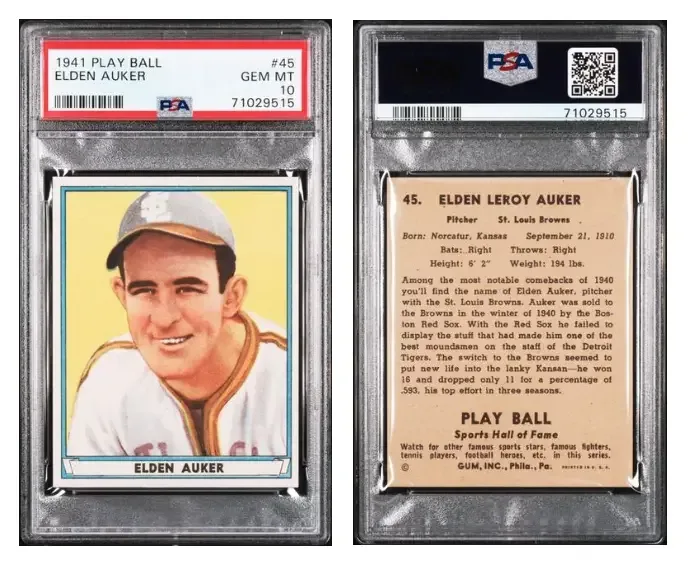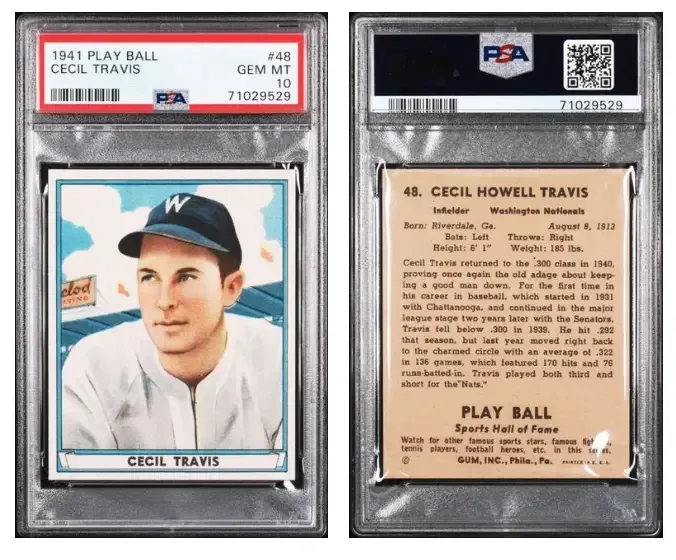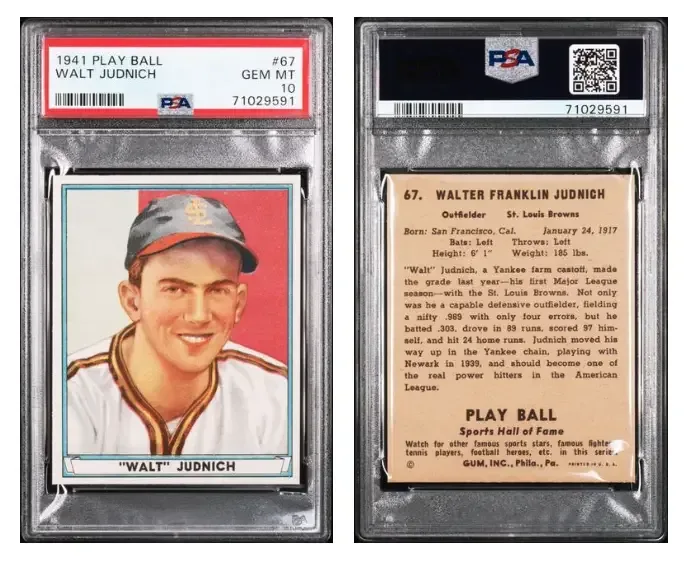
The 1941 Play Ball baseball set has a straightforward reminder for anyone tempted to judge an old card strictly by the player on its front: condition can be its own all-star.
Gum, Inc.’s pre-war set remains notable for its player portraits, but the available sales and population figures for four examples show how dramatically the market separates an ordinary surviving copy from an elite graded one. Joe DiMaggio is the obvious headline name. Yet the same preservation dynamic is visible on cards of Elden Auker, Cecil Travis and Walt Judnich—players whose ungraded cards can trade for very modest amounts while their PSA 10 copies have reached five-figure public prices.
That is not a claim that every old card will become valuable once it enters a slab. It is a clearer, more useful point: a card’s identity, scarcity and condition interact. In a set from 1941, the number of examples that have survived in exceptional shape is a separate scarcity layer above the basic question of how many copies still exist.
What “PSA 10” and population counts actually tell collectors
PSA 10 is the top grade discussed in the available figures, and it is described as the pinnacle of preservation for these pre-war cards. A population report, often shortened to “pop report,” counts examples graded at particular levels by the grading company. It is not a census of every copy ever printed, every copy still owned, or every card that could eventually be submitted. It is a count of the cards that have received those grades.
That distinction matters. A population report cannot, by itself, establish future value or guarantee that another top-grade card will never emerge. But it does give collectors a concrete way to see the gap between the card they may be able to buy raw—meaning ungraded and not encapsulated by a grading company—and the comparatively tiny number that have been recognized at the highest levels.
For this particular group, the figures are stark. Each of the four cards has one PSA 10 listed. The tiers immediately below it are also limited, although the precise numbers differ from player to player. The market’s response has been substantial, especially where a card joins that solitary top-grade position with a famous subject.
Joe DiMaggio No. 71: star power meets a one-card PSA 10 population
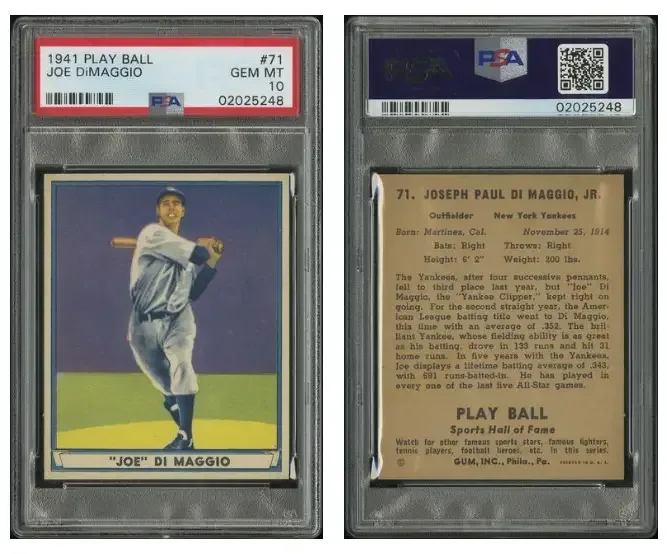
Joe DiMaggio’s 1941 Play Ball card, No. 71, is the clearest example of the two forces working together. Raw copies generally sell in the $1,600 to $2,200 range. That is already a meaningful price, reflecting DiMaggio’s standing and demand for the issue. The graded population cited here lists only one PSA 10, alongside five PSA 9s and 31 PSA 8s.
The highest public sale reported for that lone PSA 10 was $750,000 on February 21, 2020. The figure should be read precisely: it is the highest public sale identified for that grade, not a current price guide, a promise of a repeat result, or a value applicable to raw and lower-grade examples.
Related coverage includes 1941 Play Ball PSA 10s Show the Massive Value of Elite Preservation.
Still, the scale of the comparison is instructive. The price gap between a raw DiMaggio and the top graded survivor is not simply a matter of plastic packaging. It represents the market assigning enormous weight to an already coveted player card being preserved at a level no other graded submission has matched in the supplied population figures.
For prospective buyers, this is why the word “DiMaggio” alone is not enough information. Card number, grading company, grade, authenticity and the actual condition of a raw copy all change what is being purchased. A collector comparing a raw card with a PSA 10 is comparing related objects, but not interchangeable ones.
The revealing cases: Auker, Travis and Judnich
The less famous names make the condition story even sharper because their ungraded prices are so much lower.
Elden Auker’s No. 45 card has a reported raw range of $8 to $20. The cited population consists of one PSA 10, four PSA 9s and 21 PSA 8s. Its highest public PSA 10 sale was $15,000 on May 12, 2023. Cecil Travis’s No. 48 has a similar raw range of $10 to $20; its graded counts are one PSA 10, three PSA 9s and 21 PSA 8s. The highest reported public result for its PSA 10 was also $15,000 on May 12, 2023.
Walt Judnich’s No. 67 is another striking case. Raw copies generally sell for $10 to $30. Yet the population supplied for the card has one PSA 10, one PSA 9 and 13 PSA 8s. Its highest public PSA 10 sale reached $12,600, again on May 12, 2023.
Those comparisons do not erase the importance of the players. Collectors still care about subjects, teams and the stories attached to a set. But they demonstrate that top-condition scarcity can turn a comparatively accessible player card into a high-end collectible. In each case, the supply of PSA 10 examples is listed as exactly one. Judnich also has only one PSA 9 in the cited figures, a particularly narrow high-grade ladder.
A quick view of the four reported PSA 10 populations
- Joe DiMaggio, No. 71: 1 PSA 10, 5 PSA 9s, 31 PSA 8s; highest public PSA 10 sale reported at $750,000.
- Elden Auker, No. 45: 1 PSA 10, 4 PSA 9s, 21 PSA 8s; highest public PSA 10 sale reported at $15,000.
- Cecil Travis, No. 48: 1 PSA 10, 3 PSA 9s, 21 PSA 8s; highest public PSA 10 sale reported at $15,000.
- Walt Judnich, No. 67: 1 PSA 10, 1 PSA 9, 13 PSA 8s; highest public PSA 10 sale reported at $12,600.
Why raw-card prices and top-grade sales should not be blended
It is easy to see a headline result and treat it as the value of “the card.” That shortcut obscures the central lesson of these sales. A raw card’s price range captures a much broader and more variable group of items. It may include examples with different levels of wear or eye appeal, and it does not carry the same third-party grade as a PSA 10.
A PSA 10 result, conversely, represents a highly specific collecting proposition: a particular card, in a particular grade, within a population where very few cards have reached that tier. The result can be informative without being a universal valuation.
That is especially important for people who discover a 1941 Play Ball card and immediately search recent high-grade results. A low-cost raw Auker, Travis or Judnich is not “undervalued by $15,000” merely because one PSA 10 brought that sum. The sale figures instead show the market’s premium for the rarest verified condition outcome.
The key comparison is not raw card versus slabbed card in the abstract. It is ordinary surviving condition versus an exceptionally scarce top-grade example.
Practical takeaways for collectors
The numbers make a sensible case for slowing down before buying—or pricing—a vintage card. First, identify the exact card number and player. Second, separate raw listings from graded examples rather than using them as direct comparables. Third, look at the grade-specific population, including the grades immediately below the one being considered.
That last step helps frame rarity. DiMaggio’s PSA 10 sits above five PSA 9s and 31 PSA 8s in the cited figures. Judnich’s example is above just one PSA 9 and 13 PSA 8s. Both have a lone PSA 10, but the composition underneath the top matters when collectors evaluate where a particular example sits in the graded hierarchy.
It is also worth keeping the timeframe attached to the public-sale information. DiMaggio’s reported high sale was in 2020, while the three other reported top-grade highs occurred in 2023. Historic public results document what buyers paid at those points; they do not establish an automatic present-day transaction price.
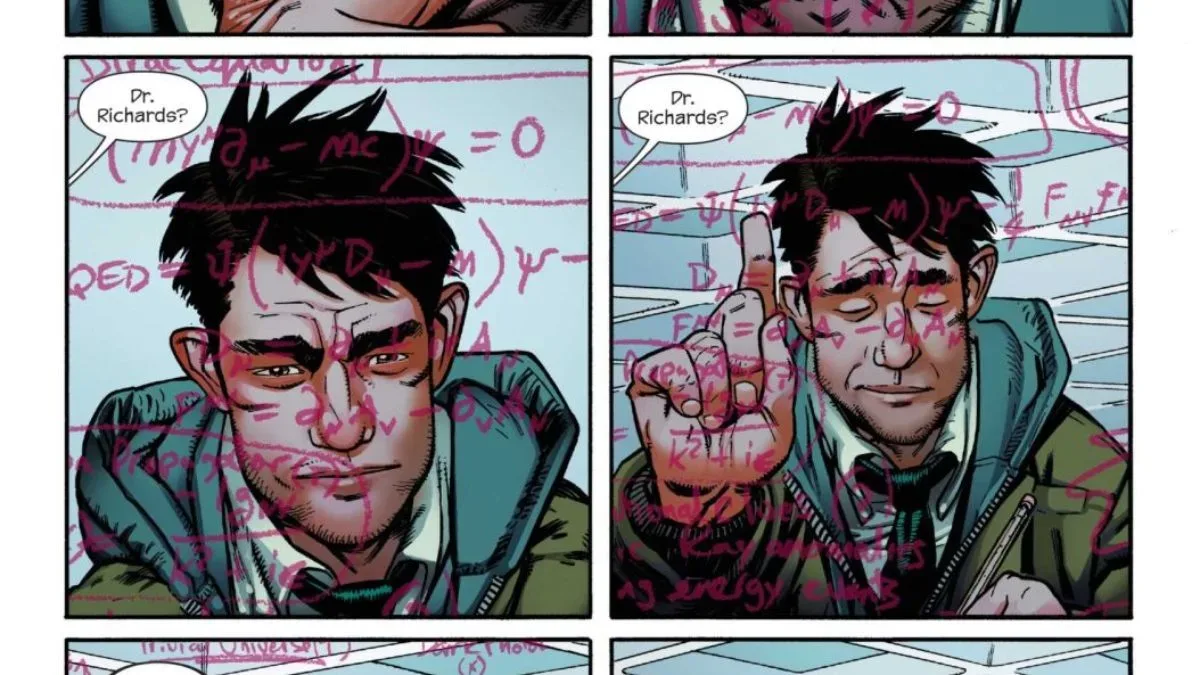
Collectors interested in other physical collectibles face the same broader task of distinguishing a standard issue from a scarce premium version. For an example in a different corner of collector culture, this site has also covered a Fantastic Four comic release tied to the collectibles space. The formats differ, but careful identification and edition-specific comparison remain more useful than relying on a single headline number.
A pre-war set with two very different entry points
The appeal of 1941 Play Ball is not limited to the market’s most expensive holders. Most cards in the set can still be found raw at relatively approachable prices, and the four examples underline how different an accessible set-building route can be from pursuing condition-rarity trophies.
For a collector who wants the portrait-driven set or a favorite player, a raw or lower-grade card may be the practical target. For someone chasing the finest graded example, the decisive challenge is not merely locating the player—it is finding one of the extremely few cards verified at the upper end of the condition scale.
That divide is why the DiMaggio result and the Auker, Travis and Judnich results belong in the same conversation. Their player demand is plainly not identical. Their raw price ranges are not remotely alike. Yet all four demonstrate the same market principle: when a card from 1941 is both desirable and exceptionally preserved, the grade can transform the collecting proposition—and the price—far beyond what the basic raw card suggests.