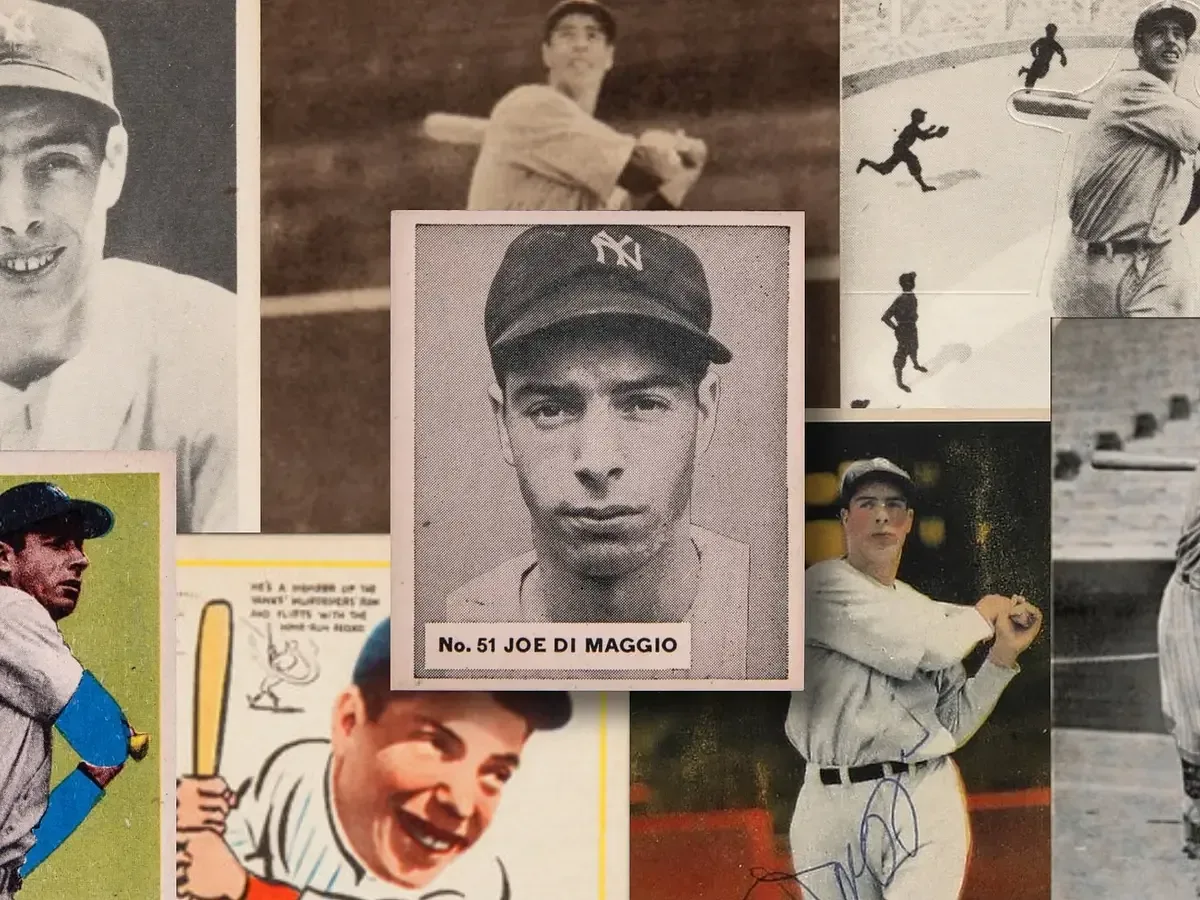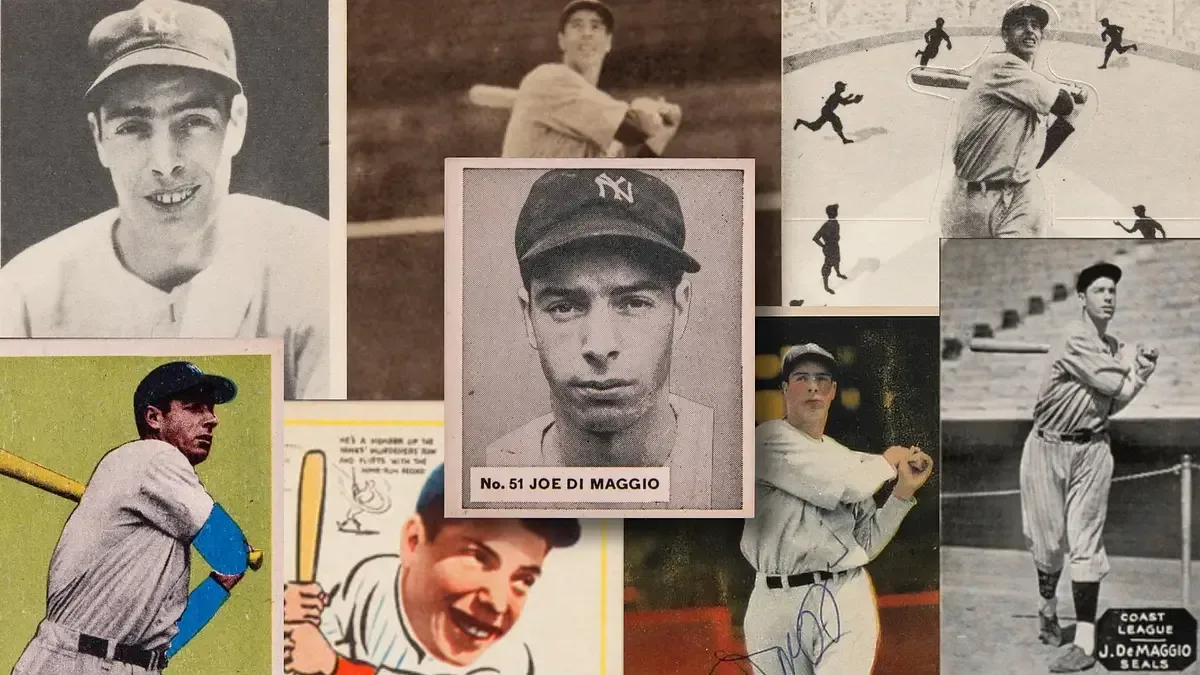
Joe DiMaggio’s reputation has never needed much help. The Yankees center fielder’s 56-game hitting streak in 1941 remains one of baseball’s most intimidating benchmarks, a record so distant from modern expectations that every long streak invites the same question: could anybody actually catch it? His on-field résumé is equally enormous. DiMaggio reached the World Series in his 1936 rookie campaign and ultimately won nine championships across 10 seasons.
That kind of career creates a collectible legacy, but DiMaggio’s card story is more interesting than a simple hunt for one famous rookie. His cardboard reaches back to his San Francisco Seals days in the Pacific Coast League, moves through some of the defining pre-war gum issues, and extends to a startlingly scarce postwar service-station card whose known population remains remarkably small. For collectors, that means there are several legitimate ways to build a DiMaggio run: by era, by design, by scarcity, or by the historical moment each card captures.
As with any vintage pursuit, condition, authenticity, alteration concerns, and provenance can radically change the equation. A card’s appeal is not merely about its printed year. It is also about distribution, survival rate, the strength of the image, and how that issue fits into the history of baseball cards. DiMaggio happens to have standout examples in nearly all of those categories.
Start before the pinstripes: 1934 Zeenut P.C.L. and 1935 Pebble Beach
The most compelling DiMaggio cards are not necessarily Yankees cards. Before the majors, he played for the San Francisco Seals, and his Pacific Coast League years gave regional issuers a chance to put him on collectible material before his national fame exploded.
The 1934 Zeenut P.C.L. card is a key early DiMaggio issue from that minor-league period. It belongs to a long-running regional tradition and gives collectors a direct connection to the prospect before the legend. The 1935 Pebble Beach piece offers a different kind of early collectible: it is a postcard, one of seven postcards depicting players from West Coast minor leagues. That format matters. It is not simply another standard-size card with a different border; it reflects a regional promotional approach and provides a much different visual and physical collectible.
These Seals pieces are essential for anyone who wants a player-focused collection rather than a Yankees-only display. They tell the story of why DiMaggio arrived in New York with enormous expectations already forming around him.
1936 World Wide Gum: the rookie-card conversation
The 1936 World Wide Gum DiMaggio is widely regarded as his true rookie card, and it has the visual authority collectors expect from that designation. World Wide Gum was Goudey’s Canadian affiliate, but its 1936 release went beyond simply repeating older Goudey designs. DiMaggio appears in a New York cap, making this a particularly meaningful transition point between his West Coast past and major-league identity.
The timing gives the card added weight. At 21, DiMaggio hit .323 with 125 RBI in 1936, finishing second on the Yankees in RBI behind Lou Gehrig, that season’s MVP. He joined a loaded club that included Gehrig, Bill Dickey, Frankie Crosetti, and Tony Lazzeri. In other words, this is not a rookie card attached to a player who needed years to become relevant. It is connected to the start of an immediately consequential Yankees career.
Related coverage includes Joe DiMaggio’s Most Iconic Playing-Day Cards and Why Collectors Still Chase Them.
For collectors who prioritize traditional rookie status, the 1936 World Wide Gum is likely the centerpiece. Its Canadian origin is part of the charm rather than a footnote: vintage collecting is full of cards whose distribution routes are every bit as important as their player checklists.
1937 O-Pee-Chee: a pop-up that became a heavyweight
The 1937 O-Pee-Chee DiMaggio is among the most distinctive pre-war cards associated with him. Its pop-up construction gives it an unusual three-dimensional character, a design decision that also complicates the survival story. Fragile novelty features and old cardboard rarely make for an easy grading journey decades later.
The set draws on visual ideas that were popular in the era, blending elements collectors may associate with Goudey and Batter Up releases. Its all-American League checklist also includes Bob Feller, making the set notable beyond DiMaggio alone. But the DiMaggio is the marquee pursuit for many collectors, especially at elite condition levels.
That is reflected in a reported 2024 sale: an SGC 9 example brought $288,000. The number should not be treated as a universal value guide—grade, eye appeal, market timing, and the tiny supply of high-grade material all matter—but it demonstrates how much premium collectors place on an exceptional copy of this unusually designed card.
1938 Goudey Heads Up: weird, wonderful, and seriously valuable
Goudey’s 1938 release, commonly called Heads Up, took a sharp turn from more conventional card portraits. The cards pair oversized heads with cartoonish bodies and lively illustrated backgrounds that can resemble a comic-strip scene. That approach may sound like a gamble, but it created one of the most recognizable DiMaggio cards of the era.
DiMaggio had appeared on a 1936 Wide Pen Premium with Yankees manager Joe McCarthy and on a solo 1937 Wide Pen Premium. Still, the 1938 Heads Up is the more prominent DiMaggio collectible among those examples. It is simultaneously playful, period-specific, and impossible to confuse with a standard issue from another company.
A PSA 9 1938 Goudey DiMaggio sold for $288,000 in 2017. A price index has placed that card around $1.4 million more recently, illustrating both the significance of the issue and the danger of treating top-grade headline figures as a baseline. The gap between an elite specimen and a lower-grade copy can be enormous. Collectors should focus on the individual card’s grade, centering, color, paper quality, and visual presentation rather than extrapolating from one trophy-level result.
The 1939, 1940, and 1941 Play Ball run
Building the 1939–41 Play Ball sequence is one of the most satisfying ways to collect DiMaggio across a changing design era. Gum, Inc.’s Play Ball line arrived in 1939, challenging Goudey’s strong presence in 1930s baseball cards. Each year gives the collector a different visual experience.
- 1939 Play Ball leans on striking profile imagery.
- 1940 Play Ball adopts a cleaner, more restrained look.
- 1941 Play Ball adds color, creating a visual endpoint that feels appropriately dramatic for DiMaggio’s most famous season.
A three-year run has an appeal that a standalone key card cannot replicate. It lets a collector see a star’s card presentation shift year by year as the hobby itself evolved. The 1941 issue naturally carries extra historical resonance because it aligns with the year of the 56-game streak, even though a card’s printed calendar does not reduce its importance to a single statistic.
For hobbyists who enjoy assembling coherent set runs, this is the DiMaggio lane with the most built-in structure. For a broader reminder that old formats and preservation stories can make collecting unexpectedly rewarding, even outside cards, see The AmiGoonies and its revival of a 1986 MSX game for Commodore Amiga.
1948 Leaf: color, stars, and postwar importance
The 1948 Leaf DiMaggio is a postwar favorite with a green background and an image of the center fielder in mid-swing. Leaf’s 98-card set is famous for containing Jackie Robinson’s rookie card, but its checklist is stacked far beyond that single landmark. DiMaggio appears alongside names such as Satchel Paige, Babe Ruth, and Stan Musial.
The set’s numbering is part of its lore. Although it contains 98 cards, the numbers run from 1 through 168, a tactic intended to encourage continued purchases. The strange numbering now adds another layer of vintage-set personality. For DiMaggio collectors, the card provides bold color and a strong action pose from a release that has never lacked hobby relevance.
1949 Aero Service Station: the card that appeared from nowhere
The most intriguing DiMaggio card may be the 1949 Aero Service Station. A raw example surfaced on eBay in 2024 and sold for $350. After PSA grading, that same card sold 10 months later for $19,200 in November 2025 through a Love of the Game auction.
Aero Service Station cards were distributed from St. Louis and are similar in style and geography to 1949 Schumacher Service Station cards. What separates the DiMaggio is the extraordinary uncertainty around its population. No second example has surfaced, and it has a PSA population of one. That does not prove another will never emerge—vintage cards have a habit of rewriting checklists, census data, and assumptions—but it makes this an especially fascinating issue.
Its story is a useful lesson in vintage collecting. The biggest cards are not always the ones everyone has known for generations. Sometimes the hobby’s most exciting object is an obscure regional issue that finally comes to light, gets authenticated, and raises new questions instead of closing old ones.
A DiMaggio collection can follow more than one path
There is no single correct DiMaggio checklist. A collector can chase the 1936 World Wide Gum as the foundational rookie, pursue the Seals issues for the earliest player history, build the Play Ball trio, or target the high-style 1937 O-Pee-Chee and 1938 Goudey. The 1948 Leaf offers postwar star power, while the 1949 Aero Service Station represents the thrill of genuine scarcity and incomplete hobby knowledge.
That range is the reason DiMaggio remains such a rewarding vintage subject. His cards do not just commemorate a historic Yankees star. Together, they map the regional, national, experimental, and sometimes downright mysterious routes through which baseball cards reached collectors in the 1930s and 1940s.