Pokémon’s latest high-end trading-card sales roundup has delivered the sort of number that makes even a full-art holofoil look understated: five cards accounted for $10,650,600 in sales, almost twice the previous week’s $5.35 million total.
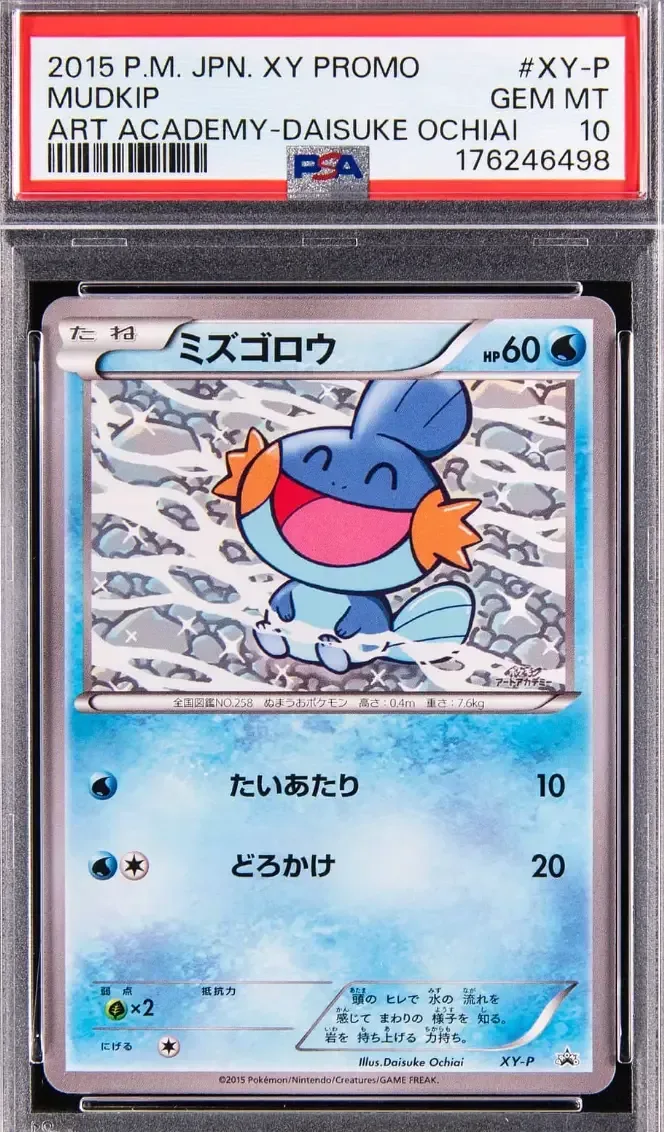
The headline act was not Charizard, Pikachu, or an impossibly shiny Legendary Pokémon. It was Mudkip. A 2015 Pokémon Japanese XY Art Academy Daisuke Ochiai Mudkip #XY-P graded PSA 10 sold for $4,880,000 on October 25. That single transaction represented roughly 46% of the top-five total, a remarkable share for a card featuring the famously cheerful Water-type starter.
All five entries in the ranking sold through Goldin on the same day. More importantly, the list reveals what is driving the uppermost tier of Pokémon collecting right now: rare promotional distribution, a story beyond the usual booster-pack chase, distinctive artwork, and condition—though the latter is not the entire story.
Mudkip’s multimillion-dollar leap
The $4.88 million Mudkip was created from the 2015 Pokémon Art Academy competition, a Pokémon-themed art contest in which participants submitted original illustrations. Winning designs became promotional cards. The card at the center of this sale features artwork by Daisuke Ochiai and carries the Japanese XY-P promotional designation.
For more context, explore Nintendo Switch 2 Storage Explained: Why microSD Express Matters Before Your Library Outgrows 256GB.
Its result is especially striking beside a sale of another PSA 10 copy one month earlier. That example brought $3.72 million through Fanatics Premier. The newer $4.88 million sale is $1.16 million higher, a jump of about 31% in 30 days.
That comparison is useful, but it should not be treated as a simple price guide for every Art Academy Mudkip—or every rare Pokémon card. Auction outcomes reflect the particular bidders present, the individual card offered, and the unusual scarcity of the item. PSA population reports list only three PSA 10 examples of this Mudkip. With so few examples in that grade reported, each public sale becomes an unusually consequential data point rather than a routine market check-in.
PSA 10 is the top grade referenced in this group of results. In practical collecting terms, a grade is a third-party assessment of a card’s condition. At less extreme price levels, collectors can often compare multiple copies and decide how much condition matters to them. At this level, the card’s scarcity, provenance as a contest-derived promo, and art can become just as central as the numerical grade. Mudkip has apparently evolved directly into an auction-room final boss.
Related coverage includes Mudkip’s $4.88M Sale Powers a $10.65M Pokémon Card Week.
The Art Academy cards did the heavy lifting
Mudkip was not the only Art Academy winner to command serious money. Two other PSA 10 examples from the 2015 competition each reached $976,000:
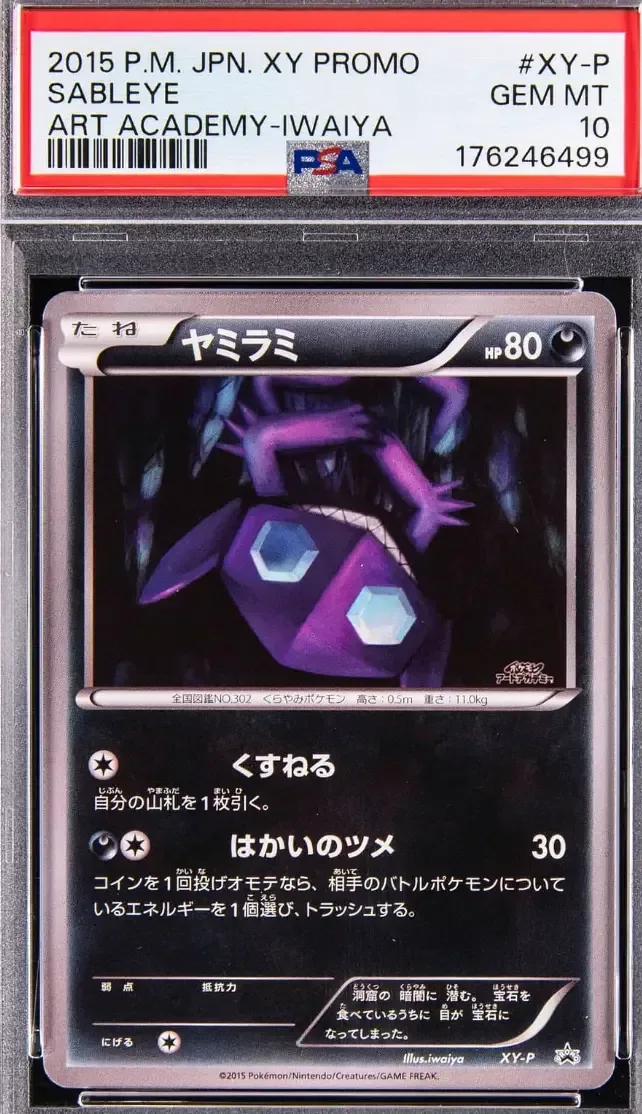
- 2015 Pokémon Japanese XY Art Academy Iwaiya Sableye #XY-P PSA 10 — $976,000
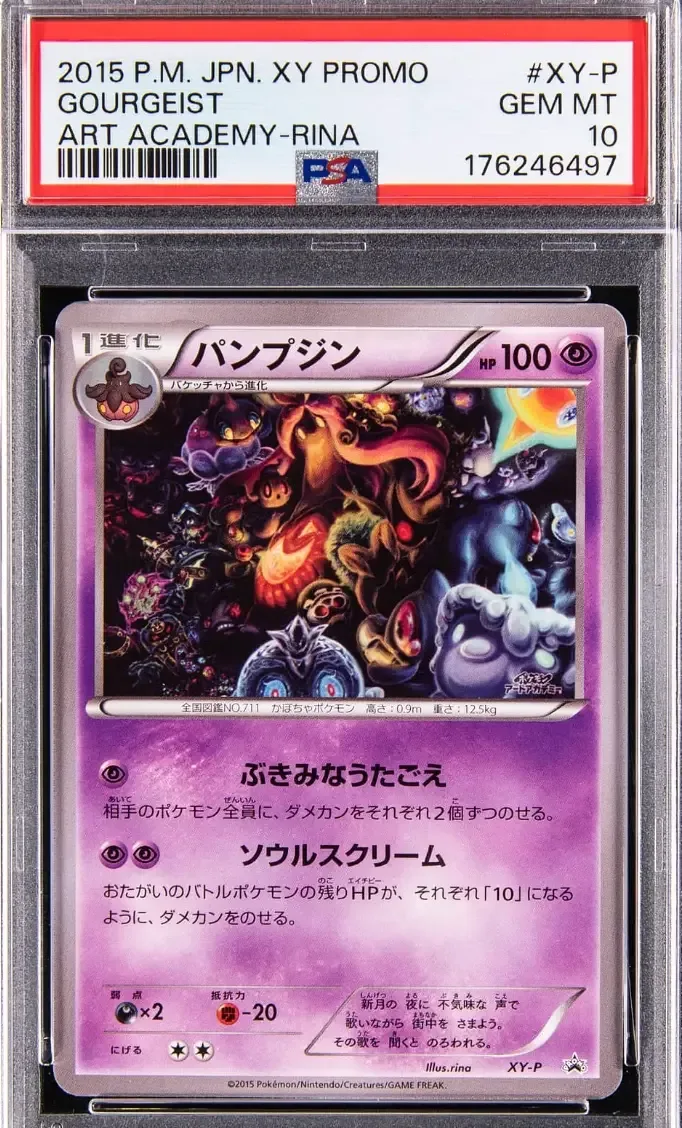
- 2015 Pokémon Japanese XY Art Academy Rina Gourgeist #XY-P PSA 10 — $976,000
Together with Mudkip, those three Art Academy cards generated $6,832,000, or a little more than 64% of the $10.65 million top-five total. The shared price of Sableye and Gourgeist is a notable reminder that this segment of the market is not only rewarding the franchise’s best-known mascots. Neither character is ordinarily expected to stand beside Pikachu in a million-dollar conversation. Their value here is bound to the Art Academy format: original contest artwork, promotional status, and limited availability.
That distinction matters. A conventional set is built around a broad release structure, where collectors generally encounter cards through packs. The Art Academy promos emerged from a competition instead. The winning illustrations make them visually and structurally different from familiar release cards, and their scarcity stems from that origin rather than a difficult pull rate alone.
For collectors watching these sales, the lesson is not that any offbeat character is suddenly a blue-chip collectible. It is that a character’s mainstream popularity is only one ingredient. When a card has a highly unusual route to distribution and a creative identity that cannot be reproduced by opening more product, demand can attach to the object itself—not merely to the Pokémon pictured on it.
Trophy Pikachu shows why condition is not the whole checklist
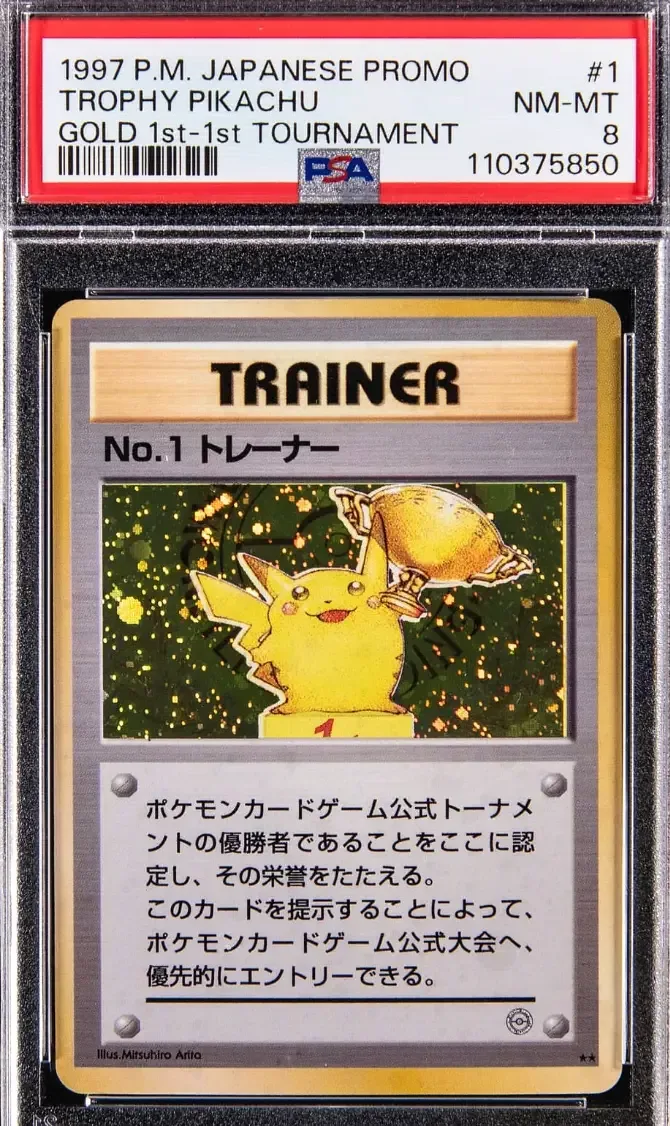
Second place belonged to a card with a very different kind of scarcity. A 1997 Pokémon Japanese Gold 1st Place Trophy Pikachu #1 graded PSA 8 sold for $3,080,500.
Unlike a pack card or a contest-derived art promo, this Trophy Pikachu was awarded for competitive achievement during Pokémon’s early tournament era in Japan. That makes it a trophy card: an item tied to a specific achievement and distribution path rather than ordinary retail circulation.
It was also the only card in the top five not graded PSA 10. Its $3.08 million result illustrates a key reality of elite collecting: grade remains important, but it is not a universal trump card. A lower numerical grade does not erase historical significance or scarcity. For trophy cards in particular, the fact that they were awards can be inseparable from their appeal.
This should not be misread as an argument to ignore condition. Instead, it is a useful framework for comparing different cards. With a broadly issued card, high grade may be the main differentiator between examples. With a historically significant award card, collectors may be weighing condition alongside a far rarer acquisition story. A PSA 8 Trophy Pikachu and a PSA 10 Art Academy Mudkip sit at very different intersections of rarity, history, art, and condition, yet both cleared seven figures in the same sales group.
Umbreon keeps classic promo rarity in the picture
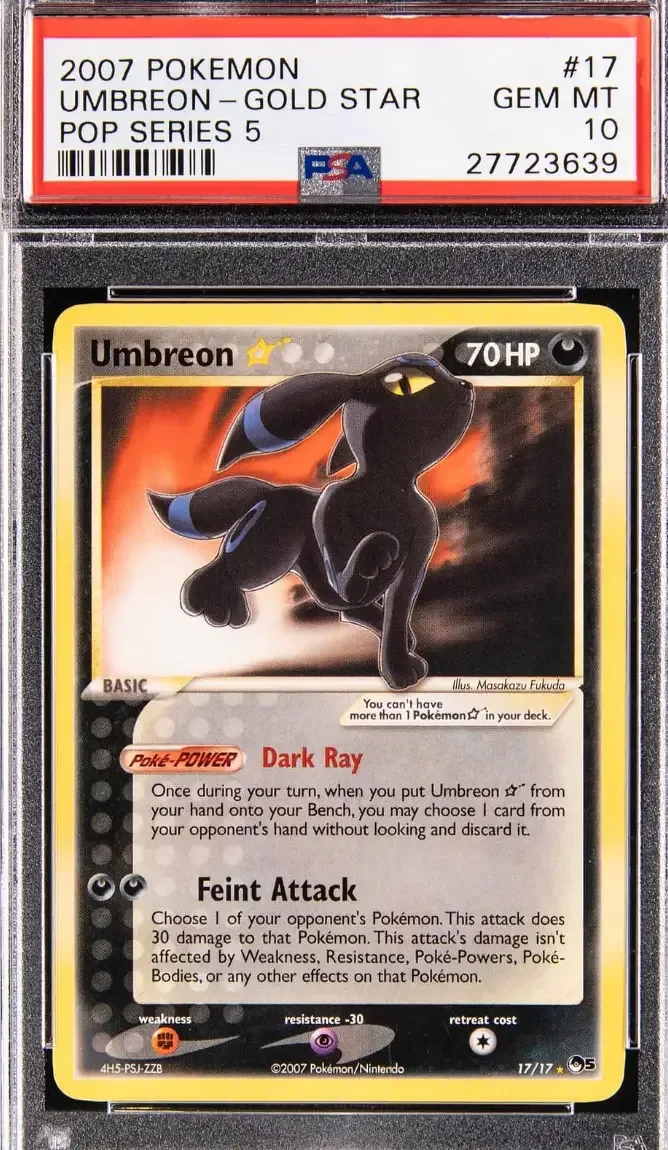
Fifth place went to a 2007 Pokémon POP Series 5 Gold Star Umbreon #17 PSA 10, which sold for $738,100. It was the least expensive card of the five only in the extremely relative sense that a $738,100 Umbreon can be described as anything other than an eyebrow-raising result.
POP Series cards were distributed through Pokémon Organized Play promotional packs rather than traditional booster releases. That promotional route differentiates the Gold Star Umbreon from a standard pack-pulled card and gives this week’s list another example of collectors responding to restricted distribution.
Umbreon’s placement is also a useful counterweight to the Art Academy sweep. The card comes from a more familiar collectible lane than the original-art contest promos, while remaining a high-end Pokémon target in its own right. In other words, the list was not exclusively about one strange and wonderful art competition; it also had room for an established Gold Star card with its own promotional history.
The five sales at a glance
- 2015 Pokémon Japanese XY Art Academy Daisuke Ochiai Mudkip #XY-P PSA 10 — $4,880,000
- 1997 Pokémon Japanese Gold 1st Place Trophy Pikachu #1 PSA 8 — $3,080,500
- 2015 Pokémon Japanese XY Art Academy Rina Gourgeist #XY-P PSA 10 — $976,000
- 2015 Pokémon Japanese XY Art Academy Iwaiya Sableye #XY-P PSA 10 — $976,000
- 2007 Pokémon POP Series 5 Gold Star Umbreon #17 PSA 10 — $738,100
What this week’s sales actually say
The straightforward takeaway is that Pokémon occupied all five places in this particular weekly TCG sales ranking. The more interesting takeaway is the composition of that sweep. Three Art Academy cards alone made up nearly two-thirds of the group’s dollar total, while an early tournament award and a promotional-pack Gold Star rounded out the list.
Every card here has a rarity story, but they are not the same story. Mudkip, Sableye, and Gourgeist trace back to a competition and artist-created designs. Trophy Pikachu is tied to tournament achievement. Umbreon came via Organized Play promotional packs. None relies on the basic proposition that a card was simply harder to pull from a normal booster box.
For anyone following premium Pokémon cards, that makes provenance a term worth keeping in mind. Here, provenance means the card’s origin and route into collectors’ hands: contest reward, tournament prize, promotional distribution, or retail release. It can help explain why two cards featuring characters of very different mainstream stature can draw comparable attention. The collectible is not just an image of a Pokémon; it is also a record of how, and why, that particular card existed.
The $4.88 million Mudkip sale is understandably the loudest number. But the broader $10.65 million total shows a market where unusual promotional history and creative pedigree are competing right alongside familiar character appeal. Somewhere, a binder page is having a very good week.