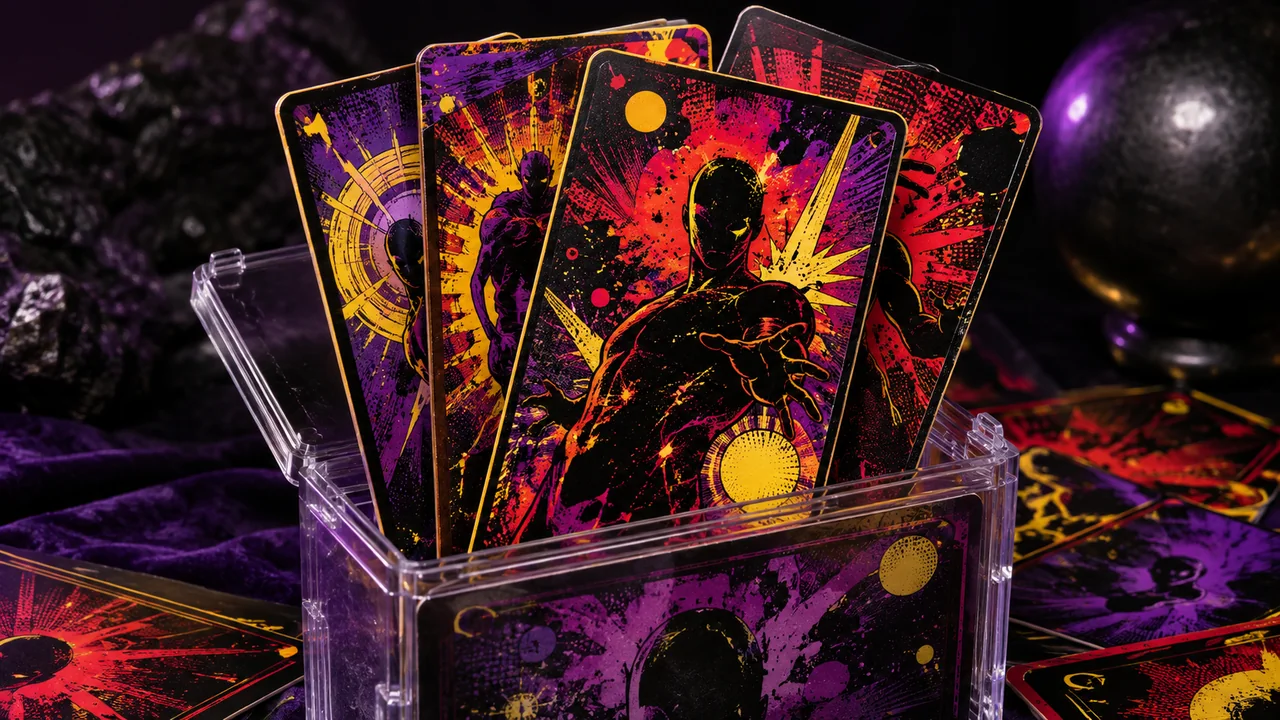
The appeal of 1990 Marvel Universe is easy to explain without a price chart: it offers a compact way to browse characters, rivalries, teams, and comic-book history. Our editorial view is that this makes it a satisfying set-building project. That is a reason to consider collecting it, not a claim that every card is scarce or that a purchase will appreciate.
Know the boundaries of the set
PSA’s set profile describes 1990 Impel Marvel Universe as a 162-card base checklist with a separate five-card hologram group and no issued parallels. It identifies character, team, battle, and classic-comic themes, with additional information printed on the backs. The PSA CardFacts profile is our reference for those set facts.
That structure gives a new collector a useful choice: build the base set first, collect selected favorites, or add the holograms as a separate project. Do not allow a seller’s use of “complete” to choose for you. Ask exactly which card numbers and additional groups are included.
Make the checklist do the work
Create one row for each card number in your chosen scope. Use separate columns for owned, condition, duplicate, and location. When considering a partial set, ask for the missing-number list rather than estimating completeness from a stack photograph.
If you are offered a finished base set, check the numbered sequence instead of counting the stack alone. A duplicate and a missing card can leave the total looking correct. This is a small exercise, but it prevents a large amount of later irritation.
Collect the backs as well as the fronts
One enjoyable way to approach the set is to compare how it presents characters across different card types. Choose a familiar hero and follow the connections to teams, opponents, and comics. Read the backs as period material: they reflect the context of the release, rather than serving as a continuously updated guide to decades of later continuity.
You can also make a short visual notebook. Describe which images feel energetic, which compositions work particularly well at card size, and which designs you want beside one another in a binder. These are personal observations, so there is no reason to force them into a numerical ranking.
Judge condition on its own terms
Look for consistent front and back photographs when comparing sets. Ask whether condition varies substantially and request examples of the weakest cards, not only the best. A few attractive top-of-stack photos cannot describe every item beneath them.
For holograms, request lighting that shows both the image and the surface. If glare obscures the card, ask for another angle. Do not assume a high grading outcome from a seller’s adjective. If graded copies interest you, inspect the exact cards and labels and use the grading company’s own verification resources.
Define a finish line
Write down whether your project ends at a readable base set, a visually consistent binder, or a selection of particular characters. Record the condition you are willing to accept and avoid changing that standard simply because a tempting lot appears.
A finished collection can be modest. The pleasure is in knowing what the cards are, seeing how they fit together, and being able to open the binder without first checking whether the market approves. For a wider route into the category, read our beginner’s guide to Marvel cards.