The Foundry #2 turns an expedition of paranormal investigators into a survival emergency when the airship Thundercloud is attacked by an enemy nobody can see. The 32-page issue, arriving September 23, 2026 from Dark Horse Comics, is written by Chris Roberson, illustrated by Christopher Mitten, colored by Michelle Madsen, and features a cover by Mitten. It is rated T+ and carries a $4.99 cover price.
The premise places characters associated with Witchfinder and the British Paranormal Society together on a globe-spanning mission: locating supernatural-powered technology and uncovering the stories of civilizations that used it, whether constructively or destructively. Issue #2 puts immediate pressure on that mission. Instead of moving freely toward its next discovery, the team must contend with a stricken vessel, rising water, and the unanswered question of what attacked them.
A voyage built around supernatural technology
The Foundry is a four-issue series set in the wider world of Hellboy. Its central idea is not simply that the uncanny exists, but that strange forces can be embedded in devices, infrastructure, and artifacts with consequences far beyond one isolated haunting or monster encounter.
That is an especially useful frame for an adventure about investigators traveling across the world. A supernatural-powered technology can be understood as an object or system whose operation is tied to occult or paranormal forces rather than conventional science alone. The stakes are therefore potentially broader than identifying an unusual relic. The team is investigating who made such tools, what they were intended to do, and how their power could be used for good or ill.
The Thundercloud embodies that tension before it even falls from the sky. An airship is a symbol of reach: it gives the investigators a means to cross distances and take their inquiry worldwide. But its destruction instantly reverses that advantage. The machine meant to make exploration possible becomes a flooded, enclosed danger zone that requires improvisation just to keep people alive.
The unseen foe is the issue’s key mystery
The official setup identifies an unseen attacker, and the preview material keeps that threat out of view. That restraint matters. A visible antagonist lets readers assess a danger’s scale and method; an invisible one leaves the characters unable to know whether they are dealing with a creature, an opponent using unfamiliar technology, an environmental phenomenon, or something else entirely.
For a series focused on paranormal devices and the cultures behind them, that uncertainty is more than a standard cliffhanger engine. It makes interpretation part of survival. If the attack is connected to the kind of supernatural technology the group is seeking, then the disaster could be evidence as well as an obstacle. If it is unrelated, the investigators still face an enemy whose capabilities have already exceeded their ability to respond.
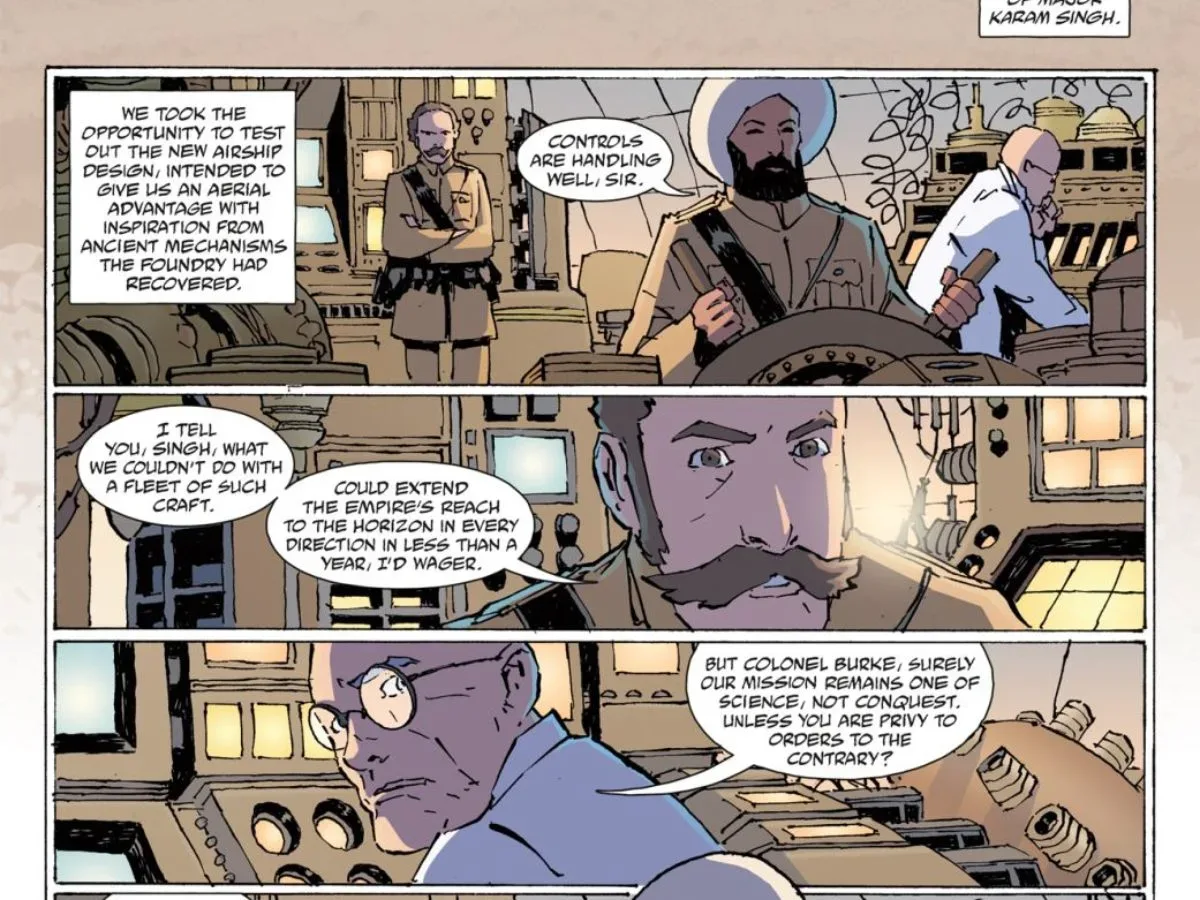
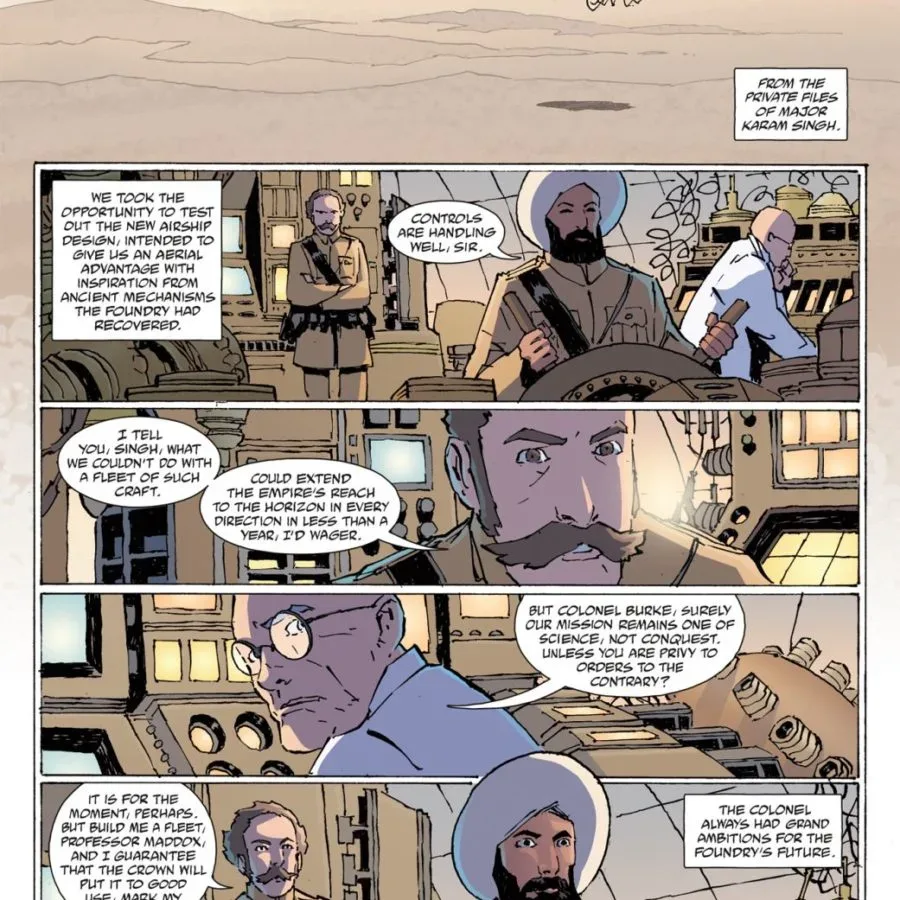
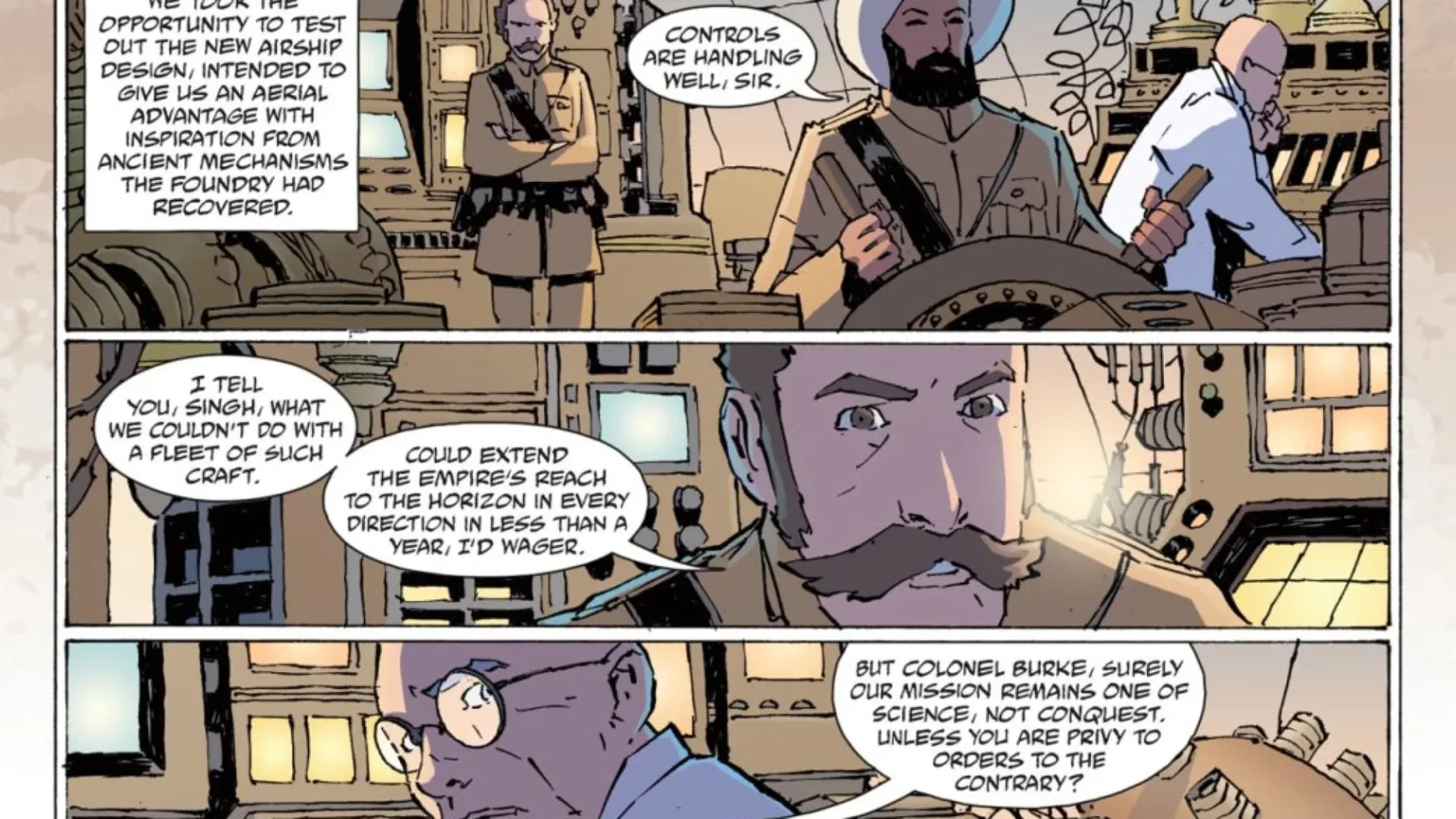
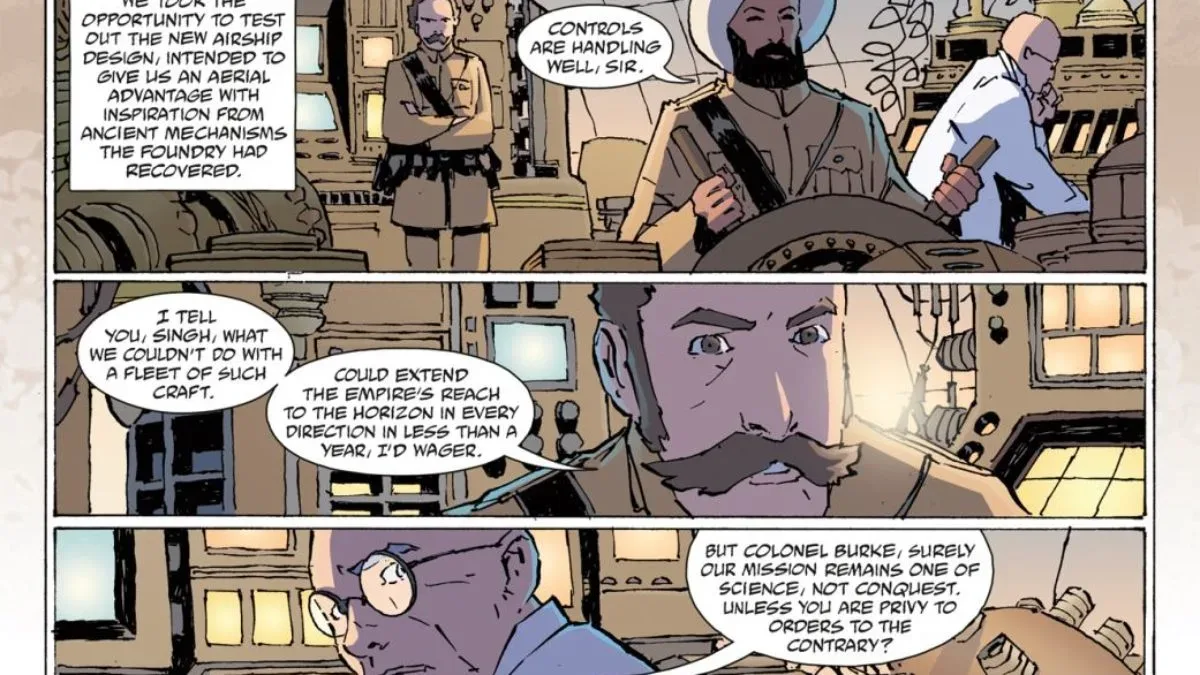
The early pages establish a sharp contrast between confidence in the Thundercloud and the reality that follows. Colonel Burke and Professor Maddox celebrate the airship’s potential to carry the Empire’s reach across the horizon. Soon afterward, the vessel is badly damaged, its occupants are moving through the hull as water rises, and one crew member is attempting to redirect ballast bladders to prevent a complete loss.
Ballast bladders are compartments used to manage buoyancy and balance. In this context, the effort to redirect them signals a practical, last-ditch attempt to control how the damaged airship sits and whether it can remain afloat. It also gives the sequence a welcome physical specificity: the characters are not merely announcing that the craft is in danger; they are trying to manage the systems that might buy them time.
Why the crash changes the shape of the story
Adventure fiction often uses vehicles as a shortcut to momentum. A ship, train, or airship gets a cast to the next location and provides a compact setting for conversation along the way. Here, the Thundercloud’s failure makes transport itself the main dramatic problem. The investigators cannot simply pursue the next supernatural lead while their base of operations is compromised.
That creates several practical implications for the issue without requiring assumptions about where the story will ultimately go. First, the group’s resources are suddenly fragile. The airship had represented mobility and presumably a controlled environment for a long-range expedition. Damage and flooding make equipment, communication, supplies, and safe passage concerns rather than conveniences.
Second, the crisis tests whether the people aboard can work across professional and personal lines. The series joins figures from different corners of the Hellboy setting, and emergencies are an effective way to show what a crossover team actually looks like in action. Expertise only matters if it can be applied under pressure; hierarchy only helps if someone can make decisions while the plan is collapsing around them.
Finally, the event puts the expedition’s stated ambitions in a more critical light. A declaration that an airship can extend an empire’s reach may sound triumphant at departure, but a shipwreck exposes the vulnerability underneath the rhetoric. The distinction between exploration and expansion is likely to sit close to the background of this premise, particularly when powerful technologies are being sought in places with their own histories and consequences.
Roberson and Mitten reunite for a compact series
Roberson returns to the Hellboy universe for the project, while Mitten supplies the interiors and cover art. The four-issue length gives The Foundry a deliberately contained structure: it has enough space to establish a world-spanning mandate, assemble its investigators, introduce a mystery, and make the early journey go catastrophically wrong, without presenting itself as an open-ended run.
That limited format may also make the status of the attack especially important. With only four issues, the identity and purpose of the unseen foe are not incidental details. They are likely to shape how the series’ broader interest in supernatural technology becomes personal for the team aboard the Thundercloud.
Readers watching the current wave of supernatural and espionage-flavored comic premises can also find a different kind of mystery in Ghost of a Ghost #1’s psychedelic spy setup. The Foundry, however, grounds its immediate suspense in a more direct predicament: the people assigned to study dangerous wonders have become stranded inside the failure of their own remarkable machine.
What to know before issue #2
- Release date: September 23, 2026.
- Publisher: Dark Horse Comics.
- Format: Issue #2 of a four-issue miniseries.
- Creative team: Chris Roberson, Christopher Mitten, Michelle Madsen, with a cover by Christopher Mitten.
- Story focus: Paranormal investigators from Witchfinder and the British Paranormal Society search for supernatural-powered technologies around the world.
- Immediate conflict: The Thundercloud is attacked by an unseen foe and goes down, leaving those aboard to deal with the flooding wreck.
- Specs: 32 pages, T+, $4.99.
The early crisis makes #2 a pivotal installment for the miniseries. The Thundercloud is no longer only the team’s method of travel; it is the evidence that their assignment has attracted danger before the investigation has properly found its footing. Whether the attacker is tied to the supernatural technologies being pursued remains unconfirmed, but the issue’s survival scenario ensures the investigators have no safe distance from the mystery.