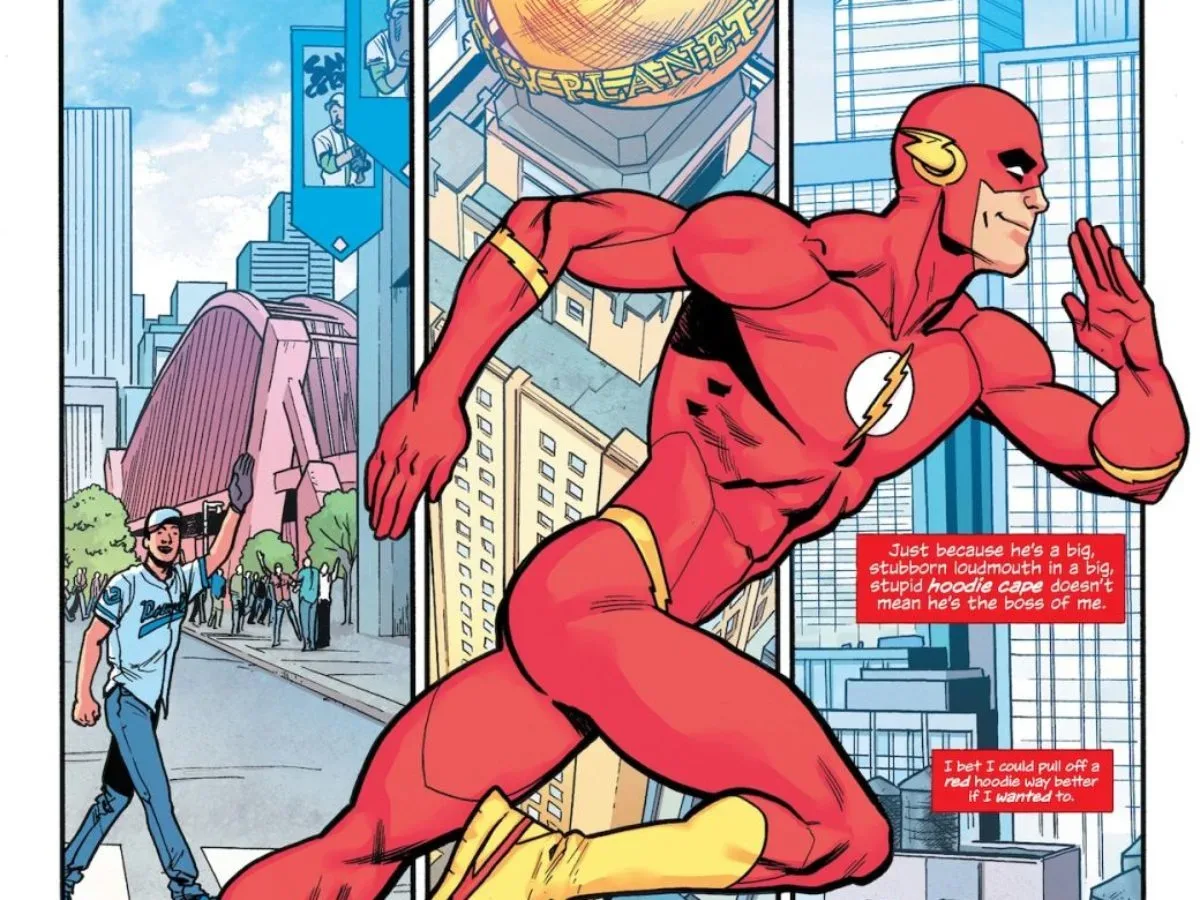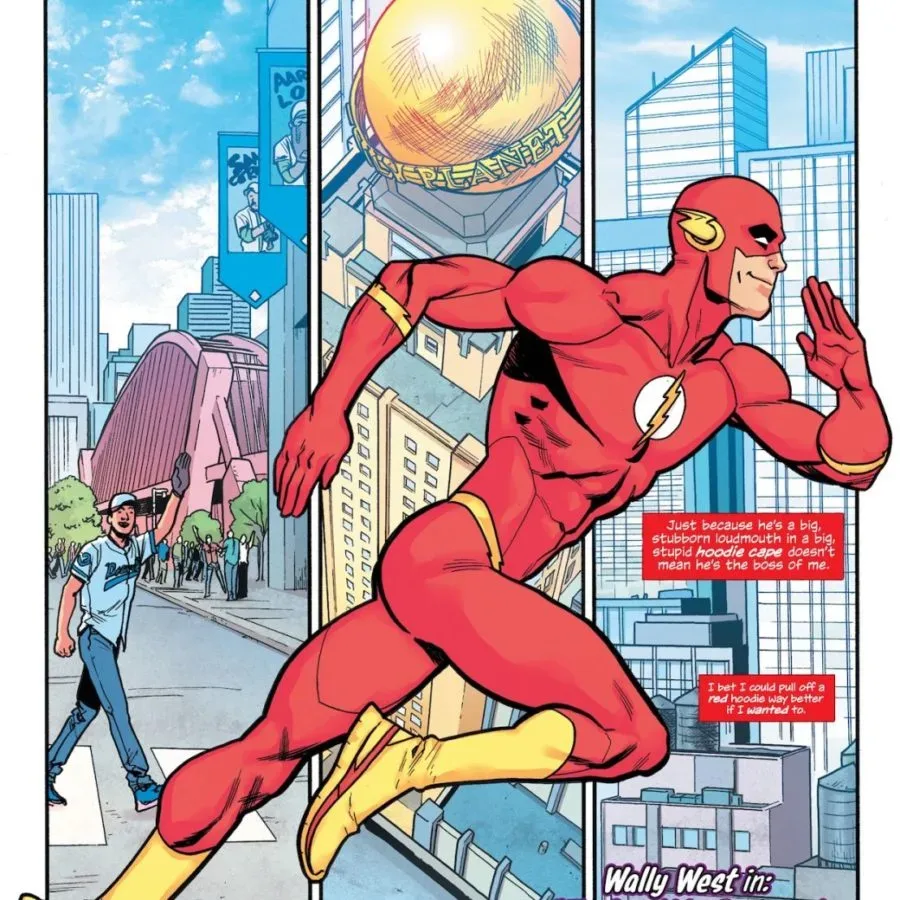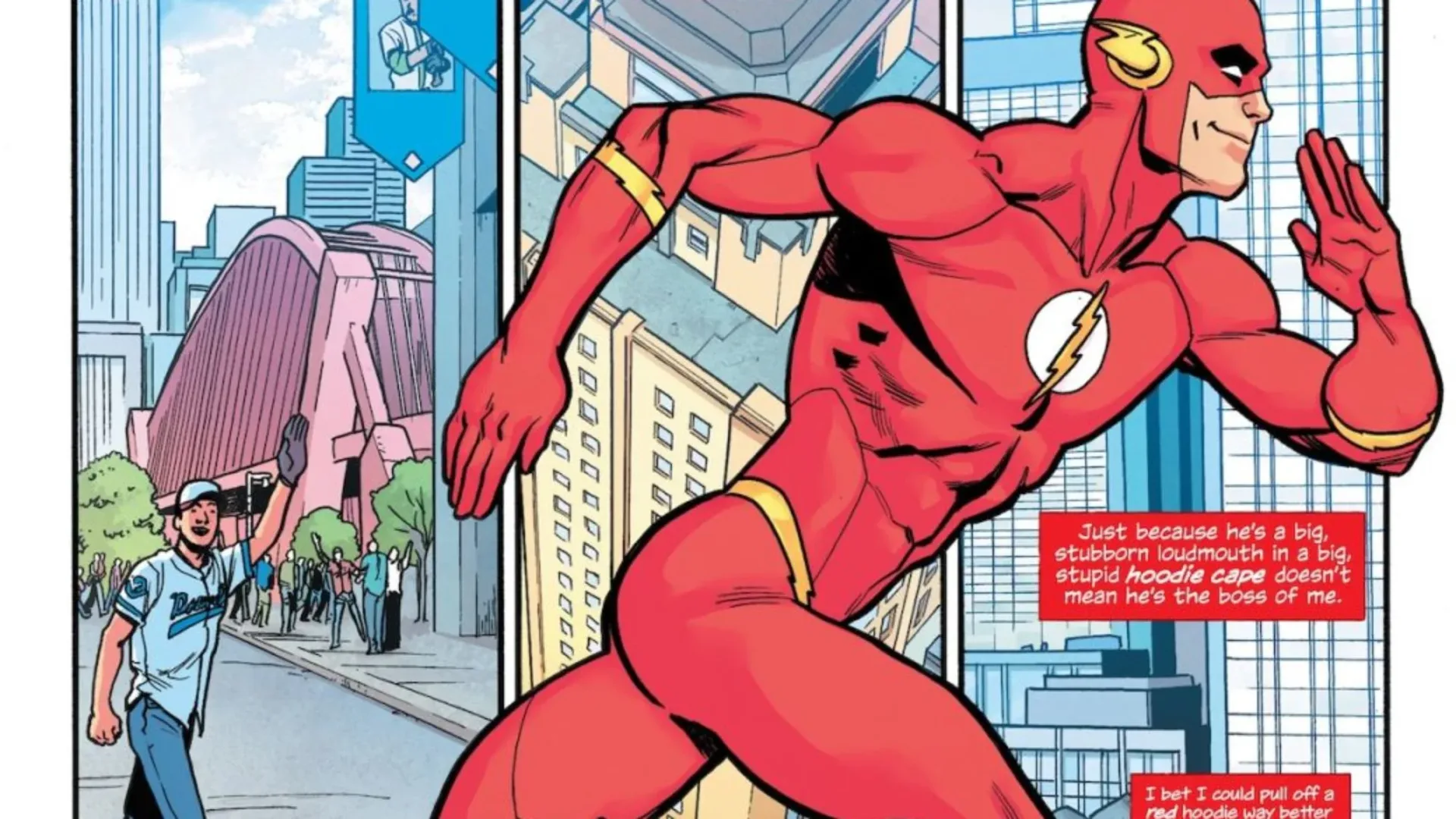
Wally West’s expanding role gets an appropriately impossible-looking stress test in The Flash #37. The issue, written by Ryan North with art and cover art by Gavin Guidry, sends the Scarlet Speedster into a crisis spread across Central City, Keystone City and Metropolis. The central hook is not merely that three emergencies happen at once. It is that Wally’s growing ability to see disasters before they occur gives him a chance to get ahead of all three.
That ability is called the Flashes of Insight, and the new issue pushes it further than before. Wally can apparently look farther into the future, identifying accidents and crimes early enough to prevent them rather than simply arriving in time to contain the damage. The immediate example is a coordinated assault on three bridges in three cities. It is a massive logistical challenge even for a hero defined by speed, and it places the emphasis on prediction as much as movement.
The Flash #37 is scheduled to arrive in comic shops on September 23, 2026. The standard edition carries a listed suggested retail price of $3.99. Variant covers by Ejikure and Juni Ba are also listed at $4.99 each.
What “Flashes of Insight” mean for Wally West
Precognition is the ability to perceive events before they happen. In superhero stories, that power changes the nature of a conflict. A conventional rescue story asks whether the hero can reach danger quickly enough. A precognitive rescue story asks whether the hero can correctly interpret what is coming, decide what deserves intervention, and act without creating a worse outcome.
For a speedster, the combination is especially potent. Wally is no longer responding only to a call for help or a visible catastrophe. If his insight gives him meaningful warning, he can plan routes, locate threats, protect bystanders and possibly identify the people behind an attack before the event fully unfolds. The premise makes his speed feel less like a single superpower and more like the final stage of a larger emergency-response process: see the danger, understand it, then get there.
The three-bridge attack is built to demonstrate the scale of that idea. It is not framed as one bridge incident with a clear center of attention. It is simultaneous, distributed across separate cities, and seemingly designed to force a choice. Wally’s abilities may enable him to avoid making that choice at all, but the solicitation also makes clear that hostile forces are paying attention to his new status quo.
That matters because a hero who can prevent catastrophes before they begin becomes a direct threat to anyone depending on surprise, panic or carefully timed spectacle. The opposition in this issue has not been identified in the available details. What is established is their objective: Wally’s increasingly effective use of future sight needs to stop.
Three cities, one impossible response time
Central City and Keystone City are strongly associated with the Flash side of DC’s world, while Metropolis broadens the mission into Superman’s home territory. The setup therefore makes Wally a protector whose responsibilities extend beyond one familiar patrol area. The description refers to him as the savior of three cities, though it also playfully acknowledges that the count depends on how those connected locations are viewed.
In practical story terms, expanding a hero’s territory raises the stakes without requiring a purely physical escalation. A single threat can be enormous, but three carefully coordinated threats create uncertainty. Is the bridge attack the main plan or a diversion? Are the attacks connected by a shared goal beyond destruction? Does the knowledge Wally receives show the complete picture, or only flashes that he must assemble under pressure?
Those are questions suggested by the premise rather than confirmed plot points. Still, they reveal why the new power is more interesting than a simple upgrade. Foresight can give a hero more information, yet information can carry its own pressure. Seeing a crisis in advance means knowing that failure may be avoidable—and having to live with every difficult call made while trying to avoid it.
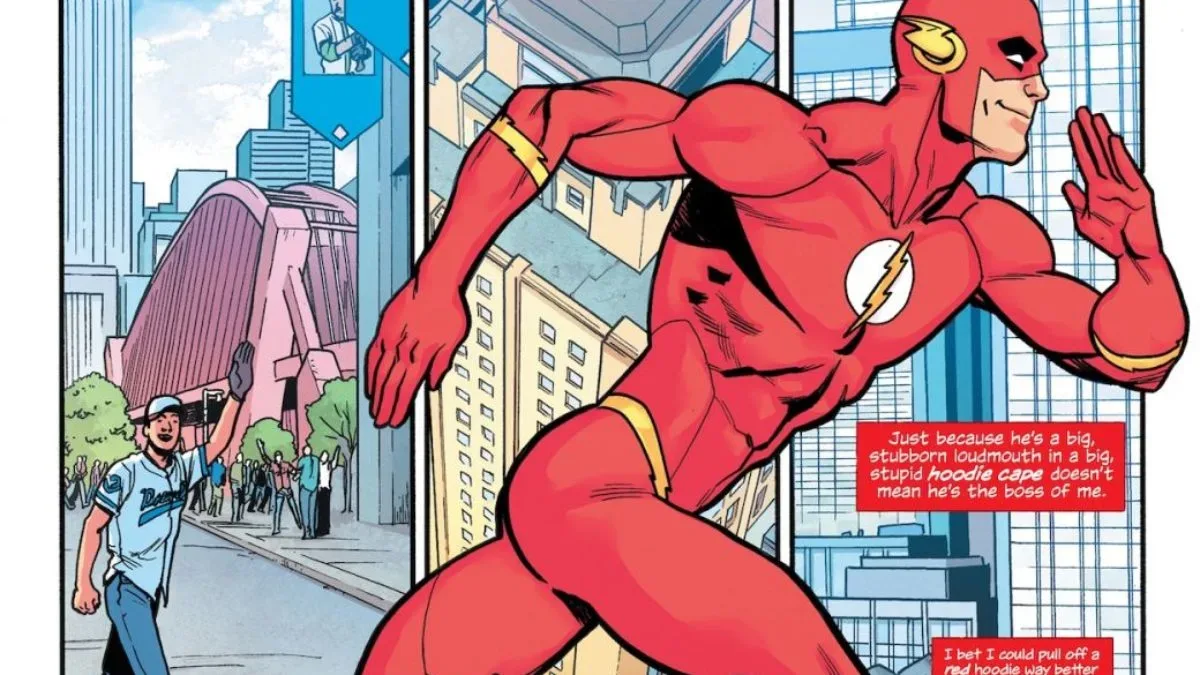
The preview material reportedly depicts Wally moving between city scenes before racing along a highway, with images of bridges in danger. That visual approach suits a plot about simultaneous events. Intercut locations can make readers feel the distance between emergencies, while Flash’s movement can collapse that distance on the page. Guidry’s art has the task of making Wally’s response look thrilling while preserving a clear sense that these are separate crises with real consequences.
The Batman question is more than a gag
One notable beat has Wally asking, “What would Batman do?” It is a natural line for a story in which speed alone is not enough. Batman is often associated with preparation, contingency planning and reading an opponent’s strategy. Wally is not expected to turn into Batman, nor would that be the point. The question instead underlines a tactical shift: faced with a coordinated operation, the Flash may need to think like an investigator as well as run like a rescuer.
That framing creates a useful contrast. Batman’s approach is often about anticipating threats through evidence, preparation and planning. Wally’s Flashes of Insight are supernatural or superhuman forewarning. Both tools concern anticipation, but they carry different limits. Preparation depends on what has already been learned; a vision of the future must be interpreted and acted upon before the moment passes. The appeal of the issue may lie in seeing Wally apply his own instincts to a Batman-style problem.
It also puts a little extra weight on the enemies’ reaction. If they are attempting to stop Wally specifically because he is preventing disasters ahead of time, then the conflict is not only about the bridges. It is about control of the future. Wally’s gift has begun interfering with plans before those plans can become reality, which makes it inherently disruptive to any adversary who expects events to proceed unnoticed.
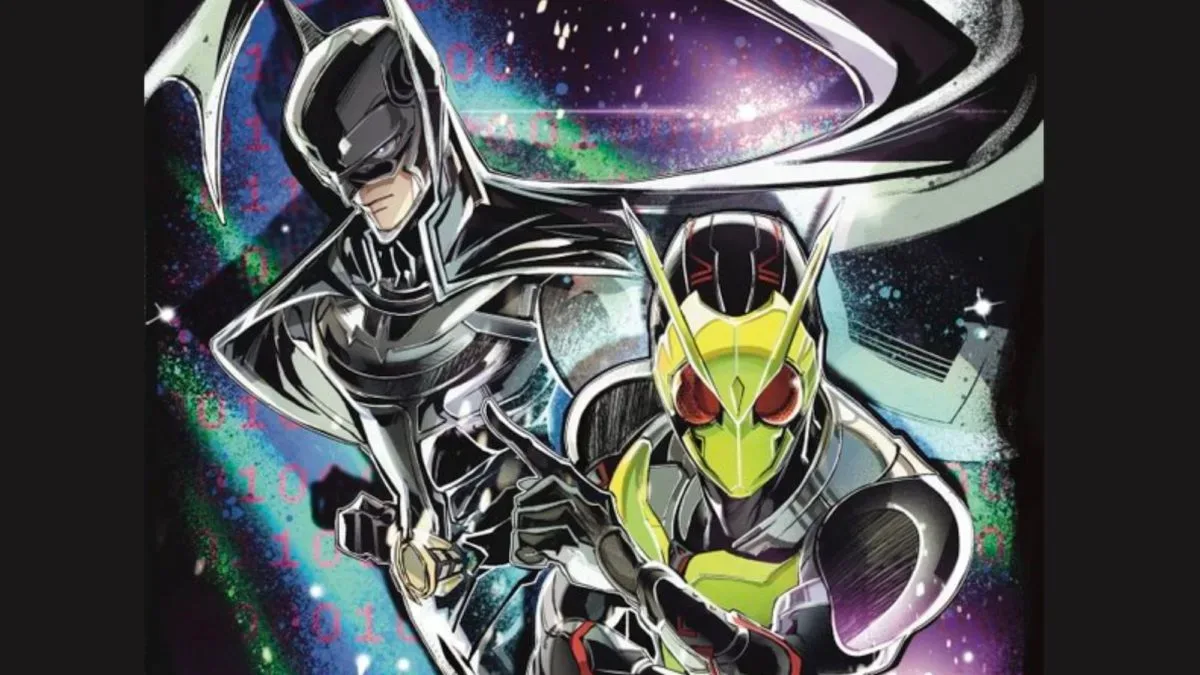
Readers looking for more DC crossover-adjacent comic news can also see the details on Batman x Kamen Rider Zero-One.
Why prevention raises the dramatic stakes
At first glance, stopping crime and accidents before they happen sounds “objectively great,” as Wally himself sees it. The issue’s premise agrees with that basic instinct: preventing a bridge explosion is better than cleaning up after one. But superhero fiction tends to find drama in the complications surrounding an otherwise admirable power.
First, seeing danger is not automatically the same as understanding it. A future image may reveal an outcome without explaining motive, timing or the complete network behind it. Second, simultaneous threats turn even a powerful ability into a resource-management problem. Wally may be fast enough to save people at several sites, but the people orchestrating the crisis may be counting on him to commit his attention somewhere. Third, stopping visible harm can expose a hero to the less visible source of that harm.
The solicitation’s mention of forces determined to stop Wally opens the door to that larger contest. No names, methods or motivations have been confirmed, so readers should not assume a particular villain or conspiracy. What can be said is that the antagonistic pressure is directly tied to Wally’s recent success. The better he gets at preventing disasters, the more urgent the pushback becomes.
This gives The Flash #37 a potentially satisfying double structure. On the surface, there is a race against three bridge attacks. Underneath, there is a challenge to Wally’s evolving identity. Is he simply a hero who arrives first, or is he becoming a guardian who can reshape events before anyone else realizes a crisis has begun?
Release and cover details
- Title: The Flash #37
- Publisher: DC Comics
- Release date: September 23, 2026
- Writer: Ryan North
- Artist and main cover artist: Gavin Guidry
- Standard edition SRP: $3.99
- Ejikure variant cover: $4.99
- Juni Ba variant cover: $4.99
The issue’s pitch is direct but flexible: Wally West has become capable of looking farther ahead, and that has allowed him to protect three cities at once. The bridge attacks provide a visible proof of that achievement. The enemies trying to halt him ensure that the very thing making Wally more effective will also make his life harder.
For readers following the current Flash direction, this is a clear checkpoint issue. It tests whether Flashes of Insight are merely a convenient way to stage bigger rescues or a development that will force Wally to approach threats differently. The answer will begin arriving when The Flash #37 reaches shops on September 23.