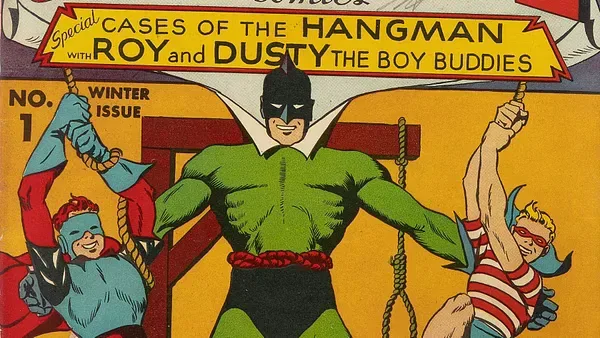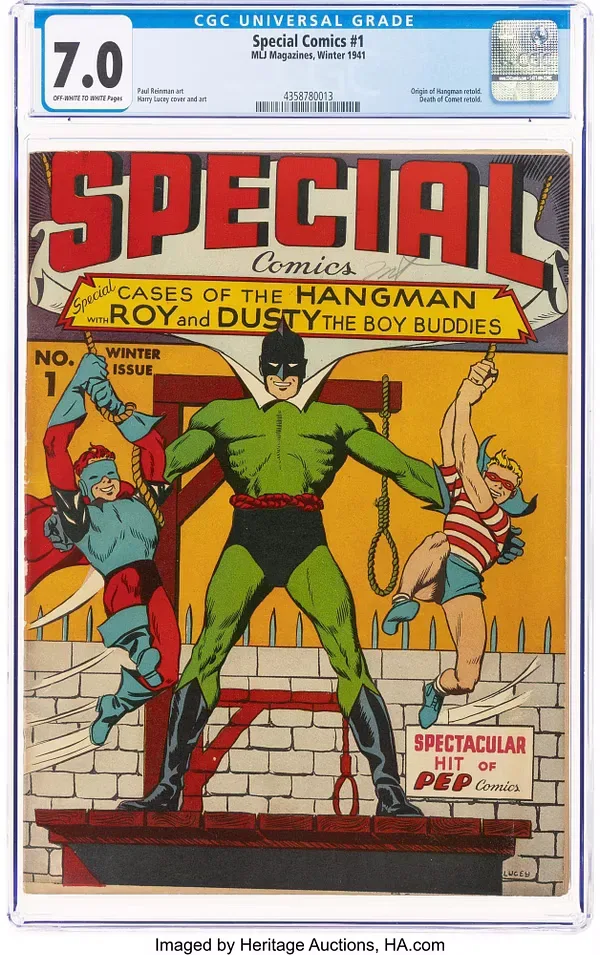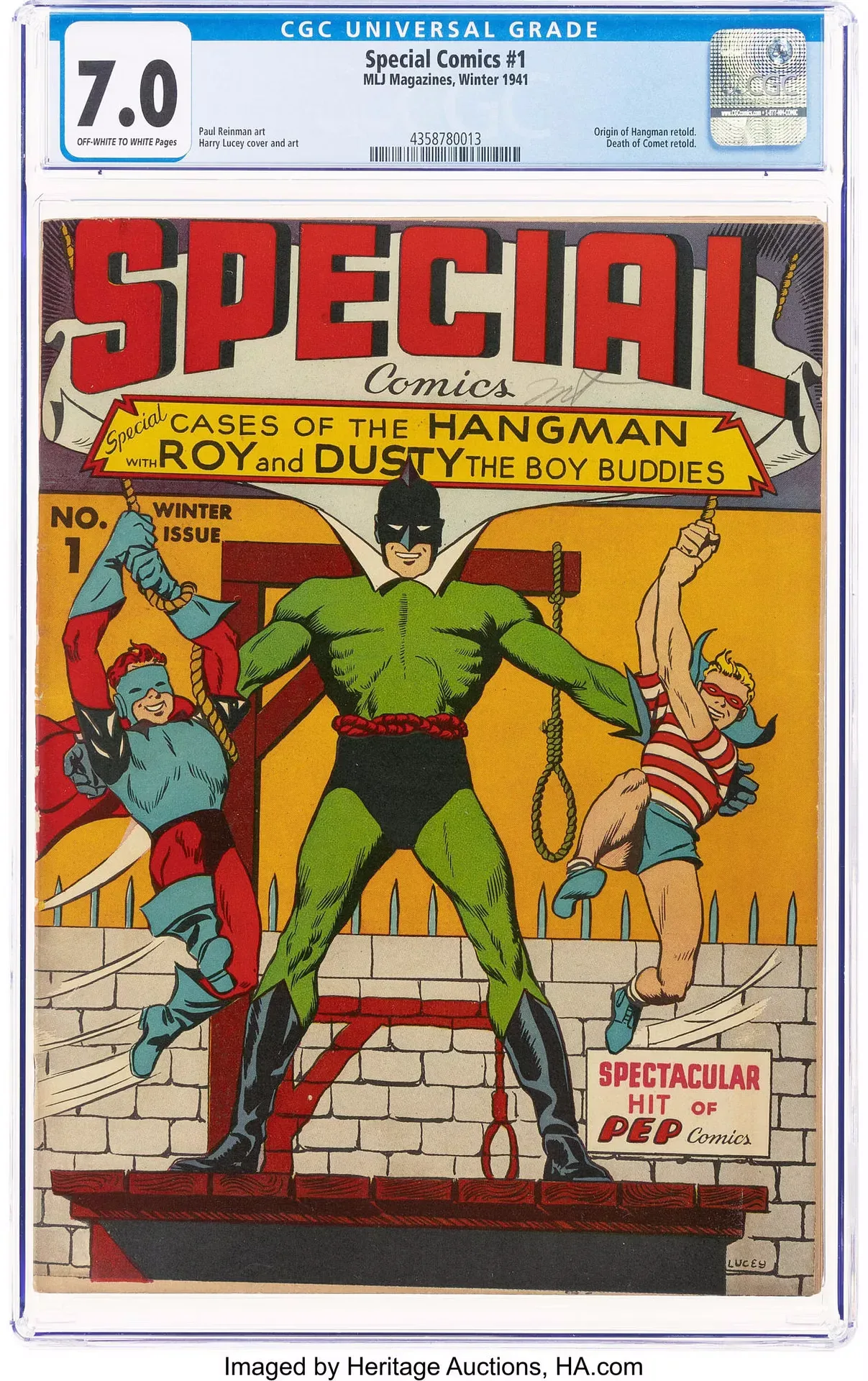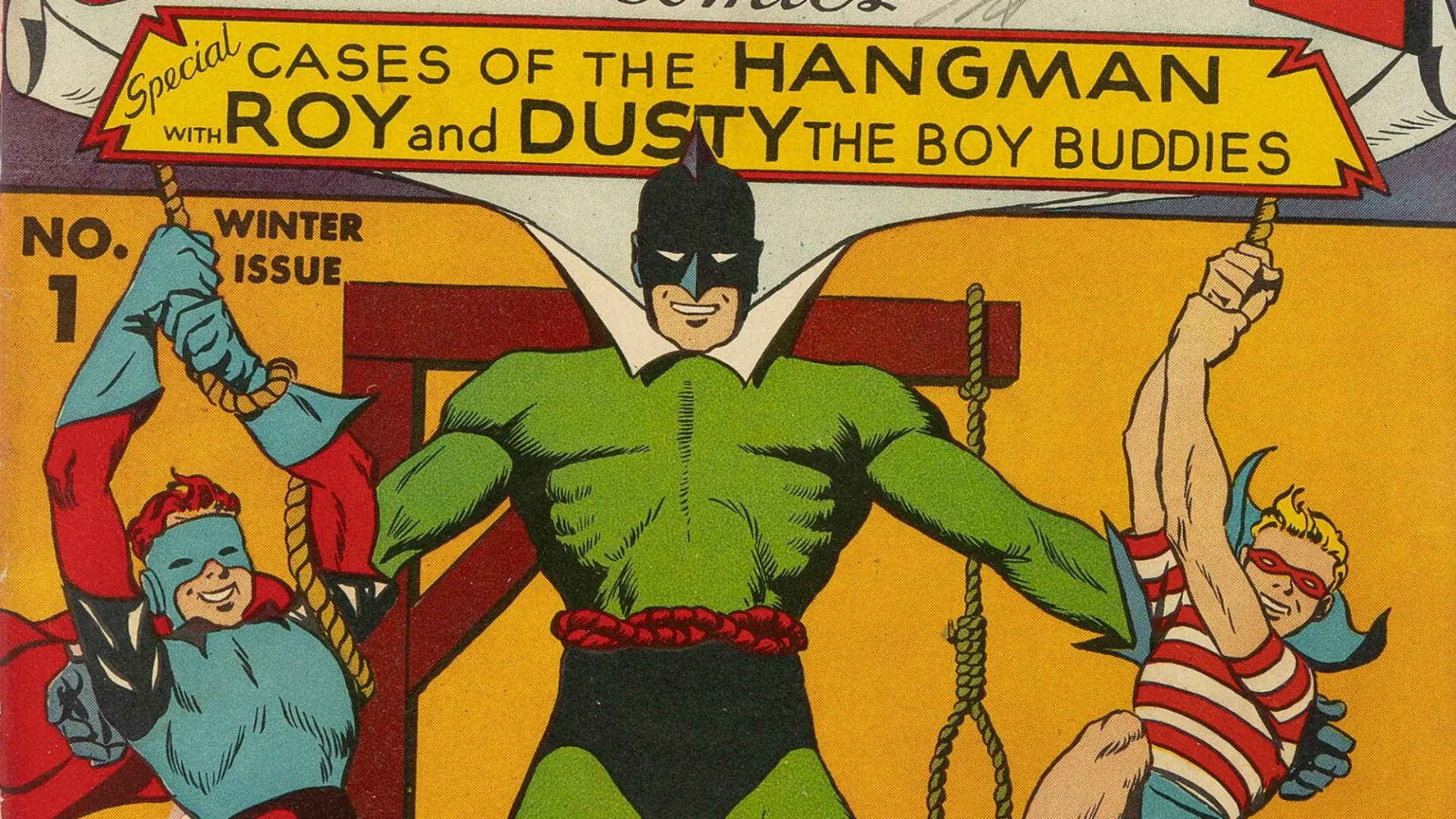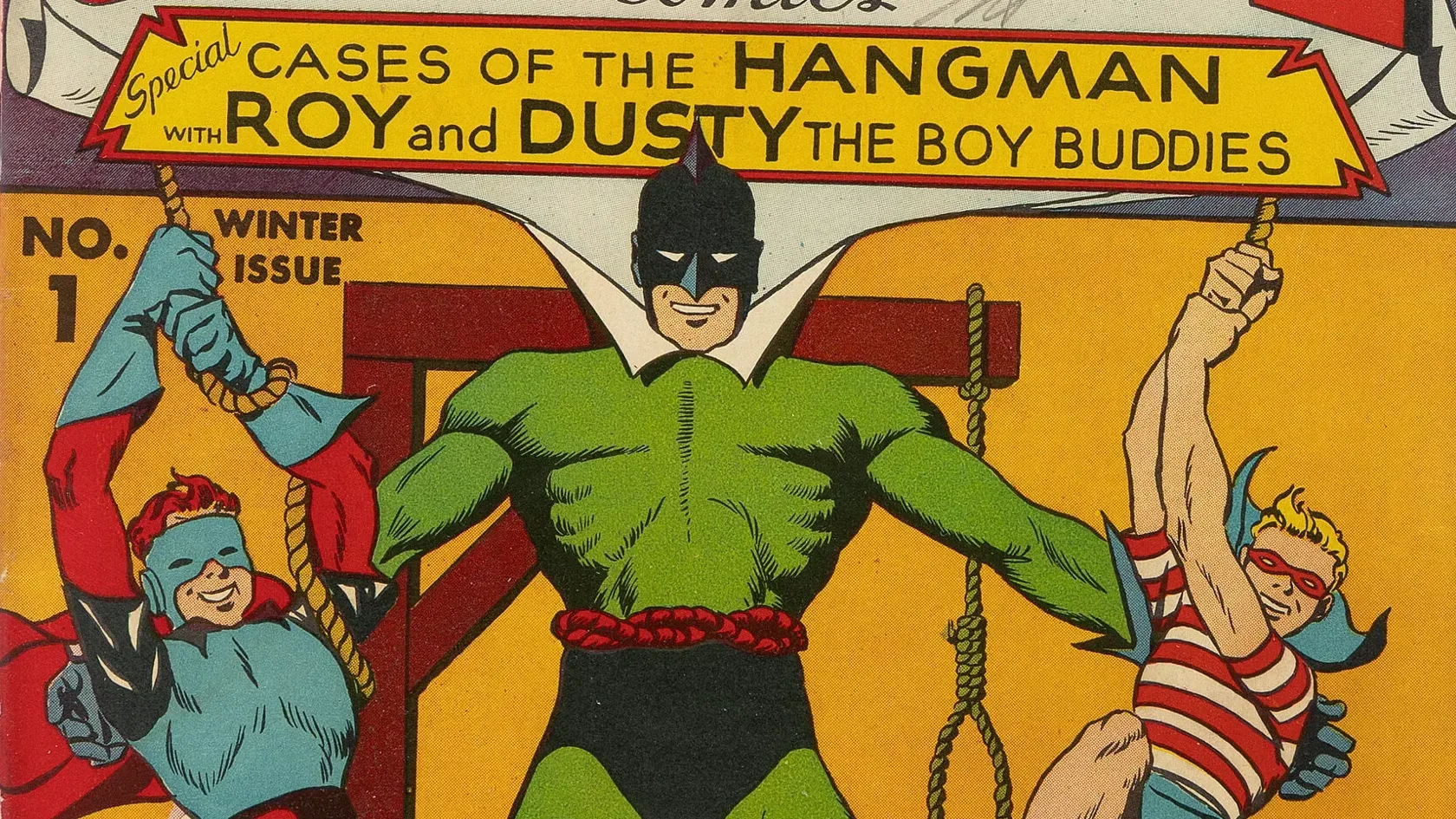
Special Comics #1 occupies a particularly odd place in Golden Age comic-book history. Published by MLJ in 1941, it is the solo-series launch of the Hangman, but not under the title readers had initially been told to expect. Publisher bulletins first advertised The Hangman Comics; the published first issue instead arrived as Special Comics #1. The next installment then adopted the more straightforward Hangman Comics #2.
That makes the book more than simply an early issue featuring a costumed hero. It is a one-issue title anomaly tied to a character with an unusually severe starting point: Bob Dickering becomes the Hangman after the murder of his brother, John Dickering, better known as the Comet. The issue revisits that premise and moves into the Hangman’s “special case” stories, while also carrying work associated with Harry Lucey and Paul Reinman.
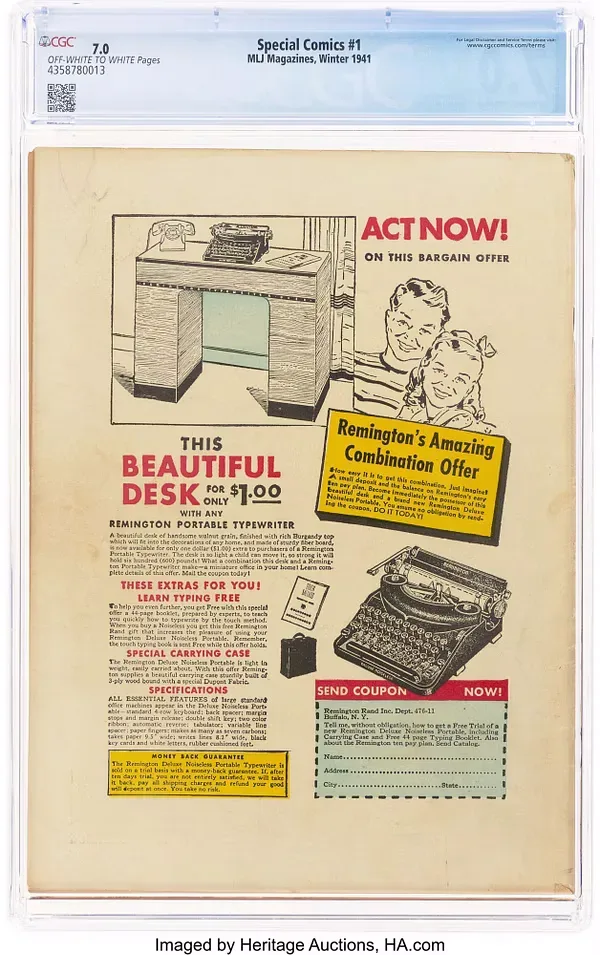
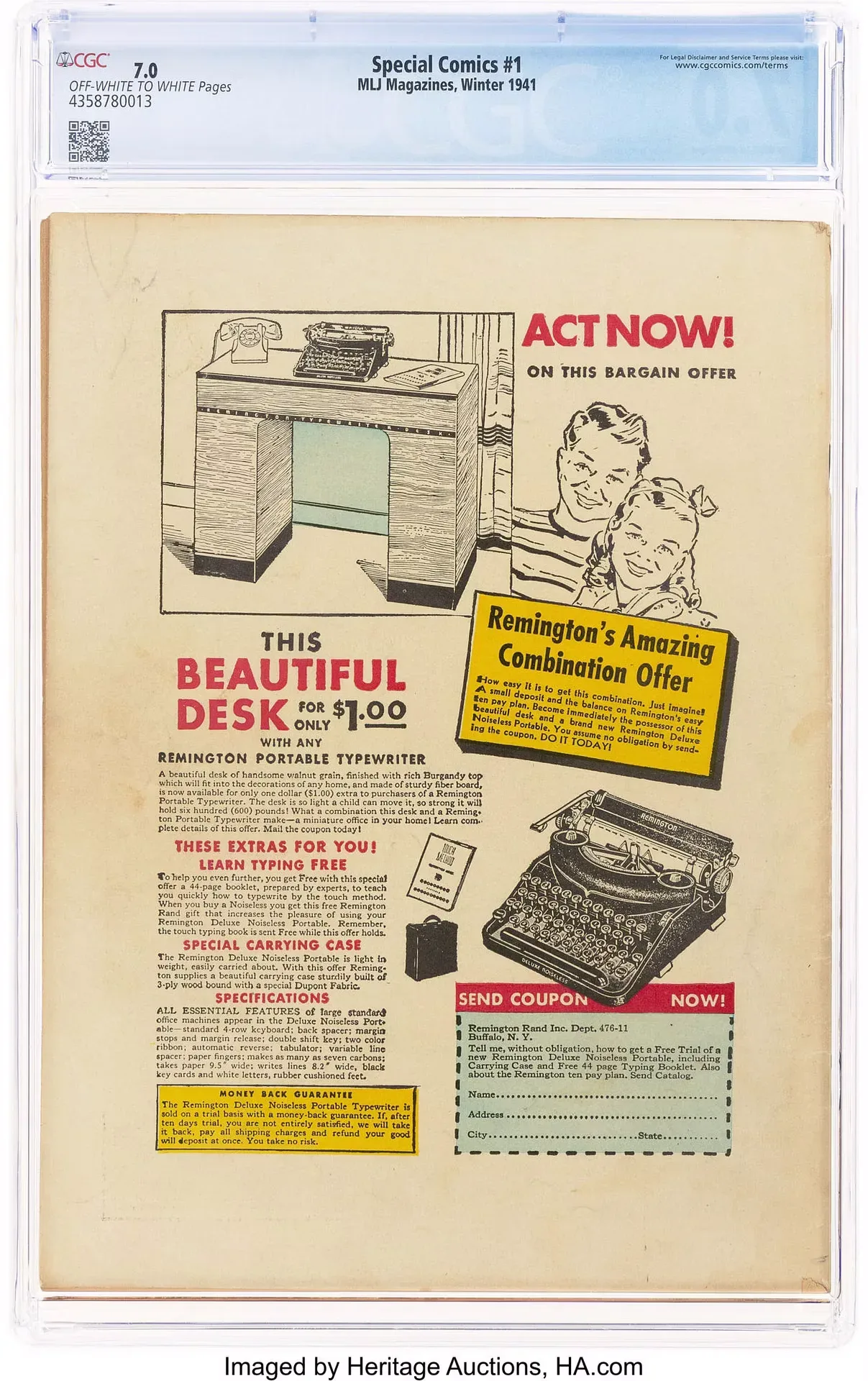
A CGC FN/VF 7.0 copy with off-white to white pages is scheduled for the November 5, 2026 Golden Age Century Comics Showcase Auction VI, designated #40378. For collectors, the appeal is not just that the comic is old or scarce. It combines a character-series launch, a short-lived masthead, a documented pre-publication title change, and a formative story from one of MLJ’s darker superhero concepts.
The title changed before the series could settle
MLJ’s own promotional material charts the shift. An editorial bulletin in Pep Comics #24 said presses were running on The Hangman Comics, presenting it as a coming release around Christmas. Yet the subsequent bulletin in Pep Comics #25 calls the magazine Special Comics and connects that name to the heroes’ “special cases.”
The reason for the revision has not been established. That uncertainty matters. It would be easy to turn a late title change into a firm story about production trouble, marketing strategy, or a rights concern, but the available evidence does not identify the cause. What can be said is narrower: the publisher publicly used one name, issued the debut with another, and then continued the numbering under a third presentation, Hangman Comics.
Copyright timing adds to the impression that the switch occurred close to publication. Pep Comics #24 reached newsstands two weeks before Special Comics #1, despite its claim that the presses were already running. That does not prove exactly when a production decision was made. It does, however, show why the book’s naming history remains so notable. The evidence preserves an unusually visible gap between a publisher’s announced plan and the comic readers ultimately saw.
Why a one-issue masthead matters
For comic collectors, a masthead is the title and design identity presented on a comic’s cover. A one-issue masthead can make identifying a series launch less intuitive than simply locating issue #1. Here, Special Comics #1 is the first solo Hangman series issue, while Hangman Comics #2 is its direct continuation. The continuity is not hidden, but the title transition can cause the debut to be overlooked when readers or buyers search only for the later series name.
That is a different kind of significance from a first appearance. The Hangman had already entered MLJ’s line in Pep Comics #17. Special Comics #1 is important because it marks his move into a solo title and because that move happened under a cover name used only once. It is best understood as a solo-series launch with a transitional title rather than as the character’s introduction.
A replacement hero built around grief and retribution
The Hangman’s premise emerged from the Comet’s death. Bob Dickering takes up crime-fighting after John Dickering is murdered, making the character’s launch explicitly rooted in loss and revenge. That setup distinguished him from a cleaner, more celebratory superhero handoff. The series was not merely introducing a new masked figure; it was asking readers to follow the brother of a hero who had been removed from the line.
MLJ addressed the Comet’s death in an inside-front-cover bulletin in Pep Comics #19, after readers reacted to it. The company’s position was that John Dickering had unintentionally killed a police officer and therefore faced retribution himself. Whether or not a reader accepts that reasoning, the bulletin demonstrates that the event was controversial enough to require a response in the comics themselves.
MLJ’s bulletin argued that, even though the officer’s death was unintended, “retribution” had caught up with John Dickering.
That framing helps explain why the Hangman carries such a forceful vengeance setup. The new hero does not enter a world untouched by consequence. His brother’s fate had been publicly defended by the publisher as moral punishment, and Bob’s answer is to become a crime-fighter. The solo issue recaps the origin before turning to the character’s special cases, giving new readers the basis for the identity while positioning the title as an ongoing adventure book.
In modern superhero publishing, continuity labels and character histories are often parsed with intense precision. Discussions around a story’s place in a wider canon can even become news in their own right, as seen in this look at a forthcoming discussion of DCU canon. Special Comics #1 offers a much earlier, tangible version of why those distinctions matter: its changing title complicates the simple question of what counts as the beginning of the Hangman’s solo run.
What is inside Special Comics #1
The comic’s importance is grounded in its publishing history, but it also has identifiable content. The Hangman material revisits the origin arising from the Comet’s death, then advances into the hero’s special-case format. That connection between the content and the temporary title is meaningful: Special Comics was not an arbitrary phrase in the publisher’s promotion, but language tied to the cases featured in the book.
The issue also includes Boy Buddies adventures associated with Paul Reinman. Harry Lucey is associated with the cover and interior art. For a book often discussed primarily as a Hangman key, that broader creative makeup is worth keeping in view. Golden Age anthologies and mixed-feature comics can gain their historical identity from the total package on the stands, not only from the lead feature that later becomes the main collecting focus.
It also contains a full-page advertisement for Jackpot Comics #4 that includes Archie among MLJ’s established characters. The ad places the issue at an interesting intersection in the publisher’s output. Around this period, MLJ had also introduced Archie in Pep Comics #22, with a bulletin explaining that laughter was needed in grim times. The contrast is sharp: the Hangman’s solo launch leans into bereavement, accountability, and revenge, while Archie was being framed as a lighter answer to the same larger mood.
That does not make Special Comics #1 an Archie comic, nor does the advertisement redefine the Hangman title’s purpose. It does provide useful period context within the issue itself. One MLJ publication could promote a cheerful new figure while its lead story centered on a hero born from a murdered brother and a predecessor’s disputed death.
Scarcity, grading and the upcoming copy
The CGC census lists 29 Universal copies of Special Comics #1. The listed population includes one copy graded 7.0 and six copies graded higher. A census is a count of comics submitted to a particular grading service and encapsulated under its records; it is not a complete count of every surviving copy. Raw, unsubmitted, privately held, restored, or otherwise differently classified examples may exist outside that number.
Still, the figure is useful context for the auctioned 7.0. The grade is described as FN/VF, shorthand for Fine/Very Fine, and the copy is noted as having off-white to white pages. Page-quality terms describe paper color and preservation characteristics, separate from the numerical assessment of the comic’s overall condition. Neither term alone settles a comic’s desirability, but both are standard pieces of information when an older book is offered for sale.
The practical takeaway is to identify the issue correctly before comparing copies or researching past sales. A search for Hangman Comics #1 will not lead to this solo debut, because the continuation begins at #2. Searching Special Comics #1, The Hangman Comics, and the Hangman’s solo-series history will better reflect the book’s unusual route to publication. Likewise, an auction listing’s numerical grade should be read alongside the stated page quality, certification details, and the fact that a census reflects only graded submissions.
An overlooked launch with a clear historical case
Special Comics #1 endures as a compelling MLJ artifact because several supported details converge in one place. It is the Hangman’s solo-series debut. It was promoted under the unused title The Hangman Comics. It appeared as Special Comics #1. Its continuation was renamed Hangman Comics #2. And its lead character grew from the death of the Comet, an event the publisher addressed directly after reader pushback.
Those facts do not solve the mystery of the title change, and they should not be used to invent one. They do establish why the comic is more than a curious naming footnote. It documents a rapid shift in MLJ’s presentation of a hero whose premise was already unusually dark, while preserving an early solo format that lasted under its published title for exactly one issue.