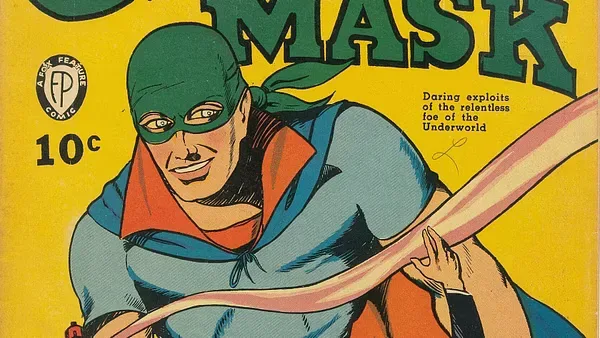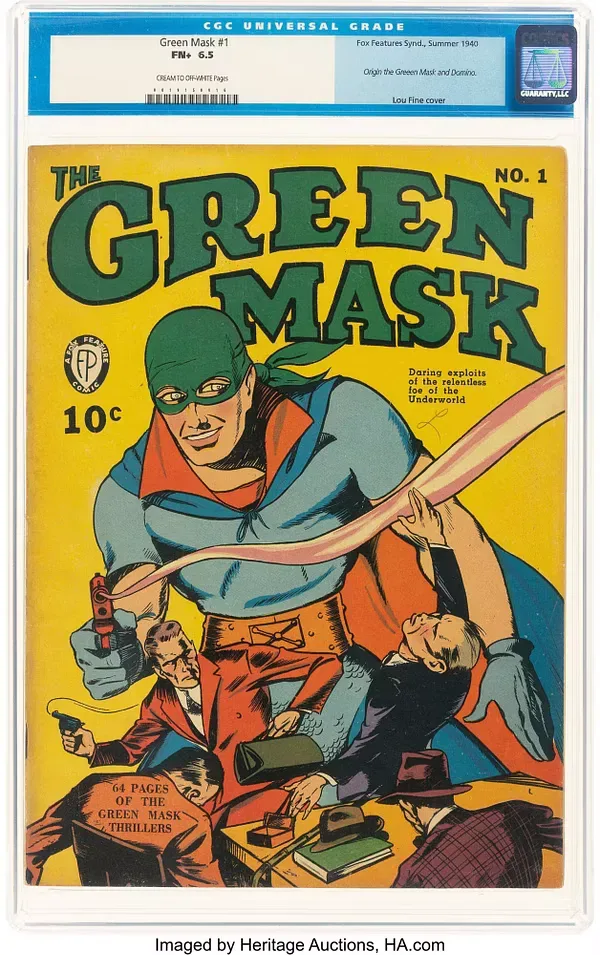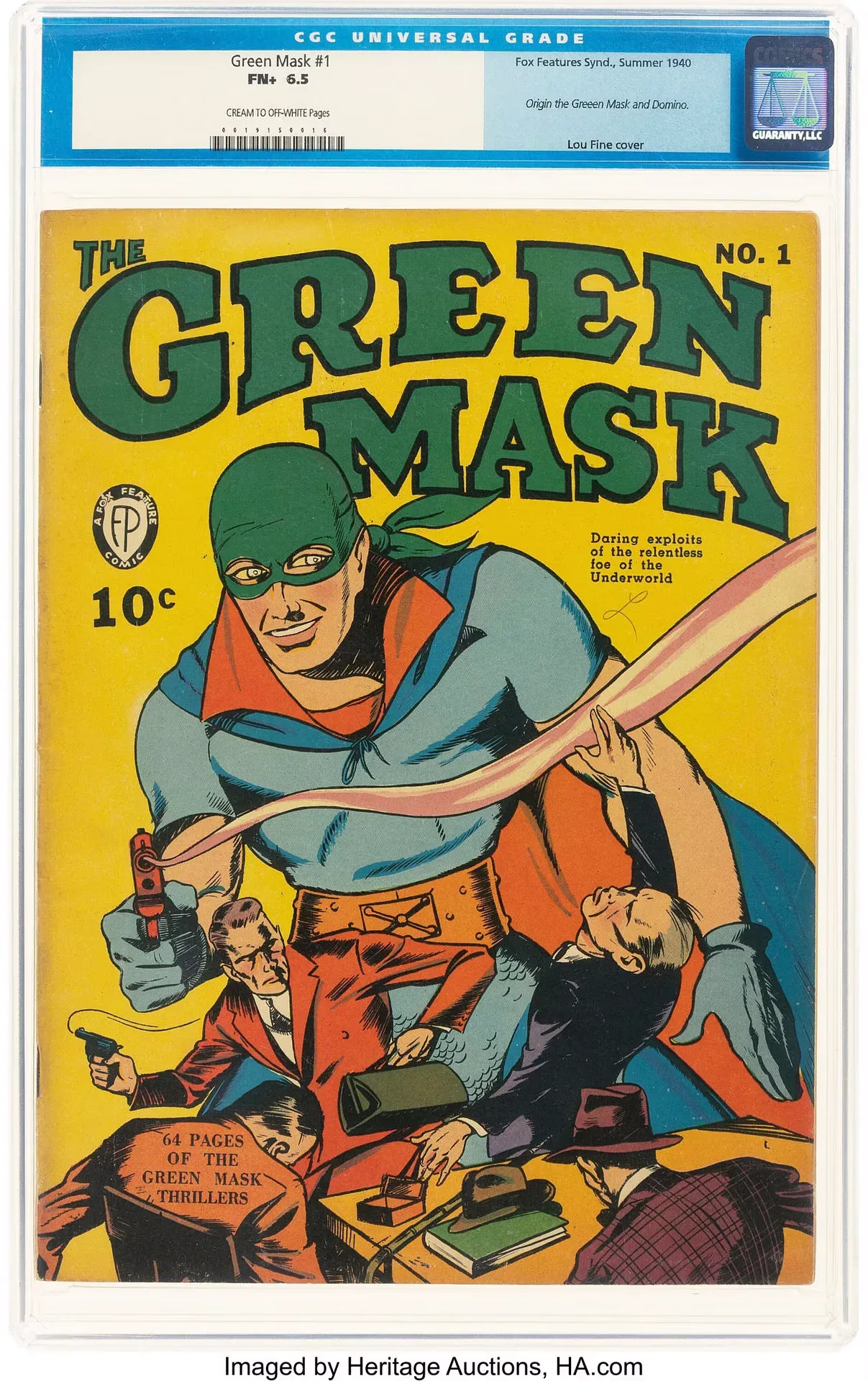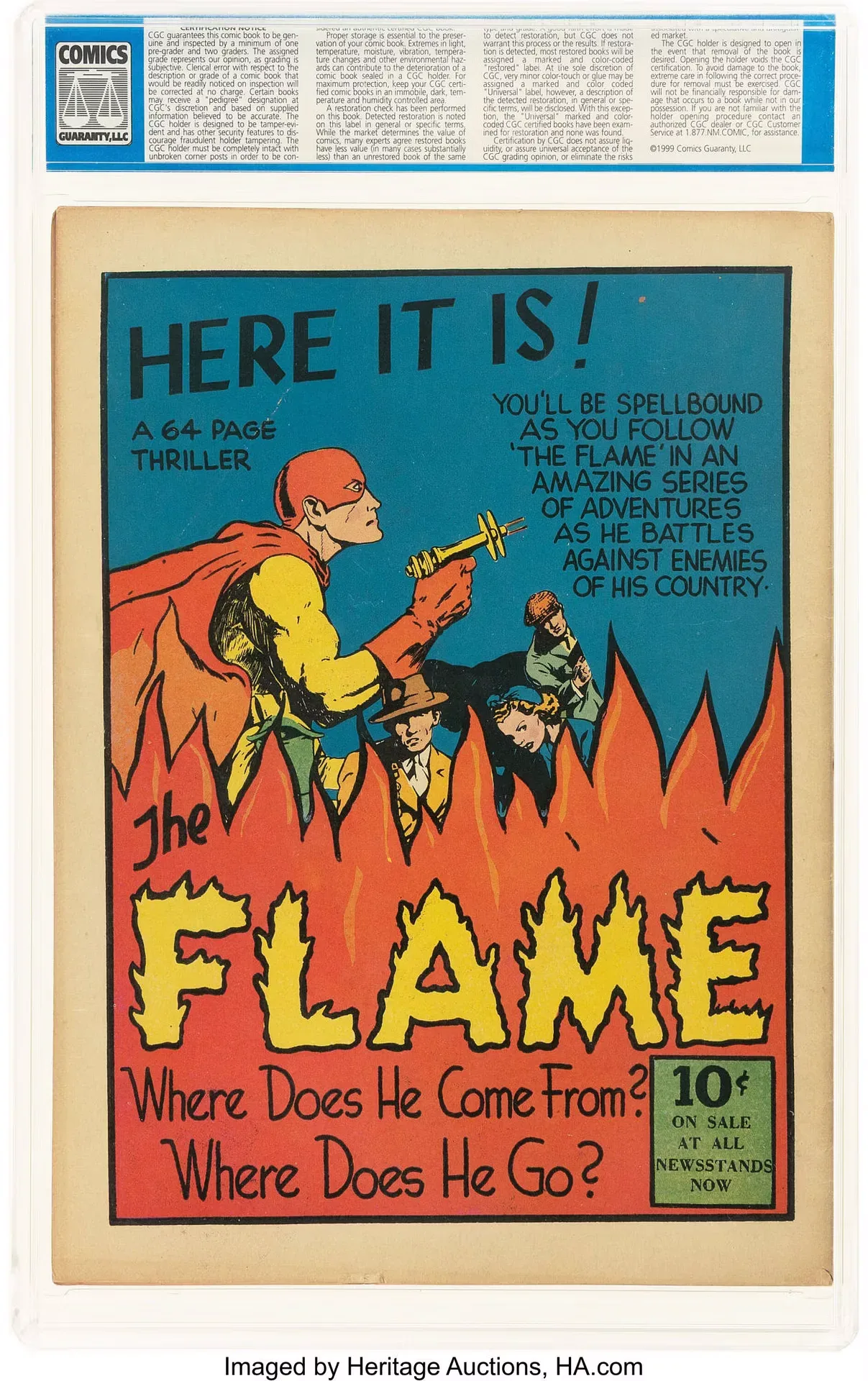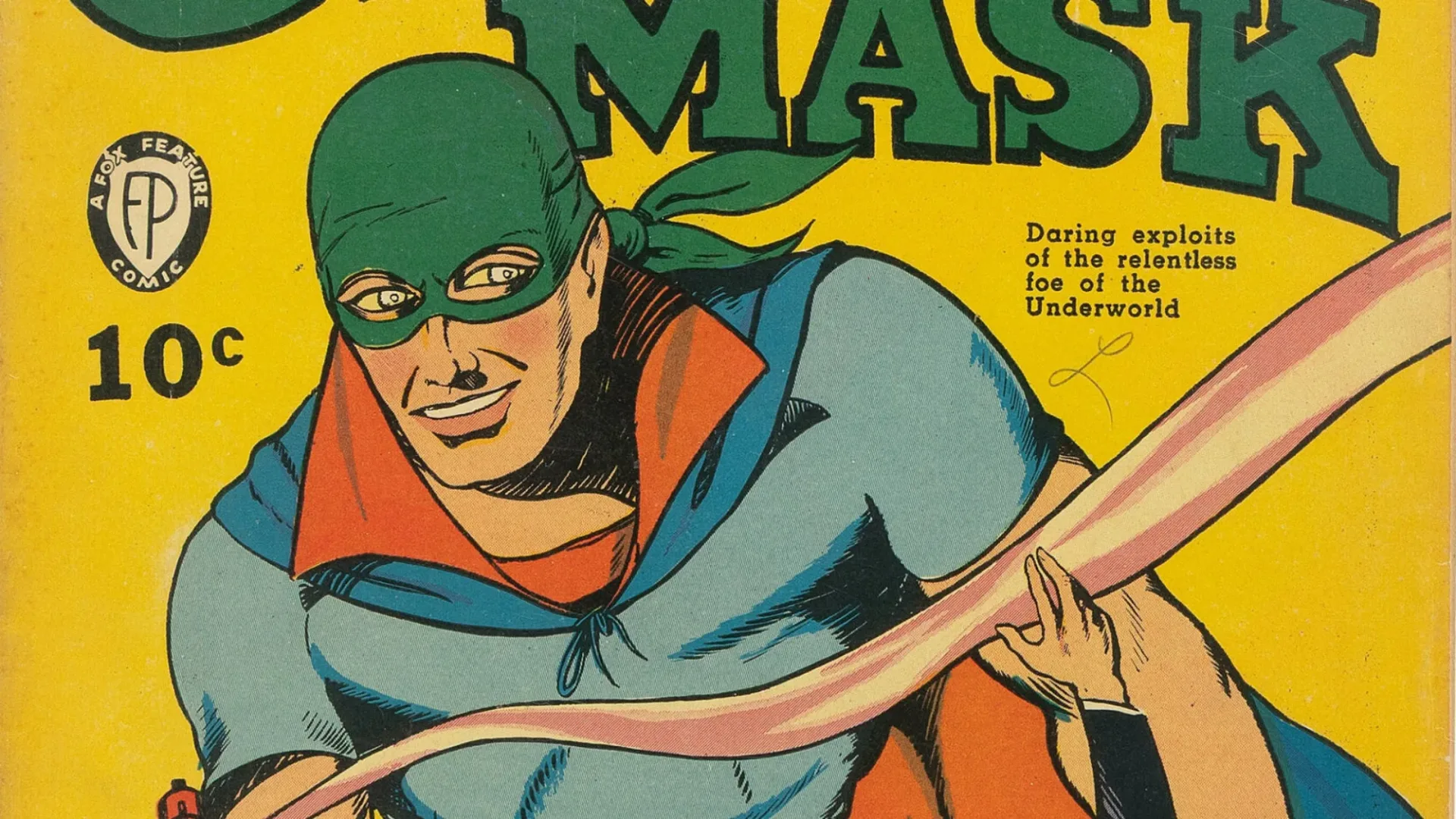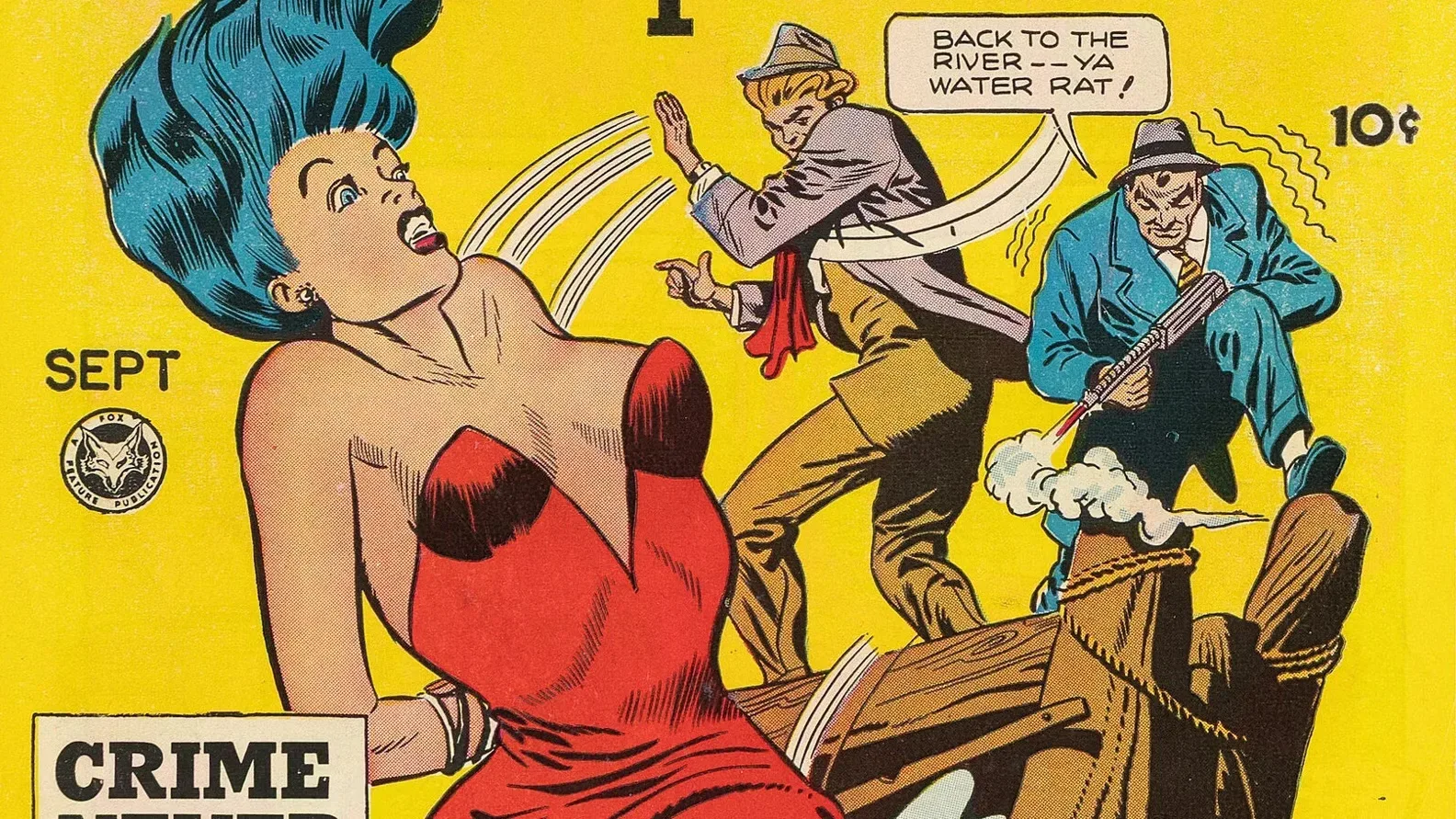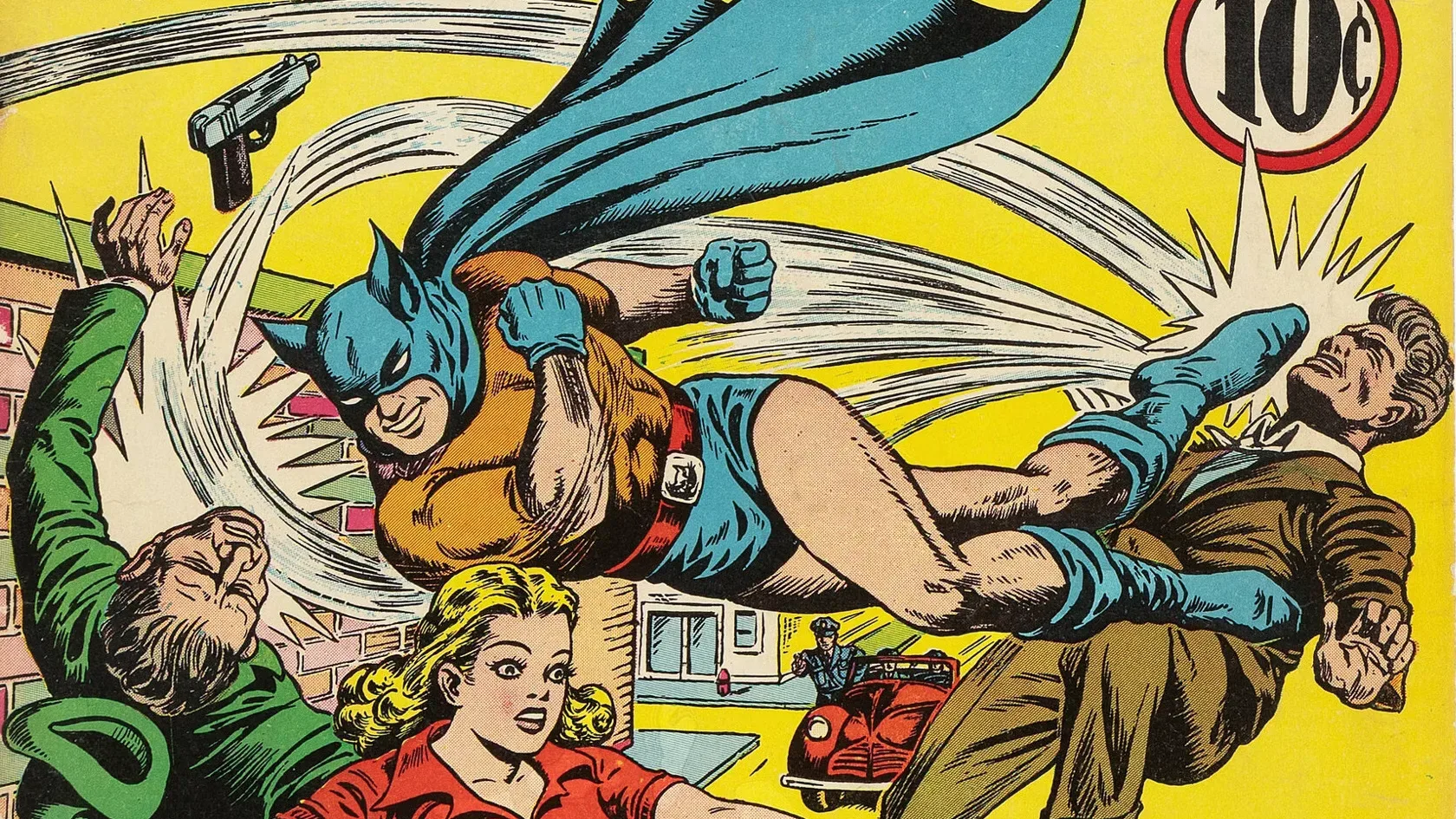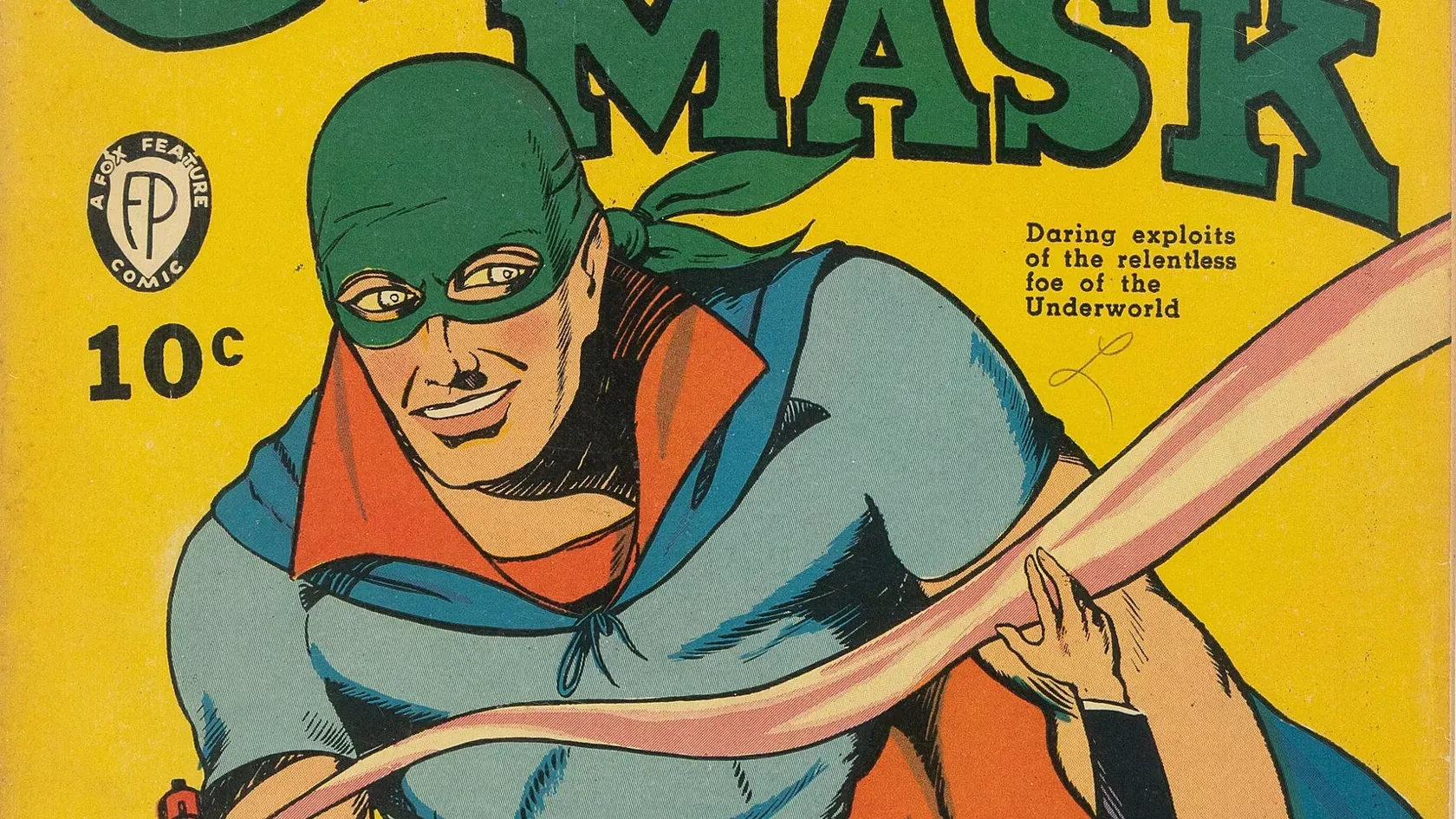
Green Mask #1, published in 1940 by Fox Feature Syndicate, is a compelling early-superhero artifact because it does much more than launch a solo title. It substantially rebuilds a hero who had already appeared in anthology comics, replacing an enigmatic pulp-style adventurer with a powered protagonist, a civilian identity, a science-fiction origin and a young crime-fighting partner. A CGC-graded 6.5 copy with cream to off-white pages is scheduled to be offered in an auction closing November 5, 2026.
That combination makes the issue notable beyond its age or scarcity. It captures a period when comic-book publishers were still rapidly working out what a superhero was supposed to be. The Green Mask had already been one of the recognizable features in Mystery Men Comics, but the version introduced in Green Mask #1 has a fundamentally different narrative toolkit: super-strength, flight, a named alter ego, an origin incident and a continuing sidekick.
From masked adventurer to Michael Shelby
Cartoonist Walter Frehm created the Green Mask, whose first appearance came as the cover feature of 1939’s Mystery Men Comics #1. He debuted there alongside Blue Beetle and Rex Dexter of Mars. In those initial Green Mask stories, however, the character is hard to pin down. He is presented more like a traditional pulp adventurer than the costumed superhumans readers would increasingly associate with the medium.
A pulp-style adventurer, in this context, means a hero defined by nerve, athletic ability and fighting prowess rather than extraordinary abilities. The original Green Mask had no signature gadgetry beyond an ordinary handgun and no stated superhuman powers. That made him a capable crime fighter, but not necessarily a character built around a distinct high-concept premise.
Green Mask #1 changes that equation decisively. The new Green Mask is Michael Shelby. His transformation begins when Professor Lascomb’s vita-ray apparatus suffers an accidental surge, granting Shelby extraordinary strength and the ability to fly. The vita-rays supply the story’s science-fiction explanation for the powers, a device that also becomes central to the introduction of the issue’s second hero.
The reboot gives Michael a personal stake before he begins his heroic career. His father, Senator Shelby, has proposed mandatory capital punishment for gang members. The senator is subsequently murdered on the orders of the Grim Circle. That event places criminal organizations at the center of Michael’s story and establishes a direct reason for his conflict with the forces behind the killing.
The result is an unusually complete reconstruction. The Green Mask did not merely gain an extra ability or a fresh costume detail. He received a new secret identity, new powers, a revised dramatic motivation and a larger ongoing conflict. That scale of revision helps explain why there is disagreement over whether the Green Mask in the earlier anthology stories and the hero of this solo series should be treated as the same character at all.
Domino the Miracle Boy enters the story
The vita-ray machine also introduces Domino the Miracle Boy. After Professor Lascomb uses the apparatus to save an injured homeless boy, the child develops powers comparable to Michael Shelby’s. Michael becomes his ward and partner.
That is important to the issue’s identity. A sidekick is more than a recurring supporting character: it is a partner positioned to share the hero’s adventures and, often, to create a second point of identification for readers. Domino’s arrival immediately gives the relaunched Green Mask a duo structure. Instead of centering solely on a previously mysterious masked man, the series establishes a named adult hero and a super-powered younger companion.
The issue’s cover is credited to Lou Fine, while the interior art is tentatively attributed to Frehm. The qualification matters. “Tentatively attributed” signals that the interior-art identification is not presented as settled fact. For collectors and comics historians, that kind of uncertainty is part of the object’s record, particularly with early comics where credits and archival documentation can be inconsistent.
A conspiracy built around war and organized crime
The story does not confine itself to a straightforward gang-revenge plot. The Grim Circle’s purpose is explicitly tied to an effort to pull the United States into war. The organization’s involvement in Senator Shelby’s murder puts a national-scale conspiracy behind the Green Mask’s new origin.
“The interests for whom we work want the United States to enter the war!”
That stated objective distinguishes the antagonist from a conventional neighborhood criminal racket. The Green Mask’s fights are framed around a threat that reaches from the murder of his father toward international consequences. It is a sharp escalation from the comparatively undefined pulp adventurer presented in the earlier Mystery Men Comics material.
Another new tale sends gang leaders from Chicago, St. Louis, San Francisco and New York after the S.S. Britannica, a ship carrying $50 million in gold from Liverpool to America. The plan is to sink the vessel. As presented, this story carries the issue’s criminal intrigue into a maritime setting and again places the stakes beyond a single city or individual victim.
These premises are also useful evidence of how expansive a first issue can be without relying on a single villain or one origin sequence. Green Mask #1 uses its pages to set up its new hero, introduce Domino, establish the Grim Circle’s agenda and deliver additional adventure material. It is effectively both a relaunch and a compact sampling of the kinds of threats the revised feature could tackle.
An altered reprint complicates the contents
Not every Green Mask story in the comic was newly created for this issue. One nine-page adventure originated in Mystery Men Comics #2. It preserves the San Sin extortion storyline, the smuggling ship S.S. Canton and Coast Guard intervention.
Yet the republished story was not reproduced unchanged. Its original Frehm byline was replaced with the name Michael Barrett, while lettering and artwork received small alterations. Most of the dialogue remains. For anyone evaluating the issue as a historical document, that distinction is worthwhile: this is not simply an all-new debut package, nor is it a direct reprint collection. It includes a previously published story that was modified for its new home.
That editing choice reinforces the comic’s broader theme of revision. The title revises a pre-existing hero, then incorporates and revises a prior adventure as part of the new series. The result is a book with several layers of continuity: an earlier Green Mask, the newly powered Michael Shelby version and material carried over from the anthology run with adjustments.
Why the identity question remains meaningful
The first Green Mask appeared in Mystery Men Comics #1; the powered Michael Shelby version later appears in Mystery Men Comics #13-31 as well as Green Mask #1-9. But the major changes in identity and abilities leave room for competing interpretations. One reading treats the relaunch as a radical reworking of an existing character. Another regards the two versions as separate heroes who happen to use the same name and costume concept.
There is no need to flatten that ambiguity. In fact, it is part of what makes the issue interesting. Modern audiences are used to the word reboot describing a restart that revises a property’s history, identity or premise. Green Mask #1 is a particularly early and dramatic example of that creative impulse. It preserves the Green Mask branding but presents a protagonist whose premise is substantially different from the one readers had encountered in 1939.
This Michael Shelby era ended effectively after the 1942 bankruptcy of Fox Publications, Inc. When the publisher resumed assembling a comics line in 1944, Green Mask #10 introduced another completely different version of the character. Rather than producing one uninterrupted heroic biography, the title maps an era in which a comic-book identity could be repeatedly redefined.
That is why this auction lot may appeal to more than readers seeking an early superhero cover. It represents an early character reinvention, an example of wartime-era plot concerns in comics, the debut of Domino the Miracle Boy, and a book containing both new material and a modified earlier story. For a broader look at how comic settings and characters can keep evolving across eras, see our discussion of Madripoor’s enduring comic-book potential.
What the CGC census says—and does not say
The CGC census lists 45 Universal-label copies of Green Mask #1, including three graded 6.5 and 11 graded higher. The auction copy is graded FN+ 6.5, with cream to off-white pages.
CGC is a third-party comic grading service. Its census is a count of examples it has graded and recorded; it is not a count of every copy that exists. Likewise, a Universal label refers to a standard graded comic rather than a book designated for restoration or another special label category. The census figures therefore provide a useful snapshot of certified copies, not a complete measure of the issue’s surviving population.
A 6.5 grade is notable here because only three Universal copies are recorded at that same grade, while 11 sit above it in the census data provided. The cream to off-white page designation describes paper quality and color, another detail buyers commonly weigh alongside the numerical grade, cover presentation, restoration status and historical relevance.
For collectors, the key practical point is to distinguish the issue’s multiple attractions rather than reducing it to a single scarcity claim. It is a 1940 comic, but also a major Green Mask reinvention; it bears a Lou Fine cover, has interior art tentatively linked to Walter Frehm, introduces Domino, and marks the powered Michael Shelby era. Those attributes are the substance behind the book’s appeal, while the census figures help frame the specific graded copy being offered.