Some Golden Age crime comics sell the promise of lurid fiction: gangsters, hidden guns, betrayals, and a final reckoning delivered in a few volatile pages. Murder Incorporated #5 has an unusually direct connection to a real criminal case beneath that familiar formula. The 1948 Fox issue turns the notorious Rhode Island headquarters known as “Crime Castle,” associated with bootlegger Carl Rettich, into the setting for a grim true-crime feature.
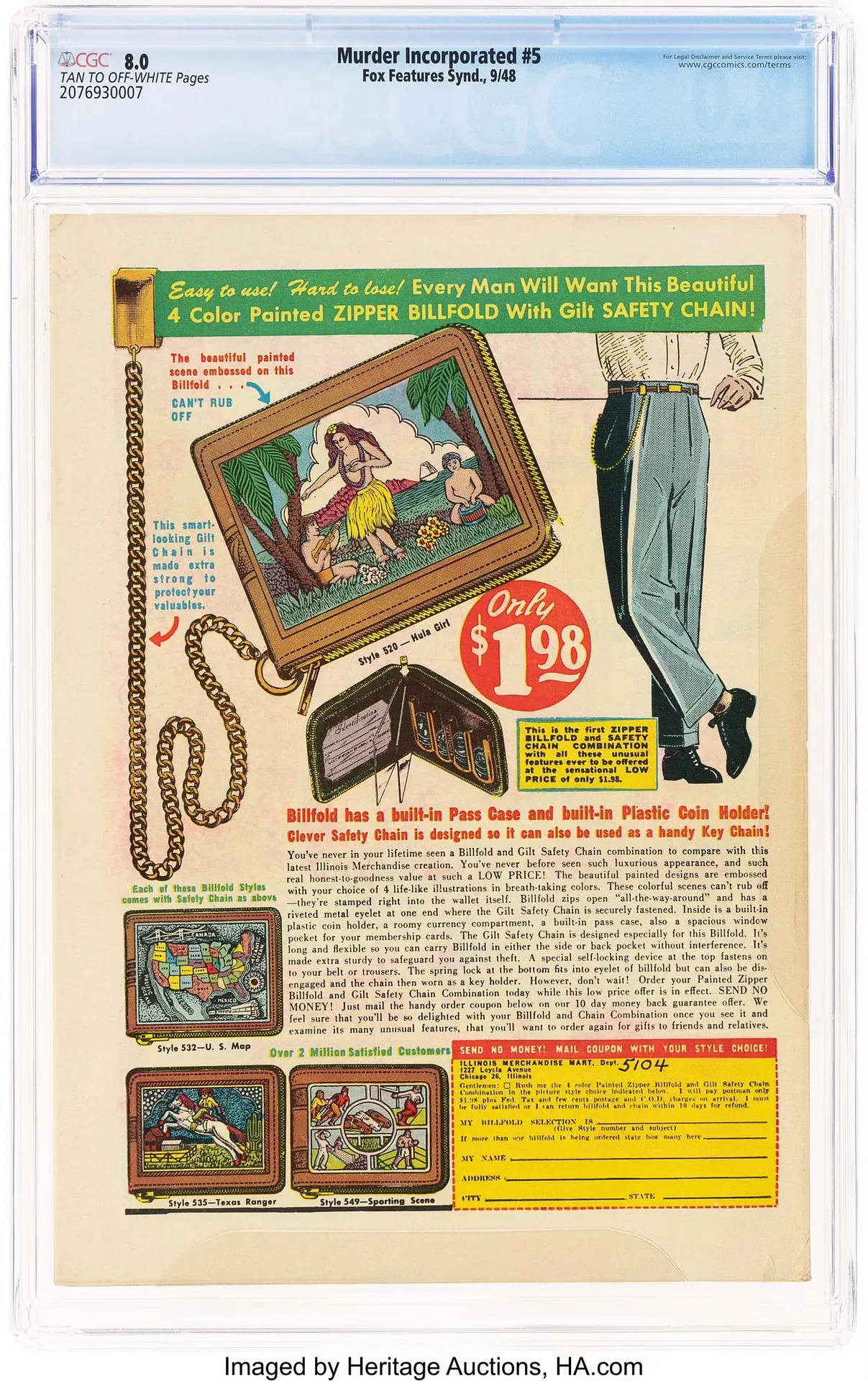
A CGC VF 8.0 copy with tan to off-white pages is scheduled for the September 24-26, 2026 Comic Books Signature Auction #7469. For collectors, the attraction is not merely its dramatic cover imagery or the scarcity of better-preserved copies. The issue also sits at the intersection of postwar sensational comics, newspaper-fed crime storytelling, and a documented 1930s investigation involving the Fall River mail robbery.
A comic-book-ready premise with a real foundation
“Crime Castle” sounds invented for a villain’s hideout, yet the name was associated with Rettich’s Rhode Island mansion well before Fox published Murder Incorporated #5. The building’s supposed secrets gave the case an irresistible shape for popular storytelling: concealed spaces, weapons, criminal associates, and the prospect that evidence or money could still be found on the property.
The historical case gained broad attention during the 1935 investigation into a mail robbery in Fall River, Massachusetts. A May 1935 United Press report linked the $129,000 theft to Rettich’s mansion, the death of associate Andino Merola, and the disappearance of Danny Walsh. Walsh, another prominent bootlegger and Rettich partner, had disappeared in 1933.
Investigators excavated the mansion and its grounds while the press followed the work closely. Money was recovered, and the possibility of further hidden material sustained public interest. That combination matters when considering why the material was such a natural fit for a crime comic more than a decade later. A fortified home and an expanding criminal network already supplied a visual, easily understood hook. Fox did not need to invent the central atmosphere; it adapted a story that had already been framed in sensational terms for newspaper readers.
How the Fox story reshapes the case
The feature in Murder Incorporated #5 presents Rettich’s career as a chain of robberies, betrayals, and killings. Postal inspectors ultimately break through the gang’s defenses. In the comic’s telling, concealed weapons and a secret conference room push Crime Castle toward pulp melodrama, making it resemble a purpose-built criminal lair rather than simply a location tied to an investigation.
Yet the story does retain a meaningful evidentiary thread. A false license plate associated with the Fall River robbery becomes part of the plot’s movement from ominous setting to criminal proof. That is an important distinction. The comic is not only using Crime Castle as a spooky backdrop; it is drawing on the case’s investigation, in which the mansion and the material found around it were central to public fascination.
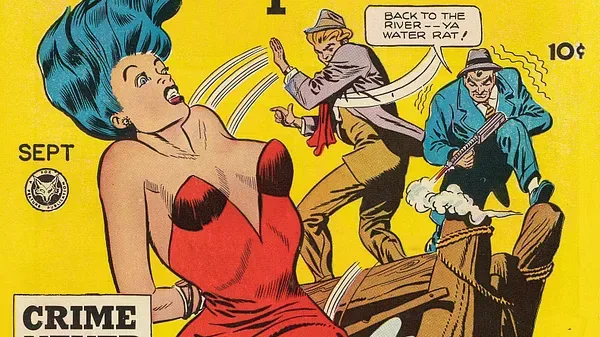
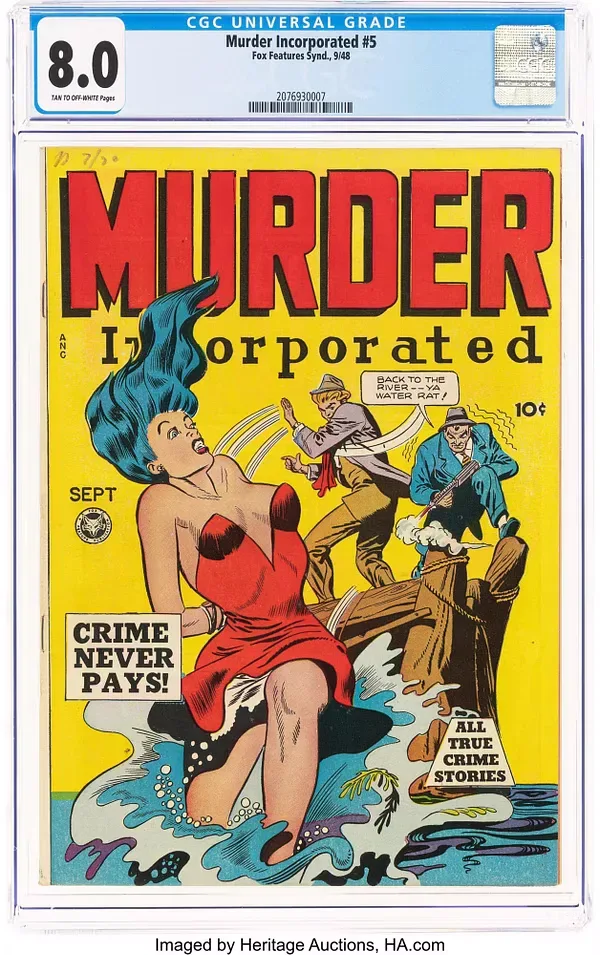
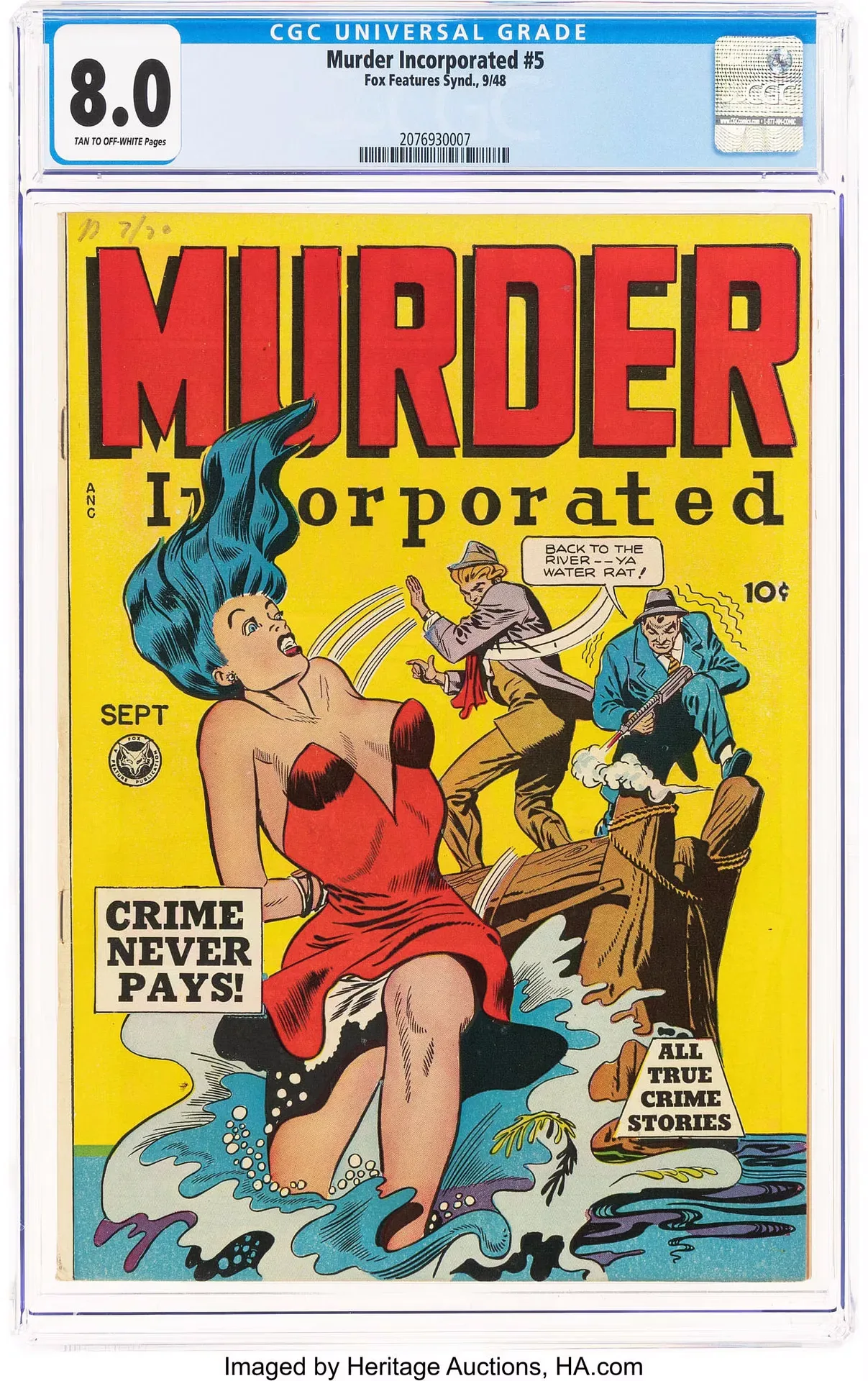
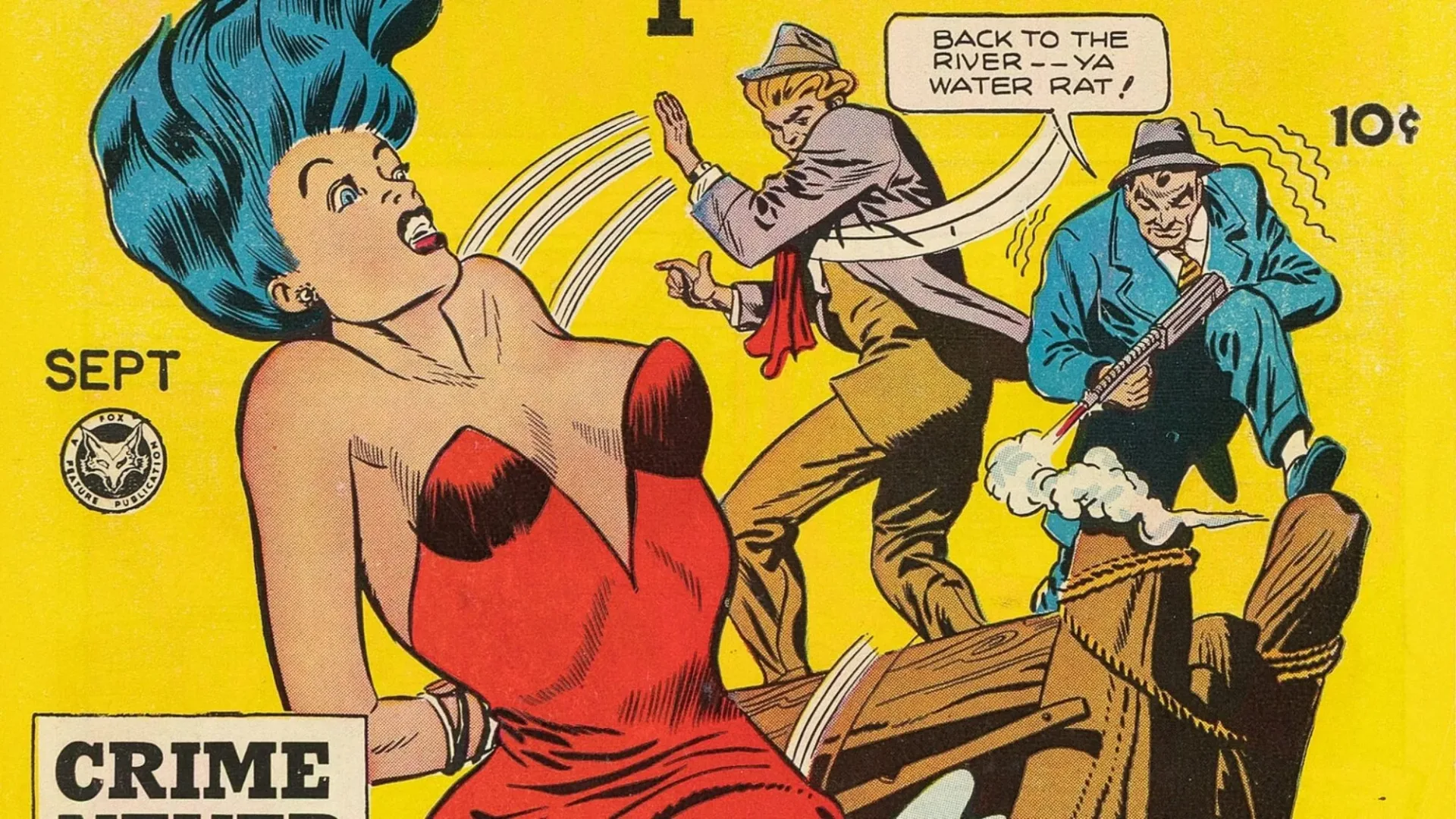
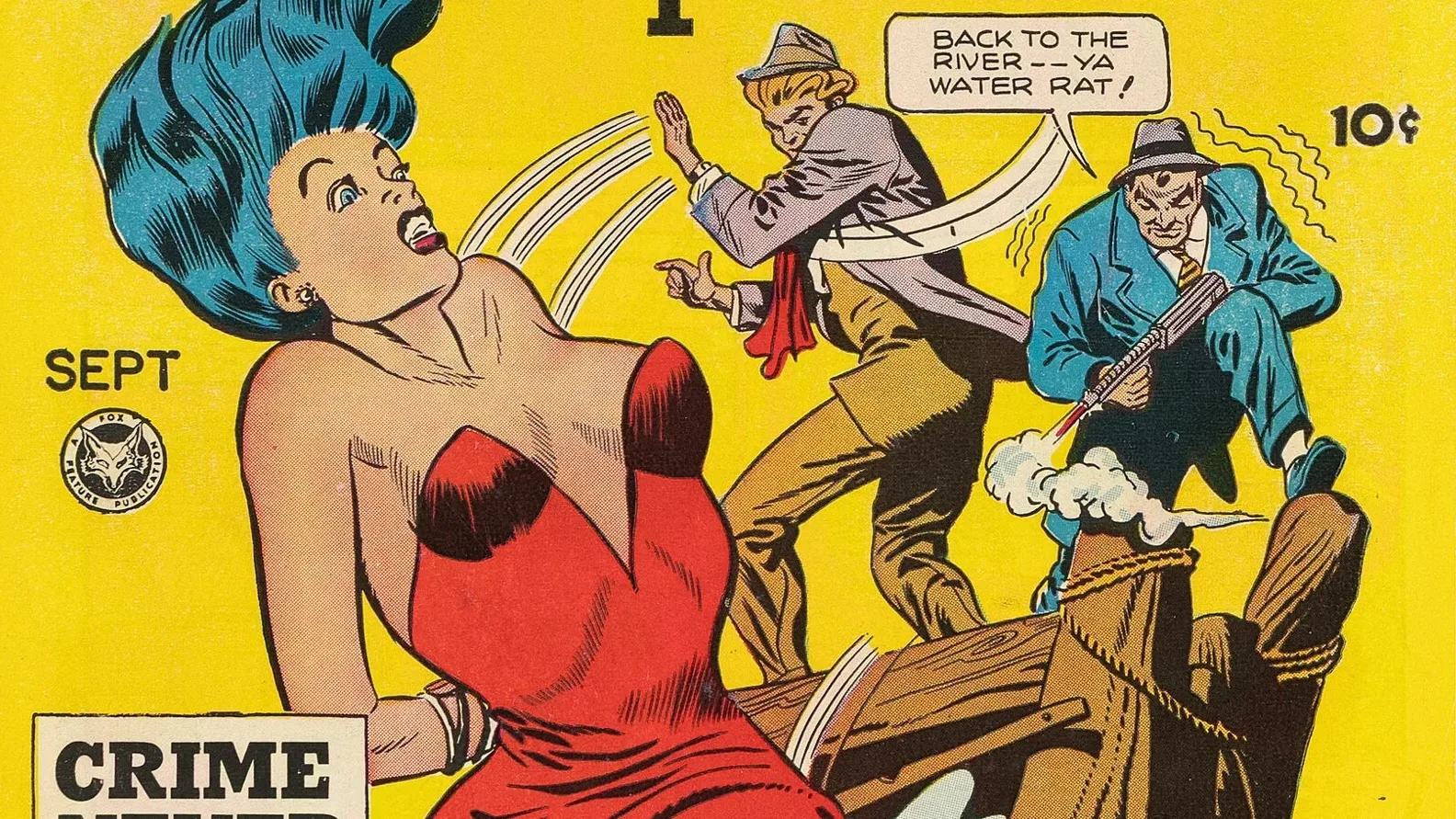
The sharpest example of adaptation rather than documentation is Danny Walsh. Walsh’s disappearance was real, but his body was never found. The comic gives the event a far more explicit and brutal resolution, depicting Walsh drowned with his feet encased in cement. The issue’s cover, showing a bound woman being thrown from a pier into the water, may broadly echo that heightened version of the story.
That change illustrates the editorial logic of the book. A disappearance leaves ambiguity. A depicted murder provides a climax, an image, and a clean narrative answer. It also means readers and collectors should be careful not to treat the comic itself as a historical record. Its value as an artifact is precisely in the way it converts fragments of real crime reporting into sensational sequential storytelling.
What “true crime” means here
In this context, true crime does not mean a strictly factual reconstruction. It means the comic draws its premise, people, and major criminal associations from real events, then reshapes them for drama. The transformation can include compressed timelines, stronger links between characters, invented motives, and definitive outcomes where the record remains uncertain.
That approach was especially useful for a comic story: readers could recognize the appeal of a headline-driven case while receiving a self-contained tale with visual danger and a decisive ending. For modern readers, the gap between record and retelling is part of the issue’s historical interest. It demonstrates how crime stories could travel from an investigation and press coverage into a very different popular medium.
The record behind the lurid details
The 1936 appellate opinion in Rettich v. United States helps clarify particulars tied to the mail-robbery case. It includes several names that also appear in the comic story: McGlone, Dugan, Harrigan, and Fisher. Rettich’s later imprisonment at Alcatraz is also a matter of record.
Those details give the issue a more substantial connection to history than a generic “ripped from the headlines” label might suggest. Still, the documented links should not erase the story’s fictional embellishments. The mansion, the Fall River robbery, the associates, Walsh’s disappearance, and Rettich’s imprisonment establish a real framework. The cement-foot killing supplies the sort of certainty and horror that comic-book storytelling could impose on an unresolved disappearance.
For collectors who enjoy crime comics as cultural objects, this tension is the point. The book is both a Fox crime comic and a period interpretation of a case that had already generated attention in 1935. It preserves a particular style of popular retelling: real names and high-profile criminal allegations filtered through heightened stakes, compressed cause-and-effect, and imagery designed to grab a newsstand audience.
Why the grade and census matter
The CGC census lists 24 Universal copies of Murder Incorporated #5, including one graded 8.0 and one graded higher. A Universal label is CGC terminology for a standard, unrestored collectible comic without an alternate label designation such as a qualified or restored example. A census, meanwhile, is a count of copies graded by that company, not a count of every surviving copy of the issue.
That distinction is practical. Census figures can help indicate how often a particular issue has appeared for grading, but they cannot establish the complete surviving population. They also change as additional books are submitted. In this case, the listed total nevertheless provides useful context for the offered 8.0 copy: it is among a limited number of recorded Universal-label examples, and only one census entry sits above that grade.
VF 8.0 means “Very Fine” under the familiar numerical grading scale. It signals a comic in notably strong collectible condition, while the stated page quality—tan to off-white—describes the paper rather than the structural grade. For buyers, both parts of that description are relevant. The numerical grade speaks to the book’s overall physical state as assessed by the grader, while page-color language offers additional information about aging.
No auction result is guaranteed by a census figure, an 8.0 grade, or a memorable story premise. But these factors give a bidder a clearer way to evaluate what is being offered: an authenticated, graded example of a 1948 Fox crime comic with limited census representation and a distinctive real-world basis for its lead feature.
What makes this issue stand apart
Golden Age crime comics can be collected for art, scarcity, publisher history, cover design, or their connection to the changing boundaries of mid-century popular entertainment. Murder Incorporated #5 adds another angle. Crime Castle is not a wholly fabricated set piece, and the comic’s cast overlaps in part with a documented federal case. That makes the book a compact example of how real events were repackaged into sensational entertainment.
The credited creators of the story remain unknown, which places even greater weight on what is visible in the finished object: the publisher’s approach, the deliberately lurid plotting, and the way a real investigation became comic-book material. Its cover image and Walsh sequence also show how the issue privileges immediate visual peril over the messier uncertainty of the actual case.
Readers interested in comics that reinterpret nonfiction can also see a modern counterpart in the broader graphic-novel space, including the upcoming graphic-novel adaptation of All Systems Red. The subjects are entirely different, but the comparison highlights a continuing truth about the format: adaptation is not transcription. A comic makes choices about what to show, what to simplify, and what kind of experience the page should create.
For the September auction, the strongest case for Murder Incorporated #5 is therefore a layered one. It is a high-grade Fox crime comic from 1948. It has a scarce recorded CGC population in Universal labels. And it carries a story built around a location and criminal case whose stranger-than-fiction qualities were already part of the public record. The comic does not preserve that history without distortion—but the distortion is exactly what makes it revealing.