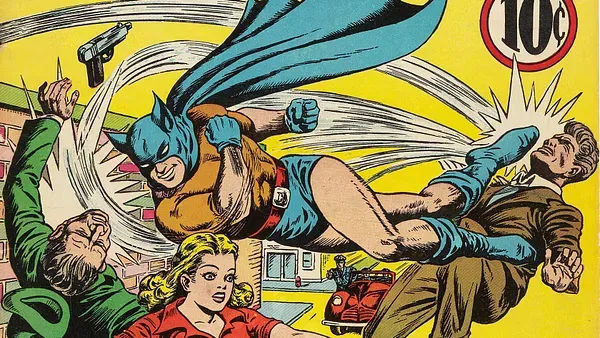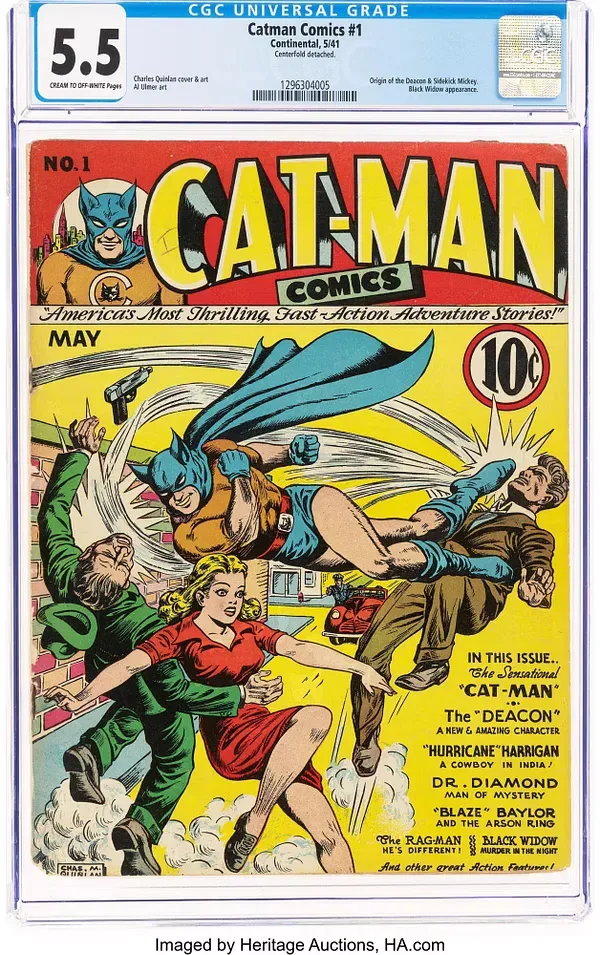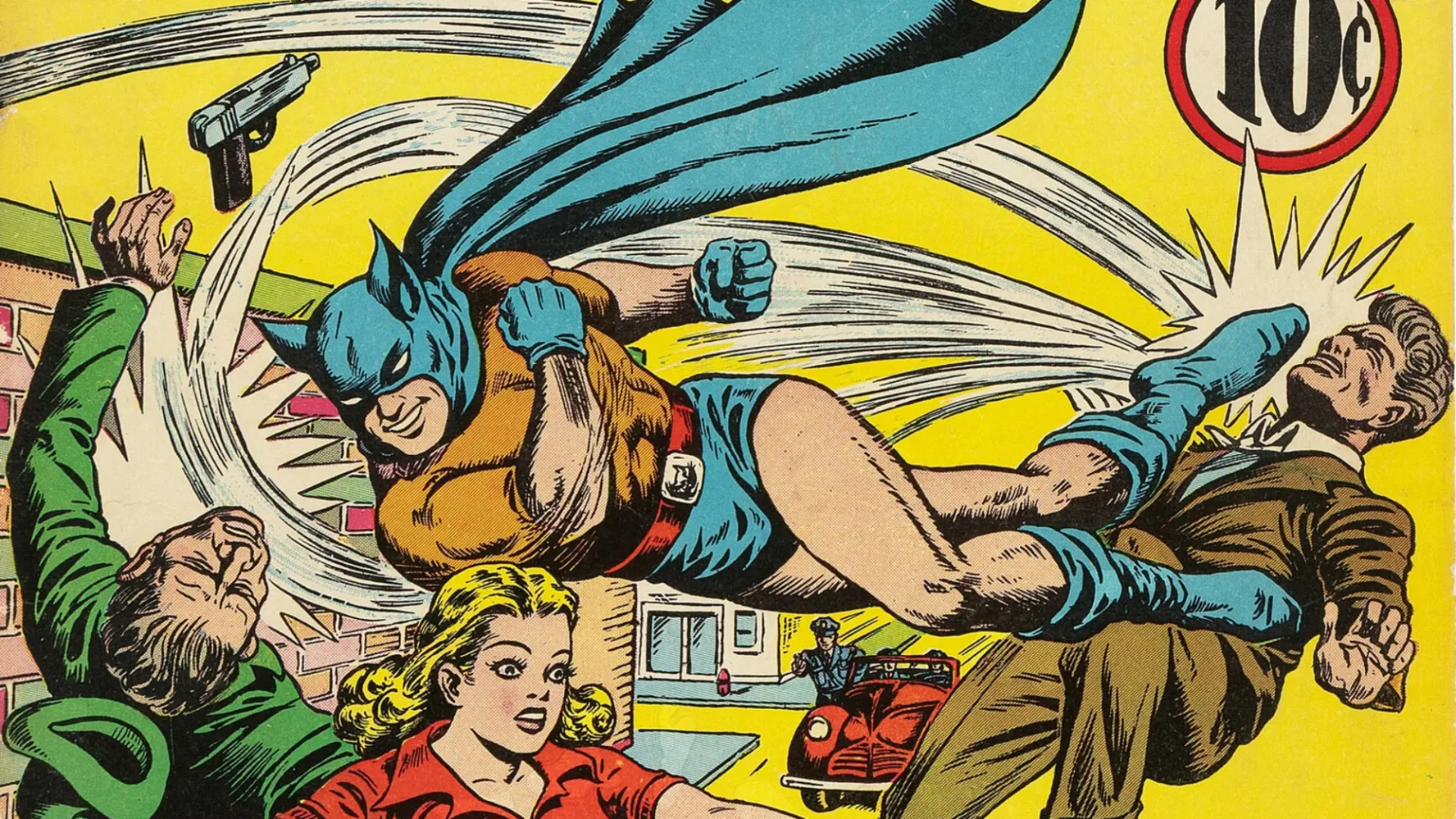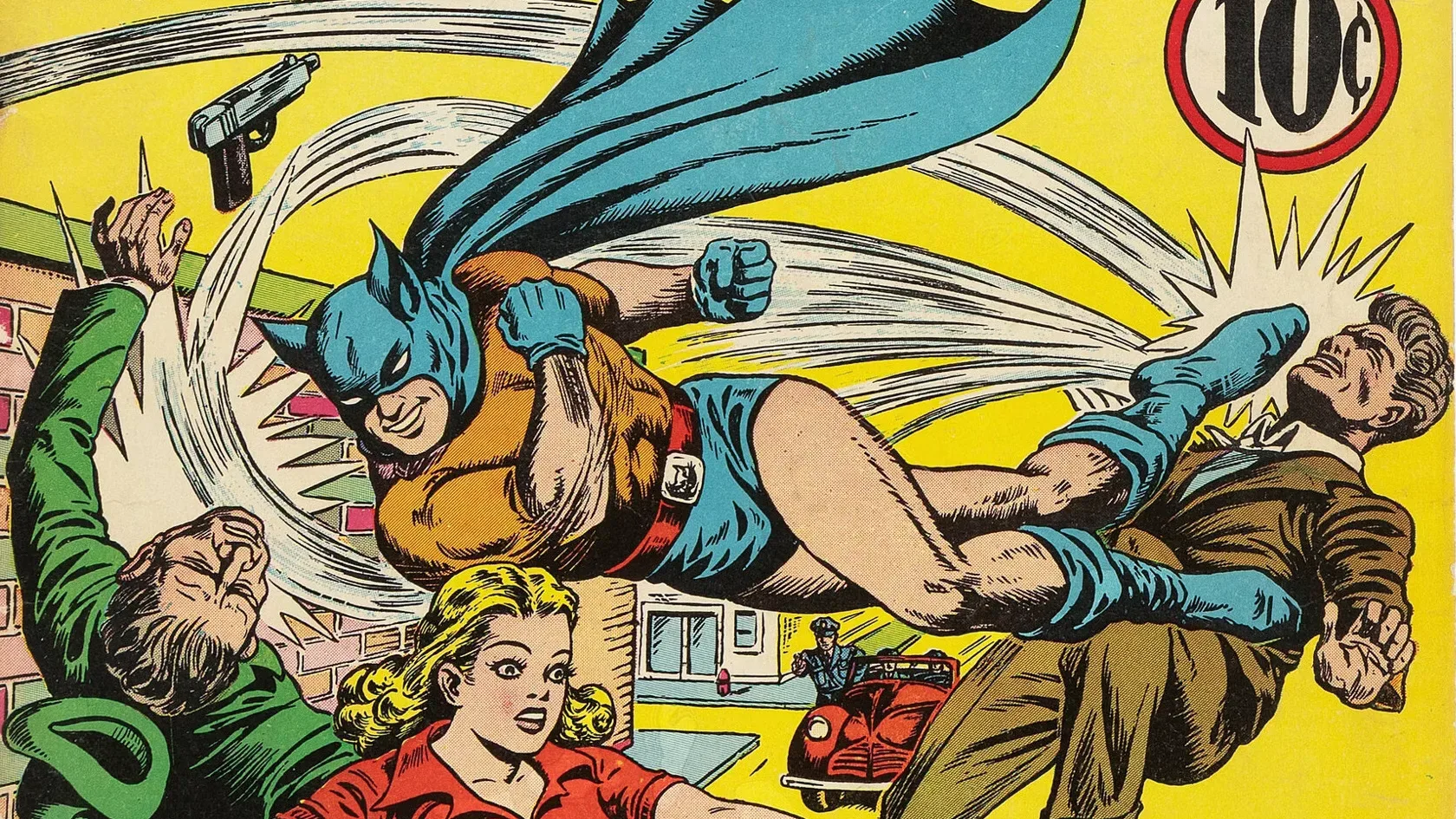
Cat-Man Comics #1 is headed to auction with a premise that is pure early-superhero escalation: a bridge-melting death ray, foreign saboteurs, invisible beams, and a hero whose answer to being killed is to come back with one fewer of his nine lives.
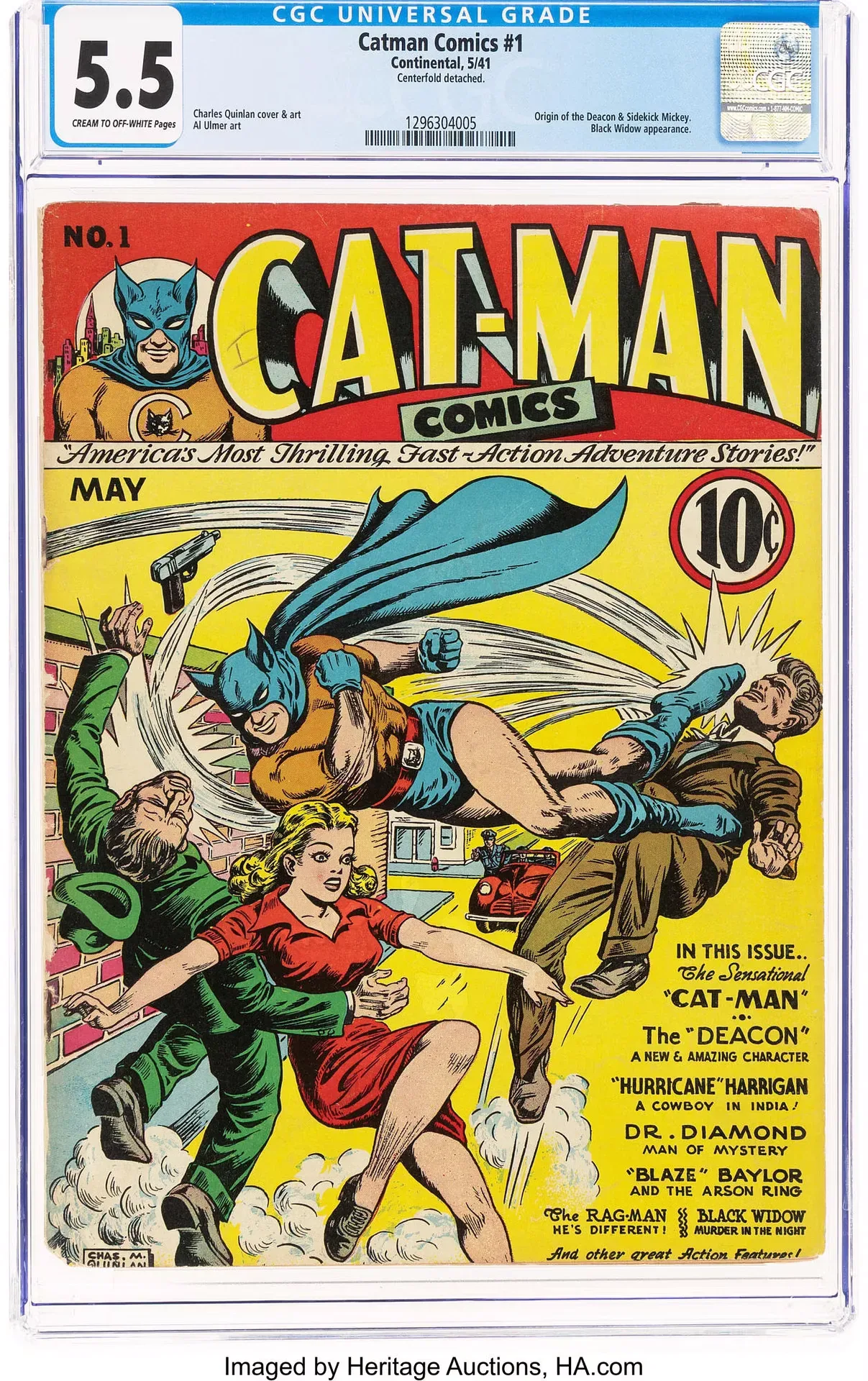
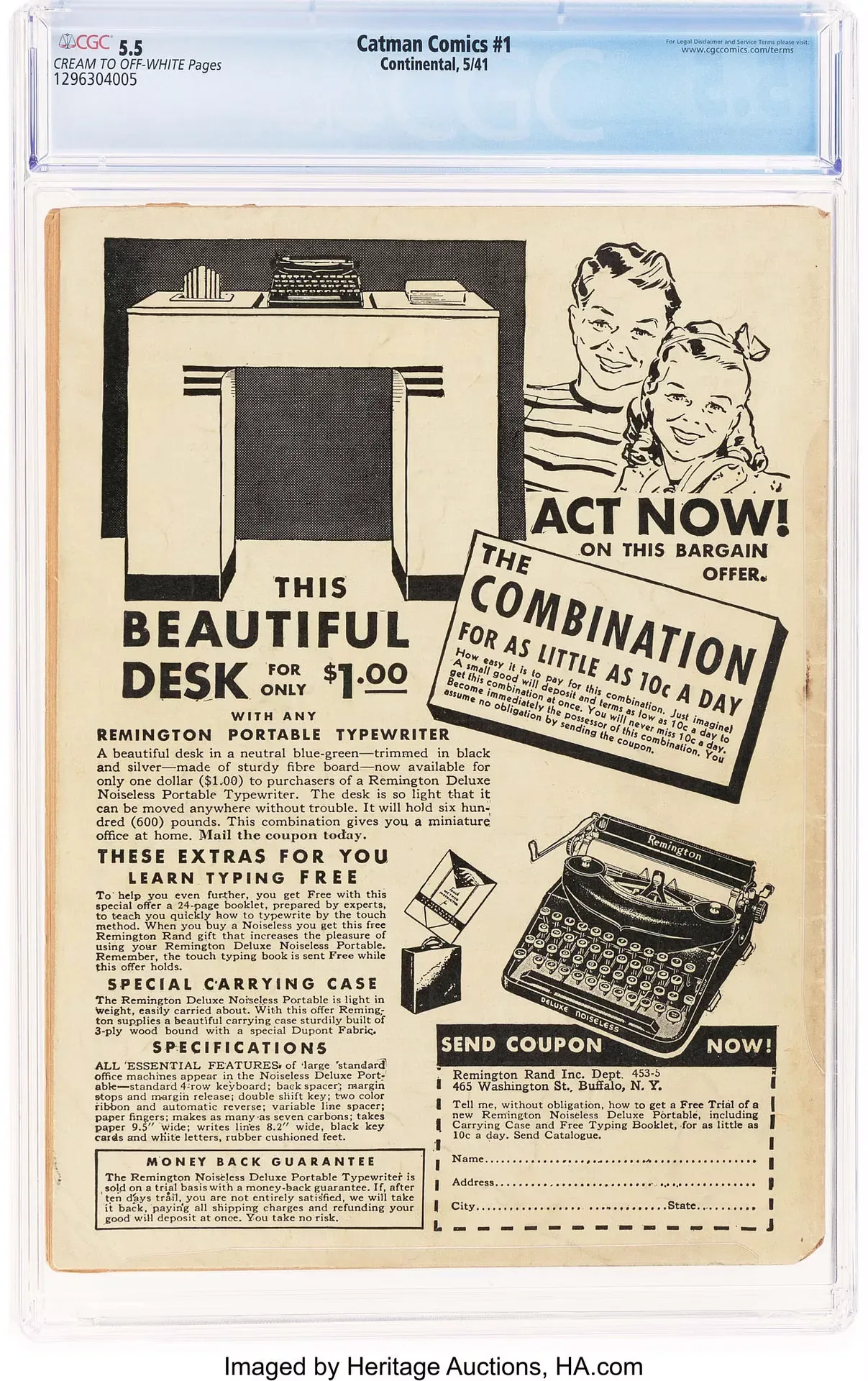
The Continental comic carries a May 1941 cover date and represents Cat-Man’s solo-title debut after appearances in Crash Comics Adventures #4 and #5. The offered copy is graded CGC FN- 5.5 with cream-to-off-white pages and is listed in the November 5, 2026 Golden Age Century Comics Showcase Auction VI, numbered #40378.
Its lead adventure, credited to Martin Panzer and Charles M. Quinlan, is notable not merely for deploying a suitably pulpy “death ray,” but for putting the character’s central supernatural hook to use in the plot. David Merrywether’s unusual origin is not decorative backstory: being raised by a tigress and endowed with nine lives gives Cat-Man one more chance after the villains’ weapon does what no ordinary comic-book trap can safely do—it kills him.
A hero who can follow invisible destruction
In the story, attacks strike Golden Star Bridge and Midburgh Bridge, transportation targets presented as important to national defense. The culprits are Brent and Jonson, agents of an unnamed foreign power, who possess a machine capable of melting bridges. That threat makes Cat-Man Comics #1 part superhero adventure and part sabotage thriller, with vital infrastructure serving as the stakes.
Merrywether’s first advantage is that he can see rays normally invisible to everyone else. That ability lets him trace the attacks back toward their perpetrators. It is a particularly efficient comic-book power because it turns a supposedly untraceable weapon into a clue: the ray leaves a path Cat-Man alone can follow.
Yet tracking the machine does not make Cat-Man invulnerable. The agents spring a trap, and the ray kills him. The spirit of the tigress that raised him restores him to life, allowing the hero to return to the confrontation. The story therefore takes the old cat-and-nine-lives expression literally, converting it into a finite supernatural resource and a dramatic solution to an otherwise terminal encounter.
That distinction matters. Cat-Man is not simply shrugging off an attack. The death ray is treated as lethal, and resurrection is the unusual mechanism that changes the outcome. Once revived, he captures the agents and turns over both them and the machine to the authorities. The threat is consequently transformed from foreign sabotage into a possible defensive tool for the United States.
What “Tesla-inspired” means in this context
The death ray in Cat-Man’s story arrives from a real period of public fascination, speculation, and skepticism around Nikola Tesla’s proposed “teleforce.” In an October 20, 1940 newspaper feature titled Proposing the ‘Death Ray’ for Defense, Tesla’s claims were discussed alongside earlier death-ray promises and hoaxes.
Teleforce, in this setting, refers to Tesla’s proposed weapon concept rather than a demonstrated device in the comic’s real-world background. The proposal was described as capable of melting aircraft engines and defending the American coast. Tesla reportedly offered the concept to the United States while insisting he be free of bureaucratic or expert interference. The contemporaneous discussion did not treat the claims as settled fact; it expressed substantial doubt that such a system would work.
Cat-Man Comics takes the more entertaining route. Its version of the idea functions exactly as feared: the ray can destroy bridges, kill a person exposed to it, and become a strategically important piece of captured technology. In other words, the comic takes a debated defensive claim and makes it immediately tangible as a villain’s weapon.
That move captures why “death ray” stories were so adaptable to comics. The phrase carries technical menace without requiring pages of engineering explanation. A ray is invisible until a hero with the right power can see it; it can strike from a distance; and its destructive potential can be made clear with one spectacular target. For this story, bridges are an especially direct visual and narrative choice, because their loss implies severed routes and a danger extending beyond a single victim.
National-defense stakes before the hero’s victory
The lead feature does not position Cat-Man against a random criminal scheme. Brent and Jonson’s attacks target infrastructure tied to national defense, and their unnamed foreign allegiance frames the device as an act of espionage and sabotage. The plot’s final reversal—delivering the weapon to authorities—also follows from those stakes. Cat-Man does not destroy the ray after surviving it; he helps place it in government hands for potential American defense.
That is a useful snapshot of how a 1941 comic could combine fantastic elements with contemporary anxieties. The story does not need to prove teleforce in scientific terms. It instead asks a simpler adventure question: what happens if an enemy already has such a machine? Cat-Man’s nine lives offer the answer, but only after the weapon has been established as dangerous enough to defeat him once.
The issue was not alone in drawing from Tesla-related death-ray ideas. Tesla’s teleforce concept also informed the debut of the Masked Marvel in Centaur’s Keen Detective Funnies V2#7. Cat-Man’s version stands apart through the way its supernatural revival is built directly into the response to the technology. The machine supplies the modern menace; the tigress spirit supplies the mythic counterweight.
Charles Quinlan’s role in the launch issue
Cat-Man had previously appeared in Crash Comics Adventures #4 and #5, with art by Irwin Hasen. For the new solo title, Charles M. Quinlan took on key duties, including the cover and the lead story credited with Martin Panzer. Quinlan’s work in the issue extends beyond Cat-Man: he is credited on the Blaze Baylor and Hurricane Harrigan stories and supplied illustrations for the prose feature Private Jones.
That makes issue #1 a broader example of a period comic-book package rather than a single-feature item. A buyer interested in Quinlan is not looking only at a cover assignment or a short contribution; the issue contains several places to examine his work across superhero, adventure, and prose-feature illustration formats.
For readers looking at the wider medium rather than the auction catalog, the issue also shows how fast comics could establish a distinctive character rule. Cat-Man’s prior appearances introduced the hero, while the solo launch makes the nine-lives idea consequential. It becomes a plot device with a cost, a source of suspense, and the reason he can finish a case that a conventional hero could not survive.
That blend of a strong gimmick, science-fiction danger, and national-defense framing is part of what makes Golden Age debuts compelling. A first issue has to sell readers on a hero quickly. Here, the creative team gives Cat-Man a clearly legible advantage—he can perceive invisible rays—and then immediately proves that it is not enough on its own. His other defining attribute, resurrection through the tigress spirit, is what carries the story across the finish line.
What the grading census says—and does not say
The current CGC census lists 59 Universal entries for Cat-Man Comics #1. Seven are graded 5.5, while 18 are graded higher. Universal is CGC’s label category for standard unrestored comics; it is distinct from a statement about how often the issue was printed or how many raw, ungraded copies remain.
Likewise, a census is best read as a record of copies submitted to that grading service, not as a complete population count. It can help situate an offered graded copy within the existing recorded group, but it cannot by itself settle total scarcity. For the listed FN- 5.5 copy, the supplied census figures establish that multiple examples have received the same grade and that higher-graded entries are recorded.
The page description is also specific to this offered book: cream-to-off-white pages. Collectors assessing any vintage comic should distinguish between the numeric grade, the label category, and page-quality description. They communicate different parts of a graded copy’s condition profile, rather than functioning as interchangeable measures.
For more comic-book coverage, see this look at Darkseid Vs. The World #1 and Absolute Batman’s place in DC All In.
A compact Golden Age premise with unusual stakes
Cat-Man’s solo debut ultimately earns its identity from the meeting of two ideas that could scarcely be more different. One is a topical fantasy of destructive technology, informed by widely debated teleforce claims. The other is ancient animal folklore made literal: a cat has nine lives, so the hero may die and still return.
In Cat-Man Comics #1, neither idea remains abstract. The death ray melts bridges and kills Cat-Man; the ninth-life premise brings him back to stop the agents. For an issue dated May 1941, that makes the title launch an unusually direct showcase for its hero’s defining premise, Quinlan’s broad artistic presence, and a moment when speculative weapons were easily translated into four-color peril.