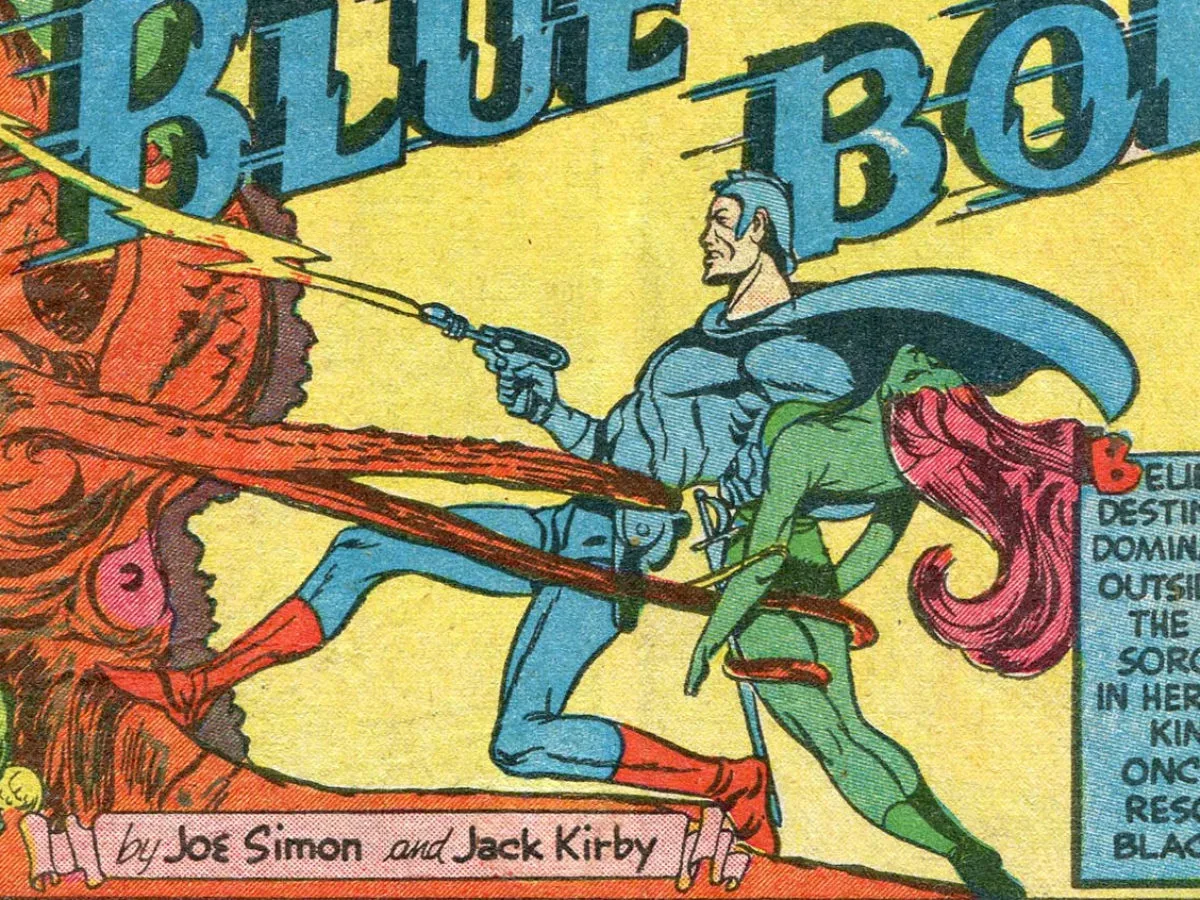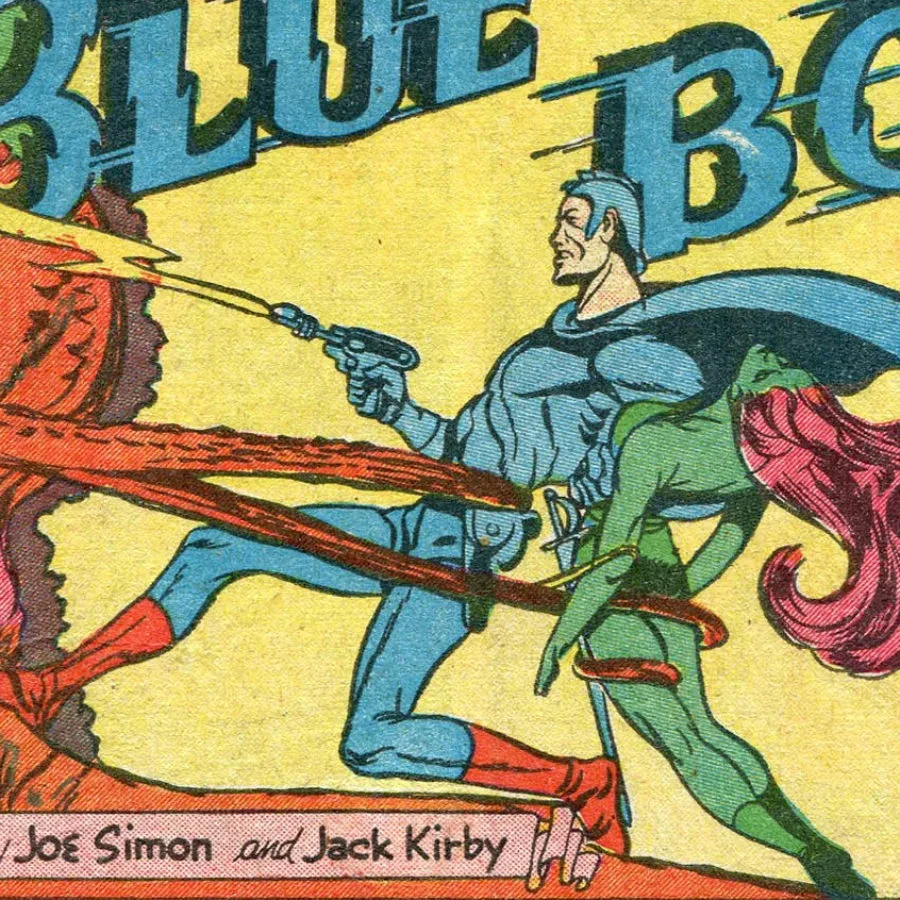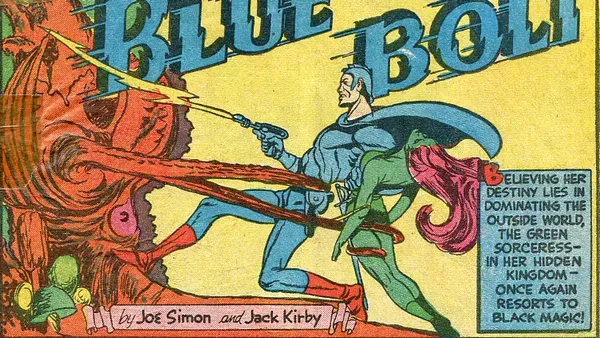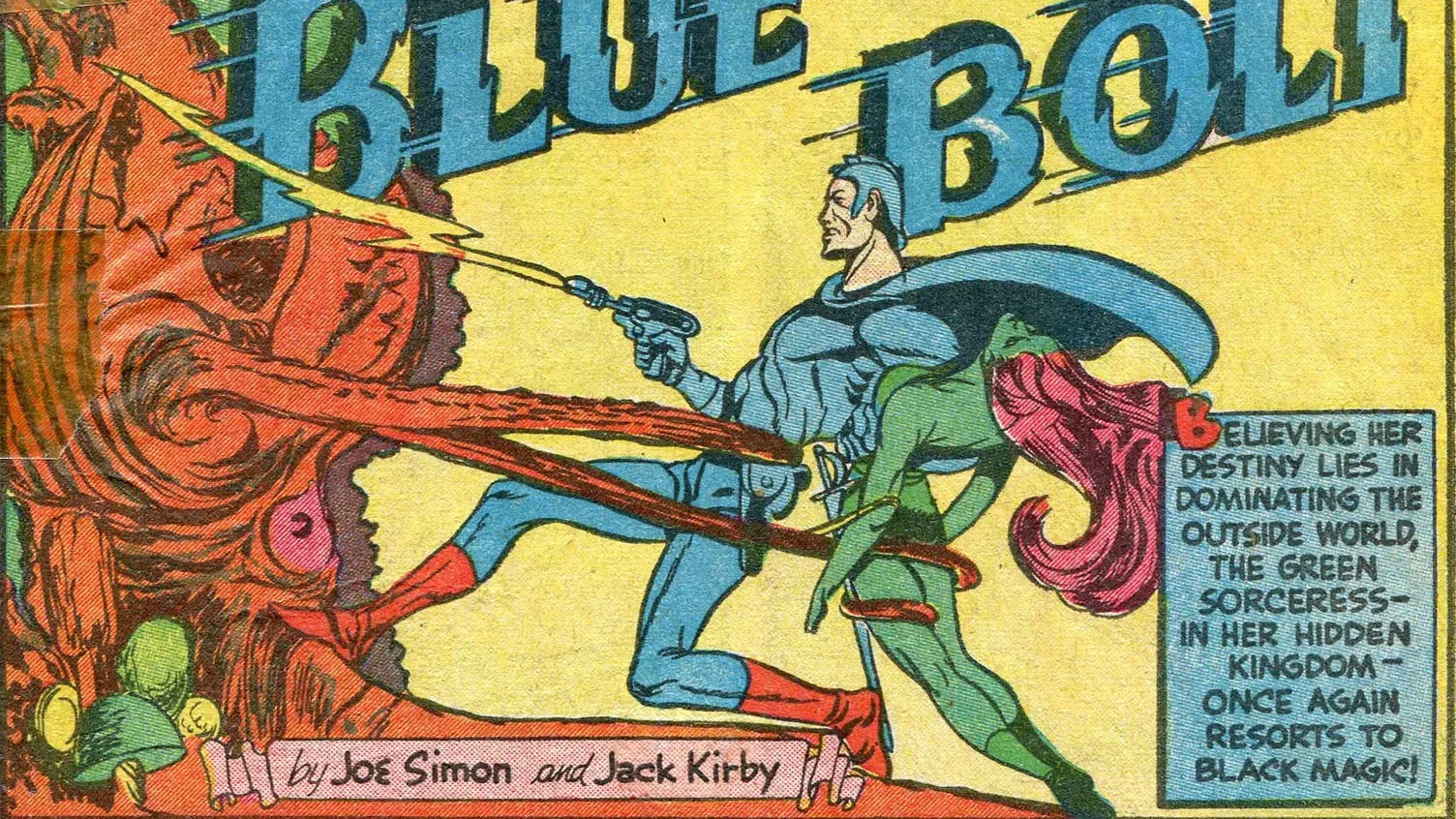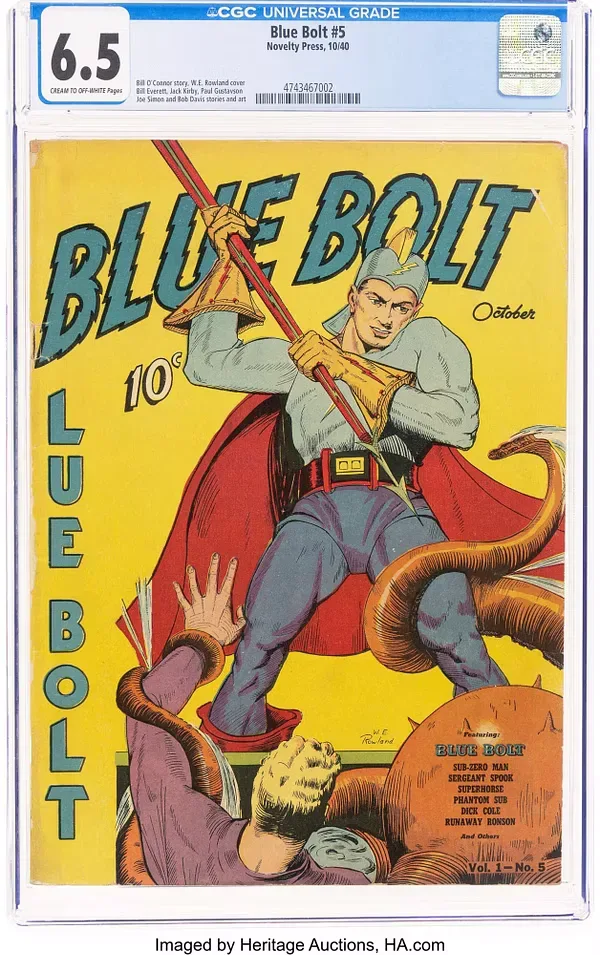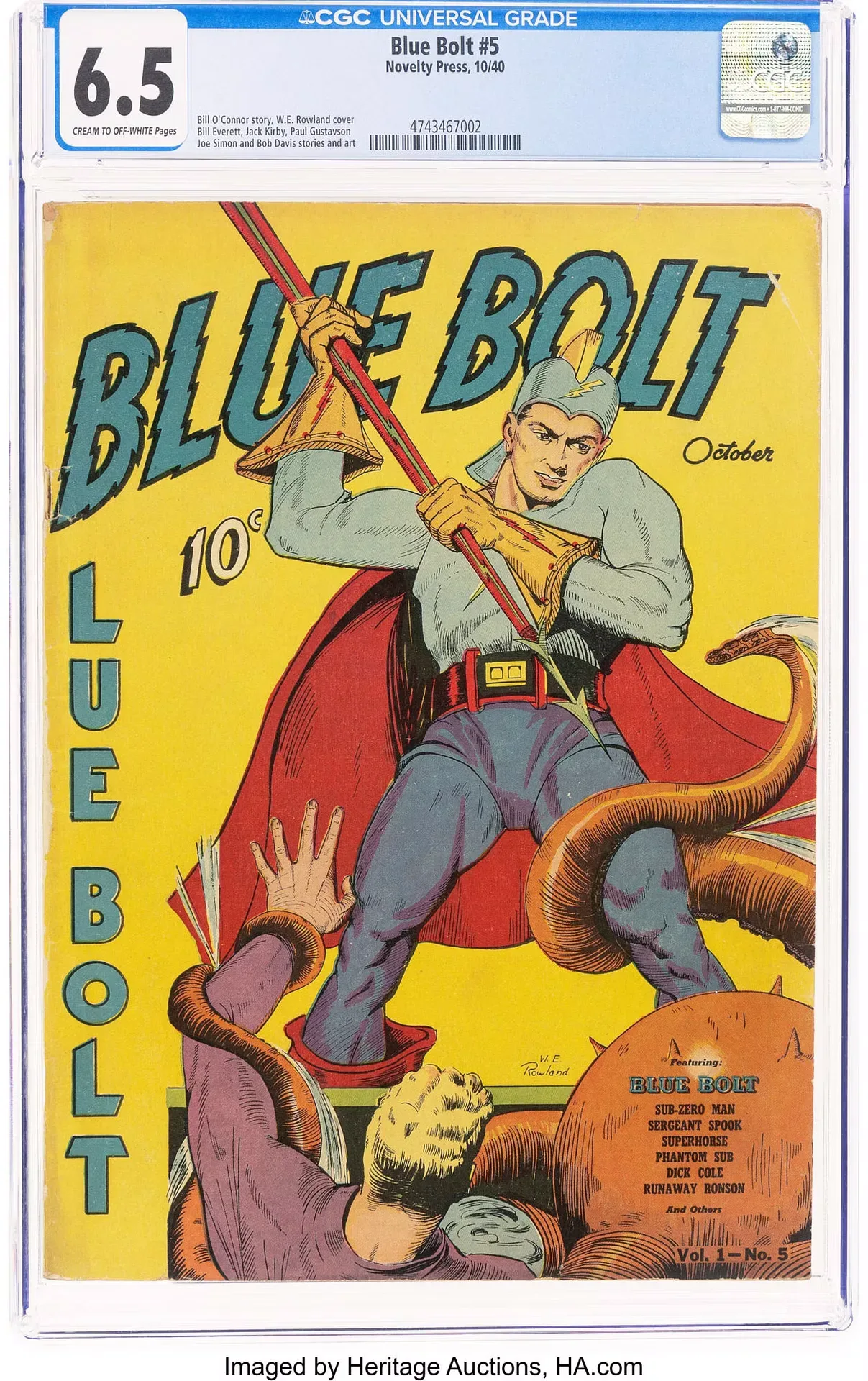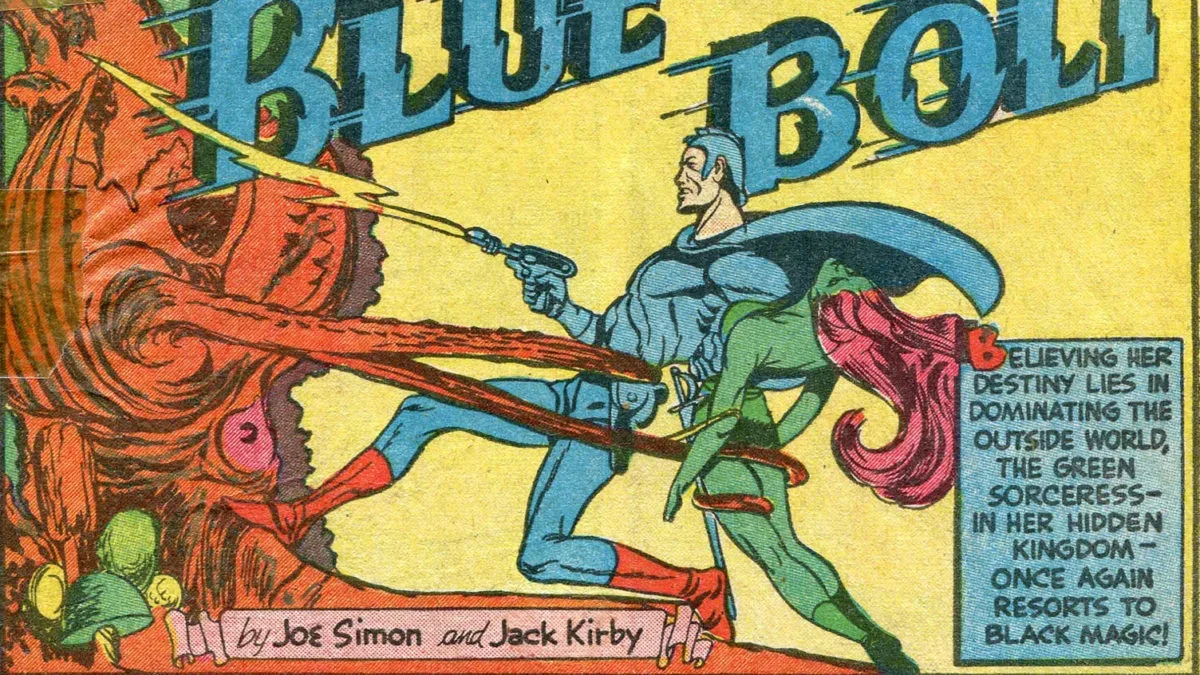
Blue Bolt #5, cover-dated October 1940, is headed to auction as a notable early entry in the documented partnership between Joe Simon and Jack Kirby. The Novelty Press comic is significant because it is the first installment of Blue Bolt to print both creators’ names together, even though their collaboration had begun before this issue.
The offered copy is graded CGC FN+ 6.5 with cream to off-white pages and is listed for the November 5, 2026 Golden Age Century Comics Showcase Auction VI. Its appeal is not simply the presence of two eventual comics giants on an early credit line. The issue also provides an unusually vivid snapshot of the creative territory the pair were exploring: superhero adventure colliding with occult menace, cosmic-horror imagery and a science-fiction premise built around the fourth dimension.
For collectors, that combination matters. Golden Age books often derive significance from a mixture of scarcity, creator history, character history and the particular strangeness of their stories. Blue Bolt #5 has a clear creator-history hook, but its narrative supplies the more distinctive reason to look twice. Rather than treating another dimension as a loose synonym for a faraway realm, the story asks what it would mean for a person’s perception to be changed by moving through it.
The first printed Simon and Kirby credit in Blue Bolt
Simon and Kirby are jointly credited in Blue Bolt #5, making the issue a tangible milestone in a partnership that was already taking shape. That printed attribution is important because it gives the book a specific place in the record of their early work together. It is not merely an issue later associated with the creators; it visibly marks their collaboration in the series itself.
The story shows why that milestone remains interesting. It does not settle into one genre lane. Blue Bolt is sent into a crisis rooted in sorcery and an ancient text, yet the danger becomes an elaborate science-fiction problem involving a constructed path into a fourth dimension. The result has the broad, high-energy qualities associated with early superhero comics while also leaning into a more unsettling sense that ordinary space can be breached.
The antagonist at the center of the plot is the Green Sorceress. Her scheme begins when a supernatural messenger delivers an ancient book. Her followers use the knowledge it contains to build a gateway to the fourth dimension, with the immediate aim of taking control of the world’s radium supply. A scientist develops a response and sends Blue Bolt to intercept the threat.
That setup is compact, but the details distinguish it from a routine battle against costumed criminals. An old book, supernatural delivery and invocations of realms beyond ordinary human history give the opening a cosmic-horror flavor. Radium, a scientist and dimensional travel give the same plot a pulpy technological frame. The comic turns those ingredients into a superhero problem: Blue Bolt has to enter the impossible space rather than simply stop its architects from outside.
The fourth dimension is a storytelling obstacle, not wallpaper
The most memorable consequence of Blue Bolt’s trip is not just that he becomes transparent. The more imaginative complication concerns his sight. In the fourth dimension, he sees all sides of objects at once. Instead of granting him effortless super-vision, this makes familiar surroundings difficult to understand. The amount of visual information is too much to organize into a useful picture.
Special goggles return his vision to a three-dimensional view. That is a wonderfully direct piece of comic-book problem solving, but it also reveals what the story is trying to do. The fourth dimension changes Blue Bolt’s relationship to the environment around him. Objects have not simply become more dangerous; they have become harder to perceive in a meaningful way.
What does “fourth dimension” mean here? In this context, it is a speculative extra direction or dimension beyond the three spatial directions people ordinarily use to describe the physical world. It is not presented as a rigorous physics lesson. Instead, the premise supplies a narrative tool: someone able to move through an additional spatial dimension might reach otherwise inaccessible parts of an object or enclosure, and might perceive surfaces normally hidden from view.
That basic idea had a history outside comics well before Blue Bolt #5. Charles Howard Hinton’s 1884 essay What Is the Fourth Dimension? explored how an added spatial dimension could make it possible to reach beyond an enclosed boundary without passing through it, as well as access normally concealed portions of a solid object. By the late 1930s, the concept had circulated broadly enough in popular commentary to be associated with both unknown space and ideas about time.
The comic uses the concept in a particularly practical way. It does not require readers to accept a detailed scientific model. Readers only need to understand the immediate stakes: the Green Sorceress’s forces have gained access to a place that allows them to threaten the world from an unfamiliar angle, and Blue Bolt cannot function there normally until his goggles make the visual chaos manageable.
That makes the issue a useful example of how Golden Age comics could absorb ideas from popular science, occult fiction and adventure serials without separating them into tidy categories. The fourth dimension is both a route for invasion and a source of body-and-mind disorientation. The ancient book is both an occult artifact and the blueprint for a plot with global material stakes.
Cosmic horror meets superheroics
The issue’s atmosphere is also central to its reputation. The Green Sorceress speaks of forbidden routes beyond space, ancient vaults and civilizations that had become dust before humanity’s earliest ancestors. This language gives the story a sense of deep time: the threat is not only geographically distant, but attached to a past so vast that human history barely registers against it.
That is where the cosmic-horror element enters. Cosmic horror, broadly speaking, is horror driven by the suggestion that humanity occupies a very small and vulnerable place within an immense, unknowable reality. The story’s ancient knowledge, supernatural messenger and inaccessible realms create that feeling. But Blue Bolt #5 remains a superhero comic. Its hero is dispatched to act, a scientist contributes a countermeasure, and the goggles offer an actionable solution to the dimensional perception problem.
The contrast is part of the book’s charm. The premise flirts with forces that seem too large or strange for ordinary people to grasp, then answers them with the direct momentum of superhero adventure. Blue Bolt may be overwhelmed by what he sees, but the narrative gives him equipment that makes the world legible again. The strange becomes something that can be confronted.
It is also worth separating the issue’s interior importance from its cover attribution. The cover bears the signature W.E. Rowland, but the identity behind that name is uncertain. It may refer to an individual artist, a house name or a pseudonym connected with Larry Antonette. The available attribution evidence is not conclusive enough to settle the matter for both pencils and inks. What is clear is that the cover is not by Simon or Kirby.
Even so, the cover creature fits broadly with the story’s otherworldly material. For a prospective bidder, the distinction is useful: the comic’s Simon-and-Kirby significance rests on the jointly credited interior installment, not an assumption that they created the cover. In vintage comics, such credit precision is essential. A desirable issue can have major creator significance without every visual component being attributable to those creators.
What the census figures do—and do not—say
The issue is described as tougher than it may first appear. The CGC census includes 11 Universal copies, two of which are graded 6.5 and two of which grade higher, along with one Restored copy.
Universal is CGC’s standard label category for a comic without restoration or another label designation. Restored identifies a book that has received restoration. Those categories should not be treated as interchangeable when comparing copies, because restoration status can materially change how collectors assess an item.
The reported census is useful context, not a complete measure of every surviving copy of Blue Bolt #5. It reflects books submitted to that grading service, rather than all copies that may exist in collections, dealer inventories or ungraded holdings. Still, 11 Universal examples is a small certified population, and the offered 6.5 sits at a grade shared by only one other Universal copy in that population, with just two listed above it.
That certified context helps explain why this particular issue can draw attention beyond the usual appeal of an early superhero comic. It joins a visible Simon-and-Kirby milestone with a genre-blending story and a relatively limited number of recorded graded examples. The book’s importance is therefore layered rather than dependent on one claim alone.
Why this issue is a useful collecting case study
Blue Bolt #5 illustrates a practical rule for anyone evaluating older comics: identify exactly what makes the issue matter, then keep those reasons distinct. Here, there are at least four separate points.
- Creator history: It is the first Blue Bolt issue with a joint printed Simon and Kirby credit.
- Story content: The plot combines occult material, cosmic-horror atmosphere, superhero action and a fourth-dimensional science-fiction device.
- Cover attribution: The cover is signed W.E. Rowland, with the underlying identity unresolved; it is not a Simon or Kirby cover.
- Certified population: The reported CGC census has 11 Universal copies and one Restored copy, with the offered 6.5 among the higher recorded Universal grades.
Keeping those strands separate prevents a familiar kind of vintage-comic confusion. “Early Simon and Kirby” can describe why the interior is important, but it should not become a blanket attribution for the cover. A small grading census can indicate that certified examples are uncommon, but it cannot by itself prove absolute scarcity. And a strong genre premise can make a comic culturally intriguing even when it is not tied to a first appearance or other more standardized collecting label.
For readers interested in the broader pop-culture collecting landscape, newer licensed merchandise can offer a very different kind of collecting proposition, as seen in Palworld’s official toy collection. Blue Bolt #5, by contrast, is defined by surviving-paper condition, credit history and the specificity of one 1940 story.
The November offering gives collectors an opportunity to consider all of those facets at once. It is a comic where the historical credit is immediately meaningful, the story has an unusually concrete use for its science-fiction idea, and the graded-copy data supplies a measured sense of how seldom examples appear in certified form. Blue Bolt’s fourth-dimensional trip may be pure pulp invention, but the issue’s place in the early Simon and Kirby record is very real.