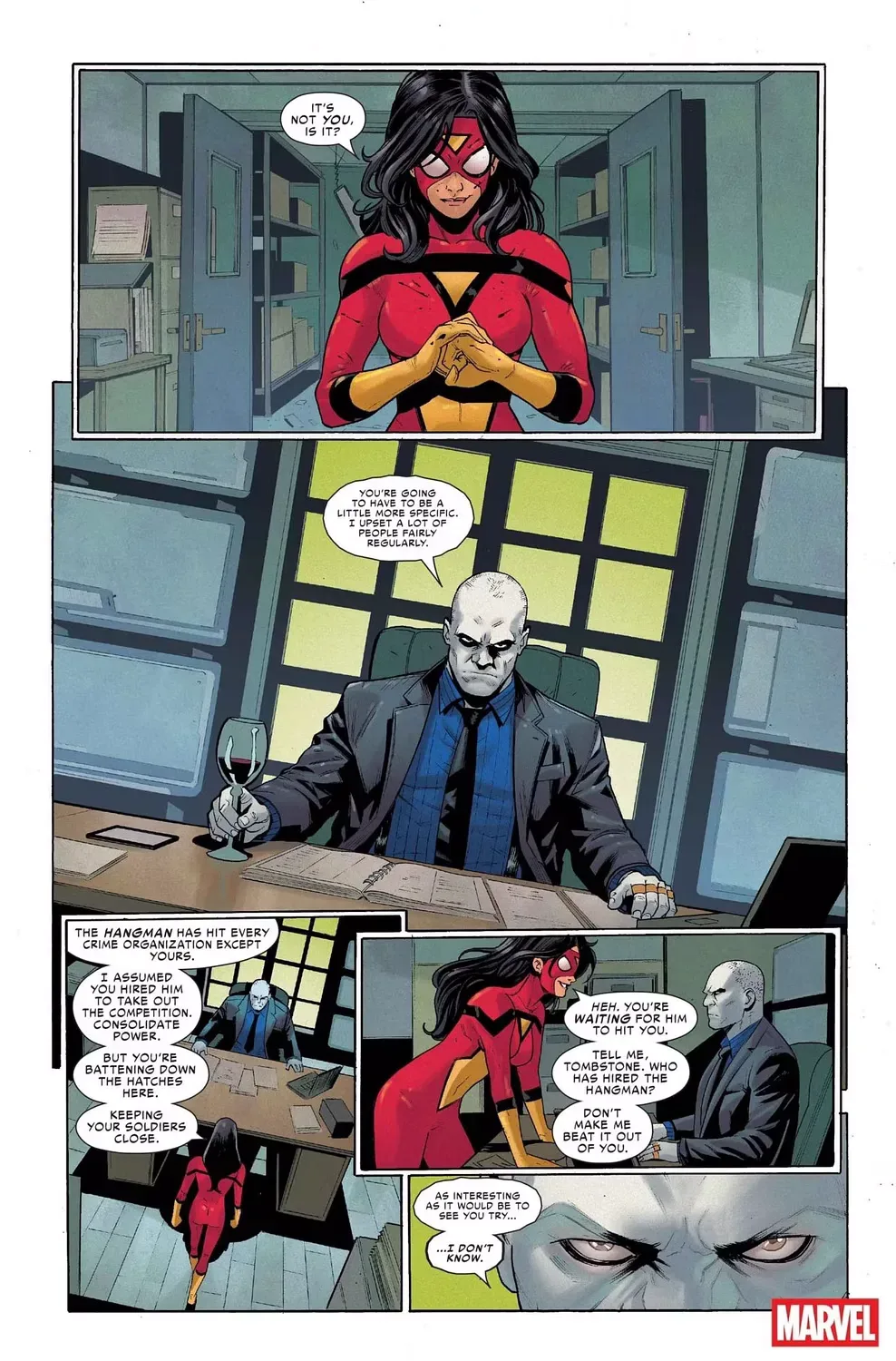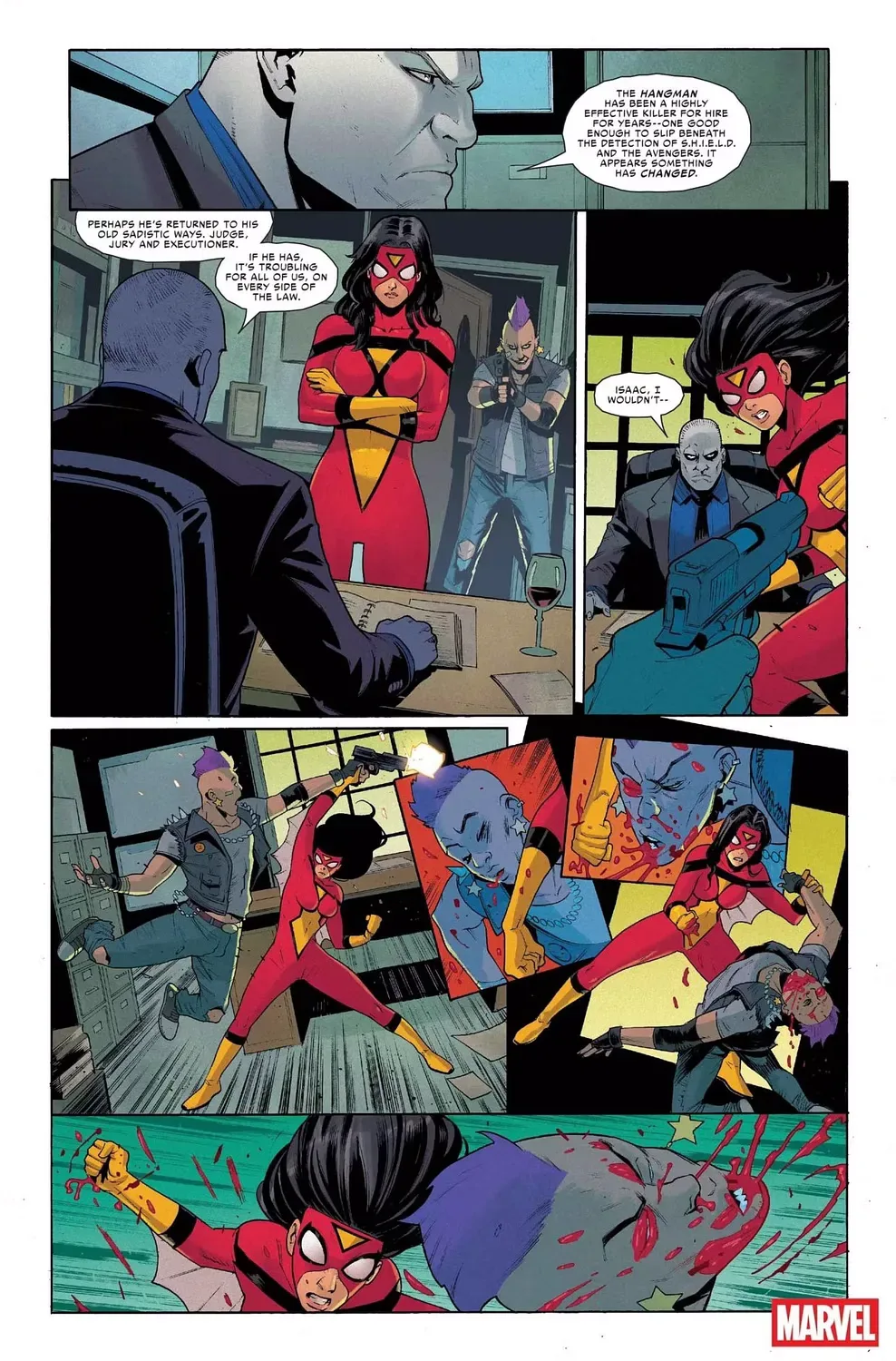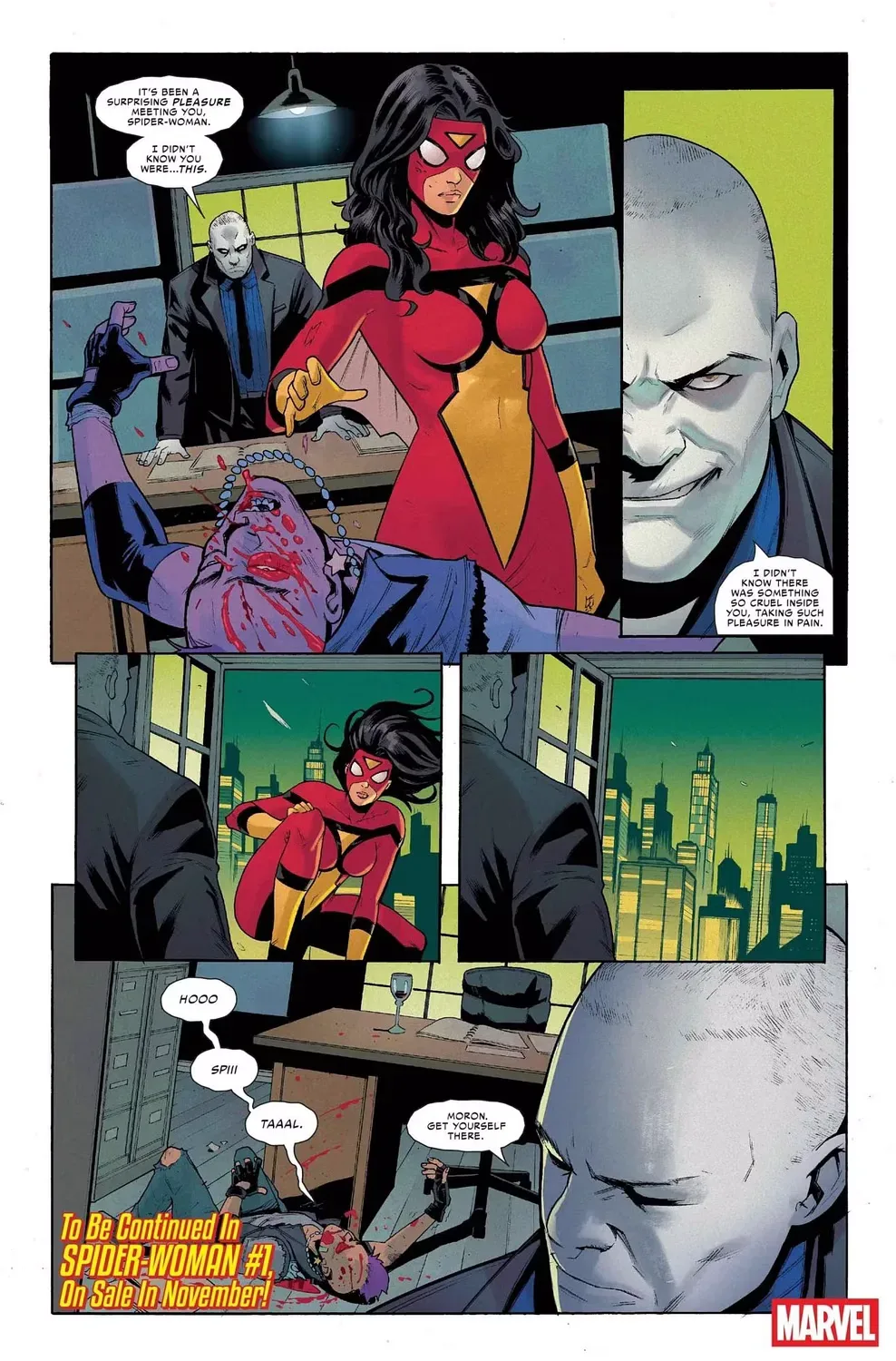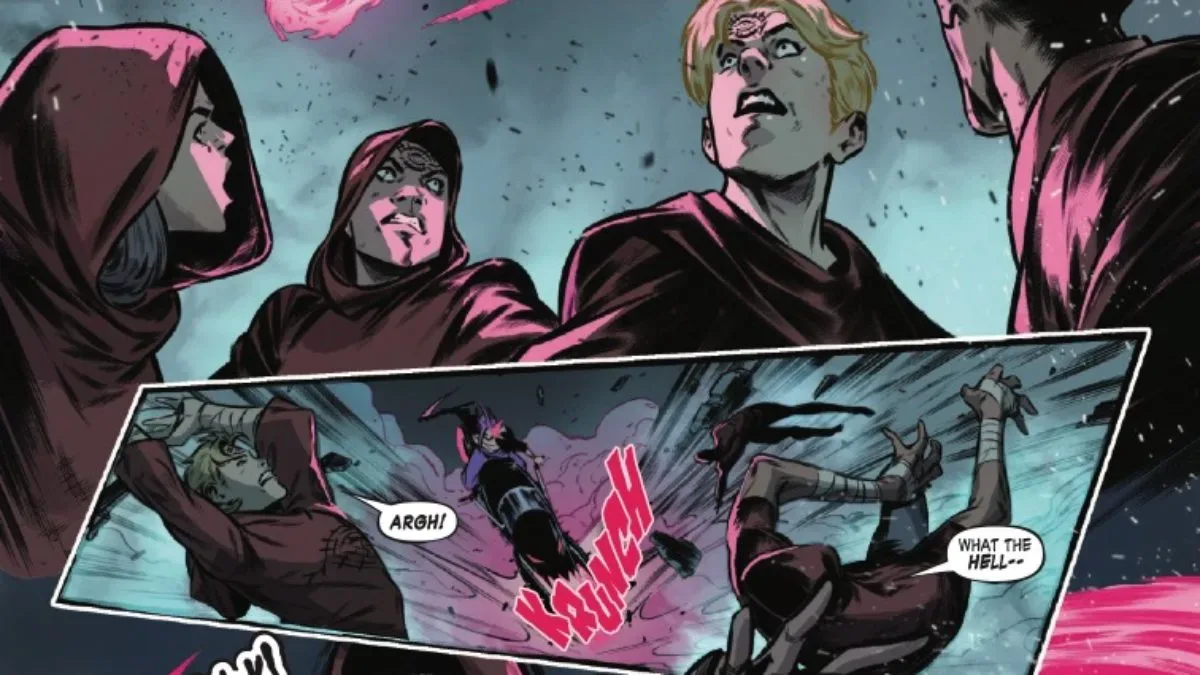
Marvel is putting an unusually clear long-term push behind Spider-Woman #1, the new Jessica Drew series from writer Dan Watters and artist Andrea Broccardo. Due November 4, 2026 for $4.99, the comic pairs one of Marvel’s most seasoned spies and investigators with one of its least suitable roommates: the Carnage symbiote.
That setup is not being framed as a quick crossover detour. During New York Comic-Con Retailer Day, Marvel sales staff described the title as an ongoing series it hopes to sustain for years, and indicated that more retailer-facing information is coming about extra printings of the debut plus a discount connected to orders of issue #2. For a monthly comic, that is a meaningful sign of intent: publishers need shops to commit to later issues as well as a splashy first installment if a new ongoing is going to establish a real audience.
The creative pitch is refreshingly specific. Jessica Drew is returning to private-investigator work and partnering with Ben Urich on assignments too risky for ordinary reporters to chase. The series is set to mix detective plotting, noir-inflected horror and super-powered action, while the Carnage bond turns every violent encounter into both a case complication and a personal threat.
Jessica Drew’s investigation has a problem with teeth
The key premise is not merely that Spider-Woman has Carnage attached to her. Watters has described the relationship as unexpectedly reciprocal. Carnage is not able to dominate Jessica in the manner it expects, while Jessica is becoming colder and more alien under the symbiote’s influence. In effect, she increasingly sees herself as Carnage’s jailer rather than its host.
That distinction gives the book a potentially strong ongoing engine. A symbiote in Marvel comics is a living organism that bonds with a host, commonly granting unusual physical abilities while also creating psychological and ethical pressure. Here, the threat is tied directly to the work Jessica has chosen. The more danger and violence she encounters while investigating, the more opportunity Carnage has to regain its familiar bloodthirsty nature.
It is an especially awkward occupational hazard for a super-powered private investigator in New York. Jessica cannot plausibly solve dangerous cases by staying far from violence, yet every fight risks giving the entity inside her more purchase. That tension should allow the series to approach action scenes as story consequences rather than simply interruptions between clues. Winning a confrontation may still worsen Jessica’s larger situation.
Watters has also positioned Jessica on retainer for the Daily Bugle. Ben Urich and the Bugle bring a journalistic purpose to the detective setup: they can uncover leads and identify stories, but they cannot responsibly send an unpowered reporter into every lethal corner of a city full of masked criminals and monsters. Spider-Woman becomes the person who can go where the paper cannot.
That is a clean practical reason for the partnership, and it gives the comic room for a different rhythm than a conventional superhero patrol. A lead can begin as a reported incident, develop through interviews and investigation, and eventually become a confrontation that tests Jessica’s control. It is also a way to make her long-established investigator credentials central to the premise rather than incidental character trivia.
Noir horror, explained without the trench-coat homework
Marvel has called the book detective-driven and noir horror, while Watters has cited a giallo sensibility in discussing the visual direction. Those labels point to tone rather than a promise that Spider-Woman will suddenly abandon costume action for a black-and-white crime serial.
Noir generally emphasizes moral pressure, secrets, urban danger and protagonists working through situations where clean answers are scarce. In this case, the fit is easy to see: Jessica is investigating threats in New York while concealing an even more alarming secret of her own. Her internal conflict with Carnage adds a horror dimension to every moral choice.
Giallo is a term associated with Italian mystery and horror storytelling, frequently characterized by stylized suspense, striking imagery and murder-centered investigation. Watters’ comment suggests an atmospheric visual influence, not a checklist of borrowed plot devices. Broccardo’s clean linework, ability with action and aptitude for drawing Jessica in unnervingly spidery poses are presented as central to landing that blend.
The result could be a book where a case’s mood matters as much as its villain of the month: dark streets, dangerous witnesses, visual unease and a protagonist who may be the scariest thing in the room if Carnage gets enough leverage. The premise is tailored to Jessica’s physicality, too. Spider-Woman can move and fight in ways that support eerie, off-kilter page compositions instead of treating her solely as another web-slinging silhouette.
Old adversaries are coming back into the picture
The new run is looking to Jessica Drew’s earlier rogues rather than relying only on the more familiar orbit of modern Spider-Man villains. Watters has pointed to Hangman and the Needle as examples of the strange antagonists he wants to spotlight.
Issue #2, priced at $4.99 and dated December 16, 2026, explicitly puts Spider-Woman on Hangman’s trail through New York’s criminal underworld. The official description asks whether Jessica can prevent Carnage from taking control during the conflict, reinforcing that this is not a detachable “villain fight” subplot. The antagonist, the city and Carnage’s appetite are designed to push on the same fault line.
Watters’ interest in these characters appears to be less about retooling them into something unrecognizable and more about giving their existing oddness room to breathe. Hangman is described as an extreme vigilante, while the Needle is a figure associated with silencing victims by stitching their mouths shut. Both are inherently suited to a book seeking unsettling crime-story textures.
Wolverine is another relationship Watters has flagged for future exploration. Jessica and Logan’s history in Madripoor gives the series a potentially useful character connection: someone who knows her well enough to recognize what is driving her, and perhaps to notice the difference between Jessica in control and Jessica being changed by Carnage. No specific issue or appearance has been announced, but the relationship is clearly on the creative team’s list of material worth revisiting.
What Marvel’s retailer push actually means
Marvel’s support is not a guarantee that any ongoing comic will last indefinitely. It does, however, show that the publisher is treating this as a title it wants retailers and readers to consider beyond issue #1. The mentioned plans involve an opportunity for additional overprints of the first issue and a discount tied to ordering the second.
In comic-shop terms, an overprint is an additional printing beyond the original production run. It can help a store respond if demand for a debut turns out to be higher than anticipated. A discount on a later issue speaks to the other side of the equation: continuations need readers to return after launch week. Those measures are business tools, not a creative verdict, but they matter because a new series’ early order levels can shape how confidently shops stock future installments.
Readers interested in supporting an ongoing can help in straightforward ways: ask a local comic shop to reserve the book, make clear whether the order includes issue #2, and pick up the series on schedule if it clicks. That is less glamorous than wrestling a symbiote on a rain-soaked rooftop, admittedly, but it gives retailers better information than a vague “I might grab the trade someday.” The broader comic-shop business remains closely tied to the pull-list relationship between regular customers and stores, a dynamic also visible in recent reporting on how books and related categories are supporting comic shops.
For Marvel, the message is direct: Spider-Woman is not being sold as a fleeting anniversary curiosity, despite arriving amid Jessica Drew’s 50th-anniversary celebration. It is being positioned as a durable character book with a defined genre identity, a dedicated creative pairing and a retailer strategy intended to help it find its footing.
A darker lane for Spider-Woman
There is a sensible reason this concept stands out. Jessica Drew has a long history, but the combination of investigator, Daily Bugle operative and reluctant Carnage warden creates a focused premise that can generate fresh cases without losing a central threat. Each story can ask two questions at once: what is happening in New York, and what is happening to Jessica as she tries to stop it?
Broccardo’s art will be a major part of whether that proposition lands. Watters has emphasized the artist’s clarity, action work and willingness to lean into the strange physical possibilities of Spider-Woman. For a noir-horror superhero comic, clarity is not a small thing. Mysteries need visual information readers can follow; action needs to feel kinetic without erasing the dread; and Carnage needs to seem horrifying without swallowing Jessica’s presence as the book’s lead.
Spider-Woman #1 arrives November 4, 2026. The second issue follows December 16. Marvel’s early campaign makes the ambition plain: Jessica Drew is being handed a dark, case-driven new status quo, and the publisher wants readers and retailers to give it enough runway to become more than a one-case wonder.
Shop the products
Check current price, model and availability at the retailer.