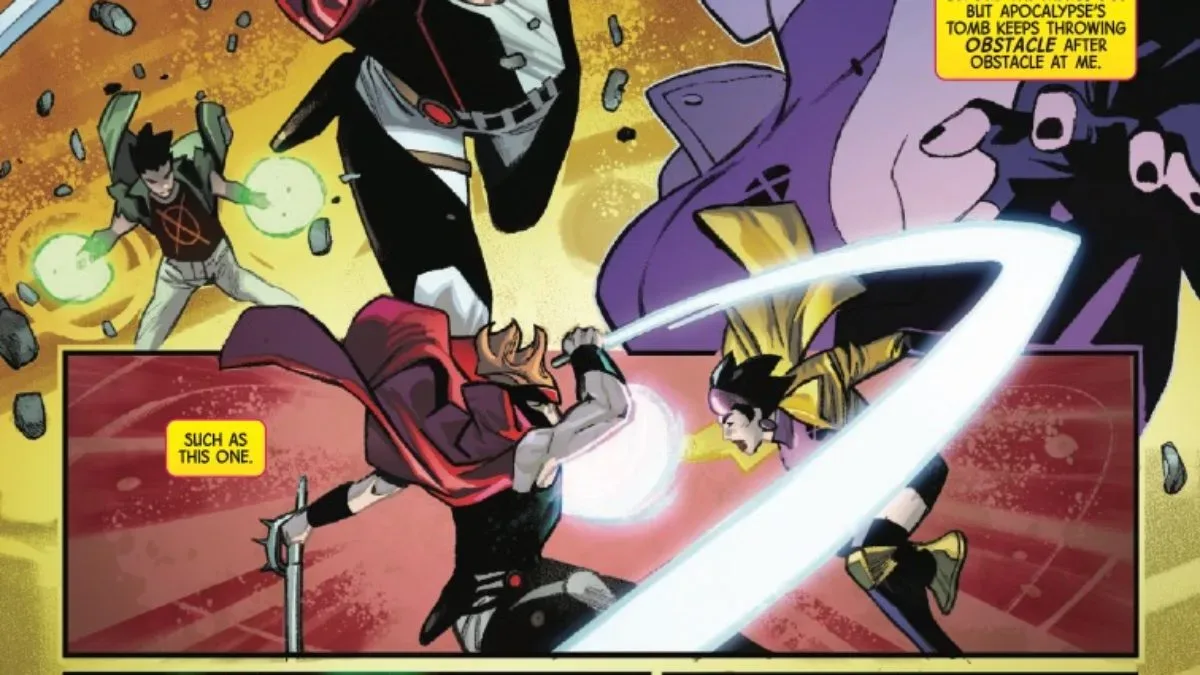
Jessica Drew is taking on a job that should suit a superhero perfectly and make her life considerably worse: investigating New York’s most dangerous stories for the Daily Bugle.
Spider-Woman #1, by writer Dan Watters and artist Andrea Broccardo, launches November 4, 2026 as part of Spider-Woman’s 50th-anniversary celebration. The new direction puts Jessica in the role of a super-powered private investigator on retainer to the newspaper, creating a structure built around mysteries, street-level danger and cases too hazardous for an ordinary reporter to chase. The complication, naturally, is Carnage. Jessica is currently controlling the symbiote, but keeping control is not the same as being untouched by it.
The result is a premise with two ticking clocks. Jess must solve cases in a city packed with people eager to start fights, while violence presents Carnage with exactly the kind of environment that could help it reassert itself. Watters’ setup makes the symbiote more than an extra power set or a cosmetic menace: it is a volatile presence that can change how Jessica sees herself and approaches a case.
A detective assignment gives Spider-Woman a focused reason to investigate
Spider-Woman becoming an investigator for the Daily Bugle is a smart use of a role Jessica has held without it always being central to her adventures. In this version, the paper has a practical reason to hire someone like her. Some leads are too dangerous to pursue with unpowered journalists, particularly in a New York populated by superhumans, criminal organizations and creatures with a talent for turning a routine interview into a property-damage claim.
That distinction matters. A traditional private investigator is usually paid by an individual client and follows a case toward a personal or legal resolution. Jessica’s arrangement with a newspaper places her closer to investigative reporting: uncovering information, entering hostile situations and chasing stories that could have public consequences. She is still a P.I. in the broad, pulpy sense, but her employer gives each mystery a built-in connection to the city and its institutions.
It also lets the series use an episodic detective framework without suggesting that every issue must be disconnected. A case-of-the-month rhythm can introduce suspects, victims and unusual corners of New York, while the larger Carnage problem continues to worsen in the background. The series has already positioned mysteries as a major element, so the promise is not merely that Jessica will punch criminals while holding a notepad. The investigative work is part of the engine.
That approach can make her powers narratively useful in ways that differ from a standard superhero patrol. Spider-Woman may be the person sent into a place where the editorial staff cannot responsibly send a regular reporter, but the task is not completed simply by winning a fight. She still has to learn what happened, judge whom to trust and bring back an answer. For a character carrying an unstable symbiote, that is an especially demanding job description.
Carnage makes Jessica colder, while Jessica confines Carnage
The core character tension is not presented as a straightforward possession story. Carnage and Spider-Woman are affecting one another in ways neither anticipated. Jessica is becoming colder and more alien in response to the bond, yet the symbiote is also failing to dominate her as it expects. Rather than simply serving as Carnage’s host, Jess increasingly sees herself as its jailer.
A symbiote, in this context, is the living entity bonded to a host. The danger in Jessica’s case is psychological as well as physical. If the bond makes her more distant or severe, the question is not only whether Carnage escapes. It is whether Jessica can remain recognizably herself while using the strength that comes with keeping it contained.
There is a nasty feedback loop in that arrangement. Carnage responds to violence; the more of it the symbiote encounters, the more it begins to resemble its former self. But a super-powered investigator operating in New York is unlikely to get through many cases by politely asking witnesses to form an orderly queue. Every confrontation can become both an immediate obstacle and a risk to the containment effort.
That gives action scenes a purpose beyond spectacle. When Jessica fights, she is not just overcoming an enemy; she may be exposing Carnage to the stimulation it needs to become more dangerous. Conversely, refusing to act could put civilians at risk or allow a mystery to go unresolved. It is a pressure point that suits crime fiction well, where a detective’s choices often have costs even when they are correct.
The notion of Jess as Carnage’s jailer also shifts the expected power relationship. Carnage is described as bloodthirsty and only barely contained, but it is not initially depicted as fully in charge. That leaves room for a story about discipline, temptation and erosion rather than one in which the hero is immediately reduced to a passenger. Whether Jessica can maintain that advantage is the dramatic question, and the series’ emphasis on violence suggests it will not be easy.
Early Spider-Woman villains are returning to the board
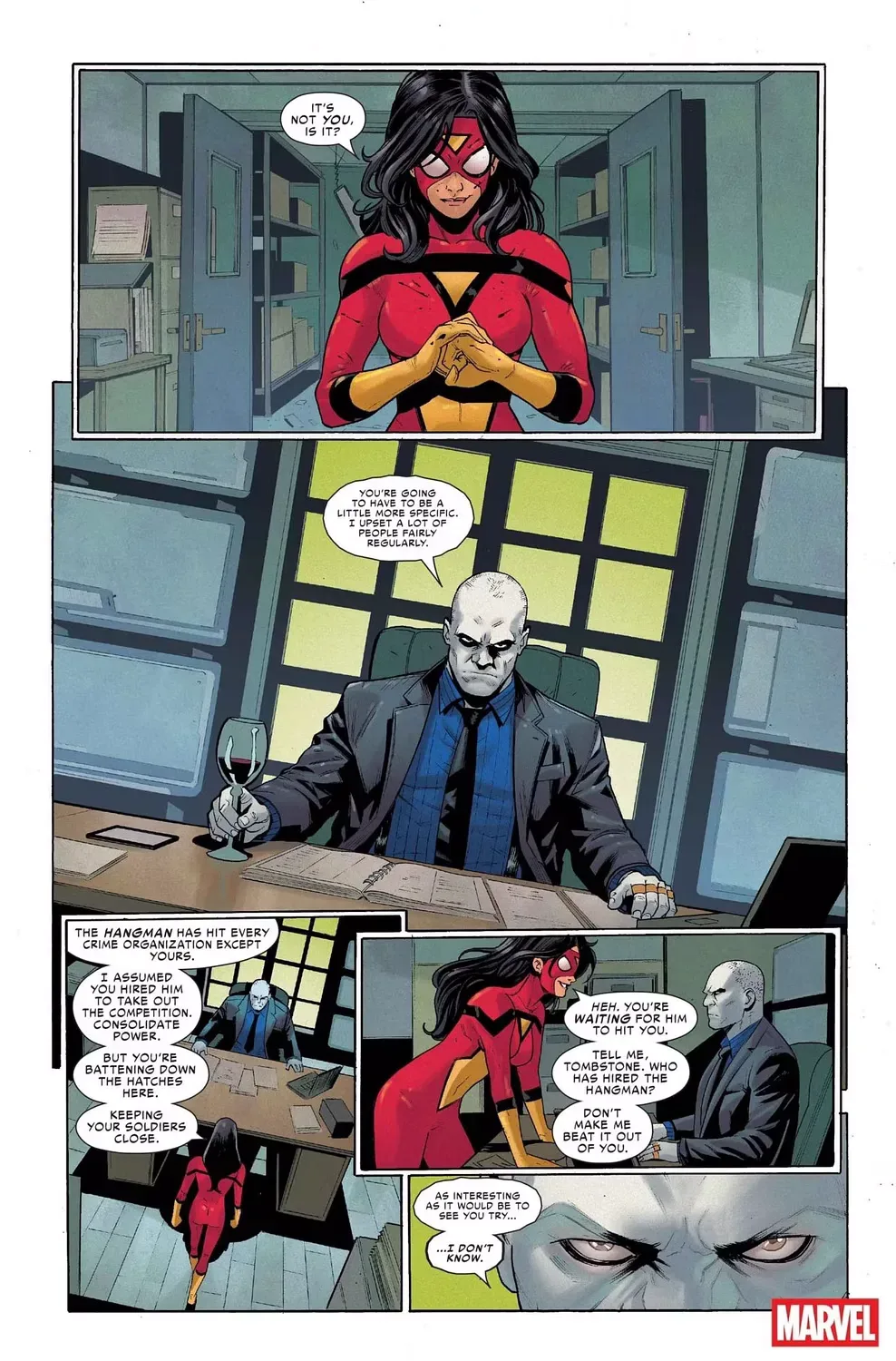
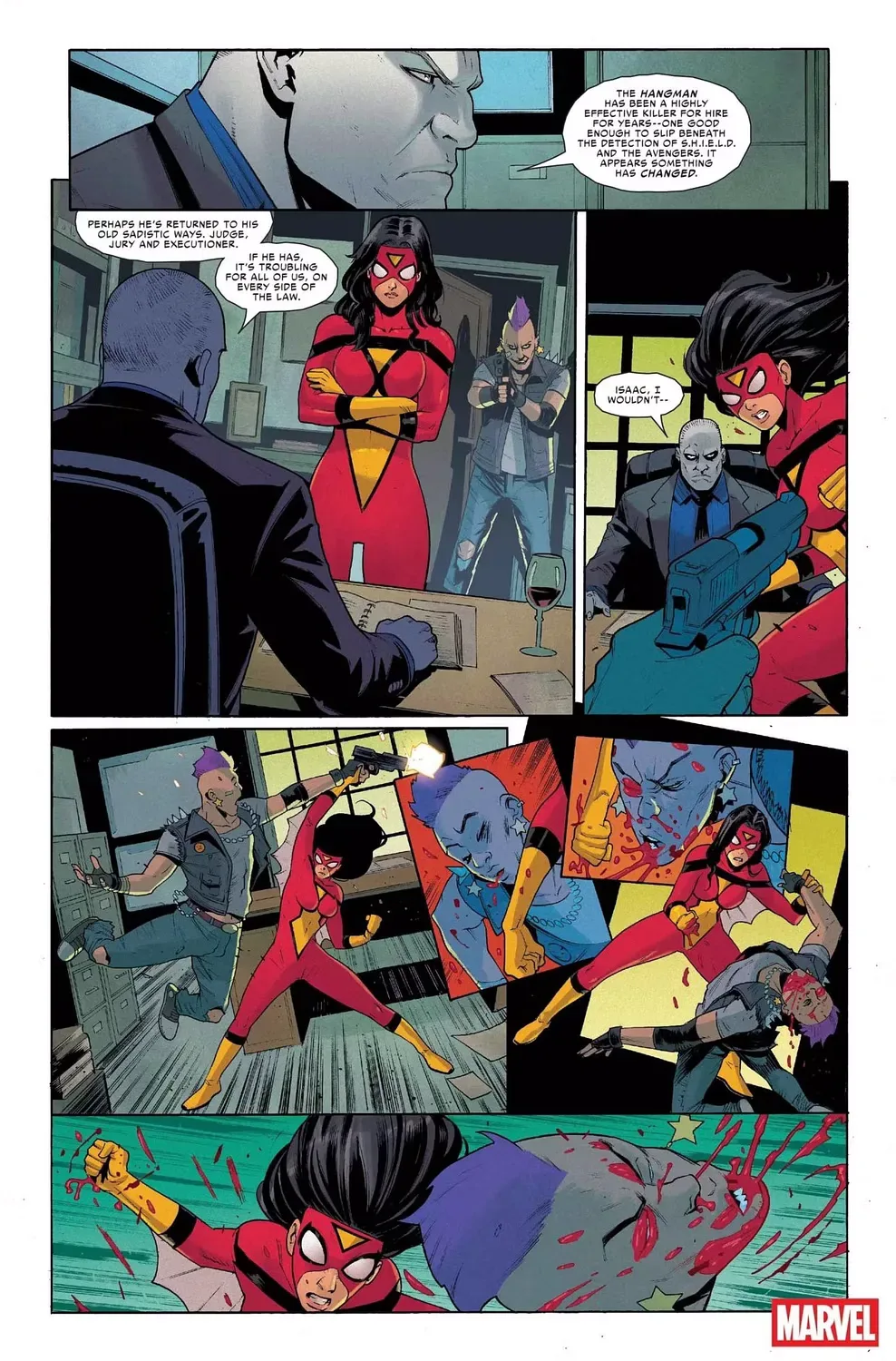
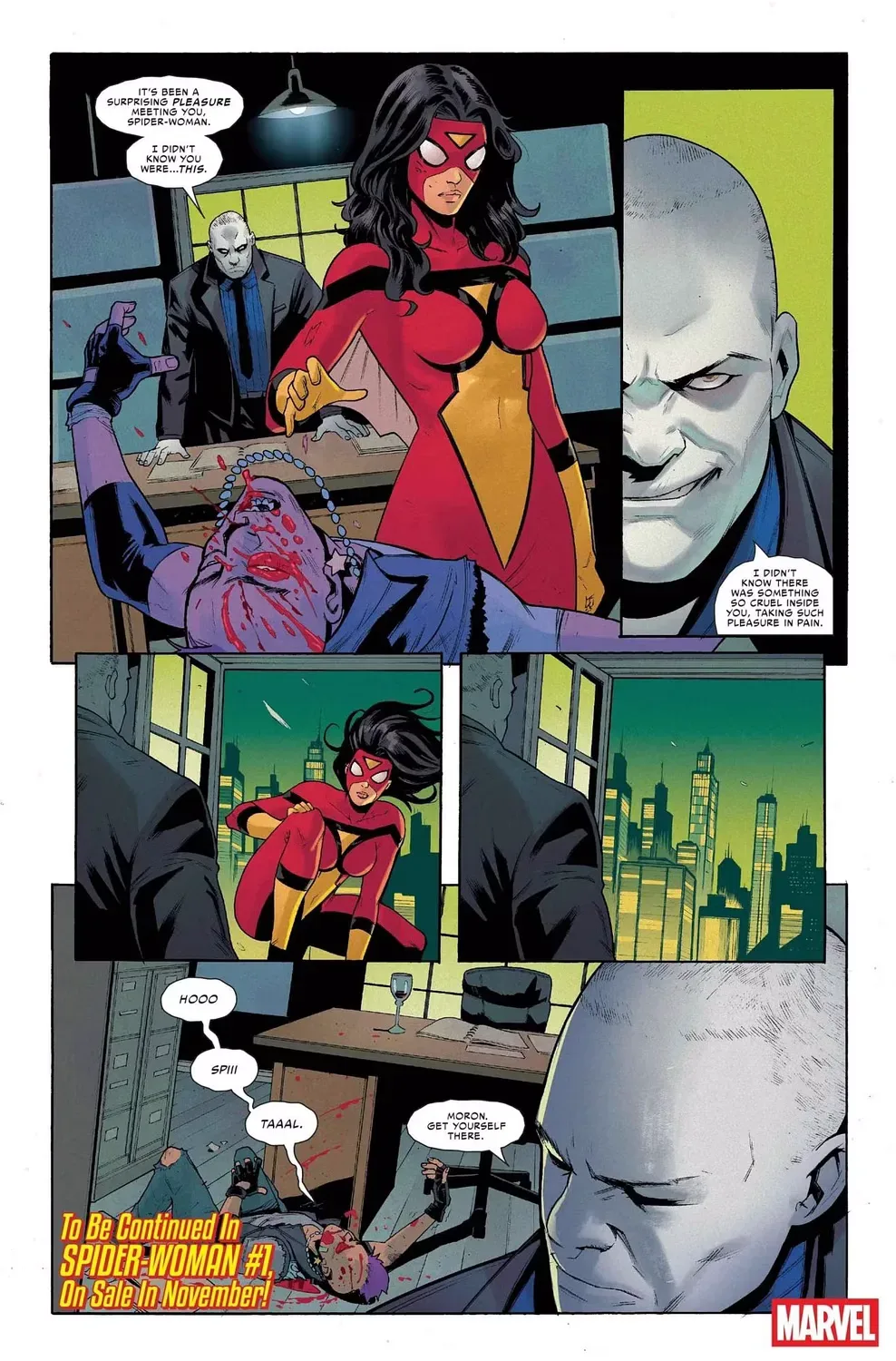
The first issue’s preview material includes Tombstone, while Watters has identified two early Spider-Woman foes he wants to bring back: the Hangman and the Needle. The choice is deliberate. Rather than treating Jessica’s older antagonists as pieces that need substantial reinvention before they can be used, the series is interested in putting their unsettling qualities on the page.
The Hangman is described as a vigilante whose emotional stability compares poorly even with the Punisher’s. The Needle is a much more overtly horrific figure, stalking victims and sewing their mouths shut in pursuit of silence. These are not villains that naturally produce a bright, breezy mystery, and their presence supports the book’s darker stated direction.
For newer readers, returning adversaries provide a way into Spider-Woman’s own history without requiring a syllabus before issue one. Their reappearance signals that the series intends to treat Jessica’s back catalogue as fertile material, not merely background trivia. For established readers, it creates the prospect of seeing distinctive villains used with a different mood and a new central conflict.
It is also significant that the series has a mystery premise. Characters such as the Hangman and the Needle are not only physical threats; their particular fixations can shape the kind of case Jessica investigates. A vigilante and a killer obsessed with enforced silence both fit a story world concerned with evidence, witnesses, public truth and the people who want that truth buried.
Wolverine and Madripoor history may matter
Watters has also pointed to Jessica’s long-running connection with Wolverine as territory he wants to explore. The two worked closely together in Madripoor, and the proposed appeal of their dynamic is familiarity: Wolverine knows who Jessica really is and understands what drives her better than most people do.
That is a potentially useful counterweight to the Carnage storyline. If Jessica becomes more emotionally remote under the symbiote’s influence, a character who recognizes her patterns may be able to spot changes that other allies miss. Nothing establishes the precise form or timing of Wolverine’s role, so readers should not assume more than the clear tease. Still, the connection promises a relationship based on knowledge of Jess rather than a random crossover encounter.
The series’ use of older Spider-Woman material and the Madripoor link points in the same direction: Jessica Drew is not being introduced as a blank-slate detective. The book’s new job and symbiote predicament are forward-moving hooks, but they are being laid over existing relationships, enemies and history.
Andrea Broccardo’s art is central to the crime-horror atmosphere
Broccardo’s contribution is positioned as more than clean superhero staging. Watters highlights the artist’s crisp linework and ability to handle extended action, along with pages that let Jessica twist herself into unusual, spider-like poses. That combination should be particularly valuable for a series balancing investigation and physical danger: scenes need to be readable when clues are being placed, then energetic when the investigation turns violent.
The creative team has also discussed a giallo sensibility for the book. Giallo is a term associated with Italian crime and horror storytelling, often invoking a stylized, heightened atmosphere alongside murder-mystery elements. Here, it describes an aesthetic goal rather than a complete list of story mechanics. The available details point to a comic that wants its mysteries, grotesque villains and unnerving Carnage material to share a visual language.
That sensibility makes sense for Spider-Woman’s situation. Her work for the Daily Bugle supplies the investigative spine; Tombstone, the Hangman and the Needle supply criminal and horror-inflected threats; Carnage brings body-horror-adjacent unease directly into Jessica’s own life. Broccardo’s art has to make those components feel like one book rather than three genres fighting over the same evidence locker.
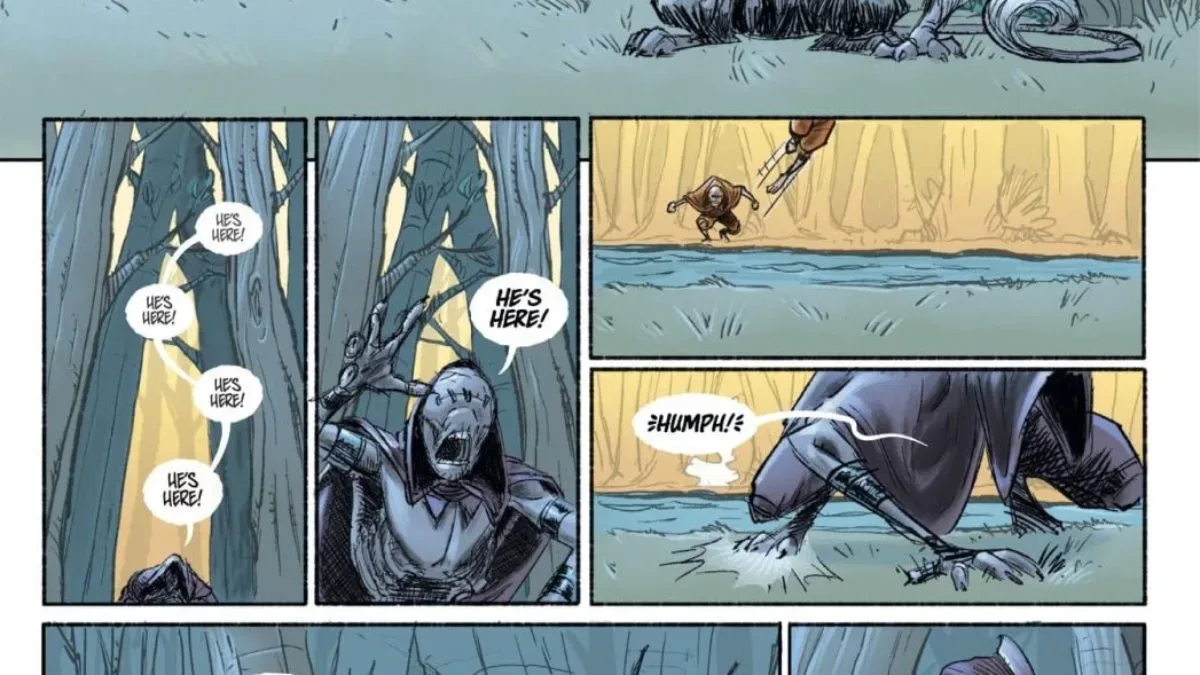
Readers looking for another current comic launch can also see how a wholly different fantasy setup begins in Sunder #1’s cosmic adventure. Spider-Woman #1, by contrast, is putting its heroine in a far more urban and claustrophobic predicament: investigate the darkness in New York while carrying some of that darkness with her.
Release details
Spider-Woman #1 is written by Dan Watters with art by Andrea Broccardo. It arrives November 4, 2026, carries a $4.99 cover price and continues Spider-Woman’s 50th-anniversary celebration. The issue promises old foes, mysteries and a Carnage symbiote that Jessica Drew can contain for now—but apparently not without paying a personal price.
Shop the products
Check current price, model and availability at the retailer.