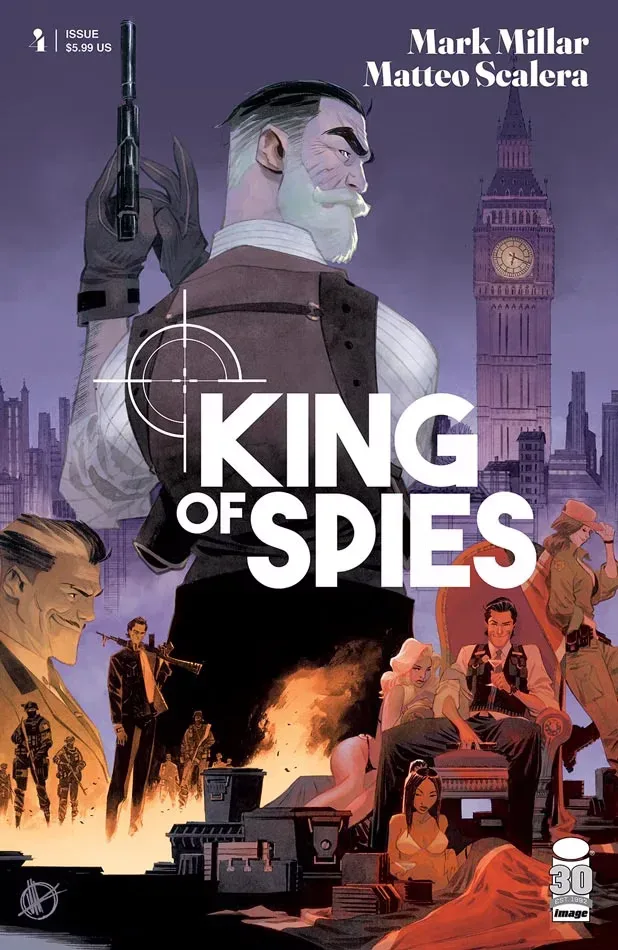
Mark Millar says King of Spies is set to be the next Millarworld property made for Netflix, positioning his 2021 four-issue spy comic as the immediate priority among several screen projects. Millar also named Nemesis, The Magic Order and Psychic Sam as projects in the broader pipeline, while offering the clearest indication yet of how a proposed Nemesis film trilogy could be structured.
The important qualifier is that these are Millar’s own descriptions of work in development, rather than a full public production announcement with casting, a director, a release window or plot details from Netflix. Still, he was direct in saying that King of Spies would be the next project to shoot, and that several productions were being lined up close together before the end of the year.
For comic readers, the news puts the spotlight back on a compact series that was conceived with screen potential from the outset. For movie audiences, it suggests a nastier, more cynical use of spy-fiction language than the polished heroics often associated with the genre.
What King of Spies is about
King of Spies was published as a four-issue Millarworld comic in 2021. It was written by Millar, drawn by Matteo Scalera and coloured by Giovanna Niro. The central character is Sir Roland King, once Britain’s most effective secret agent and now a retired man whose life has narrowed into pain, private clubs and arms dealing.
After receiving a terminal cancer diagnosis, King is given six months to live, with only part of that period expected to be in good health. Instead of quietly accepting the prognosis, he decides to use his remaining time to target people he believes have caused serious harm. That premise turns the story’s old-school intelligence operative into a fugitive force: a man with decades of tradecraft, resources and institutional knowledge pursued by security services as he carries out a personal campaign.
The comic also gives King a personal antagonist in his estranged son, who has his own reasons to want Roland stopped. That relationship matters because it prevents the setup from being only a series of revenge missions. The pursuit is tied to the damage King has caused within his own family, as well as to the targets on his list.
Millar has described the character as being somewhat modelled on Sean Connery. The series opens in Panama in 1990 before moving to King’s present-day reckoning. It uses familiar British spy-story furniture—secret-service operations, henchmen, weapons and global power—but pushes it toward a more confrontational fantasy of accountability.
Why the adaptation has a clear hook
The premise is unusually easy to state: what happens when an aging former super-spy decides his final mission is to punish powerful people he considers untouchable? But its simplicity should not be confused with a conventional spy adventure. The key tension is that King is not merely facing an enemy organization or a geopolitical threat. He is turning his skills against the sort of establishment he spent decades serving.
Millar has compared the comic’s appeal to a mix of Tinker Tailor Soldier Spy, Kingsman, Unforgiven and Kill Bill. Those comparisons describe tone and ingredients rather than confirming anything about the movie’s content. Taken together, though, they point to a story intended to combine espionage procedure, heightened action, anger at entrenched power and the finality of a protagonist who knows he does not have long left.
That terminal diagnosis is more than a countdown device. It alters the usual action-thriller logic. A protagonist who expects to die may be harder to deter, bargain with or frighten, while the agencies trying to stop him face someone trained by the same world they represent. The phrase tradecraft refers to the practical methods of intelligence work: maintaining cover, surveillance, evasion, contacts and operational planning. In this case, King’s long career means his pursuers are chasing a figure who understands their playbook.
Millar has also said this is the comic book he is happiest with, and called the screenplay strong while withholding the writer’s name. He said that writer happens to live near him, a coincidence they discovered during a video call. No cast or filmmaker beyond that unrevealed screenwriter was identified.
King of Spies was built with a film future in mind
The screen focus is not an entirely new direction for the property. When the comic was announced in 2021, it was described as being based on designs from the Netflix Millarworld team and intended to lead into a Netflix film. Millarworld itself had been acquired by Netflix in 2016.
That background helps explain why King of Spies arrives as a logical choice for the next adaptation rather than a surprise revival. It is a self-contained, four-issue story with a protagonist, a deadline, a personal conflict and a built-in engine for escalating pursuit. Those features can make a limited comic series easier to shape into a single film than a sprawling superhero continuity.
It is also worth separating “next to shoot” from “coming soon.” A project entering or preparing for production is not the same thing as a project with a dated release. The supplied details do not establish when viewers will be able to watch King of Spies, who will play Roland King, or how faithfully the screenplay will follow every element of the comic.
That distinction is especially useful for readers who follow comic adaptations closely. Development can involve a great deal of work—scripts, production planning and creative decisions—before a platform shares a trailer, a cast list or a premiere date. For now, Millar’s comments establish priority, not a viewing timetable.
Nemesis is being simplified into a three-film plan
Millar’s comments on Nemesis provide a more detailed example of how he expects a comic property to change for film. Rather than directly adapting the original Steve McNiven series in full, the proposed movie version is planned as a trilogy drawing chiefly from the newer run: Nemesis Reloaded, Nemesis: Rogues’ Gallery and Nemesis Forever.
The original series will not be ignored altogether. Millar specifically pointed to its Japan-set opening sequence as material intended to carry over in some form. But he said the film approach would streamline continuity and keep the premise simple: “evil Batman versus the world.” That is a shorthand description, not a literal connection to DC’s Batman. It communicates the central inversion: a highly capable, gadget-equipped, strategically minded figure whose role is that of a villain rather than a hero.
Continuity is the network of previous events, characters and rules that connect installments in a fictional universe. It can reward longtime readers, but it can also create a high barrier for moviegoers arriving without knowledge of multiple series. Millar’s stated plan is therefore an adaptation strategy, not just a selection of stories: use the newer comic trilogy as the backbone, retain selected earlier elements and reduce the amount of background a first-time viewer must absorb.
He also indicated that Big Game, the Millarworld crossover comic, is unlikely to be part of this immediate adaptation cycle. Crossovers unite characters and concepts from separate works; they can be exciting for established readers but depend on audiences already understanding a larger shared setting. Millar suggested Big Game is better suited to comics for now, with the possibility of a screen version pushed far into the future, if it happens at all.
The larger slate—and what remains uncertain
Beyond King of Spies and Nemesis, Millar named The Magic Order and Psychic Sam among the projects in motion. The available information does not provide a production order, casting, release plans or detailed adaptation outlines for those titles, so they should not be treated as equally far along simply because they were mentioned together.
Psychic Sam occupies a different business position from the Netflix-owned Millarworld comics. It was crowdfunded outside Millarworld by John Romita Jr., Millar’s Kick-Ass co-creator, through Mark Millar Productions; another title, Conquered, was part of that effort as well. Millar has said he plans to establish his own film studio, with Psychic Sam included in that ambition.
There have also been reports, not confirmed in the material available here, that Millar ceased to be a Millarworld employee at the start of 2025, when Mark Millar Productions was established. Those reports should remain just that: unconfirmed. They do not change the key practical point that Netflix owns the Millarworld properties discussed here, while Millar continues to be involved with films and comics tied to them.
The recent publishing pattern is part of why these adaptation comments stand out. The Millarworld line has not introduced new original-property comics since that point, while Star Crossed brought together existing properties Sharkey, The Bounty Hunter and Space Bandits. A heavier emphasis on film work would fit Millar’s statement that movies currently take roughly 90% of his time, even as he says he still enjoys making comics.
What comic readers should watch for
The immediate takeaway is not that every listed project is guaranteed to arrive on a specific date. It is that Millar has identified King of Spies as the next priority and has sketched a concrete creative route for Nemesis. Those are more useful signals than broad talk of a “universe,” because they identify a particular story, its intended format and, in the case of Nemesis, the comics supplying the foundation.
A Dark Horse Comics item related to King of Spies is listed for December 15, 2026, though the supplied information does not establish its exact nature or any formal tie to the film’s timetable. Readers should be cautious about treating a publishing listing as proof of a screen announcement until official details arrive.
For those curious about Millar’s work beyond this spy story, his comics career includes major superhero material such as The Authority, The Ultimates and Civil War, along with creator-owned titles including Wanted, Kick-Ass and Secret Service/Kingsman. That mix helps frame the current slate: the projects range from sharp genre premises to worlds that can support larger adaptations, but King of Spies is being presented as the first move.
Fans looking for more screen-focused pop-culture coverage can also read our review of Below. For Millarworld, however, the next meaningful update will likely need to answer the basics still left open: who is directing, who will play Roland King, and when Netflix expects the mission to begin.
Shop the products
Check current price, model and availability at the retailer.