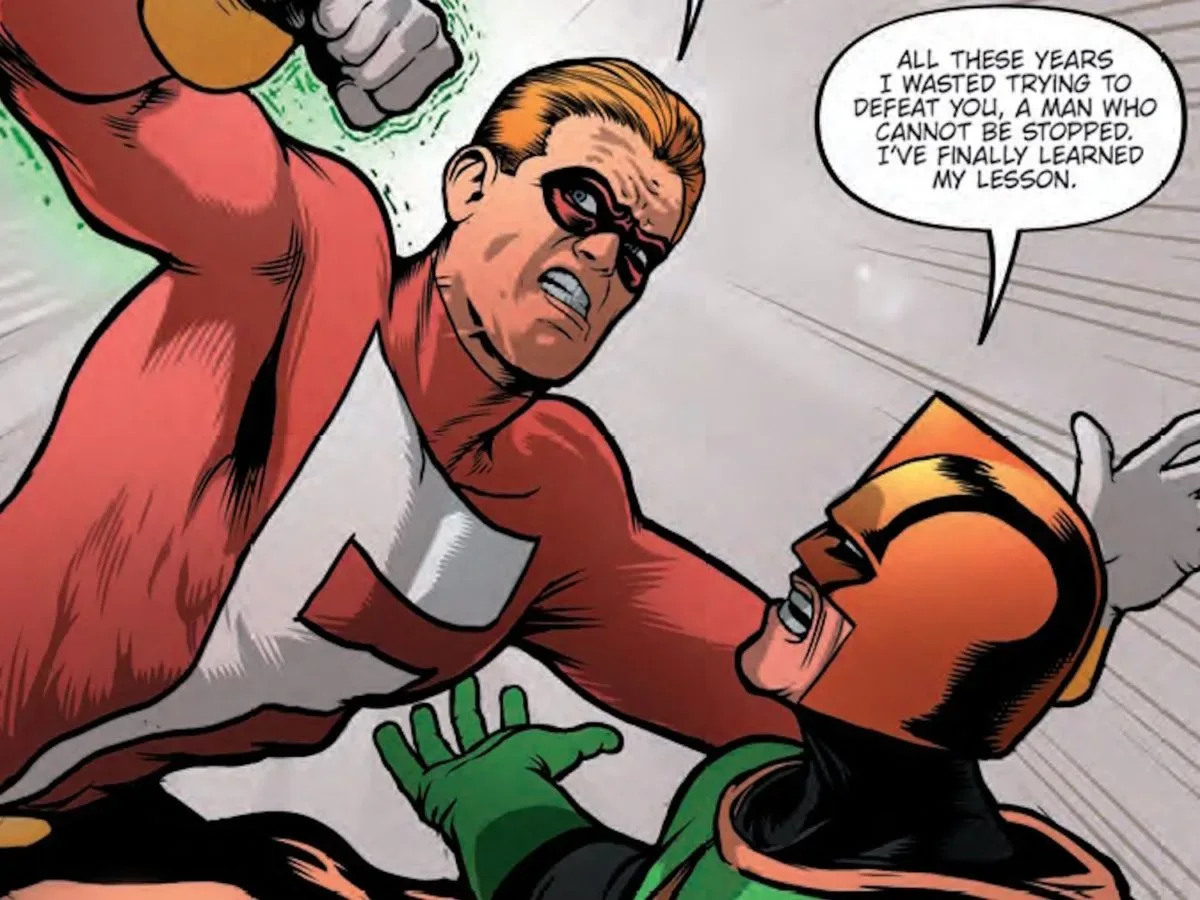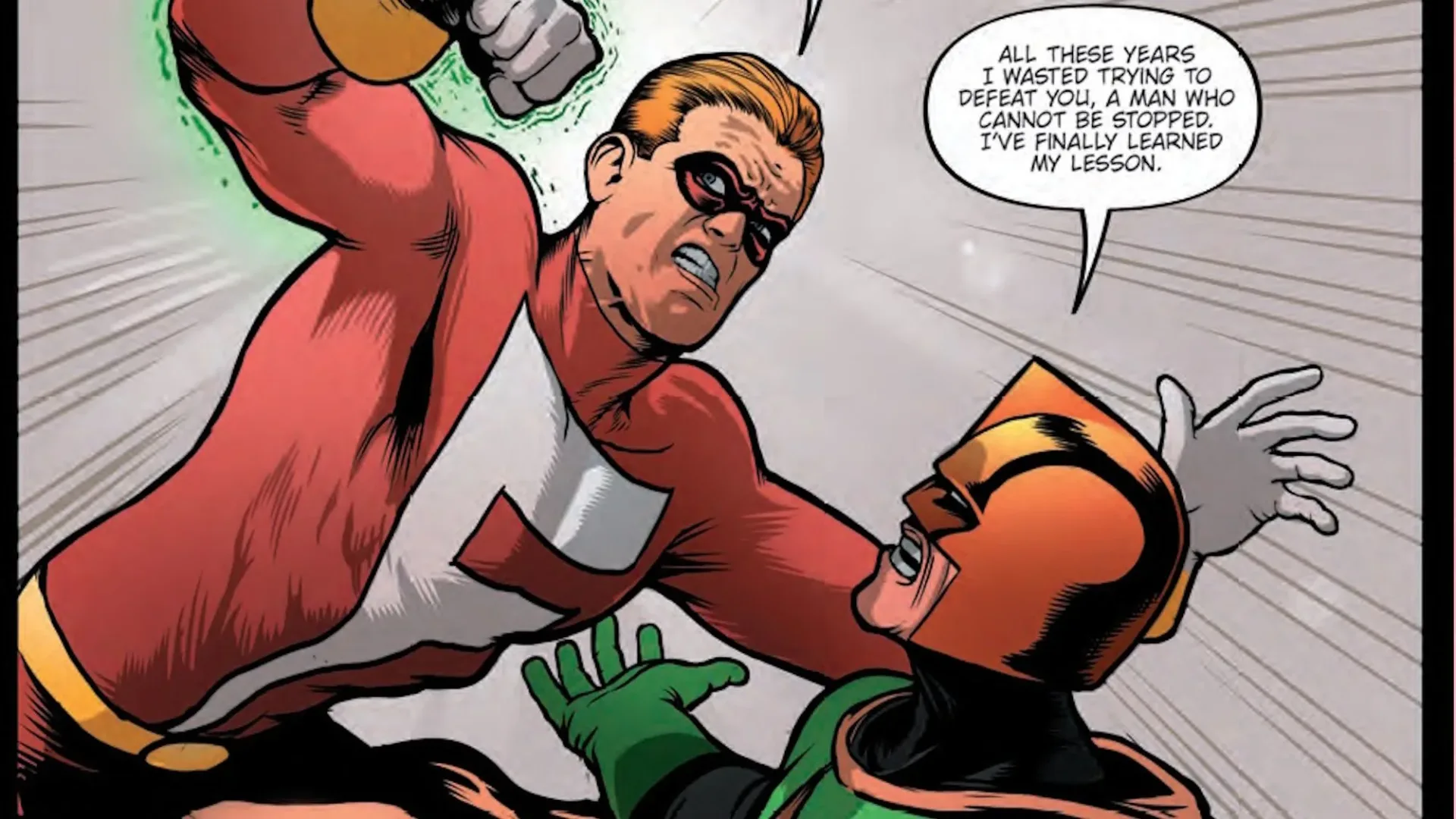
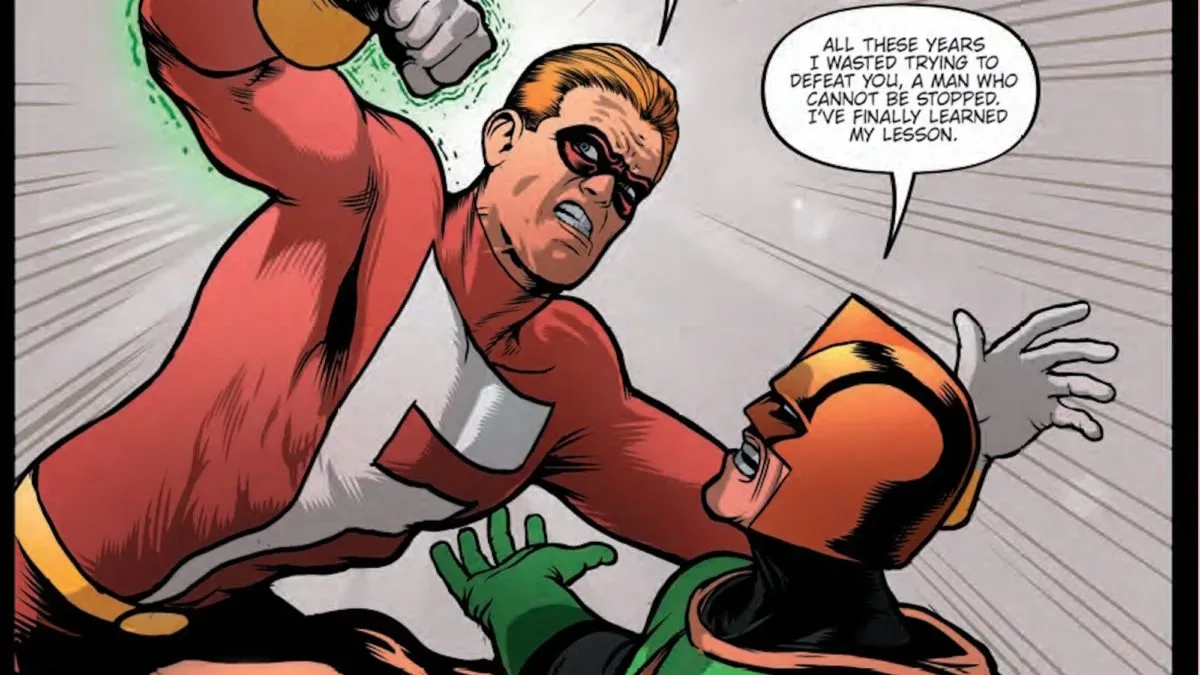
Golden Years, a new five-issue superhero miniseries from New Pain Productions, will send a hero from the 1950s into a present that has no memory of him. Captain Future’s problem is not simply that he has been displaced in time: he must rebuild a life in an unfamiliar era while enemies who do remember him begin to close in.
Writer Michael Katz is joined by artists Kevin Maguire, Jack Herbert and Netho Diaz. The arrangement is especially central to the book’s premise. Maguire will provide the covers and flashback material throughout the series, while Herbert draws the modern-day pages in issues #1 and #2. Diaz takes over the present-day art beginning with issue #3 and remains on the series through issue #5.
The first issue is scheduled for December 16, 2026, at $4.99. New Pain has listed the series as monthly, with issue #2 due January 13, 2027 and issue #3 following in February 2027. Retailers can order the comic through Philbo Distribution.
One character, two visual eras
The creative split is more than a rotating-art-team credit. Golden Years is structured around a contrast between Captain Future’s earlier life and the world in which he now finds himself. Maguire’s work is set to establish the flashbacks and the superhero styling associated with the character’s 1950s history. Herbert and, later, Diaz will depict the contemporary storyline.
That makes the changing visual language part of the storytelling architecture. Flashbacks are scenes that revisit events before the main timeline; here, they have a defined thematic job. They can show the version of Captain Future that was known, understood and presumably had a place in his own time. The current-day scenes instead begin from absence: he is forgotten by the public, unfamiliar with the systems around him and forced to make sense of threats that have changed with the era.
The premise does not indicate that Captain Future is merely a visitor seeking a quick route home. The announced setup emphasizes adaptation and reconstruction. He has to establish a new life, encounter modern crime and respond to adversaries in a setting that lacks the social context, support network and reputation he once had.
That contrast also gives the book a clear way to approach a familiar superhero device without treating it as a simple costume-era novelty. A hero out of time can be played for visual fish-out-of-water moments, but Golden Years puts the more serious imbalance at the center: the wider world has lost its memory of him, while the people who wish to harm him have not. Recognition, in this story, appears to be a weapon held by the wrong side.
How the first three issues are positioned
New Pain’s descriptions outline an escalation across the opening issues, even while holding back the wider group targeting Captain Future.
- Golden Years #1 introduces Captain Future as a 1950s superhero stranded in the present. He must adapt to the era and rebuild a life, with the added danger that his enemies remain aware of him.
- Golden Years #2 gives him what is described as a crash course in modern crime. That suggests the series will move beyond the broad shock of time displacement and into the practical challenge of operating as a hero under changed conditions.
- Golden Years #3 brings direct attacks from unfamiliar modern supervillains. Captain Future receives help from a local hero called Night Fox, without knowing that a larger organization is working to destroy him.
The issue-three synopsis is where the series’ conflict becomes more specific. Captain Future is no longer only contending with an abstractly changed world; he is facing opponents from that world, and their attacks are part of something bigger. Night Fox offers the possibility of a local connection, but the solicitation makes clear that Captain Future does not yet understand the full scope of the threat.
There is room in that setup for a productive tension between experience and relevance. Captain Future’s past may have equipped him to be a hero, but it cannot automatically equip him to understand current villains, current crime or the covert group moving against him. Conversely, a newer hero such as Night Fox may know the terrain while lacking Captain Future’s history with the enemies behind the plot. Those are story implications rather than confirmed plot points, but the announced issue descriptions deliberately place both kinds of knowledge on opposite sides of the temporal divide.
The creators and what each role means
Katz is the writer of all five issues. Maguire’s involvement covers the series’ covers and flashback pages, alongside interior art credits on the first three announced issues. Herbert is credited on the art for issues #1 and #2, while Diaz joins on issue #3 and handles the latter three issues’ modern-day material.
Maguire is identified with Justice League International, and the project gives his expressive character work a persistent role rather than treating his contribution as a one-off cover assignment. Covers serve as each single issue’s primary front image, but his flashback pages should make his contribution felt inside the narrative as well. Since every installment is expected to move between past and present, the flashback artist becomes an ongoing storytelling presence.
Herbert’s first two issues must establish the contemporary half of the series at the same time the reader is learning Captain Future’s situation. That is a significant responsibility in a premise built on contrast: the modern setting cannot simply look different from the past; it has to feel like a place Captain Future must learn to navigate.
Diaz arrives at the point where the book announces modern supervillain attacks and Night Fox’s involvement. The material describes his contribution in terms of cinematic scale and kinetic energy. In comics, kinetic describes artwork designed to convey movement, force and momentum on the static page. It does not mean animation. Page composition, figure poses, linework and the relationship between panels can all create that impression. The series is therefore positioning Diaz’s arrival alongside a larger, more openly action-driven phase of Captain Future’s fight.
The credited handoff is potentially well suited to a five-issue format. Rather than pretending a changing art team is invisible, the book incorporates different artistic assignments into its split-era concept. Maguire anchors the past and the covers, Herbert introduces the present, and Diaz takes the contemporary conflict into the portion of the series where the threat is said to broaden. The result will depend on execution, but the announced design gives each artist a defined narrative lane.
An independent series with a focused release plan
Golden Years was created by Strider Nolan Media and is being published by New Pain Productions, a company founded by Keith Champagne. The publisher’s broader creator lineup includes Doug Mahnke, Jerry Ordway, Rich Leonardi and Keith Williams.
For readers, the immediately useful point is that this is a finite, numbered story rather than an open-ended ongoing title: each issue is labeled as part of a five-issue series. The first three solicitations establish the release rhythm and core credits, but they do not disclose every later plot development or provide full individual release dates for issues #4 and #5. The monthly plan is announced; beyond the February 2027 window for #3, exact dates should not be assumed.
The $4.99 price is listed for issues #1 and #2. Issue #3’s provided solicitation identifies the creative team and February 2027 timing but does not provide a price in the available details. Likewise, while Diaz is credited for issues #3 through #5 and Maguire is assigned covers and flashback pages for each issue, the currently available information does not lay out every specific page allocation or story beat for the final two installments.
Philbo Distribution is the route named for retailer orders. Distribution is the logistical channel through which comic shops can obtain copies to sell; it is distinct from the publisher that produces the comic. Readers interested in following the series from its opening issue can use the December 16 date and the five-part numbering when speaking with local shops, while recognizing that retailer ordering and shop stock can vary.
Captain Future’s difficult return places Golden Years among superhero stories interested in the human cost of legacy, not just the spectacle of it. For another recent comic-book discussion involving long-running superhero mythology, see our look at Batman 2026 Annual #1 and the Calculator’s role in Torus. In Golden Years, the key question is more intimate: what remains of a hero when the era that understood his identity has disappeared?