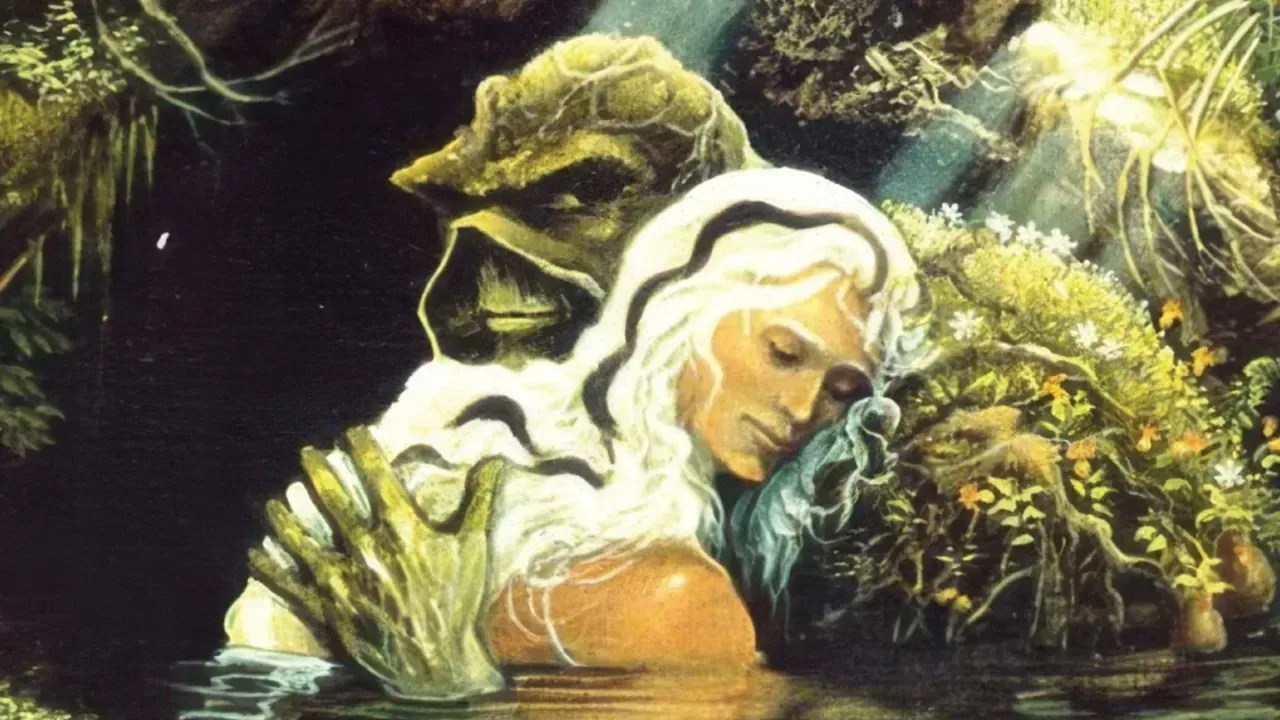
DC is preparing a major new edition of Alan Moore’s Swamp Thing material, and its most important promise is not simply that it will be large. The Swamp Thing by Alan Moore Omnibus is planned as a two-volume hardcover set in a slipcase that restores and remasters the original coloring and uses paper stock intended to reflect the period in which the comics first appeared. The set is scheduled for July 6, 2027, with a listed price of $175.
That production choice is the headline. Moore’s celebrated run has remained available in collected editions, but the currently identified paperback and Absolute hardcover options use newer, modernized coloring rather than the color treatment used in the original single issues. For readers and collectors who regard color as an inseparable part of a comic’s atmosphere, rather than a neutral technical update, this omnibus could fill a long-standing gap in the shelf.
The announcement also gives the release a wider remit than a straightforward run of regular issues. Alongside the core Swamp Thing stories, the omnibus is set to contain crossover and supplementary pages, early Hellblazer issues, an unpublished Moore proposal for Twilight of the Superheroes, surviving material from Swamp Thing: Déjà Vu, new essays by Stephen R. Bissette and Rick Veitch, and archival art and scripts.
What makes this edition different
“Restored and remastered” can sound like publisher jargon, so it is worth separating the terms from the outcome being promised here. A restoration generally means preparing historical material for a new printing while retaining its original visual character as closely as possible. Remastering usually refers to making the reproduced material suitable for modern production. In this case, the practical distinction readers will likely care about is clear: the omnibus is intended to return to the coloring associated with the original issues rather than retain the recolored look of the current collections.
Color is especially consequential in a series that moves among horror, fantasy, romance, and science fiction. It controls how a swamp feels on the page, how unnatural a supernatural image appears, and whether a scene lands as murky, dreamlike, grotesque, or brightly immediate. Newer coloring can be attractive on its own terms, but it can also change a work’s tonal balance. That is why the change has been a recurring concern among fans of these comics.
The new omnibus is also set to use period-appropriate paper stock. Paper stock is the type of paper selected for printing, including qualities such as its surface and how it takes ink. It matters because colors do not look identical on every page material. A presentation designed around paper closer to the original comics’ printing context may alter the relationship between linework, shadow, and color compared with a glossy contemporary hardcover.
There are no interior preview pages available yet. As a result, readers should treat the restoration goal as a stated plan rather than make assumptions about the exact final appearance of every page. Still, the combination of original-color restoration and period-minded paper is a notably specific response to the main objection surrounding the existing collected editions.
The contents go beyond the main series
The two volumes are intended to collect The Saga of the Swamp Thing #16-30 and Swamp Thing #31-64, which together cover Moore’s full run. The package is also expected to include Swamp Thing Annual #2 and DC Comics Presents #85.
Its scope then extends outward through John Constantine, Hellblazer #1-3, as well as pages from DC Sampler #2-3, Crisis on Infinite Earths #4, and The New Teen Titans volume 2 #18 and #22. That makes the project more than an issue-by-issue library edition. It is positioned as a broader document of the creative orbit around this era of Swamp Thing.
John Constantine is a particularly meaningful inclusion. Moore’s run introduced the character, and the first three issues of Hellblazer place a key part of that legacy in the same package. For someone coming to the material without a detailed map of DC continuity, the benefit is practical: related material is being gathered instead of left as a separate hunt across different formats.
Two archival inclusions give the set a different kind of value. The omnibus will include Moore’s original proposal for the unrealized event Twilight of the Superheroes. A proposal is not the same thing as a completed story, and readers should not expect a lost, fully finished event comic. Its inclusion instead offers insight into a project that did not reach publication in its intended form.
The set also includes the surviving pages from Swamp Thing: Déjà Vu, by Len Wein and Bernie Wrightson, described as taking place after Moore’s run. “Surviving pages” likewise signals partial archival material, not necessarily a complete narrative. For collectors, however, the appeal may be exactly that this is material tied to a notable creative history which has not simply been presented as a conventional, complete book.
Why the color issue has mattered
Readers who already own the six trade paperbacks or the two Absolute Edition hardcovers are not being told that those books suddenly cease to be readable. They remain the available ways to read the run in collected form before the new set arrives. The difference is that both have been presented with modern coloring, an approach that has drawn substantial criticism from fans who prefer the original single-issue appearance.
That disagreement is not merely about nostalgia or whether one palette looks “better” in isolation. Recoloring is an editorial interpretation. It can increase saturation, alter contrasts, shift the temperature of a scene, or make visual information more pronounced. Each of those choices can affect how art is received. In a horror-inflected comic, a darker, flatter, or more restrained palette can be part of the storytelling grammar; a different treatment can produce a visibly different mood even when the dialogue, layouts, and drawn lines remain unchanged.
The announced edition is therefore best understood as a format choice with an artistic argument behind it. It gives readers who want the historical color approach a future option while leaving the modern-color collections as alternatives for those content with them. The absence of preview art means the eventual comparison cannot yet be made page by page, but the production intention is unusually central to this release.
It also speaks to a broader reality of collected comics: an omnibus is not automatically “definitive” just because it is oversized and expensive. Completeness, paper choice, reproduction, supplemental material, binding, and the reading experience all shape that judgment. This edition has a persuasive case on contents and stated restoration goals, but individual buyers will ultimately decide whether those factors justify replacing editions they already own.
What an omnibus and slipcase mean for buyers
An omnibus is a large-format collection that packages a substantial amount of comic material in one edition. Here, the quantity is significant enough to require two hardcovers. A slipcase is the outer protective case that holds those volumes together, making the release a unified set rather than two unrelated books.
For a reader, the obvious convenience is consolidation: the central run, selected connected material, and archival extras are planned for one package. For a physical-media collector, the set’s appeal lies in the combination of format and curation. The restoration claim, period-appropriate paper, supplemental essays, original artwork, pencils, and scripts all distinguish it from a basic reprint program.
There are also sensible reasons not to rush into treating it as an automatic purchase. The $175 price makes this a premium hardcover proposition, and the release remains far away. Since interior pages have not been shown, anyone whose priority is exact color fidelity may prefer to wait for preview material before deciding. Buyers who chiefly want access to the stories, rather than a revised physical presentation, may find their existing trade paperback or Absolute editions sufficient.
Those are not contradictory positions. They reflect different priorities: reading access, shelf format, supplemental content, and faithfulness to an earlier printing aesthetic. The July 2027 date gives prospective buyers time to determine which one matters most to them.
A package built around creative context
DC’s summary frames Moore’s Swamp Thing work as a run that redefined the character, introduced Constantine and the Green, and expanded what superhero-adjacent comics could encompass. The contents support an effort to present that claim through context rather than through the main series alone. Crossovers show how the work touched other titles; the early Constantine material follows one important branch; essays and scripts promise a closer view of process; and the incomplete or unrealized projects preserve parts of the historical record that a standard collection would omit.
The term “the Green” is relevant here because it is specifically identified as one of the elements associated with these stories. Readers unfamiliar with it do not need prior continuity knowledge to understand the collector value of its inclusion: the omnibus is designed to collect the work that established a major piece of Swamp Thing’s identity, while surrounding that work with connected material.
It is a reminder that legacy works do not only survive through new adaptations or new stories. Their form of preservation matters. That same attention to enduring creative texture can be seen in other pop-culture discussions, including a look at how a lasting Twin Peaks reference is being honored in Control Resonant. In this case, the preservation question is literal: how should landmark pages look when they are printed for a new audience?
The practical takeaway
The Swamp Thing by Alan Moore Omnibus is planned for July 6, 2027, at $175. It will arrive as two hardcover volumes in a slipcase and is set to restore and remaster the original coloring on period-appropriate paper. Its collection list spans Moore’s core run from The Saga of the Swamp Thing #16 through Swamp Thing #64, plus annuals, crossover material, early Hellblazer, archival pieces, essays, art, pencils, and scripts.
The crucial caveat is equally straightforward: no interior preview art has been released, so the final reproduction cannot yet be evaluated directly. But for readers who have avoided existing collections because of their modern recoloring, this is the first announced format specifically aimed at returning the run to a closer approximation of its original visual identity.