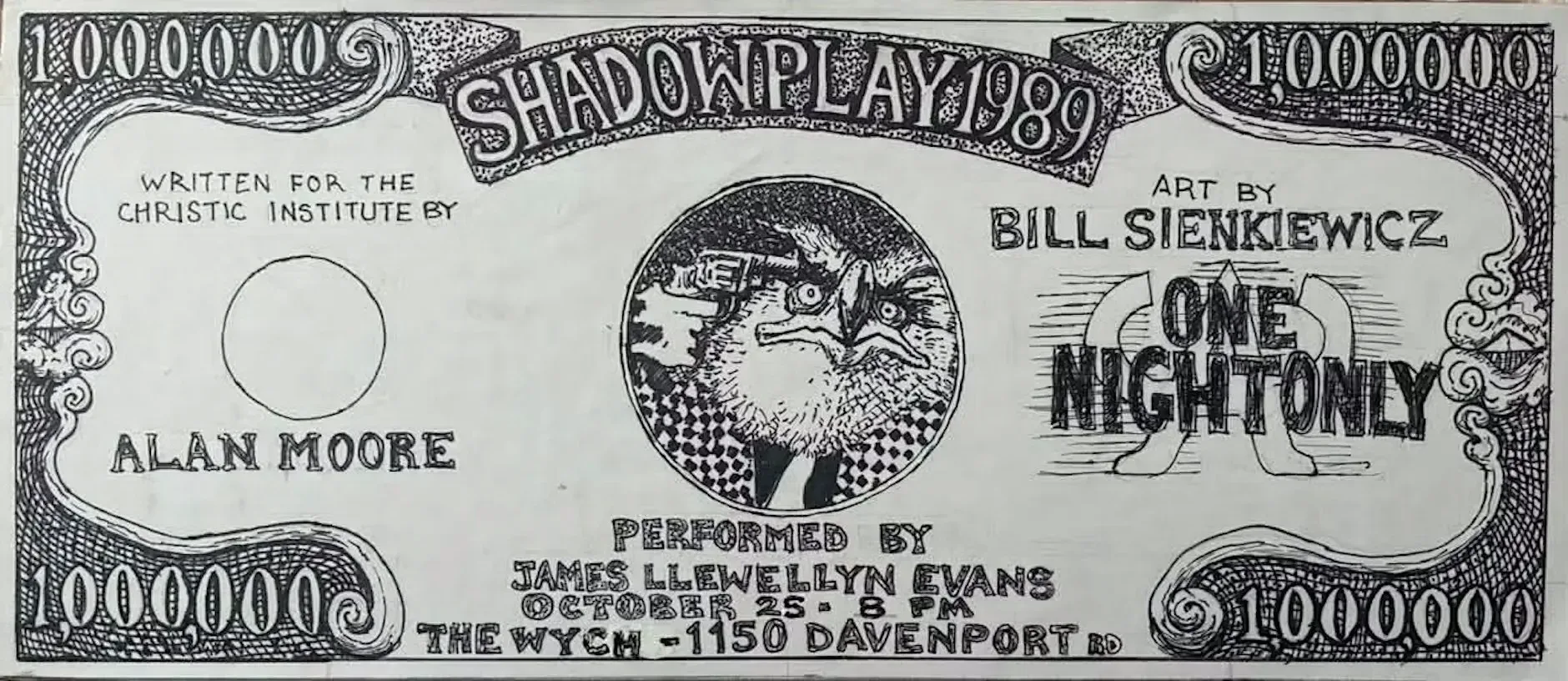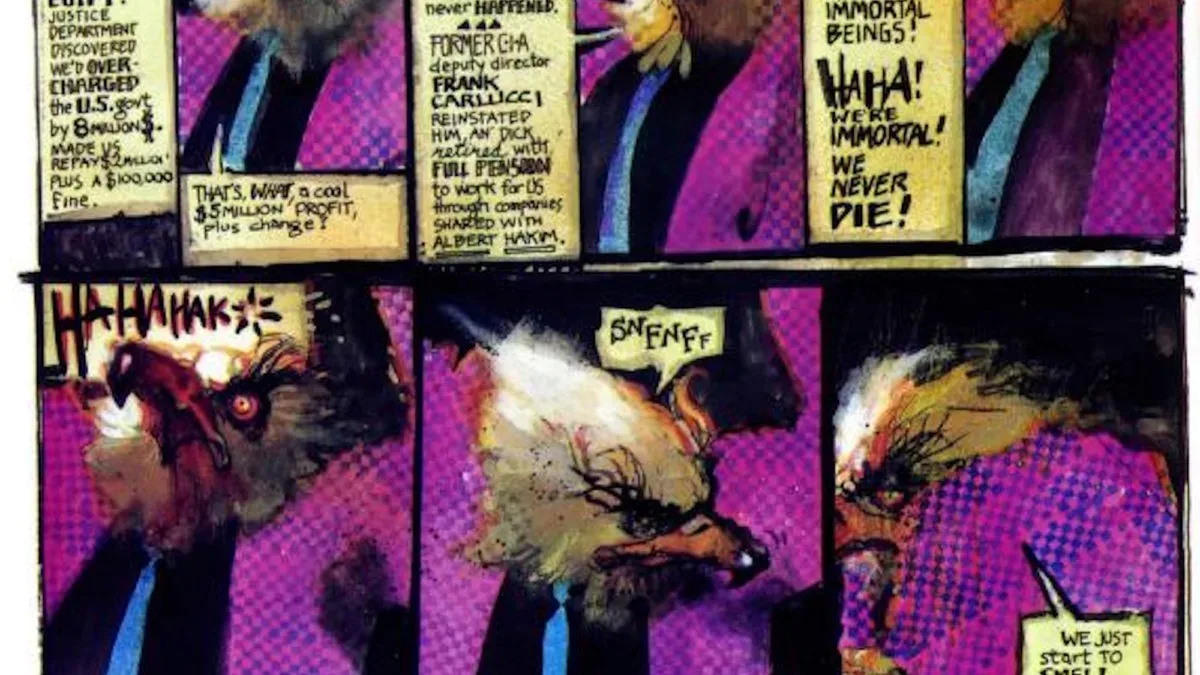
Alan Moore and Bill Sienkiewicz’s Shadowplay: The Secret Team is being adapted for the stage in Toronto. Titled Shadowplay 1989, the production is scheduled to play for one night only on Sunday, October 25, 2026, from 8 p.m. to 9 p.m. at The Wych on Davenport Road.
James Llewellyn Evans is behind the adaptation, which began as what he described as an unofficial tribute. After contacting Moore, Sienkiewicz and musician Gary Lloyd about the plan, Evans received permission from all three. The resulting performance is being presented as an authorised adaptation.
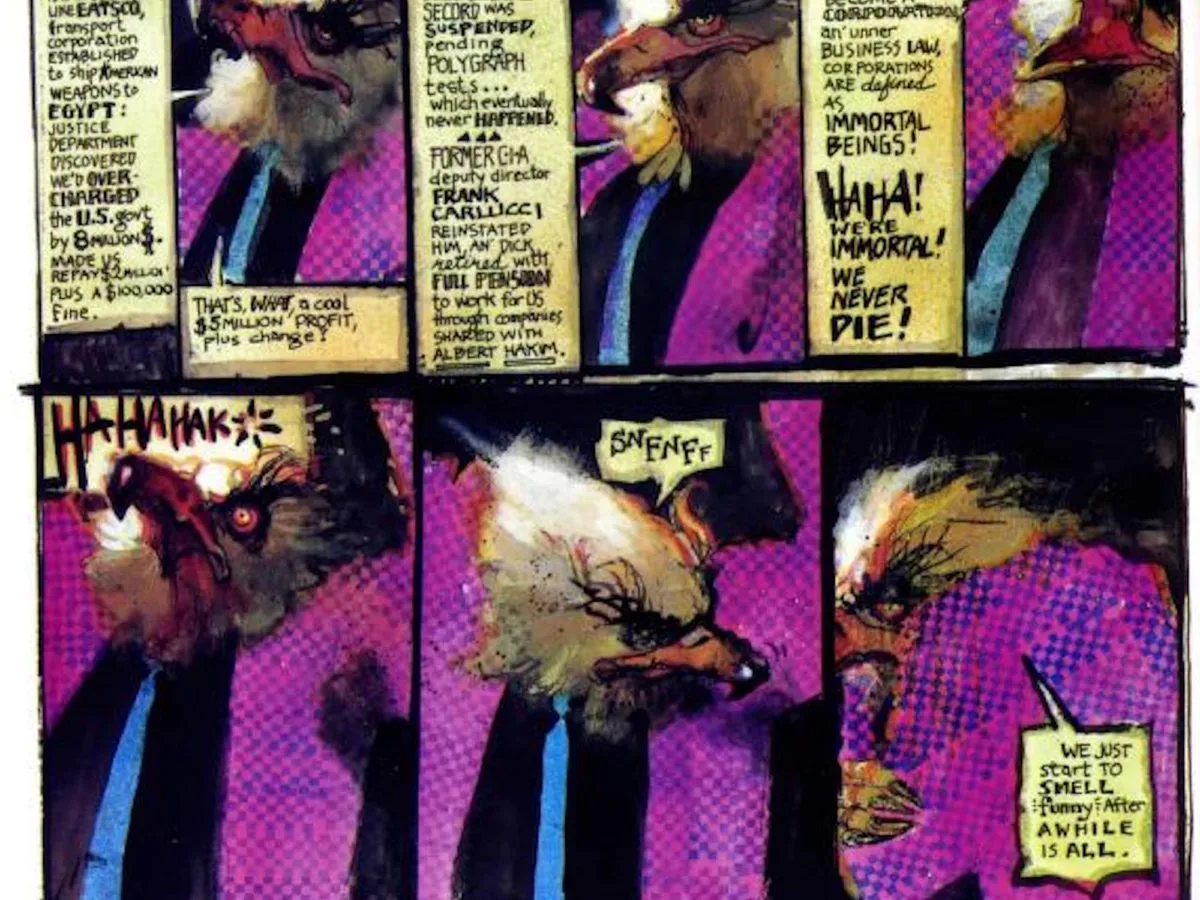
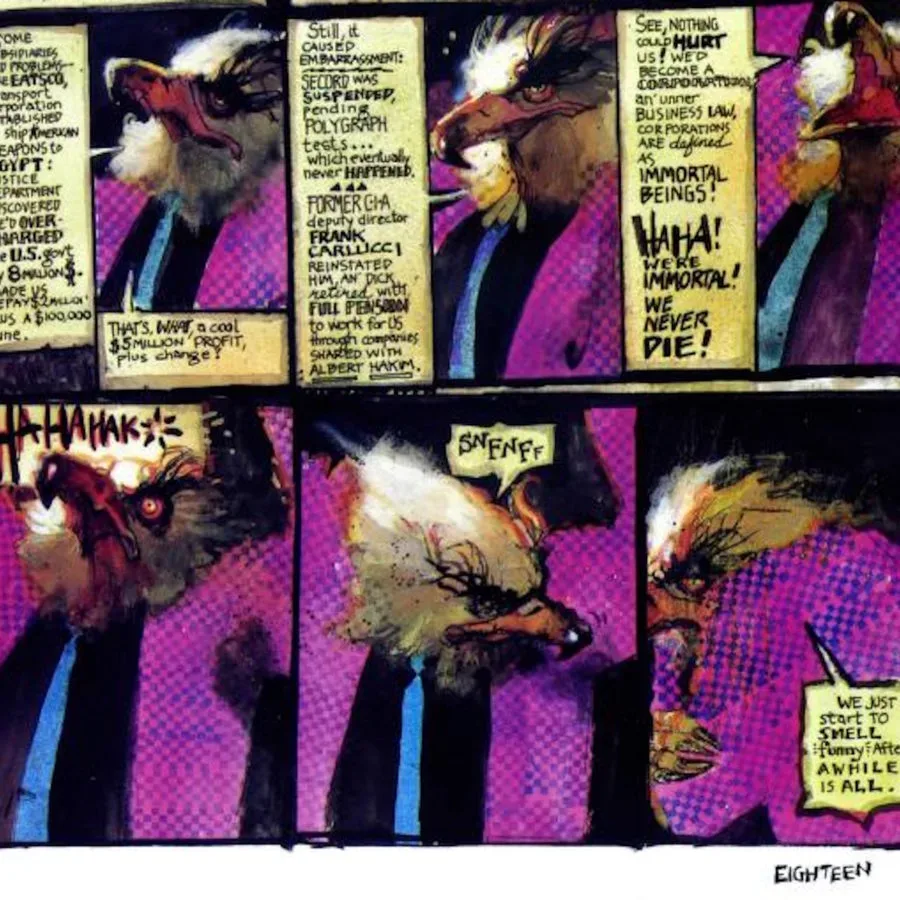
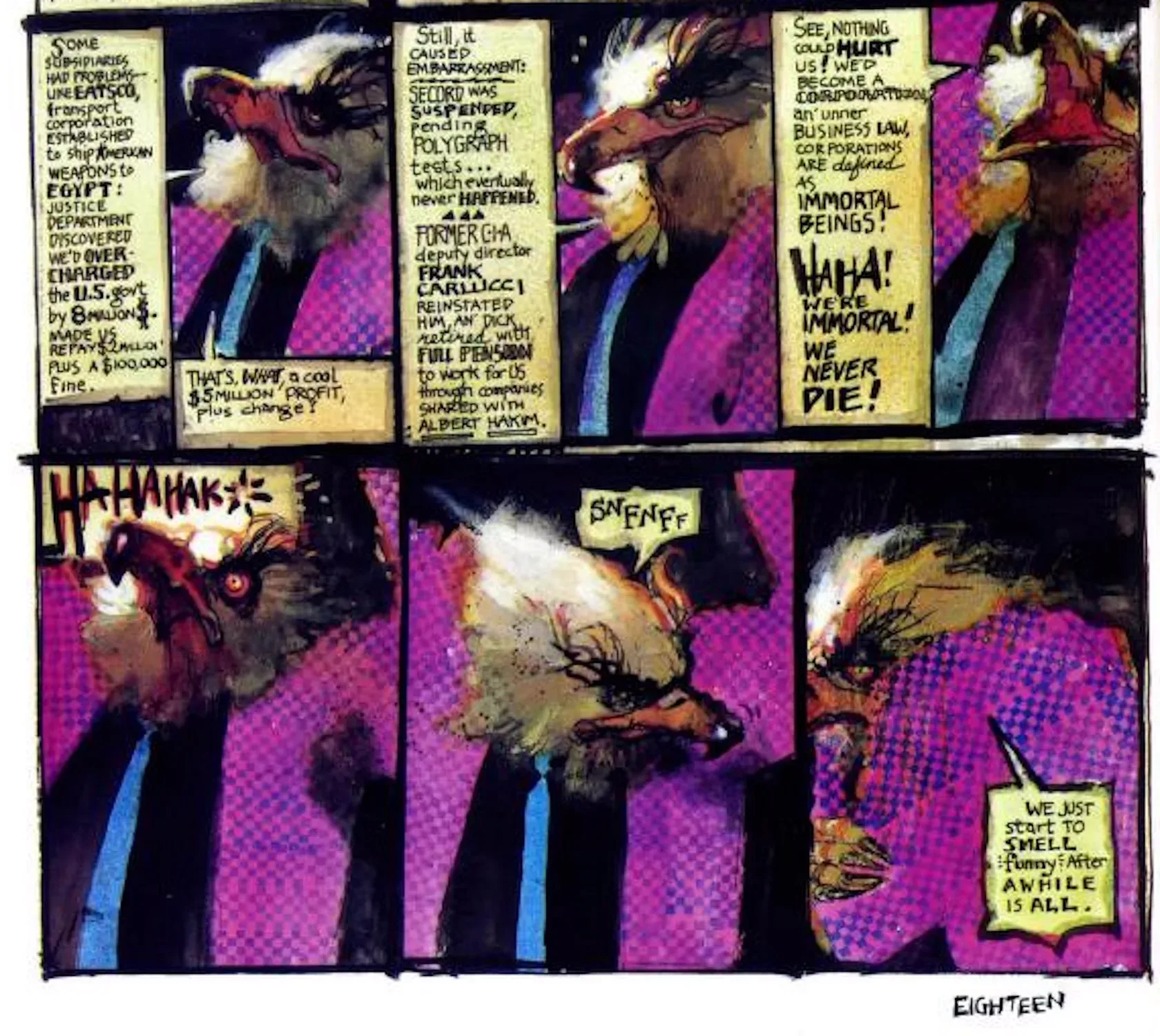
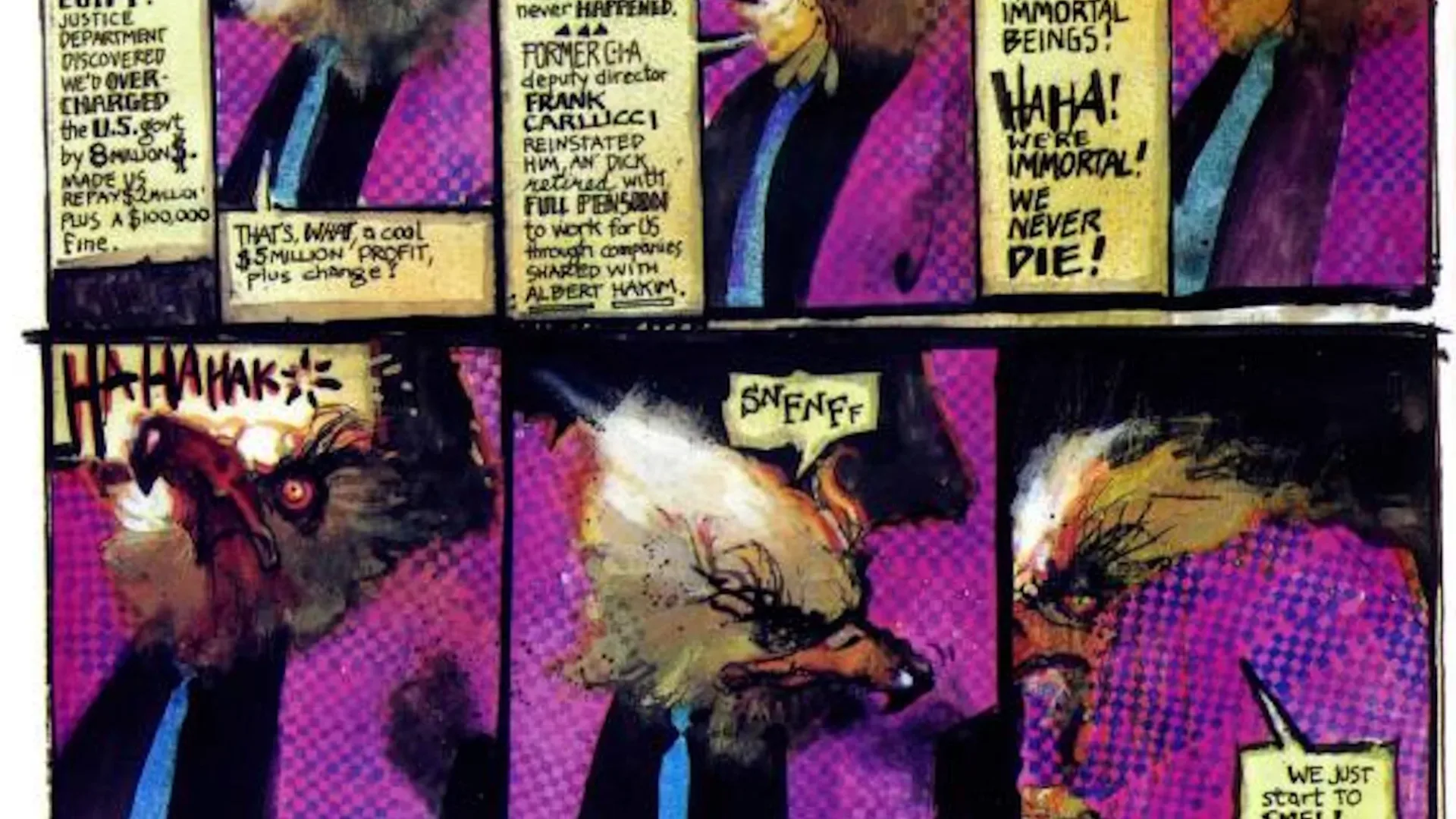
The bar setting is especially suited to the material. In the original comic, an ageing anthropomorphic eagle—an embodiment of the CIA—sits in a seedy bar, drinks, and addresses the reader directly. The character, known in the stage version as the Company Man, recounts a version of American foreign-policy history in an increasingly boastful and unhinged monologue. It is not an adventure story in the conventional comic-book sense; it is political satire built as a confrontation.
From political graphic novel to live monologue
Brought To Light was published by Eclipse Comics in 1988, with a broader-distribution co-publication with Warner Books following in 1989; Titan Comics also published it. The book was rooted in research and legal actions associated with the Christic Institute concerning alleged CIA covert operations. Daniel Sheehan, the institute’s general counsel, wrote the introduction to Shadowplay.
The volume contains two distinct works. Shadowplay: The Secret Team was written by Moore and painted by Sienkiewicz. Its visual approach and fictional framing allow a single symbolic figure to carry the piece: the eagle is both a distorted national emblem and the personification of an intelligence agency. Rather than presenting a detached institutional history, the comic makes its speaker prosecute the case against himself through swagger, denial and escalating confession.
The other half, Flashpoint: The La Penca Bombing, was written by Joyce Brabner and drawn by Tom Yeates. It uses a more straightforward narrative mode to address the 1984 La Penca bombing in Nicaragua, involving Contra leader Edén Pastora and the subsequent investigation by Martha Honey and Tony Avirgan.
That dual structure matters when considering Shadowplay 1989. Evans’ production is based on the Moore-Sienkiewicz half, not a full theatrical presentation of both Brought To Light stories. It will focus its 45-minute journey on the Company Man and his account of covert actions, including Cold War interventions in Italy, Iran and Guatemala; the Vietnam War; relationships with figures including Augusto Pinochet and Manuel Noriega; drug smuggling, arms dealings, assassinations and the Iran-Contra affair.
Those are serious subjects, and the original work’s rhetoric is intentionally abrasive. Its recurring image of casualties measured in Olympic-sized pools of blood is not a statistic or a literal calculation; it is a grotesque metaphor used to expose the speaker’s callousness and the human scale of the allegations being discussed. The production’s promotional description retains that bleak tone, calling the story a blood-soaked journey through American history.
What the Toronto staging will use
Evans is mounting the play with handmade costumes, props and set decoration. The design includes a conspiracy board containing portraits of every named historical figure, while rear projections of Sienkiewicz’s art will function as illustrated subtitles behind the performer.
In practical theatrical terms, rear projection means imagery displayed behind the action rather than scenery placed physically in front of it. Here, that should give the production a direct visual connection to the comic’s painted imagery without pretending a live stage can reproduce every page panel-for-panel. Calling the projections “illustrated subtitles” also suggests they are meant to accompany and sharpen the spoken material, not merely serve as background decoration.
The approach fits a work driven by voice. Shadowplay is structured around an unstable narrator speaking to an audience, so a one-person or monologue-centred setting can preserve its core tension: the viewer is being addressed by a character who expects to control the story, even as his version of events becomes more revealing. A small bar may further collapse the distance between performer and crowd that a larger proscenium theatre would create.
Evans plans to make promotional video and photographs at the venue on October 10, then record a first-person dress rehearsal in the empty bar on October 18. He intends to send that material to Moore and Sienkiewicz for their appraisal. Conversations regarding the production’s future are ongoing through Moore’s representatives, while Evans has expressed hope that this initial performance could lead to additional dates.
An unusual history of adaptation
Shadowplay 1989 will not be the first adaptation of Moore’s script. Codex Books released an audio version in 1998, with Moore narrating and Gary Lloyd providing music. The Toronto show’s authorisation therefore carries particular significance: Evans contacted Lloyd alongside Moore and Sienkiewicz before proceeding, and all three granted permission.
For comic readers, that makes the event more than a themed performance loosely borrowing a familiar title. It is a rare case in which a comparatively scarce political graphic novel, its illustrator’s painted work and an earlier audio collaborator’s connection to the script are all part of the adaptation’s stated lineage.
Physical copies of Brought To Light are described as relatively scarce and can attract substantial prices on the secondary market; the 1998 audio adaptation is said to be scarcer still. That does not make the stage production a replacement for either format. Instead, it provides another route into a work that is not necessarily easy to encounter in its original form. It also shifts the experience from private reading or listening into a shared, time-limited event.
The conversion is notable because comics and theatre organise attention differently. A reader controls the pace of a comics page, lingering over Sienkiewicz’s images or moving backward through a sequence. Theatre fixes the pace through performance. A live actor’s timing, pauses and changes in tone determine how the audience receives the Company Man’s drunken reminiscence. Projections can retain pieces of the visual vocabulary, but the dominant engine becomes the voice in the room.
That makes the advertised post-show discussion a meaningful part of the format rather than a generic add-on. Guests are encouraged to remain after the show to talk about its subject matter. Given that the work draws upon politically charged claims, historical events and the legacy of covert operations, discussion creates a space to distinguish the comic’s satirical performance from a conventional documentary presentation.
Content warning and attendance details
The production carries a content warning for coughing, slurs, drugs, suicide, loud noises and war crimes. Prospective attendees should take that warning seriously. The original material is designed to be upsetting, and its language and subject matter are inseparable from its political purpose.
Advance tickets are listed at $25, with tickets at the door listed at $30. The event description also invites guests to have a speciality cocktail before listening to the Company Man’s account. As advertised, the performance runs for 45 minutes within its 8 p.m. to 9 p.m. slot.
- Production: Shadowplay 1989
- Adapted by: James Llewellyn Evans
- Date: Sunday, October 25, 2026
- Time: 8 p.m.–9 p.m.
- Venue: The Wych, Davenport Road, Toronto, Ontario
- Running time: 45 minutes
- Tickets: $25 in advance; $30 at the door
Why this comic remains a compelling choice for theatre
Political comics can be hard to translate because their force often emerges from the relationship between text, page design and the reader’s control of time. But Shadowplay: The Secret Team has a built-in theatrical mechanism: a compromised narrator, a confined drinking environment, an audience directly addressed, and a past that arrives as a cascade of names, events and accusations.
Sienkiewicz’s projected work will be an important bridge in that translation. His paintings are not incidental illustrations added after Moore’s script; the comic’s impact comes from the collision between its accusatory language and its distressed, expressionistic visual identity. Treating the imagery as projected “subtitles” acknowledges that the stage production is not simply reading dialogue aloud. It aims to place the comic’s visual unease in conversation with a live performance.
For readers interested in other corners of comics culture, the medium remains full of projects that move between serial pages, collected editions and new forms of adaptation. Even conventional superhero continuity can turn on the arrival of an unfamiliar figure, as in this look at a possible new Gotham character in Batgirl. Shadowplay 1989, however, is working at the far more confrontational end of the comics spectrum: a one-night staging of a work built to challenge its audience rather than reassure it.
Toronto audiences will have one scheduled opportunity to see how Evans handles that challenge. Whether the event receives future performances remains undecided, but the October 25 staging has moved beyond tribute status into an authorised interpretation of Moore and Sienkiewicz’s original political comic.
Shop the products
Check current price, model and availability at the retailer.